Sunday Photo; Great Unification Buddha

Well, finally a Buddha that isn’t a Mireuk Buddha!

This is none other than the Great Unification Medicine Buddha of Donghwa Temple, in Daegu.

Standing at 33m (108 feet, by chance…), locals claim that it is the largest in the world. Though, I’m not sure how many other “Great Unification Medicine Buddhas” there are to compete with, I think they refer to other free-standing statues. I could imagine that it is the largest Medicine Buddha anywhere.

Gazing up from beneath, the physical aspect of its greatness is obvious, but there is also another reason for this title. As you may have surmized from its name, prayers are offered here for the reunification of the Korean peninsula. Inside the body of the Great Buddha are two bone shards of Shakyamuni’s, presented as gifts from the government of Myanmar.

Forum on the Thousand Hands Sutra

the German edition of "A Thousand Hands of Compassion"

The German publisher, Diederichs, had just published a German/Korean translation of Daehaeng Kun Sunim’s version of the Thousand Hands Sutra, called Umarmt von Mitgefühl, and everyone thought this was a good time to tell people more about the history of the Thousand Hands Sutra, and the significance of Kun Sunim’s edition.

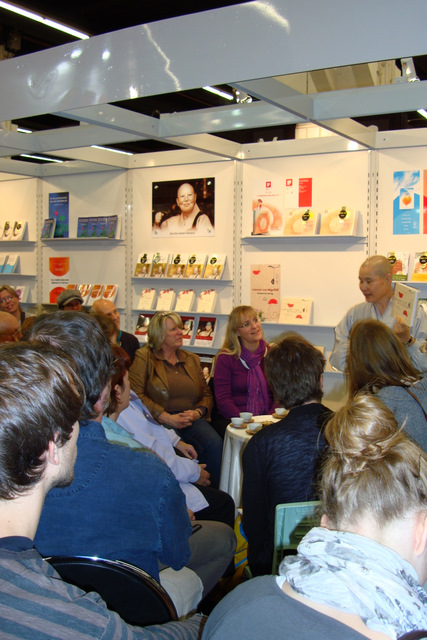
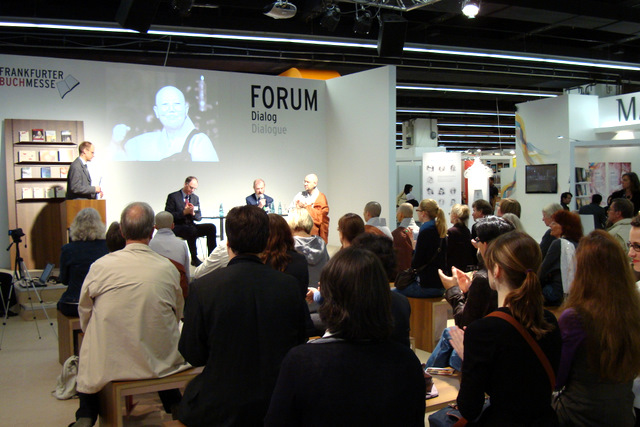
The forum was held in Hall 6, and was in four parts; first I discussed the history of the sutra, together with how the recitation version formed. Next Dr. Sunhee Suh discussed the characteristics of the recitation version and the significance of Kun Sunim’s edition. Dr. phil. Ralf Päsler discussed the cultural aspects of the translation and the problems associated with transferring concepts and ideas across cultures. Finally, Hyo Rim(임효), the artist whose work illustrated Umarmt von Mitgefühl and A Thousand Hands of Compassion, discussed the significance of the details in the paintings, and what had inspired them. As Hyo Rim talked about each painting, his descriptions felt like Dharma talks.

When we first decided to undertake the forum, I was somewhat concerned that it would be too detailed for the stressed and busy audiences at the book fair. But this is what our team members here in Korea and in Germany wanted to do, so I just threw my whole heart into it while relying on Juingong, and went forward. Actually, this is what we all were doing. And because we were all doing our best to practice like this, the forum touched many people.

It opened when Hye Jin Sunim, Hye Bek Sunim, Hye Jong Sunim, and Hye Bo Sunim began chanting the opening section of The Thousand Hands Sutra from the back of the forum center. Wearing their formal robes while hitting a moktak, they were very impressive and the entire area fell silent while people looked to see what was going on.

For the next 40 minutes we discussed the sutra and tried to give people a sense of this fundamental mind, or Juingong, that we all possess. A few people wandered off, but remarkably most stayed for the entire time. I say “remarkably” because during the first three days of the book fair, publishers are very busy, with different appointments every 15 or even 10 minutes. So they don’t have time to do other things. And yet here they were, ignoring their schedule, to hear more about practice and the Thousand Hands Sutra. The head of one German publisher even expressed his gratitude to us for presenting teachings of such depth at the book fair.

The rest of our time was spent talking with different publishers about Kun Sunim’s books and important aspects of publishing them in other countries. Several publishers from France and Germany were interested in Kun Sunim’s books, particularly translations of her Dharma talks. There was also much interest from other countries that will hopefully lead to Kun Sunim’s teachings be published in still other languages.

In addition, we had several reading sessions at our booth where Hye Jin Sunim and Dr. Ralf read from The Thousand Hands Sutra as well as a collection of Kun Sunim’s stories, called My Heart is a Golden Buddha. Hyo Rim was there talking with visitors, and visitors from years past came to the booth, often carrying well-read editions of Kun Sunim’s books.

Saving Avalokiteśvara

Examining the first of the Four Great Vows, “Sentient beings are numberless. We vow to save them all,” I developed a degree of empathetic compassion for the Great Bodhisattva, herself.

For centuries upon centuries, people have been calling out to the Great Bodhisattva, whether the name spoken be Avalokiteśvara, Guānshìyīn, Gwansaeum, Chenrezig, or one of the many others. In all this time, how many prayers were spoken for Avalokiteśvara, herself? I’d suppose some, but perhaps a small fraction?

For nearly 2000 years, if not more, Avalokiteśvara has selflessly put aside her own passing into Nirvana so that she may lend a helping hand (or many) to us ignorant, complacent folk. So, if I were to recognize Avalokiteśvara as part of my own vow to save the countless beings from suffering, how might I do my best to save her? By practicing as sincerely as I’m able, avoiding all evil, cultivating good, and purifying my mind.

The sooner I do this, the sooner we become Buddhas together, Avalokiteśvara and all!

Arriving in Germany

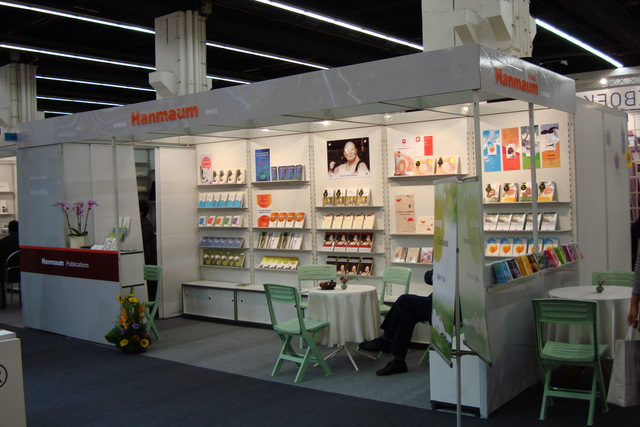
If you are going to be in Frankfurt for the book fair, be sure to stop by and have a cup of tea. Our booth is in hall 6.0 C942.

The start of the book fair began when our flight landed in Germany on Monday evening. We made our way to the House Busan, a bed and breakfast on the edge of Frankfurt. Aside from the friendly owner, perhaps its best aspect is the Korean breakfasts. I’m happy with bread and yogurt for breakfast, but the traditional Korean breakfast was a relief to the other members of our jet-lagged team!

On Tuesday we went to the grounds of the book fair, the “Messe.” The Messe, is huge, with eleven halls, some the size of football fields. There, in Hall 6.0, we began to prepare our booth for the opening of the book fair on Wednesday. Hye Jin Sunim brought buckets of cut flowers and began preparing beautiful floral arrangements, while the team from Korea began to organize the booth and arrange the books. Meanwhile, Holger and Young Ralf worked to install a foot-wide (30cm) sign around the top of our booth, which said “Hanmaum Seonwon” and “Hanmaum Publications,” which is the name the International Culture Institute uses to publish books.

The German publishers we've met have all been truly incredible people. Gerhard and Erika, on the left, are top level editors, and Herr Lord, on the right is the head of Goldmann Arkana. You'll be hard pressed to meet more down-to-earth, spiritual people.

The booth was finally prepared at about 7pm, and everyone went to Mr. Koh’s house for dinner and a meeting. Many of the female Frankfurt members of Hanmaum Seon Center had gathered there and were working hard to prepare dinner for everyone. After eating a great meal, we discussed our plans for the next day and finally headed back to the bed and breakfast.

Wednesday opened the book fair, and was a bit of a slow day at first. Many publishers have appointments to meet other publishers, and so have no time to visit other booths. Meanwhile, we were also busy, preparing for a one-hour forum on Thursday about the Thousand Hands Sutra.

Books and Buddhism: at the Frankfurt Book Fair

Some of you may have noticed a drop in my posts over the last couple of months. Things here in Korea have been very busy with finishing translations, proofing, and last minute errands as we get ready for the book fair in Frankfurt. I’m leaving today (Monday) for Germany, and won’t have time for regular posts for a while, but I thought I’d share something I wrote last year about the book fair. (This piece will be spread over about three posts.)

As I look at the title of this post, I can see where some of you might be expecting more detailed info about Buddhist books and publishers at the book fair, and as I think about it, that sounds like a great topic for a post. So I’ll take a camera and do some blogging about the book fair when I return. (It’ll be a couple of weeks, though.)

Daehaeng Kun Sunim’s Teachings at the Frankfurt Book Fair

For the last several years we (the Hanmaum International Culture Institute) have been going to Frankfurt Germany for the annul Book Fair. Each year, around 7,000 publishers from more than 100 countries gather in Frankfurt to exhibit their new books and to find books from other countries that might succeed in their country. Publishers try to find foreign publishers who can take the book back to their home country and best publicize the book and get it into stores where people can find it.

This may sound like a very commercial concern for a Buddhist organization, and in a sense it’s true. For “commercial” also means popular, something which many people are interested in. Our mission is to make Daehaeng Kun Sunim’s teachings widely available to people who don’t understand Korean. Thus, beyond just translating those teachings, we have come up with ways of reaching people. One way of doing this is through books that interest people, books they want to read. If we can produce books that have a lot of appeal, publishers in other countries will want to publish them, thereby making it easier for people in those countries to encounter Kun Sunim’s teachings.

I used to think that the translation was 90% of the work, but now I know that it’s barely 50% of what must be done. No matter how wonderful the content, if the look of the book doesn’t appeal to people, they won’t pick it up and won’t discover the content. The cover has to be interesting, the title must touch something within one, and the text layout and paper must draw the eye. Once those things are in place, then the contents can shine.

 The Road to Frankfurt 

Much of the year at the Hanmaum International Culture Institute is spent preparing for the Frankfurt Book Fair, but the last six weeks are the most difficult. It will take two weeks to print the books, so we actually only have four more weeks to work. The ladies doing the designs and layouts have to get the text and then adjust the format so that it feels comfortable to look at. Once they’ve done this, everything has to be proofread again.

The programs for publishing are very fussy, and often create “broken” characters. Somehow there was a computer code conflict and the program turns a word or character in to nonsense garbage. And sometimes it was a person, working at three or four in the morning whose eyes were too blurry. These new changes are made, and everything is proofread again. And then again. Once the file is sent to the printers, we can begin work on the publicity materials, such as brochures, posters, and handouts.

This year our new books of Kun Sunim’s teachings arrived on Saturday evening, and we left on Monday morning, and I think the books were still warm from the printing presses!

Practice, Don’t Say; Be And Learn. Don’t Explain

This slideshow requires JavaScript.

In seeking word and action, rather than being, we suffer
Seeking what we have seen, and had…we suffer more, until…
Having, we learn, and fill ourselves
Then, empty, or full, we find contentment, or loss, again…
And the cycle continues…

. . .

Joe poured tea, today

He, Eunbong, Fina, and I enjoyed the company of one another

Joe and I spoke of words, as the clouds, sky, and sun…
Poured warm, bright light…into the seventh floor window
Onto us, the tea, and the wood
It was “good”

The balancing company of sangha heals us

Hues of sepia, deep and light, sent dreamy images and aromas,
Up to our senses,
From the cups

I asked about an aspect of love

Joe said, “I don’t think about it.”
Brief, and almost empty, yet apparently resonant…
Like the sound that the copper bowl made, when we invited it to ring, earlier…
Joe’s words stealthily disappeared in me,
For I let their momentary ’emptiness’ go,
Like the bell-sound of the bowl

Then we talked about practice, and talking about practice
We agreed that practice described in sentences
Does not convey the deeper experience that practice reveals

It was at this time that Joe’s answer about love
Appeared to me about practice, and more…

As in love, in practice

In seeking descriptions, definitions, and a record of what happened
We are found to be saying something different-from what the listener can understand…
Without experience

This is suffering,
As we seek the gratification that words often cannot produce
And only experience, and practice
Can truly reveal,
And teach

Sunday Photo; Temple and cosmos

I wasn’t in Korea for long before I started marking the passage of time by the bloom of whichever flowers. The cosmos flowers bloom in midsummer but are still prevalent late into the fall. Any sincere country road will probably be lined with them this time of year.

The small Dharma Hall among the flowers is in Yeon’ho-dong, Lotus Lake Village, a tiny country village in the eastern edge of Daegu, just passed the small mountains that separate it from the metropolis, within eyeshot of World Cup Stadium.

Although these small country temples can’t compare to the large temple complexes in their impressiveness, they often have a great feeling. Talk about sincerity, it’s no wonder all these cosmos decided to gather here!

the world, our sangha

I take refuge in the place for learning the truth, which is every place.
A Thousand Hands of Compassion

“You must realize that, your husband, your wife, or your children who give you hard time are Buddha who is trying to teach you. Don’t have preconception of Buddha. Buddha is not just a golden statue set high in the Dharma hall whom you always lit a candle or offer incense to. Buddha is very close to us. Try to think that our family, neighbor, friends and parents are Buddha.”
Seon Master Beopjung

“The trees, water, air, birds, and so on can all be members of our sangha. A beautiful walking path may be part of our sangha. A good cushion can be also. We can make many things into supportive elements of our sangha.”
Zen Master Thich Nhat Hanh

“What is this? How can spring rooster’s crow be the answer to the question of truth? If you hear the rooster crow in spring correctly, then you will know the meaning of life clearly.”
Seon Master Seung Sahn

“Which one is my True nature in Three Worlds? There is one single pure object, which is my Original Self. Flowers blossom and leaves fall but it has one root. The sun and moon rise and fall but leaves no traces.”
Seon Master Haeam

“There is teaching that, “The leaf returns to the root.” It means the fallen leaf will return to the root of that tree. The nature of returning to the essence is the teaching that Nature gives. The work and effort to return to one’s essence is the purpose of Buddhism.”
Seon Master Wolha

Bul, refers to the fundamental source of every single life, including even a blade of grass, and the second syllable, gyo, refers to learning from each other; we communicate with each other through speech, mind, and actions. So the word ‘Buddhism’ means communicating with each other through the foundation, the fundamental source of life, and through that, listening to each other and learning from each other.”
Seon Master Daehaeng Sunim, ‘No River to Cross’

“Say only the Truth and convey only the Teaching. That is the work of brightening the world with Buddha’s teaching. You need to be the leader and guide to a brighter world. All of you have reason for being in this world.”
Seon Master Gosan

“If you completely understand how mind works and are able to combine your mind with others’ minds, and if you are able to deepen your wisdom and continue to practice, then you can combine your mind with even the great stars of the heavenly realm. When you can do this, the heavenly realm becomes peaceful and comfortable, and in turn this world also becomes peaceful and comfortable.”
Seon Master Daehaeng Sunim 


Link: Most quotes from here
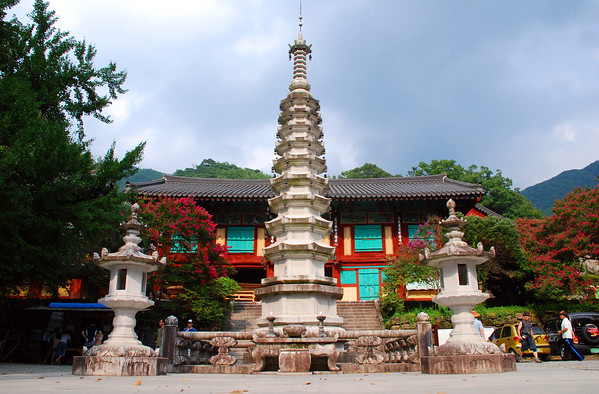
Images: This pagoda is at Hwaeom Temple, in the Jiri Mountains.

Secret practitioners, and a bit of silliness

Daehaeng Kun Sunim has often said that we need to keep what we experience a secret, for if we start talking about it, competition and comparisons often arise. In the end, our experiences become just another foothold for “I.” Instead we need to embrace those experiences and completely entrust them, let go of them, and move forward.

On a bit of a silly note, as I thought about this, I realized there have been secret practitioners showing us the way. ^-^

together…

[I’d planned on posting this, and chuckled when I opened my email this morning and saw that Carl’s post beat me to it! A good example of working together, on some level!^^. I thought twice about posting again on the same topic, but figured it’s such a nice theme, it’s worthy of investigating together… Maybe others will be inspired to add more!]

In August, on the Ox Herding blog, Barry posted about the Responsible Life, where he quickly discussed intention and the Great Vows:

The Four Great Vows

Sentient beings are numberless, we vow to save them all.

Delusions are endless, we vow to cut through them all.

The teachings are infinite, we vow to learn them all.

The Buddha way is inconceivable, we vow to attain it.

In the ensuing conversation, someone asked if the original text used the word “I” or “we”.

Chong Go Sunim responded,

In the Korean and Chinese versions, there’s no personal pronoun of I or we. Statements like this depend upon the context, and in this case, the most natural choice would be “I.”

However, I can easily imagine Seung Sahn Sunim putting a spin on it with a “we,” and no one here would complain at all. They would see that as a teaching in itself, one that compliment and enrich the usual emphasis on individual effort.

From there, Barry added,

This brings to mind two Korean phrases that I’ve heard (in translation), sometimes said in greeting or parting:

– May you become Buddha!
– May we together become Buddha!

I hadn’t really thought much about the translation before, but at the end of Ye’bul (ceremony) people turn to each other and with palms together say, “Seong Bul ha’ship’shi’yo.” In this context “Seong” is to accomplish, achieve, attain, complete, fulfill, or succeed in, “Bul” is Buddha, or Buddha-nature, and “ha’ship’shi’yo” is a very polite way of saying, “do it”. There is, indeed, no I, me, or you, but in a Dharma Hall full of people, simultaneously wishing each other to become Buddhas, the feeling of, “Let’s become Buddhas together,” emerges.

On my blog Somewhere in Dhamma, I wrote of an afternoon trip I took to YongJu Temple, with my family and friend, Carl. But one part I saved to share here. We stayed for the beginning of Ye’bul, just long enough to recite the Heart Sutra, then followed the monks as they left the hall. One monk who I’d spoken with before the ceremony waited for us by the door to say good-by. Our parting wish to him was, “Seong Bul ha’ship’shi’yo,” But he answered with palms together, a bow, and large, “Ahhh’ni’yo! Gaaaat’chi, seong Bul ha’ship’shi’yo!”

Noooo! Together, may we become Buddha!

For more on YongJuSa, you can visit my blog: