Where to speak, where to remain quiet

I hope summer has been treating everyone well! Here in Anyang, it’s “only” 34C (93F) which is down from 39C (102F) yesterday!

We’re working on translating two new talks, but they’re taking a bit more time than I expected. In the meanwhile, here’s an excerpt from one of them. I doubt Daehaeng Kun Sunim was thinking about social media at the time, but her warning still kind of applies!

Questioner: My question concerns the story of the Chinese Fifth Patriarch of Chan (Seon), Hongren, and his disciple, the Sixth Patriarch, Huineng. After Hongren passed the robe and bowl to Huineng, he warned him to leave. Huineng asked, “Where should I go?” The teacher replied, “Remain in a place where you find Huai (懷), [to cherish or embrace,] and hide yourself in a place like Hui (會), [to gather or assemble.]” I would like to ask about the deeper meaning of these words.

Kun Sunim: Huineng asked, “Where should I go?” but in reality, it doesn’t matter where the physical body goes. It is simply a matter of the mind.

The instruction to remain in a place where the character “Embrace” is found means you should help and work together with those people who sense this reality of one mind. These people are like sturdy trees, with fruit fragrant and ripening. Help them to grow and fully mature.

On the other hand, the teaching to hide yourself in places where many gather means that you shouldn’t open your mouth around those who have no interest in understanding the workings of nonduality, and who instead gather to gossip or criticize others.

So, no matter where you go, decide for yourself which place is best, and that will become the right place for you.

(From a Dharma talk on August 16, 1992)

“The One that is Truly Doing” (누가 하는가요?) More Dharma songs!

Here’s another Dharma song by Daehaeng Kun Sunim. (The lyrics are by her, the music is by Byeon Gyu Baek)

The One that is Truly Doing (누가 하는가요?)

Who is the one that enables us to see?
Who is the one that enables us to hear?
Who is the one that enables us to speak?
Who is the one that enables us to live?
Observe, observe, and observe again.
You who are observing
is true self.

People think that we see because we have two eyes,
but is this true?
People think that we hear because we have two ears,
but is this true?
People think that we speak because we have a mouth,
but is this true?
People think that we live because we have a body,
but is this true?

Observe, observe, and observe again.
You who are observing
is true self.

Messages from My True Self

(A Dharma song by Daehaeng Kun Sunim. Here is it sung in Korean: https://www.youtube.com/watch?v=0_Y4ojC2j_Q )

Deep in the dark last night
snow was falling.
Now with the dawn,
white flowers bloom on every branch,
and deep roots go far and wide.
In the high mountains, white flowers of the arrowroot vines
fill the valleys, their deep roots spreading forth.

A traveler going far and wide plays a bamboo flute,
calling out news
of our true self.
Oh, you many flowers,
you beautiful flowers,
have you yet heard,
the message from your true self?

임의 소식

어제 밤에 눈 오더니
날이 밝아 동이 트고
가지마다 흰 백송이 꽃이 피고
뿌리마다 이어가니
천상 저 높은 산위에는
골짜기마다 칡뿌리 이어가고
칡꽃이 만발했으니

길을 걷던 나그네의 대피리 소리는
온누리에 임의 소식 전달하니
만 꽃이며 만 꽃이여
님의 소식 들었는가 하노라

How to see things from a higher perspective

If you want to step out of your habitual way of thinking and viewing the world, give something.

As selflessly as you can, give something. It doesn’t have to be big or small, just give.

It can be a wish that someone’s life goes a bit better, it can be a cup of coffee or something more. Just give.

Let go as best you can of thoughts of “I” – “I gave,” “Is it enough?” “Is it…?” “I…,” whatever. You don’t have to worry about them, just give them a friendly wave and let go of them as you become aware of them.

Giving is a reflection of our nondual, interconnectedness, so when we truly give, we are pointing ourselves in that direction.

It may only be a beginning, but it points us in that direction. Back it up with viewing things positively and remembering that everything is arising from our one foundation, so that’s also the place that can dissolve everything we’re going through.

New Dharma talk collection

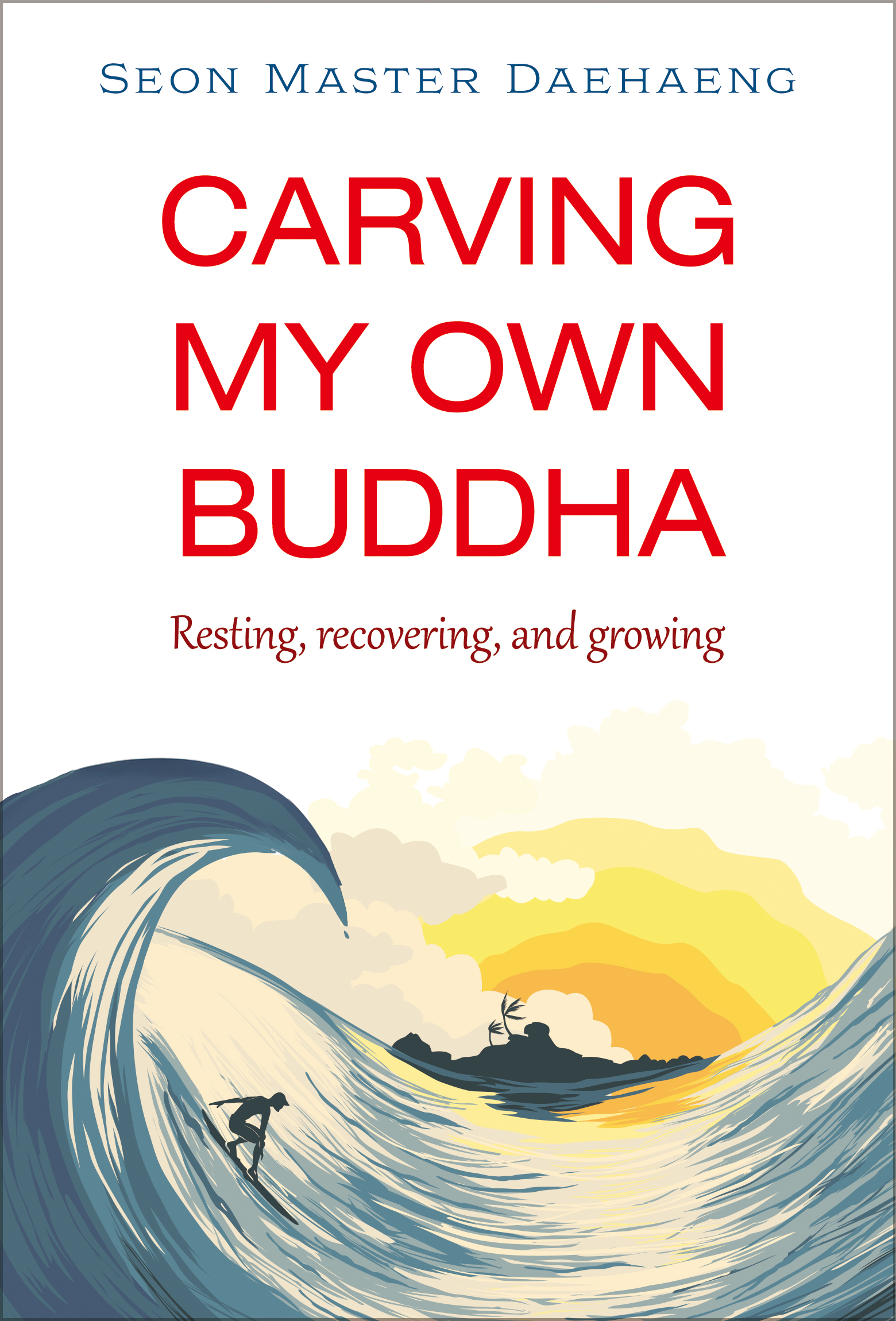
I’m excited today because we have a new collection of Daehaeng Kun Sunim’s Dharma talks out! I’m not sure if “collection” is quite the right word, because it’s only two talks, lol. But it’s 158 pages, and there’s a lot to digest there. It should be more than enough to keep someone busy!

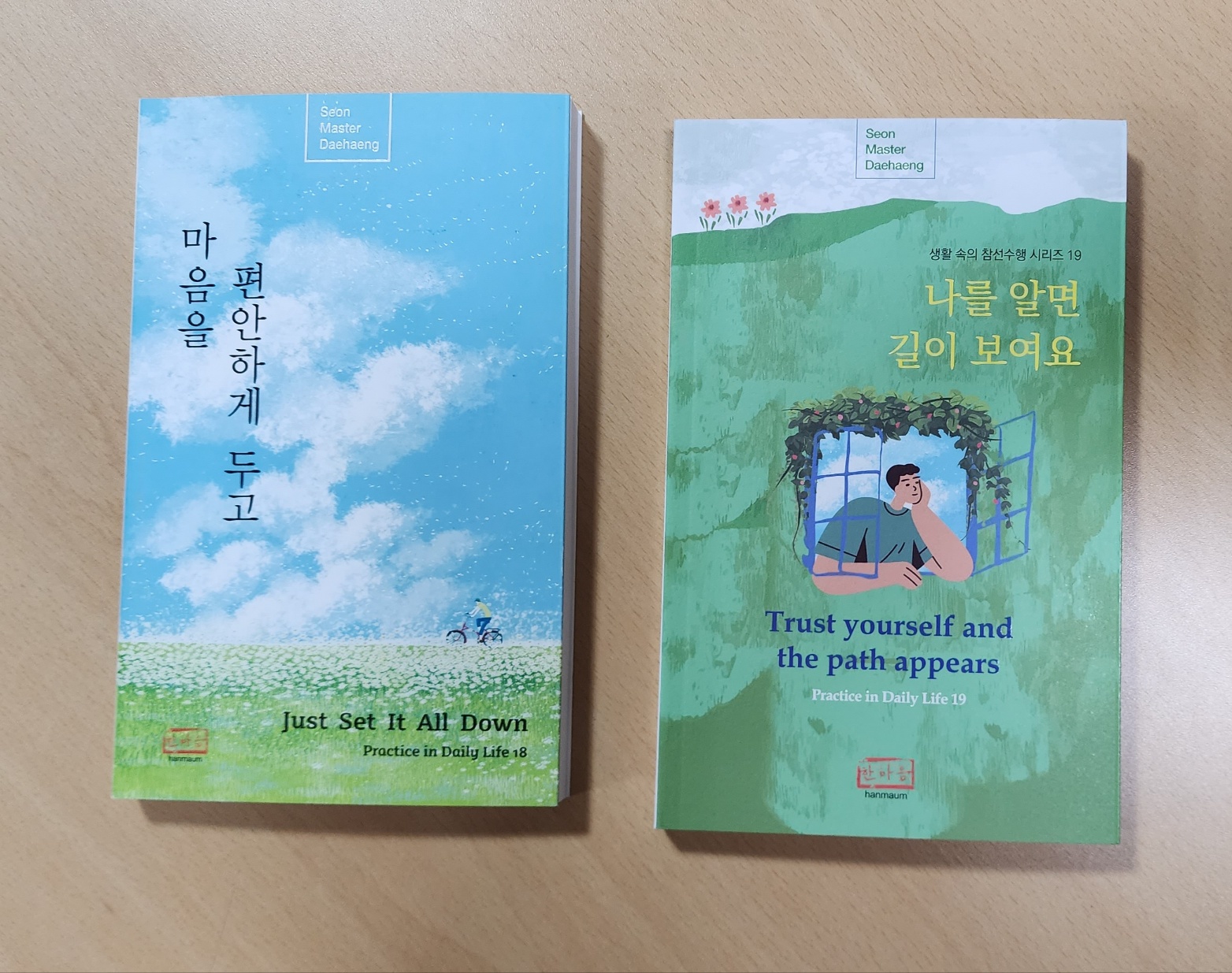
This is the combination of two previous Dharma talks that we first published in Korean/English editions. One was called, “Just set it all down,” and the other is “Trust yourself and the path appears.” Both are very nice talks.

On the one hand, the Korean/English format is popular in Korea, and it lets us get out a new Dharma talk soon after we finish translating it, but on the other hand, those are hard to make available to people outside of Korea. The Korean/English format doesn’t lend itself to an ebook format, and while it can, theoretically, be done as a print-on-demand format, it’s extremely time consuming.

But now just about anyone around the world can get these talks. The print edition is available through Amazon, and the ebook edition is available through just about every online store. And a huge shoutout to the cover designer, Su Yeon Park, who did an amazing job!

Print edition (Amazon)
Ebook edition (universal links)
Length: 158 pages
Price: $5.99 (ebook), $9.99 (paperback)

Here are the original books, in case you might already have these.

Diamond Sutra discussion group

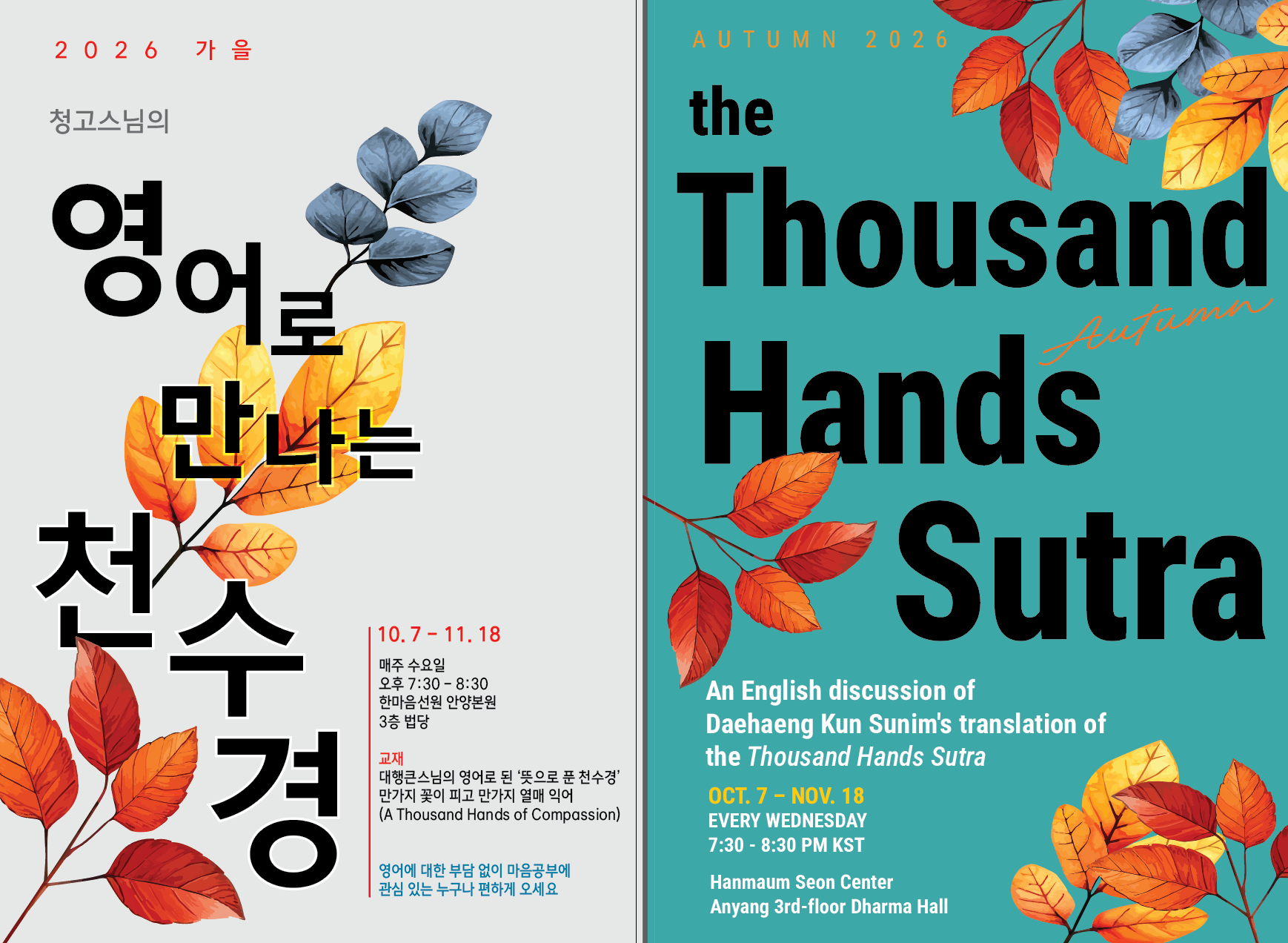
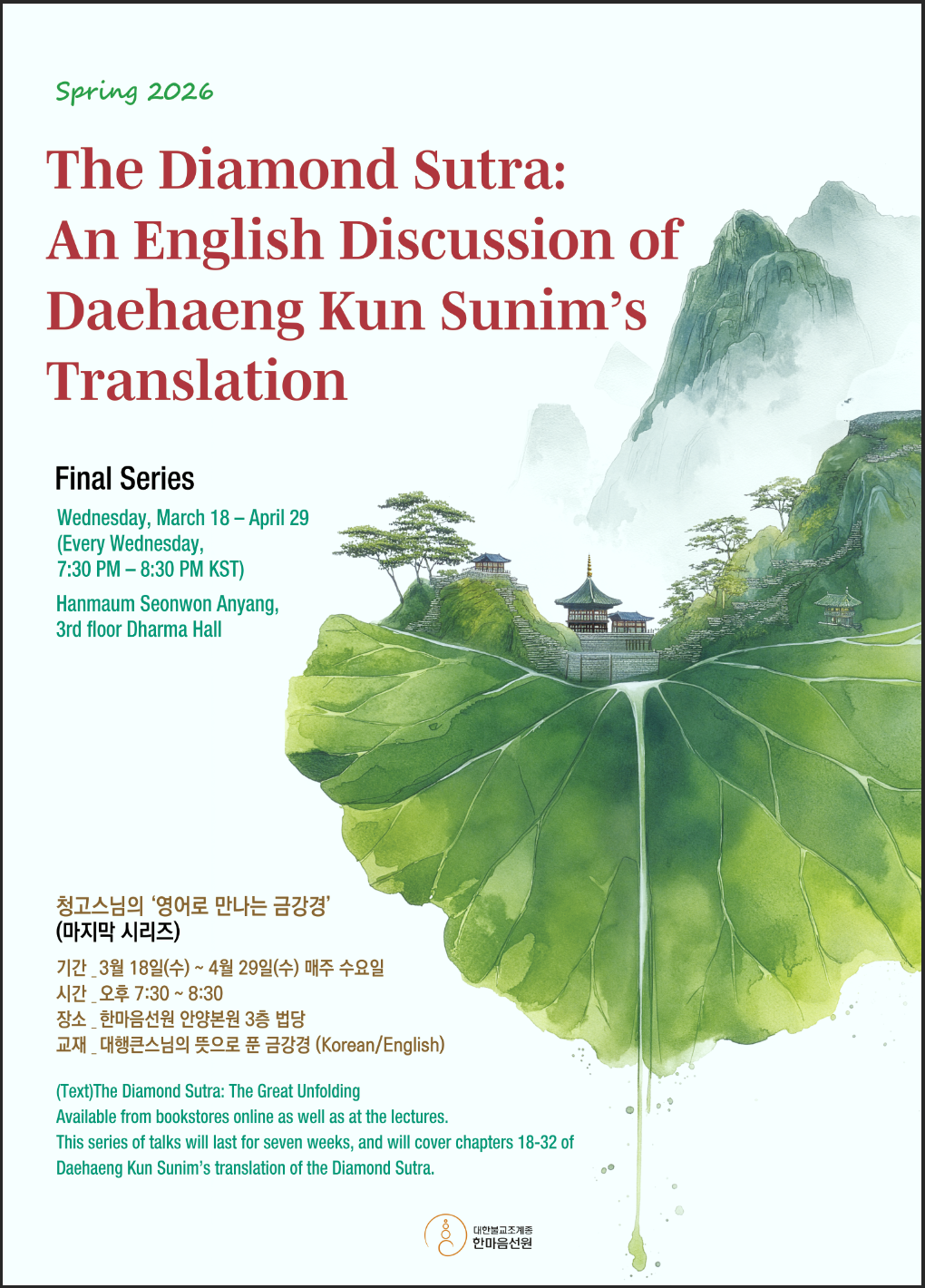
Starting this Wednesday, we’ll be continuing the English discussion series about Daehaeng Kun Sunim’s edition of the Diamond Sutra at the Hanmaum Seon Center in Anyang, South Korea.

We’ll meet at 7:30pm on Wednesdays, from March 18 to April 29. The format will be the same as last time, with me lecturing for 30 minutes, and then everyone breaking into small groups for another 20-30 minutes of discussion. Everyone seemed to have a lot of fun with this format, so stop by if you have time.

The lecture portion will be put up on Youtube a week or two afterwards, once we’ve had time to work with the video.

Dharma talk for the lunar New Year

Here’s a Dharma talk for the lunar New Year by Daehaeng Kun Sunim. In a sense, there’s a lot going on in this talk, but focus on finding just one part, one aspect that you can put into practice, and do that diligently for a week or two. See what happens!

New Year’s Candle Light Ceremony Dharma Talk

We gather together today here in the Dharma Hall and light candles, but you need to know that lighting a thousand wax candles can’t even begin to compare with lighting the candle of mind.

The light of this candle of mind, this candle of our inherent nature, is seen throughout all realms of the universe, but the light from these wax candles can’t even be seen outside of this building.

In fact, this candle of mind is always burning brightly, so can be called our eternal source of life. Because of this source, we are able to speak and act wisely and kindly, and able to light this incense of our heart, which gives off a beautiful fragrance that spreads far and wide.

Fulfilled and at peace because of this source, we are able to give rise to a compassionate smile that rises like the moon in the deep of a quiet night, illuminating all the world. But, just like when clouds cover the sun, so, too, people can’t smile when their hearts are covered in clouds.

We’ve gathered together as families and then separated so many times. It’s like the clouds gathering together and splitting up again and again. We’ve lived like this for a billion eons, and now we’ve reached the level of human beings. At this point, there’s no one who hasn’t once been our mother, our father, or our child.

This is why I say, “Think of everyone as yourself. Don’t look down on anyone, and don’t put others above you. See them all equally, see their pain as your pain. And not just only human beings – there’s nothing that’s not you, no life that’s not your life. What others are going through is also what you are going through.”

So take every single thing, without exception, and entrust it inwardly, knowing, “All of this arose from one mind, so my one mind is also what can solve this.” When you do this, what was input in the past begins to dissolve, and that intention becomes new input, and functions accordingly. This is the method by which you can dissolve karma, the five hell-states, and all of the problems caused by genetics, ghosts, and the conditioned nature of existence.

You also need to be aware of the fact that all the lives within your body are living together as one whole, and continuously change  ̶  never stopping for an instant and never remaining in the same form.

So don’t blame others for anything, and don’t resent others. Instead, remember that your presence has contributed to causing some part of what you are going through, and work on brightening your mind.

If you participate in the Candle Light ceremony here, coming to the Seon Center even just once a year and practice like I just said, that will benefit your parents, children, and spouse. As you try to brighten your mind, that effort will cause the dark clouds of their minds to fade, and help them to be more gentle and positive. Further, the karmic states of consciousness of the lives that make up their bodies will become kinder and act like bodhisattvas. As this happens, they’ll be able to go forward brightening themselves.

If you do so, even the spirits of the dead will become brighter as well. Becoming one with your bright mind, they will naturally step out of states they may be trapped in, and go forward on their own path.

How can I describe the benefits and wondrousness of being able to contribute to all of this? Of this amazing mind? There are just no words that can describe the virtue and merit of lighting this one candle of mind that connects the seen and unseen.

So what I’d like to ask of you is to always try to see things from others perspective, to stand in their shoes and understand their heart. If you act and speak based on this, then you’ll be precious to everyone, and even the unseen Dharma realms will cherish you. For what you do, and the thoughts you give rise to, are also known throughout all the universe.

Your mind should be able to become one with others, where your mind is their mind and their mind is your mind. Keep working on being generous, behaving kindly, and speaking gently, so that you are able to fully become one with them.

Homage to Shakyamuni Buddha
Homage to our inherent Buddha
Homage to the foundation within us that is none other than Shakyamuni Buddha.

New editions of the Diamond Sutra, print and ebook!

Woohoo! We’ve just published two new editions of Daehaeng Kun Sunim’s translation of the Diamond Sutra! Both of these are designed for people outside of Korea, using stores that most people around the world can access. One is a 3-language print edition, and the other is an ebook edition.

As you may have guessed, I love this book so much. Kun Sunim’s Korean translation is so deep and lyrical. It’s nonduality from beginning to end, and even when you don’t quite understand what she’s saying, it still changes you. It nudges your consciousness forward, and it seems to do that every time I read it. I think we were able to capture some of this in the English, for it has the same effect on me. I hope you, too, will experience this and that its light will shine and brighten your mind and heart.

The English text has a few small changes from the first edition we published in Korea. Most are related to changing the layout from a poetry style structure to a paragraph style layout. The change was necessary for the ebook formatting, but it also fit the new print edition as well. The changes were mostly taking long paragraphs that used line breaks (instead of periods) for pauses and pacing, and breaking them into shorter sections. However, there were one or two sentences that we were inspired to retranslate, and I’ll try to post a change log of those before too long.

The Diamond Sutra: The world as an interconnected whole is a paper edition of Daehaeng Kun Sunim’s translation, with the Chinese and Korean on one side, and the English translation on the facing page. We’ve set this up to be printed and delivered through Amazon, and it’s come out very nice. (We used Amazon because it makes the print edition accessible around the world. The Chinese text is Kumarajiva’s translation.)

Length: 200 pages
Size: 178mm x 210mm (10 inches x 7 inches)
Cover: Paperback

Link to print edition

Here are some samples of the interior layout:

The Great Unfolding is the ebook edition, with the same text of the English and Korean translations. The English introduction and text are in the first half of the book, and the second half is Kun Sunim’s original Korean translation, 뜻으로 푼 금강경. The layout came out nice, and I really love the cover! I think this might be the best cover we’ve ever done. (We went with a different title because the structure of the text had to be so different to accommodate the ebook format. )

Link to online sellers


Rim Hyo art exhibits in Seoul and Jeonju

The artist who illustrated “The Thousand Hands of Compassion,” Rim Hyo, is having three(!) simultaneous art exhibits until February 1. Two are in Seoul, one is at Chung Buk University in the city of Jeonju, and one is at the Bloomvista resort. I’ll put the gallery details at the end of this post, along with information about the exhibition book. It’s 240 pages, and features much of what Mr. Rim has done over the last three years. I took a few photos of his works, but they only convey a weak, watered down sense of the actual paintings.

These are the works he produced after his studio, and archived works, were destroyed in flooding three years ago, and they reflect his struggles with loss, growth, and moving forward in life. The underlying medium is hanji, traditional paper, and lacquer.

In Seoul, his works are on display at the HB Gallery, (their instagram page has some great images of the works there, https://www.instagram.com/hbgallery_official/ ) and at the Jeonbuk Museum of Art Seoul Branch https://www.jma.go.kr/web/page.php?pcode=EB02

Here is the exhibition book, and it can be found at most major book stores, including Kyobo (link). This has most of the works he’s produced in this time period. There were a lot that I found I couldn’t stop looking at. Why, I wasn’t sure, but something about them kept drawing me back. As a bonus, lol, here are a couple of more images from the book.

Songs to help us move forward

Here at the Seon Center, we have a lot of Dharma songs. (Koreans *love* to sing, lol.) These are essentially short Dharma talks set to music. They were usually poems spontaneously given during Dharma talks by Daehaeng Kun Sunim, and then later set to music. (Sometimes they had a few changes to them to fit the music, but the composers got Kun Sunim’s approval on those.)

These get sung all the time. After Dharma talks, after dedications, at closing ceremonies for weekend retreats, you name it, they get sung, lol. But one place we use them is as part of memorial ceremonies, because at their core, these songs are teachings. Aside from being really good teachings, I admire them because they are such a clever way of helping people to learn important points. As we sing these, we’re repeating them over and over, and the meanings and implications percolate down within us.

Here is one of my favorites that we use as part of the memorial ceremonies.