Sangha

“I take refuge in the sangha”
This weekend, I did

My Dharma Brother Joseph, “Gil Do”,  and his kind and caring wife, Eunbong,
Their wisely-countenanced and
Jolly Daughter, Fina

My patient and erudite teacher and friend, Chong Go Sunim
And my Dharma Brother Marcus, “Seokjong” with his gift of mindfulness

All in kind and compassionate listening, counseling, sharing and generosity
Brought me to this place

So…
To all I say,
Come to the temples
Be you Buddhist, Christian, Muslim, Agnostic, or Atheist
There is serenity and the tone of peace here

Emanating,
Resonating,
Penetrating and cleansing

A Holy Spirit,  a Buddha Nature, a Juingong
And you find it in yourself
And it takes you home

To freedom

Thank you,

Brothers and Sisters of the Sangha

This is Yongju Sa, in Suwon…
Where the monk said:
“Katchi Sungbulhaseyo”
Let us become enlightened ones,
Together

How beautiful
How necessary

Sunday Photo; Zen Cloud Temple’s Main Hall

Although there are many things that bring me back to SeonUnSa, the Zen Cloud Temple, its Dharma Hall is among my favorites in the country. Its long, thin Buddhas are friendly, welcoming, and smile down compassionately. The old, faded and beams and walls radiate wisdom. I haven’t found my way back to this temple in a couple of years, but I often find myself traveling here in my thoughts…

Being drawn to outward things

Although everything is part of our practice, we still have to make an effort to rein in our ADD, ordinary consciousness. Until we do this, it’s difficult to connect with our fundamental nature. Here are some words of gold by Daehaeng Kun Sunim about this. Although the idea seems simple, it contains deapths that are unimaginable. In this same Dharma talk, she pleaded with listeners, “Please, please don’t mistake intellectual understanding for the ability to do this.” Like developing good handwriting, we need to keep trying to apply the following until it becomes second nature.

A tree has its root, and is alive because of that root. Our every movement happens because of our root. So no matter what you confront, if you focus everything on one place, your fundamental mind, this becomes true samadhi, precepts, and wisdom. This is what’s called the “fragrance of precepts, samadhi, and wisdom.”
      Take care of everything in this way. Sunims practice by entrusting everything to their fundamental mind. Then they don’t end up causing problems for themselves, for their teacher, the temple, or their fellow practitioners. Of course, laypeople as well need to practice like this.

However, when problems occur, many people just react to those, and run around looking for solutions in the material realm. Unless we first entrust things to our foundation, nothing will go right. Accidents will happen, big disagreements will arise, you’ll meet people determined to hinder you, and leading a normal life becomes impossible. Do you think you can solve all of these through your intellect and sweat? When you’re able to truly return and entrust everything you encounter to this foundation, such that what you input changes and manifests back into the world, then your life will become very relaxed and so many problems will cease to be.


 A few days ago, The Zennist included the following quote by Szu-hsin Wu-shin. It’s definitely worth repeating:


While still alive, be therefore assiduous in practicing Dhyana (contemplation).  The practice consists in abandonments.  ‘The abandonment of what?’ you may ask. Abandon your four elements (bhuta), abandon your five aggregates (skandha), abandon all the workings of your relative consciousness (karma-vijnana), which you have been cherishing since eternity; retire within your inner being and see into the reason of it.  As your self-reflections grows deeper and deeper, the moment will surely come upon you when the spiritual flower will suddenly burst into bloom, illuminating the entire universe.  The experience is incommunicable, though you yourselves know perfectly well what it is (Szu-hsin Wu-shin of Huang-lung [1044–1115]).  
 
  
 Quotes by Daehaeng Kun Sunim copyright 2010 The Hanmaum Seonwon Foundation

Guest Post: Colin on reading the Tao Te Ching

Introduction: I first met Colin back in Istanbul in 1998. He’d already lived in the city for five years, I was there for just one. In 2000 we both came to Bangkok, and while I’ve been coming and going, Colin has been here the whole time since.

I’ve not yet seen Colin at a single Dharma talk of any tradition, but I know few people who live the teachings more fully in every moment of his life and art. He paints, draws, takes great photos, and lives a life of compassion and appreciation.

I asked him if he’d like to contribute a post on this blog, and he said he’d write something on the Tao Te Ching. Which, by the way, he reads, a single verse a day, from the most battered-looking book you’ve ever seen in your life!

Guest Post: Colin on reading the Tao Te Ching

Now all you need for this exercise is… a piece of paper and a pen !

Now get down and draw a vendiagram , yup one of those ( if you can’t recall what it looks like feel free to ask marcus )

now place an X in the diagram to express where you currently stand in your life related to groups of interest or disinterest

eg. mother-inlaws or religion… excellent !

Now if this current place appears to be a tiny bit fractious or indeed you simply fancy a change in perspective without being noticed,

then you need L’s hat shop.

” Ma ! Bobbie’s wearing his grimy awful baseball cap but he’s walkin’ like he’s wearin’ a Trilby !”

” Come on J.R. you’re just jealous. ”

( Bobbie always did have a hard time… I mean even when J.R. was shot he came out dancin’. )

” Hon’ you’re got to learn to shoot straight… like I do . ”

Now at L’s hat shop he has as you all know, 82 different hats in all shapes and sizes to fit anyone, and that’s not all you can change them

anytime you want unbeknown to your fellow groups . hat no 18…. is what I’m sporting today.

Imagine there you are in that bunker again… before hole no 18 you can just about see the flickering flag. yes you have to get your

shoes mucky again, muttering to yourself because quite frankly your parnter has had enough you take your first swing at the ball.

No ! it hits the bunker edge and gently laughingly rolls back down…

Now comes that job of finding your swing, the one that suits your body and mind…. you read chapter eighteen again. looking between

the lines gritting your teeth you let go ! You feel the sand beneath your soles, the wind ruffles your hair and you begin to listen

to the rustling of the leaves ( why are leaves always rustling in zen accounts you mutter…. )

flowing you swing your club and VOILA the ball sails cleanly over the edge and I’ll be damned right into hole no 18.

and once again connecting with yourself you fin d your walk and mind seem to just float along… man that L really knew his stuff

good job he was around.

—————————–

Link:
He’s not updated it for a while, but here’s Colin’s excellent blog: Spaces and Lines

—————————-

Picture: The lovely image here is also by Colin. His partner’s father, a wonderful man, passed away last year and after the five days of ceremonies at the local temple, Colin presented this magnificent work to the head monk, where it was very warmly received.

the true self

The name of Nirvana is One-mind. One-mind is the Womb of Tathagata
– The Lankavatara Sutra

“Observe the empty monarch of mind; mysterious, subtle, unfathomable, it has not shape or form, yet it has great spiritual power, able to extinguish a thousand troubles and perfect ten thousand virtues. Although its essence is empty, it can provide guidance. When you look at it, it has no form; call it, and it has a voice.”
– Layman Fu Shan-hui (487–569) in Cleary, Teachings of Zen

“Nirvana has innumerable names. It is impossible to give them in detail; I will list only a few. Nirvana is called extinction of passions, the uncreated, peaceful happiness, eternal bliss, true reality, dharma-body, dharma-nature, suchness, oneness, and Buddha-nature. Buddha-nature is none other than Tathagata [Amida Buddha]. This Tathagata pervades the countless worlds; it fills the hearts and minds of the ocean of all beings. Thus, plants, trees, and land all attain Buddhahood.”
– Shinran, Commentaries on Notes on the Essentials of Faith Alone

“If you touch the phenomenal realm deeply, you touch the ultimate realm which is the realm of no birth and no death. The ultimate is nirvana, it is God, and it is available to us twenty four hours a day.”
– Zen Master Thich Nhat Hanh

“Having searched for myself in all myriad things
True Self (Juingong) appeared right before my eyes
Ha! Ha! Meeting it now, there is no doubt
Brilliant hues of udumbara flowers spill over the whole world”
– Seon Master Gyeongbong Jeongseok (1892 – 1982)

“You can call Juingong one thing or inherent nature. You can call Juingong the thing that does not have anything, or you can call it Amida Buddha, or the main Buddha. You can call it God or my love because it is the fundamental place. Juingong can never be fixed because it can become anything. Juingong is the parent as well as the child, the highest person as well as the lowest. Juingong is the true self that leads you, no matter what name is used.”
– Seon Master Daehaeng Sunim, ‘No River to Cross’
——————————————————————–

Links:
– Thank you so much to Joseph for the great photo.
– More from me on True Self at this post, here.

Bowing, Meditating, And A Challenging Video

Love, Peace, and Joy to You!

Last night I did 108 bows, but I made about 114 vows, or so. I  bow for the same reason I meditate; I know that the benefits in bowing and meditation can change my behavior, or Karma. That is the point of spiritual practice, in my view.

I offered more vows, (and altered some of the existing ones) as I bowed and recited them, because I have my own ideas about what I need to do, think, believe, and practice, to live a better life for myself and those around me. 

This, to me, is finding the truth within; taking lessons from different doors I have walked through, but not forgetting the journey I can make by paying attention along the way, having walked through the door in my own “heart” and by looking through the window of my own mind.

When we do not do this, accepting one way or one dogma part and parcel, I feel we sacrifice our own mind; our own connection to the divine, and truths waiting to pass through us as individual portals of consciousness.

I have experienced the benefits of prostrations and meditation. I am not talking about anything supernatural, in any way, shape , or form. I am giving testimony about physical, mental, and behavioral changes in my life and in the lives of those around me as a result of my meditation and bowing, and as a result of the beautiful vows and acts of contrition I recite while doing these practices.

I believe that if most people on this planet-regardless of their religious, spiritual, or philosophical practices were to take these vows every day and try to be mindful of them (if not actually fulfill them all the time) many problems would begin to go away quickly, as long as we didn’t fight over the concept and force it on anyone.

I also believe that taking these vows while prostrating or meditating  makes the vows more effective and easier to follow because making a promise and acknowledging pious and impious behavior while doing something physical manifests the vows and acknowledgements deeper in the mind, and in one’s behavior. 

Having said this, I offer a great video for your nourishment, which actually sort of takes a crack at repetitive spiritual practices, like bowing…so I apologize to anyone who might be offended when they come across it.

Also, I saw only the first part of this video after writing my article, and put it up then. In addition, I have since discovered there are five other parts that go into greater detail.

Lastly, I can be a bit myopic, so I didn’t notice the title, which some may find a bit alienating. I often think people should be more careful with their titles if they would like a wider audience to consume their ideas! As consolation, I say that I feel the essence of the ideas expressed in the video, you may find worthwhile, if not wonderfully enlightening; perhaps even worthy of passing on.

Peace, Love, and Joy to You and Those Around You!

Carl

Sunday Photo; MangHaeAm Mireuk

Yes, another Mireuk Buddha, and one with a very interesting story, but I’ve decided to save that for another time, and take a personal approach to this one. I hope no one minds!

(And I realize that this anti-climatic intro just may be contrary to a certain Great Vow by creating a degree of suffering instead of saving anyone from it, so if you really do want to know the story surrounding the Buddha, and can’t find it on Google, let me know, I could add it in the comments, or it would make a nice little Future Post… (Future Buddha… get it?) 😉 )

(click here to continue reading…)

Korean Autumn

Yesterday I had the good fortune to be at our main temple for monks, Kwang-myong Sa. Daehaeng Kun Sunim  had gone there for a visit, and it also turned out to be one of the nicest days of the year.  


We’ve been working for a few years on building a new Dharma hall, completing each phase as money is saved to pay for it.


To give you a sense of the scale, the monk in this photo is about six feet tall

more fun with old roof tiles!


Hye Su Sunim, Kun Sunim's attendant
Touring the construction with the Abbess of the Anyang Hanmaum Seon Center
My Dharma brother, Chong Hyup Sunim


how to get to heaven

The world we live in
is none other than the realm of Buddha.
Here it is forever Spring,
flowers bloom without end,
and the fragrant path is ever open.
 – A Thousand Hands of Compassion

As a teenager, to the bewilderment of my family, I became a Christian. My memories of that period are of long summers, walking across the gorgeous East Anglian countryside totally in love with the trees and fields and birds and insects, praising God in everything I saw.  I’d walk from church to church across farmland and along country lanes, and never left the divine presence.

A couple of decades later my interest in things spiritual re-awoke and, living in Thailand, I looked to Buddhism. I loved the temples and Buddha images and the devotion of the Thai people, but recoiled from teachings that denied the beauty of this world. To this day I disagree with the Four Noble Truths, I don’t see life as only suffering and I don’t want to eliminate love for life.

I remember going to hear a Therevada monk give a talk on developing dispassion in which he used a day trip to see a waterfall as an example of the human condition. After traveling up into the mountains, everyone looks at the waterfall for a few minutes and then, seconds later, they’re eating their sandwiches – ready for the next distraction. So, what use waterfalls?

It’s only recently I’ve seen how Buddhism truly encompasses a love of, and even gratitude for, this very world we live in. I saw it first in the sheer attention to beauty in most Korean temples. But then I saw how that lovely balance of building, stream, woods and mountains didn’t come about by accident, how it was a manifestation of a core teaching I’d overlooked.

Yet I have trouble seeing this world as the Pure Land. After all, that’s where I’ll be taken by Amida Buddha and the Bodhisattvas after death. This world, with its violence and cruelty, is far from pure. Even in its pristine state, creatures live and die by eating each other. Illness, old age and death touch us all. The Buddha wanted to transcend this, the Therevadans and Pure Landers are both right – our task is to just get out.

And yet, doesn’t the idea that this very realm is no other than the Buddha-realm accord with my earliest, and possibly deepest, spiritual experiences as I communed with all the creative energy and beauty of the world? Doesn’t the teaching that we are all connected through this power-source of Buddha-nature accord exactly with my impulse for appreciation and gratitude?

I take refuge in one mind,
remaining just as it is, it ceaselessly takes care of all things.
I take refuge in one mind,
with all-embracing harmony it saves all beings everywhere.
I take refuge in one mind, which completely looks after all beings throughout the world and universe.
I take refuge in one mind,
with a single thought transcending time and space, it nurtures all.
I take refuge in one mind, endlessly giving light to all.
 – The Thousand Hands of Compassion

Thinking back, looking up at those huge East Anglian skies and resting in the all-encompassing arms of God didn’t mean that all my pain went away, it did mean I had, in some small way, transcended it, even transformed it. And it happened not through practice or meditation, not through Buddhology or Theology, but through resting and appreciating and letting go.

You only need to breathe lightly
for the miracles to be displayed.
Suddenly you hear the birds singing,
the pines chanting;
you see flowers blooming,
the blue sky,
the white clouds,
the smile and the marvelous look
of your beloved.
 – From ‘Our True Heritage’, a poem by Thich Nhat Hanh

And now I think of it, that monk I heard in Thailand those years ago had a point. What use waterfalls if you then simply head for the sandwiches? But if you bring to the waterfall your time and peace and appreciation, if you are in touch with that part of yourself that is deep and still and peaceful, then, yes, life also is deep and still and peaceful and we can taste the Pure Land.

So, for me, the Pure Land remains a destination after I die and I make no apologies for my faith, but what I have learnt from masters such as Thich Nhat Hanh and Daehaeng Sunim, is how to spend more time in the Pure Land whilst in this realm now. Something that accords with my experience and makes sense to me. Pain and suffering doesn’t go away, but it can be seen for what it is, a necessary part of being alive. And being alive is wonderful.

the fundamental thing

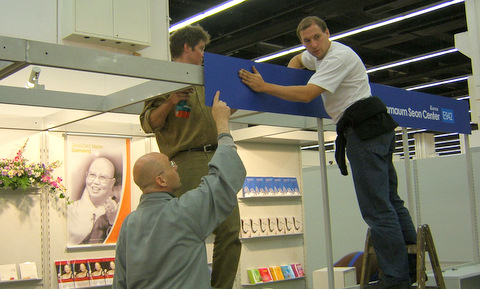
Things here have been a bit busy as we get ready for the bookfair in Frankfurt this October. One of the projects we’ve been working on is a Spanish-English edition of a great Dharma talk by Daehaeng Kun Sunim.  Her focus in this talk is on the necessity of us connecting with this inherent nature, the effects of being able to connect with it, and the need to function from that place.  There are some great lines in this talk where she really lays it bare for the practitioner; here’s one that got my attention!  If your thoughts just spill out your mouth, you won’t be able to make this connection!

 Here is the excerpt:
 

My overall point is this: people who want to discover their fundamental mind, shouldn’t allow themselves to be drawn outwardly by the things that happen to them. Instead, they must take everything that confronts them and return it inwardly.

Even though you have a good intellectual understanding of what I’m saying, please, please don’t mistake that for true understanding. Instead, have firm faith in your inherent foundation, and entrust every single thing there.

No matter what confronts you, your practice needs to be such that when you quietly entrust something to your fundamental mind, that which you entrusted will change and manifest back into the world. Your understanding and practice have to be translated into action.

Only then will you be able to truly deal with all the problems of your life, your family, and even the Earth. 


Copyright 2010 the Hanmaum Seonwon Foundation