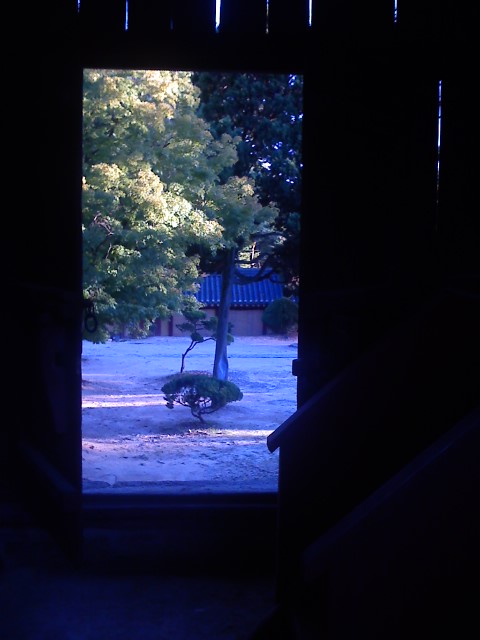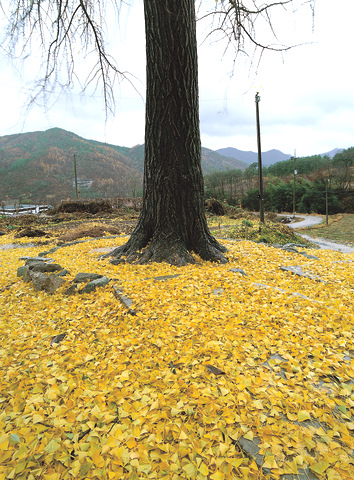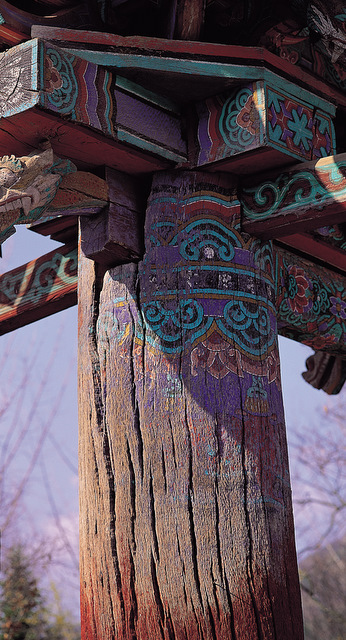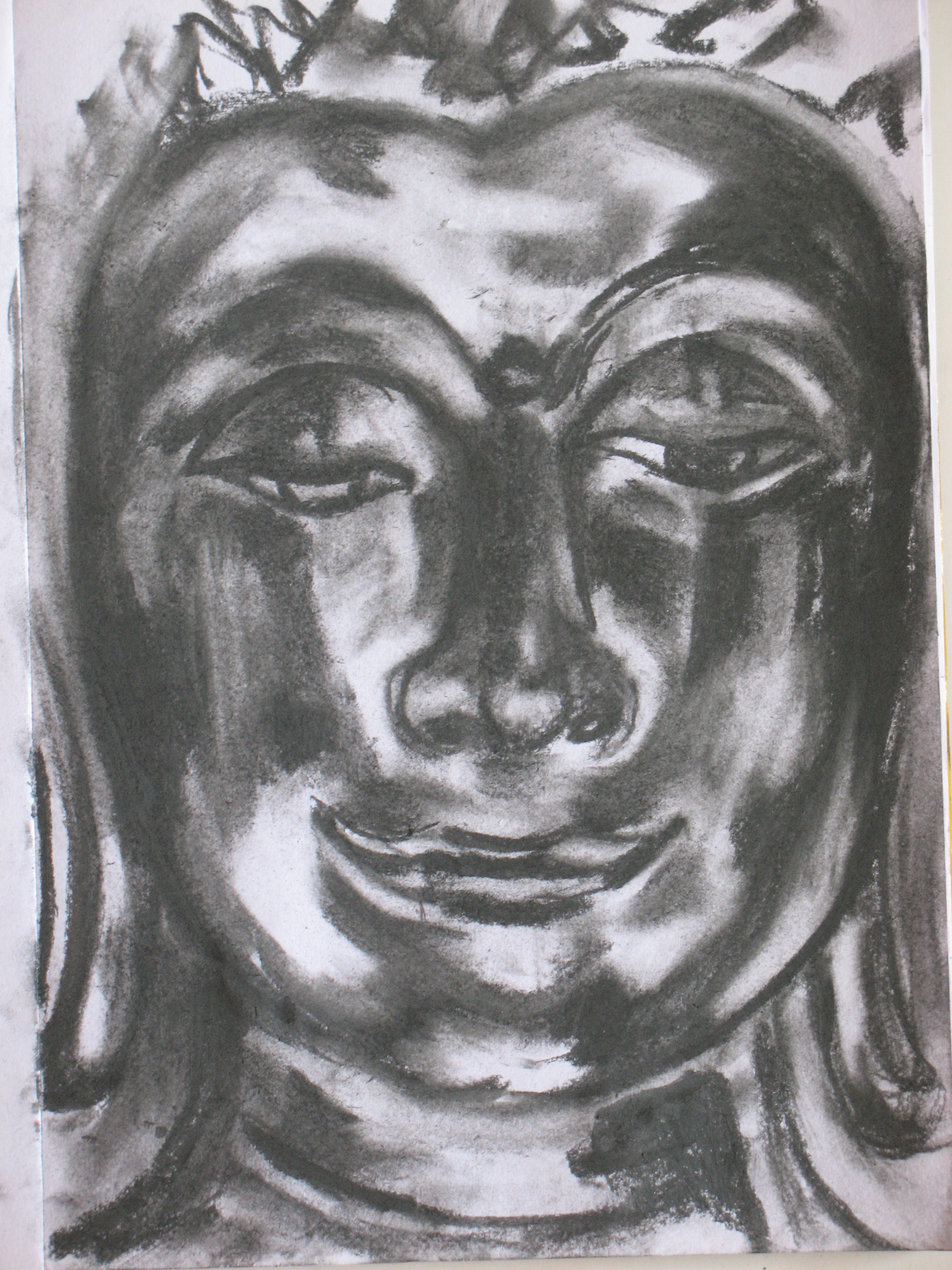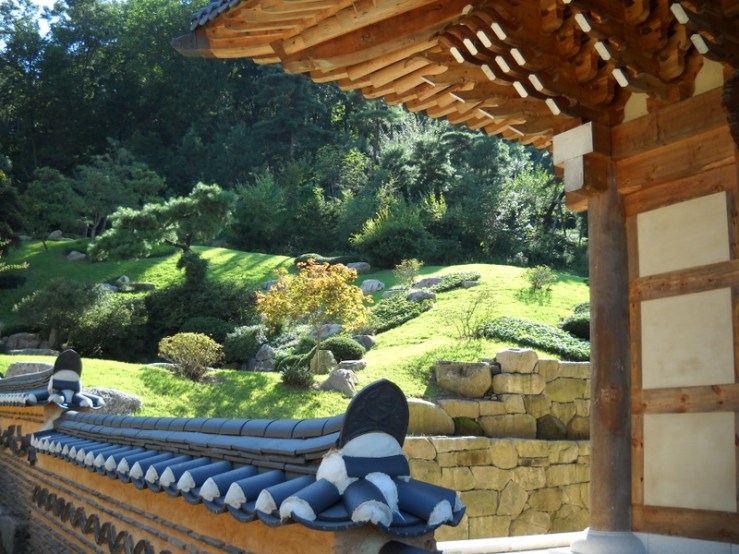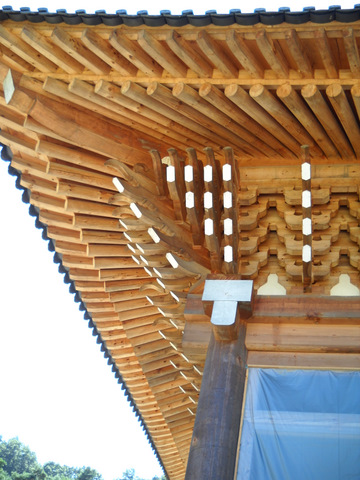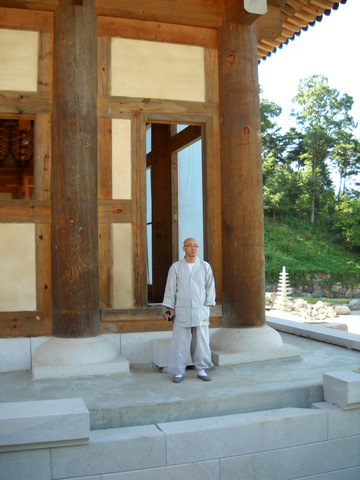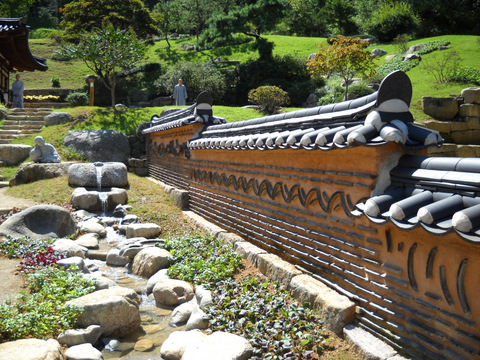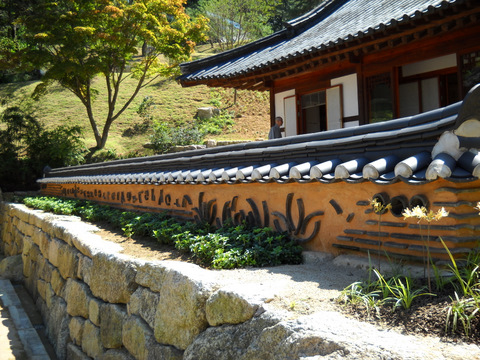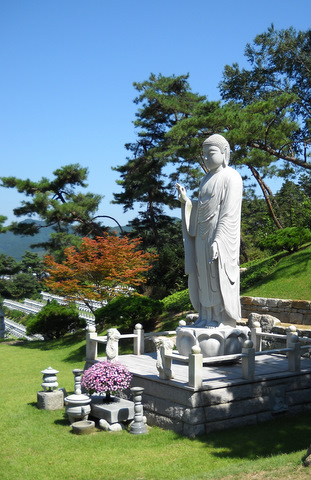
Sunday Photo; the path to GwanEum Temple

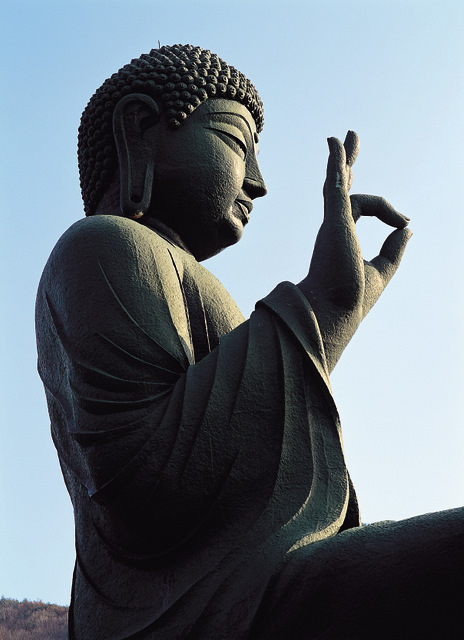
I didn’t think to count them at the time, but from what I was able to make out from another photo, if there aren’t 108 Buddhas here, it’s really close to it!

Each Mireuk Buddha has been carved with slightly different features and there are several different mudrā among them. Once you pass through the small shrine of the Four Heavenly Guardians, there are another two rows of much larger than life Mireuk Buddhas, each sitting on a column of piled stones.

There are more Buddhas across the grounds of this temple than most other temples combined!

advice to the sincere practitioner

In 1929, Hanam Sunim was asked about how to practice after enlightenment,  but I think his answer applies just as well to any point in our practice.  There’s also a bit of practical advice about how to avoid false teachers (or becoming one yourself!)

Yong-jia (永嘉玄覺, 665-713) said about people who are satisfied with one enlightenment experience and so stop practicing: “Saying that everything is empty, yet ignoring cause and effect, and behaving badly is to invite disaster.”

Don’t follow the example of those shallow people who misunderstand the meaning, who are too stubborn, who ignore the principle of cause and effect, and who don’t understand that what they receive is the result of their own actions.

If you don’t awaken to the living word and see only words and letters, or if you are caught by right and wrong, then you won’t be able to gather any strength, and your speech will not be in accord with your actions, so you won’t be able to avoid becoming one of those people who overestimate the level of their own practice. Thus you must have very sincere determination.

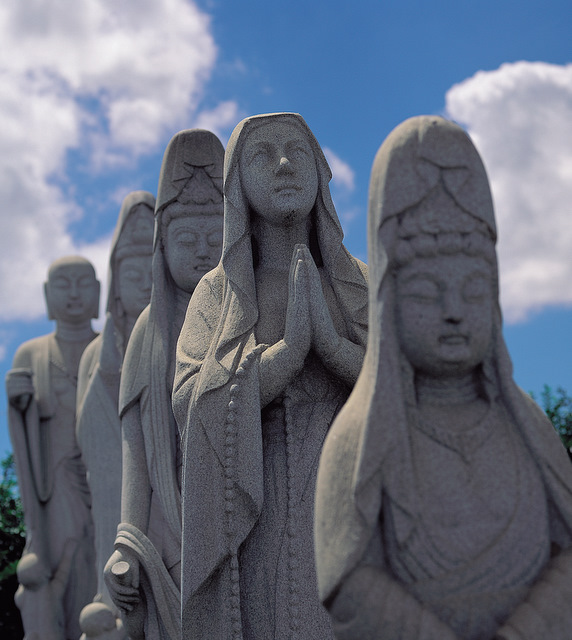
Bodhisattva statue in front of the Dharma Hall at Woljeong Temple

Thich Nhat Hanh

I have been catching a bit of Thich Nhat Hanh on Buddhist TV lately. Last night he really left an impression on me, like never before, or, perhaps I have been “away” too long.

He talked about nourishing positivity in us, and steering away from the negative.

He also said something that surprised me just a little; ‘when you have a positive feeling, or are around a positive person, ask it/her to stay. Maintain it in your mind.’ It sounded a little like attachment, but I know that isn’t what he meant.

Finally, He said what we already know from the Buddha; that we nourish our depression, our anger, our negativity, and so it is a choice.

When he spoke about the negative outcome of our nourishment, thoughts, actions, and finally our states of mind, he talked of course about suffering. But he said that suffering is necessary. He even said that suffering is a part of the kingdom of God; it’s necessary for the understanding of pain, and thus the growth of compassion. I really appreciate Thich Nhat Hanh making Zen inclusive, rather than exclusive.

In the end, he sounded like Dae Heng Sunim, the Buddha, and all Zennists; we are all part of one another, just as the clouds are part of the flowers we see, meaning no one thing happens or exists without everything else; a lesson to not see ourselves as separate, which leads to self-righteousness and blame.

BTV

In Korea, there is a Buddhist TV network called 불교TV (BulGyo TV). I don’t watch it often, but occasionally I’ll leave it on for a while if they are broadcasting temple chanting or scenes from temples around the country. Most of the times I check, there are Dharma talks, occasionally in English, and once I even saw a cooking show hosted by a nun.

A few days ago, my wife was flicking through the channels and called me over, “Look, I think this is Daehaeng Kun Sunim on TV.”

For those of you who know her face, it is memorably distinct, and it was, indeed, Kun Sunim on TV.

In the short bit that I was able to translate (loosely) from the talk, she told the large group of nuns, monks, and lay-practitioners,

Our body is like a ship and our mind is the pilot. If the pilot is unsteady, how can the ship keep straight?

how to get out of hell

how to get out of hell

“With one thought, evil karma accumulated over endless eons disappears, leaving nothing behind, like dry grass in a fire.”
A Thousand Hands of Compassion

Funny how life is. One minute things are going nicely, and the next, seemingly out of nowhere, everything is Dukkha. Wobbly axle? Uncomfortably grinding along? Tell me about it. My beloved flew back to Japan and, feeling miserable, I sat and watched too much TV. With no practice I became yet more unsettled and this downward spiral led, as it always does with me, to my becoming argumentative and quietly angry. Especially on-line, but off-line too. At work, and at Sangha.

I believe in Hell Realms, real places that truly exist. The Buddha certainly did, and there are hundreds of Sutras from all Buddhist traditions that go into great detail describing the gruesome tortures that await the unfortunates destined to go there, in many cases for kalpa after kalpa, for thousands of millions of years.

Genju recently discussed these realms on her wonderful blog 108zenbooks and Joseph posted a fabulous follow-up soon after. One of the points raised in their discussions was how hell is a reality just as much in this realm as in others. Not just in terms of the vast swathes of human suffering existing on this planet, but as mental states that we all of us experience. And this was certainly true for me this week.

Thank goodness for Sangha. In this case, the usual Monday evening Littlebang meditation group. My sit was awful, my mind at fever-pitch, and although I can’t say that the meditation helped in any direct way, it certainly revealed just how off-centre I was running. And although, while in this hell of the past few days, I never killed anyone or stole anything or slept around or lied or took intoxicants, I saw that on a subtler level my mind was certainly generating the energy that would run in such a direction. Heading, in fact, straight for hell.

Just as some new western Buddhists may be surprised to learn of the existence of myriad Buddhist Hell realms (their existence taken for granted throughout Asian Buddhism), others might also be surprised to learn how important confession and repentance is in Buddhism. But for me, this week, it was my way out of the fire. Daehaeng Kun Sunim’s modern translation of the Thousand Hands Sutra, ‘A Thousand Hands of Compassion’, is a beautiful book with a text perfect for slow devotional reading and repetition.

All harmful deeds I have committed, all unwise actions arising from greed and desire, all harm done through my body, speech, and thought, I now repent of this and all other harm I have caused.”

And with that I re-commit myself. Just as I’ve done before, and just as I’ll do again, but each time is better. I re-vow to watch my energies and the directions in which I send them. Practically speaking, it means I approach people a little differently than before, with less hostility and more kindness, I remove myself from my latest Internet debates (arguing on the web is probably my very worst habit and still a tough one to break) and I treat myself more kindly too. After all, this hell burns me more than anyone else.

The photo that accompanies this seems to sum up everything I want to say. It was taken by my beloved when she was here a week or so ago and says everything that needs to be said about our lives. Heaven, Hell, student, teacher – I’m sure I’ve experienced all in previous lives, just as I know I’ve experienced all in this life; we just keep cycling round and round all the time. The way out is to look towards the Buddha, and – just as in the picture – to find the Buddha at the very centre.

For myself, I’m not really very concerned with the question of inside or outside. I believe in the Buddhas and Bodhisattvas, but I also believe that they manifest within me through my own Buddha-nature, a Buddha-nature that is shared with all. In either case, the point is to step aside and allow the Buddha to manifest. Having done that, and this week it was through repentance, what then of hell? In relying fully upon the Buddha or Buddha-nature, everything both is, and is heading towards, peace, compassion, and wordless wisdom.

“Amitabha Buddha
existing with my mind,
I vow to hurry and meet.”
A Thousand Hands of Compassion

Links:
Somewhere in Dhamma: Hell Realms
108zenbooks: no sin, no self

on the other side of the window…

Here’s an Autumn benediction from Joseph:

I’m just looking out the window,
wishing I were on the other side.
Look! a small patch of red in the leaves!
I hope you’ll get to spend more time outside than I! ^-^

p

p

p

p

p

p

p

p

p

Learning to rely upon our true nature

 Here’s a very nice Dharma talk by Daehaeng Kun Sunim.
I had to smile as I reread this, because it really reflects her direct style and emphasis on each of us awakening to this bright essence that we each have.

Regardless of whether you are a layperson or a monastic,
everyone has to practice
relying upon their fundamental mind.
For each person has this one, true thing within them.
If you think that the best thing in the world
would be to truly know
this inherent foundation of yours,
this foundation that is leading the you of the material realm,
then you will succeed in grasping the truth.

You have to practice
such that the visible realm
and the unseen realm
always function together.
If you would have your body and mind
always function as one,
then entrust everything to your true self,
the master within that formed you.
If you live like this,
you’ll be one with everything
and know what peace is,
so entrust everything there.

 This physical body is a servant of our unseen self.
It just runs errands.
So it doesn’t really matter
whether you’re considered someone important or not.
When you’re frustrated or suffering,
remember,
“Okay true self,
you’re the one that can take care of this,”
and keep entrusting.
Only when you do this with everything in your life,
can you make some progress in your practice.

The personality traits that harm and hinder you
are still quite prominent,
so let go of those things,
over and over again.
Remind yourself,
“This inner master is leading me,
only this can show me the way,”
and entrust everything to it.
If you go forward like this
while viewing things positively,
refining virtue, and doing good actions,
then your wisdom will become abundant,
and your life will be well spent.
So really give this a try.

pppppp -Daehaeng Kun Sunim

Text copyright 2010, the Hanmaum Seonwon Foundation

Images copyright Joseph

Sunday Photo; SokGyeMun’s 33 Steps to Enlightenment

The entrance to Bul-guk-sa, known as Sok-gye-mun, has among the most elaborate entrances to any temple in Korea. The highlight of which is the thirty-three stepped staircase, representing the thirty-three steps to Enlightenment (according to the one who made it in thirty-three steps… ^_^). It is divided into two sections; the lower section,  Cheong-un-gyo (the Blue Cloud Bridge), and the upper section, Baek-un-gyo (White Cloud Bridge).

Being one of the largest tourist attractions in the country, as well, it’s another temple I like to get to early in the morning, before the grounds become entirely over-run with people. During that short time, the words of the stones can still be listened to and they tell you why it’s called Bul-guk-sa, The Buddha-Land Temple.

a point in every direction (is the same as no point at all)

I remember when I began meditating, I would meet my friend Joe once a week and discuss practice a little, then sit. He’d been sitting for over a decade already, and had studied Buddhism in university. I didn’t even know a Buddha from a Bodhisattva (I’m still a little puzzled at the difference…).

One day, before sitting, he said we should set our intention.

Huh?

My intention was to sit here for 15 minutes without moving and get enlightened, wasn’t it obvious??

It actually took quite a long time to figure out what he was talking about, but I realized, eventually, without intention, I was wandering around, up and down every path I came across, lost in the mountain.  When I found my clear intention, it was like spotting the tip of a pagoda through the trees, pointing the way.

Now I must walk my path to it, keep it in sight, not to be distracted by the obstacles along the way.

Easier said than done!

difficult people, difficult emotions

A couple of days ago, Joseph wrote a great post about dealing with difficult people.  He’d remind himself, that, as annoying as someone may seem, nonetheless, they’re growing and evolving, and have already come a long way.

They may have come a long way, but there are times when even that knowledge doesn’t make it any easier! 

Here are some other ways of looking at people, which have helped me get past some emotion or negative thoughts I’ve been caught up in. These are all true, but it’s often the case that one fits better than the others. (These are from Dharma talks by Daehaeng Kun Sunim) 

1.   I also used to be just like that

2.  They have a good heart, but when they open their mouth, it comes out all wrong

3.  This person(or event) is my true nature testing me.  And helping me discover all the garbage I didn’t realize needed to be dealt with.

4.  This is my true nature helping me grow up

5.  If I hadn’t made and sent out this kind of energy, it couldn’t have returned to me like this. 

6. All minds and my mind are one mind
pppppIf I repeat this one to myself, it’s like everything inside me settles down and becomes peaceful.

(I’m a bit reluctant to get into commenting on these too much, but every single one of these has helped me get through more than a few difficult situations.

We are all connected through our Buddha-nature. Through this non-dual foundation, energy and intention are freely going back and forth. Thus, the thoughts I give rise to are felt by others, and if those thoughts are contempt, resentment, or dislike, others will respond accordingly. 

If we can resolve the situation harmoniously, that’s the end of it. However, because we are all connected as one, if we leave things unresolved or with resentment and ill-will in the air, those will all come back to us. Again and again. So take care of things harmoniously, even though it may be a bother, or seem unfair (if you saw all the causes involved, you’d probably agree it was perfectly fair!).
As you free the other person, you’ll free yourself as well.