The Message of the Stone Statue (Dharma song)

The Message of the Stone Statue(돌 장승 우는 소식, here’s a practice version Message of the Stone Statue(Korean 20111023). The levels for the piano are a bit off, but you can get a good feel for the song.)

There’s a chill in the air,
when the frost comes, white flowers will cover the earth.
Those who have no eyes must feel so sad, unable to see.
Those who have no ears must feel so frustrated, unable to hear.
Those who have no hands must feel so hungry, unable to lift food to their mouth.
Those who have no feet must feel so lonely, unable to go or come.

Over that mountain,
on the path that Spring travels,
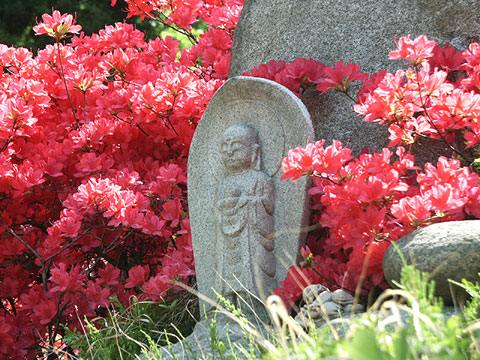
a stone statue, with tears of joy in its eyes,
is telling everyone that Spring is on the way.
Ah! How could we not know this promise of ripened flowers?!

Warm Spring is coming!
When the flowers blossom,
their fragrance will fill the land.
What a wonderful sight for those who have eyes that see!
What freedom for those who have ears that hear!
What satisfaction for those who can easily lift many hands
and help beings far and wide!
And for those whose broad feet can carry them far and wide,
without hindrance!

Over that mountain, in a valley
blossoming arrowroot vines
spread the news of Spring.
Ah! From the white-peaked mountain,
streams of thoroughly ripe water flow forth!

Even with walking, seeing, and listening,
After putting a foot on the ground,
Before lifting another up,
nothing is there.
The moon shines in a thousand rivers,
reaching in and grabbing for it,
eh-he-hah, de-he-hah!
opening my hand again,
could I even say that it came and went?

(verses by Daehaeng Sunim, English translation copyright 2011 Hanmaum Seonwon Foundation)

Korean Dharma Songs

Some of the earliest Buddhist songs in Korea were actually work songs, sung by farmers and their wives.  I’m sure that the work songs were present long before Buddhism came to Korea (circa 500 C.E.), but gradually they became examples of skillful means, as lyrics were created that reflected deep truths.
Imagine how deeply input the teachings would become as you spent hours reciting them while working:

Die once and open your eyes.
See yourself,
see yourself,
see, see.
Observe how this body is a collection
of karmic states of consciousness,
gathered together
according to karmic affinities.
See!
this body contains billions of lives.
See!
how they cause us to suffer
as they go back and forth
every instant.
o
o

Take the suffering and hardships that arise
and gather them together in your one mind.
Do this!
and the lives within your body
will be transformed into Bodhisattvas.
To save all beings,
start with those already within you.

This one mind that we all share
is the source of everything and every life.
One mind,
one mind,
our one mind and all Buddhas exist together,
working together as one. 

“All minds are my mind,
all bodies are my body,
not a thing is separate from me.”
Truly realize this for yourself,
truly bring forth this one mind.

Raise this unseen five-colored pillar high
and go forward entrusting everything to it.
Live magnificently throughout all the ups and downs of life.
Live magnificently!
Live magnificently!

(From the song “Live Magnificently,” by Daehaeng Sunim)

Dharma Songs

Koreans love to sing, and so the members of our temple have taken a number of poems and verses by Daehaeng Sunim and turned them into Dharma songs. This Saturday and Sunday we’ll even be having a festival of Dharma songs at the King Sejong Cultural Center in downtown Seoul. If you already have tickets, be sure to come! (I wanted to invite as many people as possible, but it sold out almost immediately.)

There will be a lot of performances by different lay choirs, as well as a sunims’ choir. Here’s one of the songs by the sunims during the 2004 Dharma Song festival, accompanied by traditional Korean instruments:


(This song is taken from a verse of Daehaeng Sunim’s translation of the Thousand Hands Sutra)

Sincerely entrusting everything to one mind,
Determined to know the real and help all beings,
Raising these great wishes,
May my Samadhi wisdom swiftly brighten.

May I attain every kind of virtue.
May the blessings arising from my practice guide and sustain all beings.
May all beings attain Buddhahood


This second song is called That Mind, Just As It is. It’s sung by the nuns of Hanmaum Seon Center, and is actually just a practice version.(They’ll kill me if they know I posted this!) The translation I did still feels a bit off, but here it is:

That Mind, Just As It Is (in Korean)

When water is clear, we can see the moon,
when water is murky, the moon is invisible,
but the moon doesn’t rise because the water was clear,
nor does it set when the water is murky.
When we dissolve all defilements and delusions,
mind becomes calm and clear,
and Buddha spontaneously appears.

 When our mind is clear, Buddha appears.
When our mind is murky, Buddha is unseen.
Buddha didn’t come from somewhere else,
Buddha didn’t go anywhere else.
If we calmly and flexibly guard the six senses
so that they don’t become thieves,
if we’re careful not to be caught by the functioning of the senses,
unenlightened beings at once become Buddhas.

(Chorus)
The green mountains use no words,
running water isn’t caught by anything.
Like nature, when mind remains
solemn and settled,
that mind itself is Buddha.

Refuge

In Seoul I used to attend Saturday Sangha with Chong Go Sunim and some of the good people you can see on the sidebar here. In Bangkok my Sangha was the Seon Club and the whole Littlebang group. Here in Tokyo, I’m working so hard I’ve hardly even had the chance to look for a spiritual community.

Yet at the same time the whole community is already here with me. My Dharma brothers all blog, Dharma friends email and say hi, even postcards are exchanged (thank you again Roy!). I live with my wonderful wife, truly the most patient Dharma teacher you could imagine, and I have the whole of the Internet!

Tonight on my walk home from work I was listening to a podcast from the wonderful Tara Brach, a talk called  “Taking Refuge” from January 2010. One bit, just as I was approaching my door, really caught my attention and I thought I’d share it here. What I love is the way she brings together both the outer and inner dimensions of refuge.

The outer refuge, the way we take refuge in the Buddha in an outer way, is – we bring to mind any being that expresses to us the enlightened heart-mind. It could be the Buddha, or Jesus, or the Bodhisattva of Compassion, Kuan Yin, or any being, living or mythic, any spiritual figure that in some way represents that to us. And the way that we then take refuge is to imagine that being’s love and that being’s awareness. And then let ourselves sense how that lives through us.

The reality is that in many of our moments we live in this trance of a small and limited self. Many of our moments the idea of an awakened being is outside of us, down the road, something exotic, so when we talk about taking refuge in Buddha-nature it seems abstract. And yet this refuge is so powerful, so liberating. If you imagine for a moment how your life would change every day, many times a day, in some way you glimmer that this radiant awareness really is your very essence.  That in  a way this whole spititual path is undoing that trance. It’s stopping pedalling away. When we stop pedalling away we come home to an amazing amount of space and aliveness and awareness.

The full talk and many more, as well as guided meditations, can be found on her website http://tarabrach.com/. So really, with all these resources, how can I ever forget that I’m always in the midst of Sangha? How can I forget, as Daehaeng Sunim says, that within myself I always have a Dharma hall, “which is always filled with light and where Buddha is always present.”

All we need now is for Chong Go Sunim to grab a microphone and master the art of podcasting too!
🙂

Inspiring Yourself to Practice by Won-Hyo: Part 1

We’re publishing the full text of Won-Hyo’s Inspiring Yourself to Practice (Bal shim su haeng jang). Written in the seventh century in Korea, it consists of 706 Chinese characters. (The English version looks much longer!)

According to the anthology Admonitions to Beginners, printed by the Bureau of Education of the Jogye Order of Korean Buddhism, Inspiring Yourself to Practice  is one of three staple texts for all aspiring monastics. “The text stresses the need to eliminated (sic) one’s karmic bond with the world and immediately begin practice.”

Inspiring is found in Admonitions to Beginners. Currently out-of-print, this edition needs editing and revising. The following is my rewording of the original English translation, which was produced by Mark Mueller and Won-Myong Sunim.

If you’d like to see a printing of the entire anthology Admonitions, please let us know. If there’s enough interest, maybe it could be published in the future.

INSPIRING YOURSELF TO PRACTICE by Won-Hyo Seunim

For countless eons all Buddhas residing in Nirvana
have discarded their desires and trained arduously.
From endless time sentient beings have cycled
within the burning house, having failed to discard desire.

The Pure Land is not blocked.
Yet few are those who enter;
most make their home among the three poisons.
Although the lower realms lack inherent power to seduce,
many enter therein.

The deluded mind values the five desires and the four elements
comprising the body as if they were jewels.
As this is the case, is there no one longing
to retire to the secluded mountains to practice the Way?

Enmeshed in desire, folks don’t go there.
Although you don’t take refuge in the mountains to cultivate your mind,
strive wholeheartedly to perform wholesome actions.

If you can renounce pleasure,
you will be as trusted and respected as the sages.
If you can undergo that which is difficult,
you will be as respected as the Buddha.
Those who greedily seek after things join the ranks of demons.
Those who give out of compassion are the disciples of the Dharma King.

(This post was also published on purelandway.wordpress.com: a blog specifically about Pure Land Buddhism)

a post from Japan

“If you don’t know that your inherant nature is fundamentally bright, how can you save yourself and how can you give light to people around you?”
 – Seon Master Daehaeng Sunim

A short walk from Roppongi, an energetic upmarket area of Tokyo, is a truly beautiful temple.  It was first established in 1598 as an expansion of a small roadside Kannon shrine, but you won’t find it mentioned in any guide books – probably because the buildings, destroyed in 1945, are all, as far as I understand, post-war reconstructions. And yet it is large, traditional, serene, and contains a couple of items that make it my favourite temple in the city.

The first is the statue, the largest wooden statue of Kannon in Tokyo, rebuilt in the 1970s but gorgeous. It is a standing eleven-headed Kannon with two arms holding a vase, a lotus plant, a staff, and beads. The wooden nimbus contains a number of Buddhas and the hall is built around the statue in such a way as to really give an impression of size and a sense of awe. It is lovely.

The other thing I love most about Chokokuji is the main hall. Unlike so many other Japanese temple halls which are more often than not locked and inaccessible, the huge tatami mat hall here is open and is infused with a real sense of devoted practice. It reminded me so much of Korean temples, and performing some prostrations and spending some time sitting came naturally and effortlessly.

It is, I believe, Soto-Zen (in fact, the Tokyo Branch Temple of Diahozan Eiheji, but I’m not really very sure quite what that means!) and I understand they have some meditation classes open to all on Monday nights (see the link below), but what appealed most to me (with my devotional approach to these things) was the Kannon Ceremony on the 18th of every month.

I went along with Ikumi and got there good and early, and good thing we did as the seats were soon all taken! The monks sat around the statue and chanted (the Heart Sutra and the Kannon Sutra were both delivered so fast that few laypeople there could match the pace) and went through various ritual movements and everyone had the chance to go up and burn some powdered incense and pray.

And at the end, before the monks filled out, the head monk talked to everyone there. It had been a tough time for Japan this year he said, with Ikumi kindly translating for me, but the essential thing was to move forward. “Remember” he said, “Kannon is not just a statue, Kannon lives within each one of us and is always with us, and so we have the power to set our course, set our goals, and move forward.”

Link: http://global.sotozen-net.or.jp/eng/temples/foreigner/Chokoku-ji.html

sunrise at Yeonju-dae

This is my last weekend in the Seoul area before I move back to the countryside with my family.

Something I’ve been wanting to do for a while before I go was too see the sunrise from the top of Gwanak mountain, so last night I hiked to Yeonju-dae and spend a chilly night in my tent waiting for morning.

A thick fog came in during the night, so I wasn’t sure I would even get to see the sunrise, but it just managed to shine through.

In the top photo, if you were to follow a trail past the broadcasting towers, then up and down (or around) another small mountain, you can actually come out not far from Hanmaum Seon Center.

clicking on the photos will open them in higher res.

Children’s Dharma Talk

I really have to get with posting again! Sigh.  Things have been busy here with getting a manuscript ready for Wisdom Publications, and now the the Frankfurt Bookfair.  It also looks like there will be a Russian edition of “No River to Cross” coming out before the end of the year.
 
Here’s a Dharma talk that Daehaeng Kun Sunim gave to out center’s childrens group.

Children’s Dharma Talk  

The Gugeong Pagoda on Buddha's Birthday (at Hanmaum Seon Center)

I can’t tell you how moved I am to see so many of you gathered together here today. Seeing you here today warms my heart. I was just like you when I was little. People may call you children, but you’re doing something very deep and significant when you gather here in front of the Buddha and learn about spiritual practice.

 You’re practicing, so you probably already heard that the minds of all life are connected as one. Stars have an essence that is also within us, so all of you are stars! You, stars, and this fundamental mind all respond to each other. This all happens without any wires or signals you can grab onto. When you eat something, and say “Thank you, Juingong (Buddha-nature)” your mother and father, Buddha, and sunims are all there inside of Juingong. When you take the things that come up in your life, and gather them all together at that one place, (Juingong), you can get a sense of this fundamental essence and can evolve your mind. Do this and bring forth this great power that’s within you.

             Keep practicing like this and become wonderful people. Become great beings who are able to bring peace to your family, who can guide your country, the world, and even the universe. This is all possible for you, according to how you practice. Okay?

 This Dharma talk was given by Daehaeng Kun Sunim during a Precepts ceremony for children.  

Tongdosa’s Nine Dragon Pond


Nine Dragon Pond

[ Some of you may have read this on my other site, but I just got back from a busy weekend looking at our new house in the countryside and have to get to sleep soon, so hope you don’t mind me reposting this!]

 In Korea, there are three special temples know as the “Three Jewel”, each representing one of the Three Jewels of Buddhism, the Buddha, Dharma, and Sangha.

Deep in the southern mountains is Tongdosa, the temple representing the Buddha, splendid in both atmosphere and spirit. But when the temple was founded in the year 646, there were nine evil dragons occupying the pond that the monk JaJang had to contend with.

At first, he tried chanting a mantra to make them leave but they refused, so he brushed the character for fire on a sheet of paper and, tossing it into the air, whacked the pond with his stick. With this, the water began to boil. Soon, three of the dragon flew out from the water, but collided into a cliff and died. Five other dragons flew south, and settled permanently in what is now known as Five Dragon Valley. Finally, the last dragon emerged, blinded by the boiling water. He made a vow to JaJang that if his life were spared he would be the temple guardian. JaJang accepted his offer, and the dragon remains as the temple’s guard.