Children’s Dharma Talk

I really have to get with posting again! Sigh.  Things have been busy here with getting a manuscript ready for Wisdom Publications, and now the the Frankfurt Bookfair.  It also looks like there will be a Russian edition of “No River to Cross” coming out before the end of the year.
 
Here’s a Dharma talk that Daehaeng Kun Sunim gave to out center’s childrens group.

Children’s Dharma Talk  

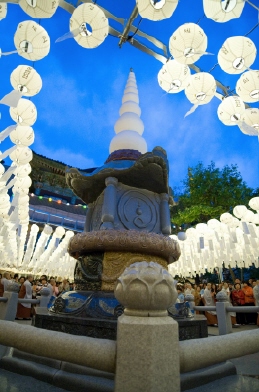
The Gugeong Pagoda on Buddha's Birthday (at Hanmaum Seon Center)

I can’t tell you how moved I am to see so many of you gathered together here today. Seeing you here today warms my heart. I was just like you when I was little. People may call you children, but you’re doing something very deep and significant when you gather here in front of the Buddha and learn about spiritual practice.

 You’re practicing, so you probably already heard that the minds of all life are connected as one. Stars have an essence that is also within us, so all of you are stars! You, stars, and this fundamental mind all respond to each other. This all happens without any wires or signals you can grab onto. When you eat something, and say “Thank you, Juingong (Buddha-nature)” your mother and father, Buddha, and sunims are all there inside of Juingong. When you take the things that come up in your life, and gather them all together at that one place, (Juingong), you can get a sense of this fundamental essence and can evolve your mind. Do this and bring forth this great power that’s within you.

             Keep practicing like this and become wonderful people. Become great beings who are able to bring peace to your family, who can guide your country, the world, and even the universe. This is all possible for you, according to how you practice. Okay?

 This Dharma talk was given by Daehaeng Kun Sunim during a Precepts ceremony for children.  

Tongdosa’s Nine Dragon Pond


Nine Dragon Pond

[ Some of you may have read this on my other site, but I just got back from a busy weekend looking at our new house in the countryside and have to get to sleep soon, so hope you don’t mind me reposting this!]

 In Korea, there are three special temples know as the “Three Jewel”, each representing one of the Three Jewels of Buddhism, the Buddha, Dharma, and Sangha.

Deep in the southern mountains is Tongdosa, the temple representing the Buddha, splendid in both atmosphere and spirit. But when the temple was founded in the year 646, there were nine evil dragons occupying the pond that the monk JaJang had to contend with.

At first, he tried chanting a mantra to make them leave but they refused, so he brushed the character for fire on a sheet of paper and, tossing it into the air, whacked the pond with his stick. With this, the water began to boil. Soon, three of the dragon flew out from the water, but collided into a cliff and died. Five other dragons flew south, and settled permanently in what is now known as Five Dragon Valley. Finally, the last dragon emerged, blinded by the boiling water. He made a vow to JaJang that if his life were spared he would be the temple guardian. JaJang accepted his offer, and the dragon remains as the temple’s guard.


Sunday Photo; Muan Lotus Pond

July through September is lotus season in Korea.

In the south-wesern tip of the peninsula is a famous lotus pond that cultivates them for their root and also makes delicious lotus leaf tea.

The lotus they grow is originally from India, but this pond is said to have the largest lotuses in Asia.

letting go, being happy


There are times when I have more (impossible) questions and complaints than answers. Times I struggle so hard to reconcile all the theories and practices of all the different traditions I’m familiar with that I feel frustrated and quite angry.
 
And sometimes this bubbles over. Like a child raging in the supermarket, I pick fault, stamp my feet, and bewail the fact that there is no perfect philosophy, no perfect community, crying out in pain that I don’t know what I’m doing!
 
Thankfully, my friends respond. Carl, Young, Joe. “About the philosophical questions you raised, I wouldn’t worry too much”, Chong Go Sunim wrote. “They are all just skillful means aimed at untying the knots some people get stuck in…. so if they don’t click with you, it’s not a problem.”
 
Young, from the Bangkok Hanmaum group, wrote about how the experiences and insights we have and the words we use to describe them are two quite different things – and of course she’s right; all my confusion last week came from getting tangled up in words rather than simply relying on the practice.
 
The funny thing is, the trick to overcoming all this, the practice itself, is really very simple – the trick of letting go! Funny how I so often forget it, am still a complete beginner, prefering most of the time instead to live out never-ending intellectual and conceptual dramas.
 
The other trick is even simper (but boils down to the same thing) – to just do what makes you happy (combined with awareness of course!) … or, as Chong Go Sunim put it the other day, what makes you feel alive! I know that if I just let go and do what makes me fully alive, life is much simpler and better.
 
Today I practiced, and in the afternoon we went to a temple. The hall was empty and we bowed and sat, wandered around a little, talked to a monk, got some calligraphy done, then joined the service – just me and Ikumi and a single monk in a huge tatami shrine room with open windows, trees and sky.
 
Gorgeous, just gorgeous. No thinking, no worrying, no trying to work it all out – just letting go, just happiness!
 

teaching Fina “letting go”

A few months ago, Chong Go Sunim presented me with the idea (challenge) of teaching Fina “letting go,” an important theme throughout Seon Master Daehaeng’s teachings.

I think my mouth said something like, “Yeah, good idea,” but my mind was going, “Yeah, right! I’m not even good at letting go!” But in the end, that’s half the point. The best way to teach a baby to let go is to do it yourself and let the baby pick up on that.

After trying several times, when Fina would grab something, to try to emit a sense of, “I don’t want that…” I wasn’t sure how far I was getting. Then one day Fina spotted a big, stuffed Pororo (her favorite Korean character) doll in the toy section and squeezed it tight her arms, swinging back and forth, excitedly shouting, “Pololo! Pololo! Pololo!” (She learned Pororo’s name about two months before she learned to say “Papa”, even if she couldn’t quite get the r’s).

At first, I thought, “Well, we haven’t bought her too many toys, she’ll really enjoy this one”, then I saw the $70 price tag and almost choked. I had a feeling that mentally mimicking “let it go” wasn’t going to cut this one, and was in no mood for a baby-breakdown, then I thought of something different.

Fina was getting used to saying “Hi” when we say people we knew, but she was even better at saying “Bye!” so I tried it. I encouraged her to give the doll a kiss on the cheek, then waved to it and said, “Byyye~”

Just like that, Fina waved with one little hand, said bye to Pororo and carefully put him back on the pile of other Pororos.

Woo hoo! I’d never bothered keeping score with Fina, it would’ve been too humiliating! but score 1 for Papa anyway!

Sunday Photo; Buddha Carving at Bomunsa

This Buddha is carved into the granite cliff near the top of the mountain behind Bomun Temple, on the small island of Seongmodo. Along the thin platform a small group of people were doing 108 bows in the summer heat.

The really interesting thing is when you follow the path around and on top of the mountain, you can look across the hazy sea and see North Korea on the other shore.

Do what makes you come alive

I happened to visit the Dalai Grandma the other day and found she had a great quote for me:

Howard Thurman 
Don’t ask yourself what the world needs. Ask yourself what makes you come alive and then go do that. Because what the world needs is people who have come alive.

Here’s another nice quote from Wikipedia:
community cannot feed for long on itself; it can only flourish where always the boundaries are giving way to the coming of others from beyond them — unknown and undiscovered brothers.

A lake in Russia, taken by my Dharma brother, Ilgyo Sunim