Jijang – Jizo, the Earth-womb Bodhisattva

One of the popular Bodhisattvas in Korea and Japan is Jijang, or Jizo (Ksitigarbha, in Sanskrit.) Often he is portrayed as the Bodhisattva who saves beings in hell, or who helps extend short lives. In Japan, he’s often thought of as the Bodhisattva who looks after children or fetuses who’ve passed away.

But there’s an interesting thing about his name that I’ve only recently noticed:  The first character, “ji”(地), means earth, and the second, “jang”(藏) means to conceal. While this is often translated as “Earth-womb,” “Earth-store,” or “Earth-treasury,” this can also be read as “concealed by earth”.  Sound familiar?  (“Only covered by dirt” is a common reference to the inherent, enlightened essence that we are each endowed with.)

That which is only “concealed by earth” can save us from hell, can bring the lives that make up our body into harmony, and can help even those who have passed away.

Jijang Bosal
Jijang Bosal
Jijang Bosal

what’s keeping me busy

What Marcus said in his post yesterday was true, life with a young, growing family is busy!

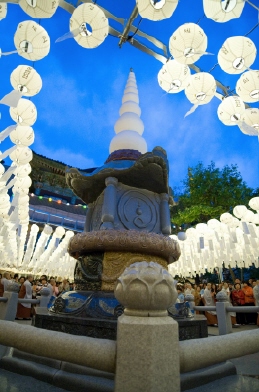
Chong Go Sunim once asked me if having children has been good for my practice. My immediate response was, “No!” in the sense that Fina used to run circles around me, like I was a pagoda, yelling, “Woo woo woo woo!” every time I tried to sit, but I knew what he was getting at. There’s a lot less room for “me” in “my” life, and that’s as valuable as anything I’d learn sitting.

The side effect, though, is that I’m hesitant to write about practice when I’m not practicing very well myself.

Until I regain a balance, I thought I’d share a few photos of what’s been keeping me busy these days. What’s been lost in meditation minutes (and sleep!) is being made up for with Love, and there’s nothing wrong with that.
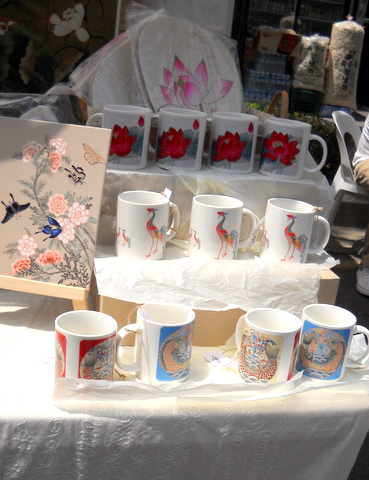
I hope they make you smile! ^_^

waking up to gratitude

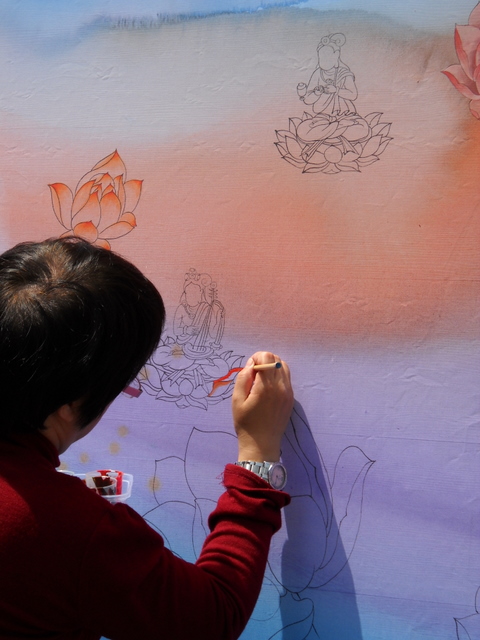
Kannon

I can hardly believe that no one has posted to this blog for two months. But life is busy. Chong Go Sunim handles so much at the Seonwon. Joe and Joseph have families to look after. I’ve no idea what Jabu is doing, Carl works hard. As do I.  Things change. Isn’t that pretty fundamental?

Plus, I wonder, what is left to say? I’ve just looked over the archives and liked what I saw! But how many times can one say it? How many ways can one say it in?

A colleague at work shared something of just that with me today. He told me about the Red Pine he was reading and asked me “aren’t you surprised at me, a Taoist, reading these Buddhist books?” “Ah, but it’s all the same” I said. “Exactly” he replied. “And the more I practice, the more I see it. The difficulty is putting it into words”.

Wake up, wake up!
You have slept millions and millions of years.
Why not wake up this morning?

That’s from Kabir, using his words. Quoted by Brother David Steindl-Rast in the introdution to “Gratefulness: the Heart of Prayer”, in which he writes “… everything is gratuitous, everything is a gift. The degree to which we are awake to this truth is the measure of our gratefulness. And gratefulness is the measure of our aliveness.”
There are so many ways to say this. Stephen Mitchell, in his version of Psalm 17, writes “let me, when I awaken,/see nothing but the light of your face.” Awakening is to see the world as it truly is, as the face of God (if you stumble on this word, pick another, call it the face of Love or Juingong or Interconnectedness).  But already I’m lost, trying to write about that which is impossible to describe.
All I know is that the flowers on my little balcony are bursting with life and energy. I know that regardless of all the pain in this poor suffering world, I feel such gratitude for their purity and beauty. Barry at Ox Herding knows me well and, like all good teachers, he teaches for the student’s needs:  “I suggest getting down on our hands and knees in the dirt, bowing to whatever benevolent deity provides such extraordinary beauty!”
And talking of waking up to aliveness, here’s Kosho Uchiyama putting it into his words: “Aslong as we wake up and live life as universal self, we work in the direction where all things are alive.  And since everything we encounter is our life, with the attitude or spirit that our whole self is taking care of its own life we aim at giving life to all things, all situations, all people, all worlds.”

So many ways to say it. So many ways to express our gratitude for this glorious world and this glorious life. “Inherently life is one. Inherently, life is Buddha.” (Seon Master Daehaeng Sunim).

an entrusting mind

Last night at the Tsukiji Hongwangi Jodo Shinshu Temple in Tokyo, Rev. Youmyou Kadono spoke on the theme of “The most important Jodo Shinshu teaching: an entrusting mind”. And he told a story from his own life many years ago, as a young parent on a day trip with his daughter to Disneyland in Florida.

His child was really excited about seeing Mickey and all his pals, so much so that as soon as Mickey appeared she ran off towards him and was soon lost in the crowd. Rev. Kadono ran to catch up, but his daughter, aware that she was now lost and separated from her parents, had burst into tears.

“Don’t worry,” Rev. Kadono said, bending down to pick her up, “I’m here, I’ve got you. And if you get lost again,” he said, “just stay where you are, stay calm, I’ll be right there, I’ll find you.” Sure enough, later in the day she ran off again, and again got lost. This time though, when Rev. Kadono found his child, she was perfectly calm, simply trusting that he’d soon be there.

“This”, Rev.Kandono said, “is the everyday benefit of the entrust mind, the mind that rests in faith” and it reminded me at once of Daehaeng Sunim’s teaching on entrusting. “Entrust everything to Juingong: entrust the things you understand and the things you don’t understand, entrust happiness and entrust suffering, entrust poverty and entrust disease.”

I know Japanese Pure Land is not Korean Zen, and some might think me mistaken for mixing the two, but this is how my path is, and I can’t help but be delighted by it. After all, as Daehaeng Sunim writes just a few lines later: “Don’t try to take care of things by relying upon theories, sutras, clever words, or other people’s ideas. Instead, just let go while believing that only Juingong can solve it.”

The great saving power of all Buddhas
becomes the saving power of my one mind.
With it I can live every day
free of entanglements.
So wonderful!
 – A Thousand Hands of Compassion 

The Gateway of Seon

I’ve been typing up translations of Dharma songs today, but our office has been kind of noisy, so I used my headphones and some music to keep from getting distracted.  By chance I’d selected the Lord of the Rings soundtrack, and the following track started playing as I began typing in this song. It’s a great teaching poem anyway, but try reading it slowly after the music starts!

 Lord of the Rings_07

With one mind as its foundation,
the whole of existence
has come into creation.
Buddhas and unenlightened beings
exist together,
throughout the heavens and earth,
everything is one.
Yet those ignorant of this
are seduced by outer things,
and cause their own pain
as they fall into evil paths.

Come to your senses,
before its too late and you leave your body.
Learn to travel freely on the path of mind,
where all phenomena and and action
become fragrant offerings,
become your sustenance.

Let’s all know this gateway of wisdom,
let’s all experience this gateway wisdom.

Everything is the manifestation of one mind,
and done by one mind.
Paradise is right here,
the inherent nature of men and women
is exactly the same.
Yet if you indulge in discriminations,
how will you ever understand the truth of emptiness?

Once born into this world,
people are trapped in a barless prison,
and just drug along to their deaths.
The path is blocked
by fixed ideas of “me,”
with one bound
just leap over these!!
Let’s all experience the gateway of seon,
let’s all experience the gateway of seon!

The Reality of Life

 In this poem that’s become a Dharma song, Daehaeng Kun Sunim describes a bit of the nature of our fundamental mind. Understanding this isn’t enough, we have to take what bits we understand and do our best to keep applying them to our daily life. Then the nature of how things truly are will gradually become clear to us.


Living in this eternal moment is the reality of life,
throughout all creation,
there’s nothing that’s not the manifestation of one mind.

Even being born as a human is the manifestation of one mind,
the skillful means of one mind.
Awaken to this one mind,
escape from the suffering of samsara,
and discover what it means to truly be free.

There’s no reason to talk about the past or the future,
for this moment is eternal.

Throughout all this world,
every single thing is the manifestation of Buddha.
Across the heavens and the earth,
at each and every place,
the Buddha is fully present.

Everything is the unfolding of one mind,
it’s compassion,
it’s light.

Dog days…

This is a friend of ours who first came to the temple about nine years ago. He has the slight misfortunate of having a girlish name, Maeli (“Plums Blossoming,” poor guy), but he seems to be okay with it!

One of the interesting things about him is that he’s taken on the job of defending the temple, and here he’s actually on station at the entrance to the nun’s quarters. He’ll start barking if a layperson comes too close to the entrance, and sometimes, for no obvious reason at all, he’ll start barking at someone in the courtyard. The thing is, since he came here, there have been no instances of pick pockets or of people trying to rob the donation boxes.

Korean Buddhist texts and ceremonies occasionally mention something called “fragrance of mind.” Like the fragrance of incense, it weaves here and there, unseen and un-graspable. And it is the results of the efforts we make to transcend ourselves and to see everything as part of ourselves.  It is this fragrance that moves amoung the people in our lives, lifting them up and brightening their path.  It’s there all the time, whether we notice it or not.

Happy New Year

I’ve just got back from the temple. It’s not like Korea, where the temple would be full of people bowing and chanting and praying (how wonderful), in Japan people seem to do a whole lot less, and yet the feeling was great, very positive and very beautiful. It was just my local temple, rarely open except for at New Years, and we joined a short line to ring the temple bell. Afterwards there was a small fire and hot drinks and we said hello to our neighbours.

Earlier, walking in the park, I thought about what my New Year’s Resolution might be this year. Something, I thought, that I could stick to. Something to resolve all this time I spend worrying about the path. I mean, one day I think that just reading a single Sutra is the way forward, then I’ll think about some serious sitting, next thing you know I’m thinking that perhaps I need a retreat or a new altar! My resolution, I thought this morning, would be the answer, the one practice I need.

Silly me. Such nonsense. If I need a resolution, it is to spend less time thinking about practice, and more time actually practicing! The path, after all, is so simple. Let go. Entrust. Have faith that the foundation, under whatever name I might give it, is taking care of everything. Then it doesn’t matter what I do. So long as I’m living by the precepts, I can meditate if I want to, read if I want to, chant if I want to. I can follow any wholesome practice that feels right at any time. I can smile, and live in happiness.

Happy New Year!

So, the Buddha and Santa walk into a bar….

Okay, that’s all I got so far! If you have any great ideas on how to end this (in a positive way), have at it in the commments!
(And thanks to Marcus for the awesome card!)

But have a happy and safe 2012, and may everyone grow and be at peace in the new year.

with palms together,
Chong Go Sunim

See with your heart

This is a famous temple site near the ancient Korean capital of Silla. One of my Dharma brothers lives nearby, and visits this site when opportunity presents. While it’s unquestionably beautiful, what draws him is the feeling of living energy. Sometime, far in the past, people practiced very sincerely and deeply here. And the echos of that can still be felt even now.
 
South Mountain near Kyoungju