back from Germany

Well, we made it back from Frankfurt with no major problems, and even met some great people and publishers at the book fair. It’ll be a few months of back and forth before anything’s finalized, but things look promising.

A professor of mine once said, “You can have a great teacher, but you still need to work your a## off.” ^-^ 
Boy, was he right! And that’s about how hard we worked as well to make things happen.

The difference between potential and realized is basically blood and sweat.
Once you know what to do, it’s a matter of throwing yourself into the task and doing the best you can. And all the while remembering is isn’t “me” that’s truly doing things, but this true nature. So that’s where questions need to be asked, and praise and blame returned to. (Although it helps to remember what’s being criticized isn’t me as true nature, but this collection of habits called “I.”) That’s what taking care of things, even when they go directions contrary to my intention. “This Buddha essence is taking care of things, so even this may be for the best.” And things really do work out for the best when I can get past “I,” and trust this inner essence.

Here are some more photos from Frankfurt. On a personal note,I’m leaving next week for the land of rain and coffee (Seattle) but I’ll be back in a couple of weeks.

The old city center at Frankfurt


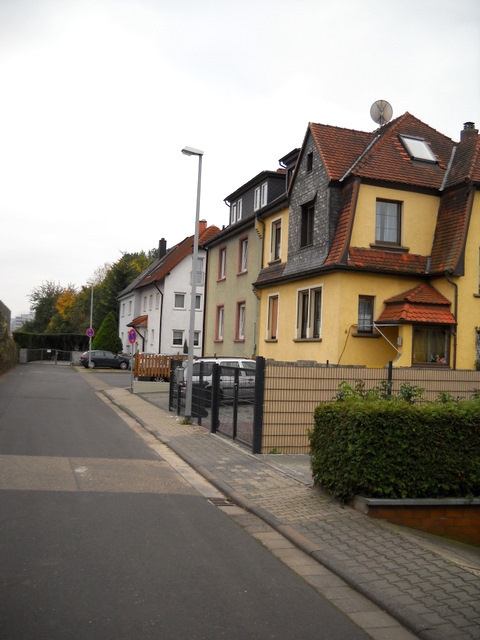
near our pension (bed and breakfast)
sunsets in Frankfurt were really something


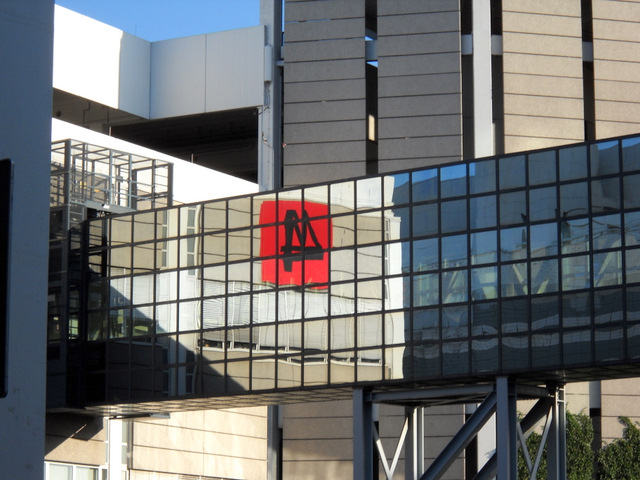
the convention grounds - 11 huge buildings


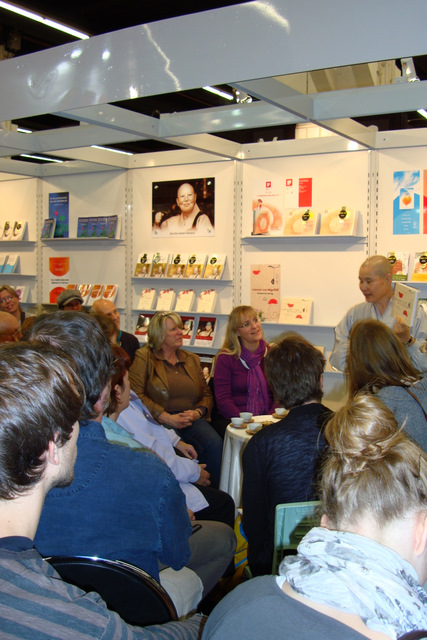
a reading at our booth


downtime


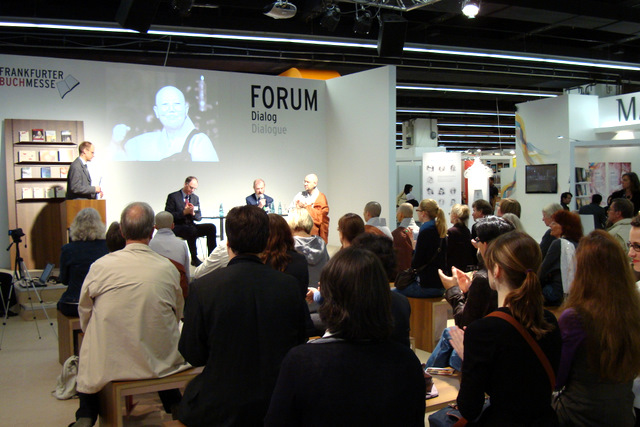
The forum we held about Daehaeng Kun Sunim, to launch the German edition of "No River to Cross"


contemplating Dukkha, via Lufthansa ^-^ (hint: that's really how close my knees were to the next seat.)

Spiritual Practice at the Frankfurt Bookfair

Spiritual Practice and the Book Fair

It’s actually difficult for me to write about my experiences there, because they were so wonderful and so many. In Korean we speak of jeong jin, or intensive practice. And that is truly what the book fair was for all of us.

Every evening we would all gather at Mr. Koh’s house for dinner and a group discussion. There were those of us from Korea, as well as many of the German members. After a meal of food that was as much heart as it was physical matter, we would talk about what had happened that day and our experiences with practicing. People’s experiences were so touching and inspiring that it was as if we were sharing a beautiful Dharma talk every evening.

You could truly feel the energy of mind. So many people had gathered together, and raised mind while letting go of “I,” that the energy was contagious. Having returned to Korea I feel a bit like a character from a story. It’s one of those stories where someone is allowed to visit a heavenly realm, but eventually has to return home and apply what he learned to his life. In fact, the energy was at such a high level, beyond my usual level, that it’s almost hard to remember it now.

This energy is what arises when everyone is completely relying upon their foundation, Juingong, and throwing themselves into the task at hand. Growing up, I had the attitude that I should be able to do everything, and do it very well. But what happened in Frankfurt is more like a stew: everyone contributed what they had to offer, in terms of mind and ability. Between us and Kun Sunim, we filled in any gaps, and were able to support each other, while giving our visitors a taste of this profound mind that we all share. For seven days, everyone completely threw themselves into the tasks before them. The food tasted better, problems melted away, and miracles happened.

All the words of gratitude that I can think of seem so inadequate. Everyone from Korea and Germany was so wonderful, with such beautiful and sincere minds. What can be said of such a thing, except to wish that every reader will soon experience this for herself or himself.

-With palms together and a deep bow
Chong Go

Forum on the Thousand Hands Sutra

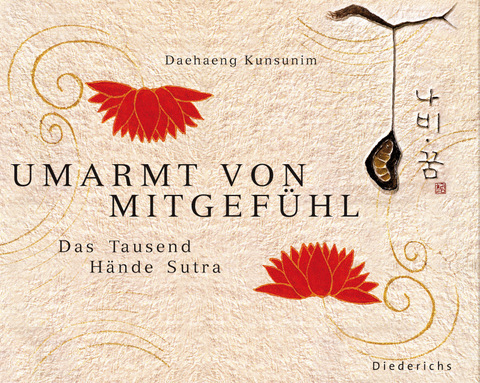
the German edition of "A Thousand Hands of Compassion"

The German publisher, Diederichs, had just published a German/Korean translation of Daehaeng Kun Sunim’s version of the Thousand Hands Sutra, called Umarmt von Mitgefühl, and everyone thought this was a good time to tell people more about the history of the Thousand Hands Sutra, and the significance of Kun Sunim’s edition.

The forum was held in Hall 6, and was in four parts; first I discussed the history of the sutra, together with how the recitation version formed. Next Dr. Sunhee Suh discussed the characteristics of the recitation version and the significance of Kun Sunim’s edition. Dr. phil. Ralf Päsler discussed the cultural aspects of the translation and the problems associated with transferring concepts and ideas across cultures. Finally, Hyo Rim(임효), the artist whose work illustrated Umarmt von Mitgefühl and A Thousand Hands of Compassion, discussed the significance of the details in the paintings, and what had inspired them. As Hyo Rim talked about each painting, his descriptions felt like Dharma talks.

When we first decided to undertake the forum, I was somewhat concerned that it would be too detailed for the stressed and busy audiences at the book fair. But this is what our team members here in Korea and in Germany wanted to do, so I just threw my whole heart into it while relying on Juingong, and went forward. Actually, this is what we all were doing. And because we were all doing our best to practice like this, the forum touched many people.

It opened when Hye Jin Sunim, Hye Bek Sunim, Hye Jong Sunim, and Hye Bo Sunim began chanting the opening section of The Thousand Hands Sutra from the back of the forum center. Wearing their formal robes while hitting a moktak, they were very impressive and the entire area fell silent while people looked to see what was going on.

For the next 40 minutes we discussed the sutra and tried to give people a sense of this fundamental mind, or Juingong, that we all possess. A few people wandered off, but remarkably most stayed for the entire time. I say “remarkably” because during the first three days of the book fair, publishers are very busy, with different appointments every 15 or even 10 minutes. So they don’t have time to do other things. And yet here they were, ignoring their schedule, to hear more about practice and the Thousand Hands Sutra. The head of one German publisher even expressed his gratitude to us for presenting teachings of such depth at the book fair.

The rest of our time was spent talking with different publishers about Kun Sunim’s books and important aspects of publishing them in other countries. Several publishers from France and Germany were interested in Kun Sunim’s books, particularly translations of her Dharma talks. There was also much interest from other countries that will hopefully lead to Kun Sunim’s teachings be published in still other languages.

In addition, we had several reading sessions at our booth where Hye Jin Sunim and Dr. Ralf read from The Thousand Hands Sutra as well as a collection of Kun Sunim’s stories, called My Heart is a Golden Buddha. Hyo Rim was there talking with visitors, and visitors from years past came to the booth, often carrying well-read editions of Kun Sunim’s books.

Arriving in Germany

If you are going to be in Frankfurt for the book fair, be sure to stop by and have a cup of tea. Our booth is in hall 6.0 C942.

The start of the book fair began when our flight landed in Germany on Monday evening. We made our way to the House Busan, a bed and breakfast on the edge of Frankfurt. Aside from the friendly owner, perhaps its best aspect is the Korean breakfasts. I’m happy with bread and yogurt for breakfast, but the traditional Korean breakfast was a relief to the other members of our jet-lagged team!

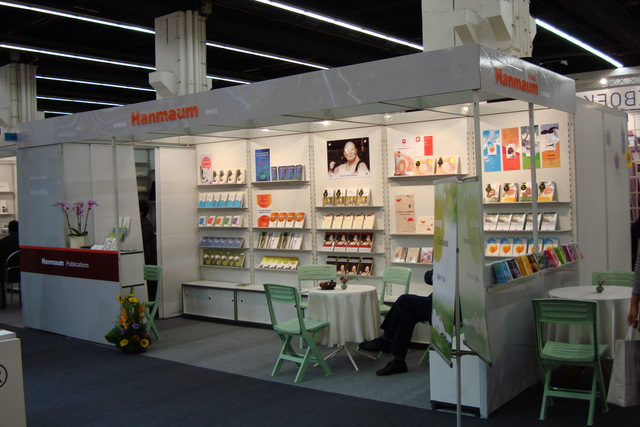
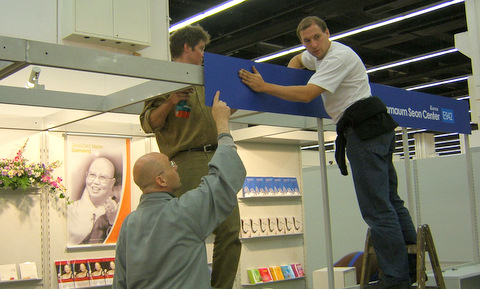
On Tuesday we went to the grounds of the book fair, the “Messe.” The Messe, is huge, with eleven halls, some the size of football fields. There, in Hall 6.0, we began to prepare our booth for the opening of the book fair on Wednesday. Hye Jin Sunim brought buckets of cut flowers and began preparing beautiful floral arrangements, while the team from Korea began to organize the booth and arrange the books. Meanwhile, Holger and Young Ralf worked to install a foot-wide (30cm) sign around the top of our booth, which said “Hanmaum Seonwon” and “Hanmaum Publications,” which is the name the International Culture Institute uses to publish books.

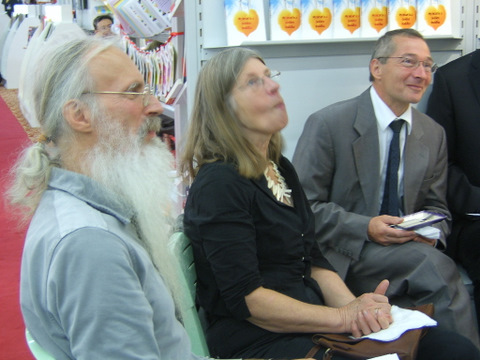
The German publishers we've met have all been truly incredible people. Gerhard and Erika, on the left, are top level editors, and Herr Lord, on the right is the head of Goldmann Arkana. You'll be hard pressed to meet more down-to-earth, spiritual people.

The booth was finally prepared at about 7pm, and everyone went to Mr. Koh’s house for dinner and a meeting. Many of the female Frankfurt members of Hanmaum Seon Center had gathered there and were working hard to prepare dinner for everyone. After eating a great meal, we discussed our plans for the next day and finally headed back to the bed and breakfast.

Wednesday opened the book fair, and was a bit of a slow day at first. Many publishers have appointments to meet other publishers, and so have no time to visit other booths. Meanwhile, we were also busy, preparing for a one-hour forum on Thursday about the Thousand Hands Sutra.

Books and Buddhism: at the Frankfurt Book Fair

Some of you may have noticed a drop in my posts over the last couple of months. Things here in Korea have been very busy with finishing translations, proofing, and last minute errands as we get ready for the book fair in Frankfurt. I’m leaving today (Monday) for Germany, and won’t have time for regular posts for a while, but I thought I’d share something I wrote last year about the book fair. (This piece will be spread over about three posts.)

As I look at the title of this post, I can see where some of you might be expecting more detailed info about Buddhist books and publishers at the book fair, and as I think about it, that sounds like a great topic for a post. So I’ll take a camera and do some blogging about the book fair when I return. (It’ll be a couple of weeks, though.)

Daehaeng Kun Sunim’s Teachings at the Frankfurt Book Fair

For the last several years we (the Hanmaum International Culture Institute) have been going to Frankfurt Germany for the annul Book Fair. Each year, around 7,000 publishers from more than 100 countries gather in Frankfurt to exhibit their new books and to find books from other countries that might succeed in their country. Publishers try to find foreign publishers who can take the book back to their home country and best publicize the book and get it into stores where people can find it.

This may sound like a very commercial concern for a Buddhist organization, and in a sense it’s true. For “commercial” also means popular, something which many people are interested in. Our mission is to make Daehaeng Kun Sunim’s teachings widely available to people who don’t understand Korean. Thus, beyond just translating those teachings, we have come up with ways of reaching people. One way of doing this is through books that interest people, books they want to read. If we can produce books that have a lot of appeal, publishers in other countries will want to publish them, thereby making it easier for people in those countries to encounter Kun Sunim’s teachings.

I used to think that the translation was 90% of the work, but now I know that it’s barely 50% of what must be done. No matter how wonderful the content, if the look of the book doesn’t appeal to people, they won’t pick it up and won’t discover the content. The cover has to be interesting, the title must touch something within one, and the text layout and paper must draw the eye. Once those things are in place, then the contents can shine.

 The Road to Frankfurt 

Much of the year at the Hanmaum International Culture Institute is spent preparing for the Frankfurt Book Fair, but the last six weeks are the most difficult. It will take two weeks to print the books, so we actually only have four more weeks to work. The ladies doing the designs and layouts have to get the text and then adjust the format so that it feels comfortable to look at. Once they’ve done this, everything has to be proofread again.

The programs for publishing are very fussy, and often create “broken” characters. Somehow there was a computer code conflict and the program turns a word or character in to nonsense garbage. And sometimes it was a person, working at three or four in the morning whose eyes were too blurry. These new changes are made, and everything is proofread again. And then again. Once the file is sent to the printers, we can begin work on the publicity materials, such as brochures, posters, and handouts.

This year our new books of Kun Sunim’s teachings arrived on Saturday evening, and we left on Monday morning, and I think the books were still warm from the printing presses!

Practice, Don’t Say; Be And Learn. Don’t Explain

This slideshow requires JavaScript.

In seeking word and action, rather than being, we suffer
Seeking what we have seen, and had…we suffer more, until…
Having, we learn, and fill ourselves
Then, empty, or full, we find contentment, or loss, again…
And the cycle continues…

. . .

Joe poured tea, today

He, Eunbong, Fina, and I enjoyed the company of one another

Joe and I spoke of words, as the clouds, sky, and sun…
Poured warm, bright light…into the seventh floor window
Onto us, the tea, and the wood
It was “good”

The balancing company of sangha heals us

Hues of sepia, deep and light, sent dreamy images and aromas,
Up to our senses,
From the cups

I asked about an aspect of love

Joe said, “I don’t think about it.”
Brief, and almost empty, yet apparently resonant…
Like the sound that the copper bowl made, when we invited it to ring, earlier…
Joe’s words stealthily disappeared in me,
For I let their momentary ’emptiness’ go,
Like the bell-sound of the bowl

Then we talked about practice, and talking about practice
We agreed that practice described in sentences
Does not convey the deeper experience that practice reveals

It was at this time that Joe’s answer about love
Appeared to me about practice, and more…

As in love, in practice

In seeking descriptions, definitions, and a record of what happened
We are found to be saying something different-from what the listener can understand…
Without experience

This is suffering,
As we seek the gratification that words often cannot produce
And only experience, and practice
Can truly reveal,
And teach

the world, our sangha

I take refuge in the place for learning the truth, which is every place.
A Thousand Hands of Compassion

“You must realize that, your husband, your wife, or your children who give you hard time are Buddha who is trying to teach you. Don’t have preconception of Buddha. Buddha is not just a golden statue set high in the Dharma hall whom you always lit a candle or offer incense to. Buddha is very close to us. Try to think that our family, neighbor, friends and parents are Buddha.”
Seon Master Beopjung

“The trees, water, air, birds, and so on can all be members of our sangha. A beautiful walking path may be part of our sangha. A good cushion can be also. We can make many things into supportive elements of our sangha.”
Zen Master Thich Nhat Hanh

“What is this? How can spring rooster’s crow be the answer to the question of truth? If you hear the rooster crow in spring correctly, then you will know the meaning of life clearly.”
Seon Master Seung Sahn

“Which one is my True nature in Three Worlds? There is one single pure object, which is my Original Self. Flowers blossom and leaves fall but it has one root. The sun and moon rise and fall but leaves no traces.”
Seon Master Haeam

“There is teaching that, “The leaf returns to the root.” It means the fallen leaf will return to the root of that tree. The nature of returning to the essence is the teaching that Nature gives. The work and effort to return to one’s essence is the purpose of Buddhism.”
Seon Master Wolha

Bul, refers to the fundamental source of every single life, including even a blade of grass, and the second syllable, gyo, refers to learning from each other; we communicate with each other through speech, mind, and actions. So the word ‘Buddhism’ means communicating with each other through the foundation, the fundamental source of life, and through that, listening to each other and learning from each other.”
Seon Master Daehaeng Sunim, ‘No River to Cross’

“Say only the Truth and convey only the Teaching. That is the work of brightening the world with Buddha’s teaching. You need to be the leader and guide to a brighter world. All of you have reason for being in this world.”
Seon Master Gosan

“If you completely understand how mind works and are able to combine your mind with others’ minds, and if you are able to deepen your wisdom and continue to practice, then you can combine your mind with even the great stars of the heavenly realm. When you can do this, the heavenly realm becomes peaceful and comfortable, and in turn this world also becomes peaceful and comfortable.”
Seon Master Daehaeng Sunim 


Link: Most quotes from here
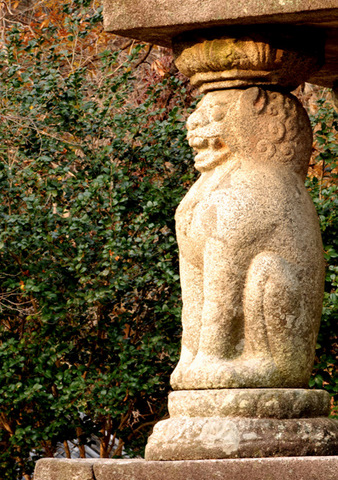
Images: This pagoda is at Hwaeom Temple, in the Jiri Mountains.

Secret practitioners, and a bit of silliness

Daehaeng Kun Sunim has often said that we need to keep what we experience a secret, for if we start talking about it, competition and comparisons often arise. In the end, our experiences become just another foothold for “I.” Instead we need to embrace those experiences and completely entrust them, let go of them, and move forward.

On a bit of a silly note, as I thought about this, I realized there have been secret practitioners showing us the way. ^-^

Being drawn to outward things

Although everything is part of our practice, we still have to make an effort to rein in our ADD, ordinary consciousness. Until we do this, it’s difficult to connect with our fundamental nature. Here are some words of gold by Daehaeng Kun Sunim about this. Although the idea seems simple, it contains deapths that are unimaginable. In this same Dharma talk, she pleaded with listeners, “Please, please don’t mistake intellectual understanding for the ability to do this.” Like developing good handwriting, we need to keep trying to apply the following until it becomes second nature.

A tree has its root, and is alive because of that root. Our every movement happens because of our root. So no matter what you confront, if you focus everything on one place, your fundamental mind, this becomes true samadhi, precepts, and wisdom. This is what’s called the “fragrance of precepts, samadhi, and wisdom.”
      Take care of everything in this way. Sunims practice by entrusting everything to their fundamental mind. Then they don’t end up causing problems for themselves, for their teacher, the temple, or their fellow practitioners. Of course, laypeople as well need to practice like this.

However, when problems occur, many people just react to those, and run around looking for solutions in the material realm. Unless we first entrust things to our foundation, nothing will go right. Accidents will happen, big disagreements will arise, you’ll meet people determined to hinder you, and leading a normal life becomes impossible. Do you think you can solve all of these through your intellect and sweat? When you’re able to truly return and entrust everything you encounter to this foundation, such that what you input changes and manifests back into the world, then your life will become very relaxed and so many problems will cease to be.


 A few days ago, The Zennist included the following quote by Szu-hsin Wu-shin. It’s definitely worth repeating:


While still alive, be therefore assiduous in practicing Dhyana (contemplation).  The practice consists in abandonments.  ‘The abandonment of what?’ you may ask. Abandon your four elements (bhuta), abandon your five aggregates (skandha), abandon all the workings of your relative consciousness (karma-vijnana), which you have been cherishing since eternity; retire within your inner being and see into the reason of it.  As your self-reflections grows deeper and deeper, the moment will surely come upon you when the spiritual flower will suddenly burst into bloom, illuminating the entire universe.  The experience is incommunicable, though you yourselves know perfectly well what it is (Szu-hsin Wu-shin of Huang-lung [1044–1115]).  
 
  
 Quotes by Daehaeng Kun Sunim copyright 2010 The Hanmaum Seonwon Foundation

Guest Post: Colin on reading the Tao Te Ching

Introduction: I first met Colin back in Istanbul in 1998. He’d already lived in the city for five years, I was there for just one. In 2000 we both came to Bangkok, and while I’ve been coming and going, Colin has been here the whole time since.

I’ve not yet seen Colin at a single Dharma talk of any tradition, but I know few people who live the teachings more fully in every moment of his life and art. He paints, draws, takes great photos, and lives a life of compassion and appreciation.

I asked him if he’d like to contribute a post on this blog, and he said he’d write something on the Tao Te Ching. Which, by the way, he reads, a single verse a day, from the most battered-looking book you’ve ever seen in your life!

Guest Post: Colin on reading the Tao Te Ching

Now all you need for this exercise is… a piece of paper and a pen !

Now get down and draw a vendiagram , yup one of those ( if you can’t recall what it looks like feel free to ask marcus )

now place an X in the diagram to express where you currently stand in your life related to groups of interest or disinterest

eg. mother-inlaws or religion… excellent !

Now if this current place appears to be a tiny bit fractious or indeed you simply fancy a change in perspective without being noticed,

then you need L’s hat shop.

” Ma ! Bobbie’s wearing his grimy awful baseball cap but he’s walkin’ like he’s wearin’ a Trilby !”

” Come on J.R. you’re just jealous. ”

( Bobbie always did have a hard time… I mean even when J.R. was shot he came out dancin’. )

” Hon’ you’re got to learn to shoot straight… like I do . ”

Now at L’s hat shop he has as you all know, 82 different hats in all shapes and sizes to fit anyone, and that’s not all you can change them

anytime you want unbeknown to your fellow groups . hat no 18…. is what I’m sporting today.

Imagine there you are in that bunker again… before hole no 18 you can just about see the flickering flag. yes you have to get your

shoes mucky again, muttering to yourself because quite frankly your parnter has had enough you take your first swing at the ball.

No ! it hits the bunker edge and gently laughingly rolls back down…

Now comes that job of finding your swing, the one that suits your body and mind…. you read chapter eighteen again. looking between

the lines gritting your teeth you let go ! You feel the sand beneath your soles, the wind ruffles your hair and you begin to listen

to the rustling of the leaves ( why are leaves always rustling in zen accounts you mutter…. )

flowing you swing your club and VOILA the ball sails cleanly over the edge and I’ll be damned right into hole no 18.

and once again connecting with yourself you fin d your walk and mind seem to just float along… man that L really knew his stuff

good job he was around.

—————————–

Link:
He’s not updated it for a while, but here’s Colin’s excellent blog: Spaces and Lines

—————————-

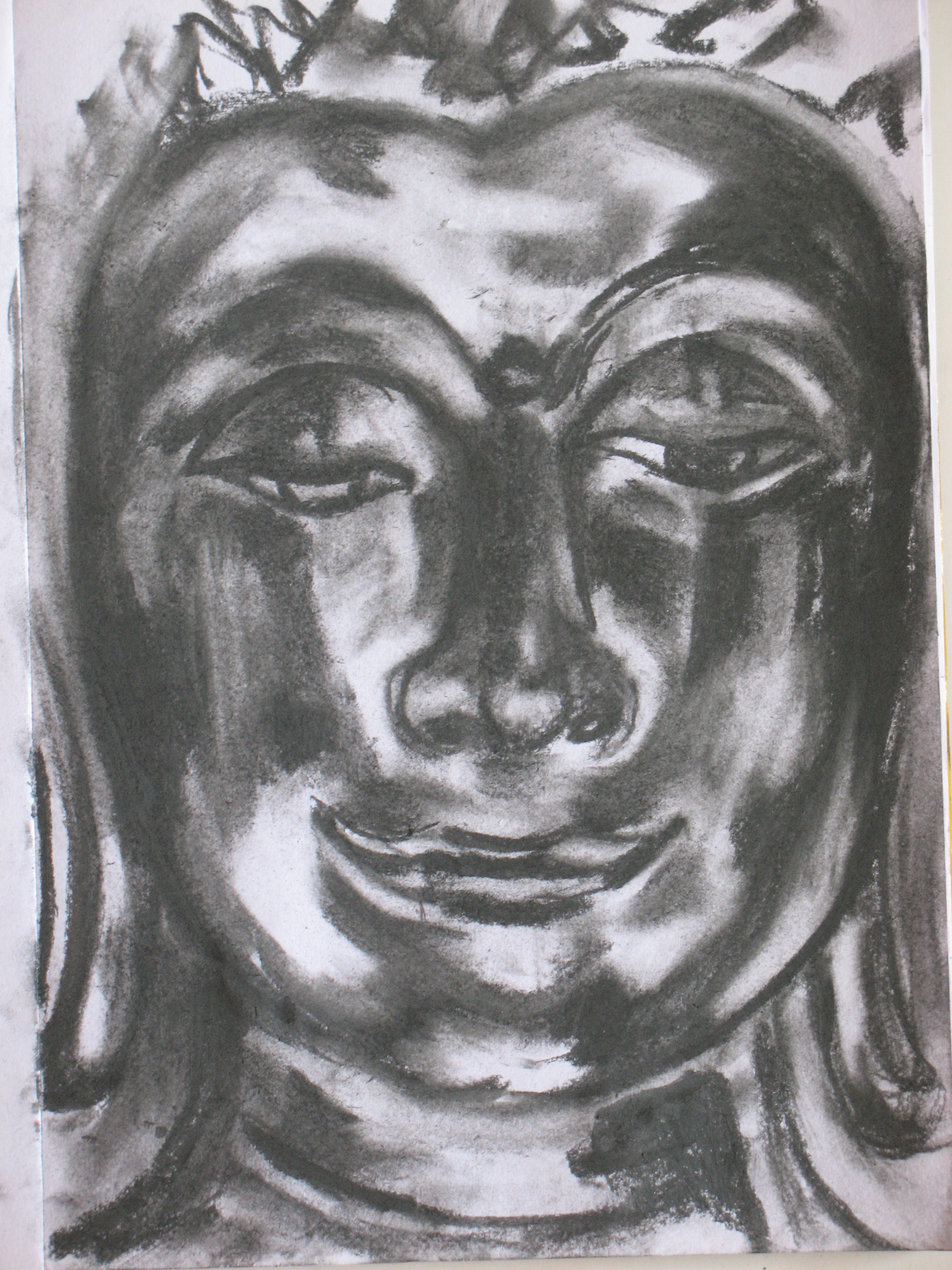
Picture: The lovely image here is also by Colin. His partner’s father, a wonderful man, passed away last year and after the five days of ceremonies at the local temple, Colin presented this magnificent work to the head monk, where it was very warmly received.