In his post a few days ago, Joseph relayed the story of a monk who died in the Jiri Mountains (A glimpse). It highlighted two critical truths, namely, that we are not our bodies, and the importance of how we use our minds.
In Chapter 2 of No River to Cross, Daehaeng Kun Sunim also covers these points:
Even after your body falls away, your consciousness remains. It often happens that people do not understand that their body does not exist anymore, and they do not realize that living people cannot see or hear them. So, sometimes, in their confusion and desire, they cause other people to suffer. If you sincerely cultivate mind while you have a body, then you can leave without having any attachments. However, if you don’t practice, then even though you’re dead, you’ll be caught up in all of your old relationships, and won’t be able to freely leave. Instead, you may just wander around, stuck in that state for a very long time. When people die, if they have never practiced spiritual cultivation, their consciousness cannot see and cannot hear. In the middle of the darkness, their consciousness cannot correctly perceive things, so those people may (accidently) enter the womb of a pig or a magpie. However, people who have cultivated mind give off a great light and thoroughly illuminate their surroundings. Even their families tend to live brightly, although individually they may not know anything about spiritual practice. (p 20-21)
Have you ever gotten caught up in a dream about walking through a building that no longer exists? Those steps you were walking up are now only empty sky a hundred feet off the ground. After we die, we no longer have physical senses, so with what are we seeing and hearing? If we haven’t practiced while alive, then we’re only experiencing the arising of karmic states of consciousness. However, we think those things are really happening, and so chase or flee them. In essence, we’re running outdoors at full speed, while blindfolded.
Thus, how we use our minds while alive is critically important to us.
In order to be born as a human being, it may have taken a thousand years of accumulated virtue and merit. It’s so hard to become a human being. Nevertheless, if you don’t let go of the habits you developed prior to becoming a human being, and if you think of only yourself, your suffering will be endless. If you live this way, you may live like this for many, many lives, stuck like a hamster on a wheel, unable to evolve. Or you may devolve and be reborn as an animal. Once you are reborn as an animal, you will suffer a lot, having to eat others or be eaten. There will be very little opportunity to reflect upon your state, and if you develop the habits of an animal, it will be even more difficult to free yourself from that state, even over billions of eons. (p 19)
We go where we look. Or in this case, where we think.
Once the level of mind changes, the body also changes accordingly. Evolution is the process of the mind becoming brighter, while creation is the outward manifestation of the minds design. Thus, while this process is evolution, it is also creation.
Mind is the basis of both evolution and devolution; they aren’t separate forces. Devolution is also done by mind. All of this is the manifestation of our fundamental mind (and how we use it.) (p 22)

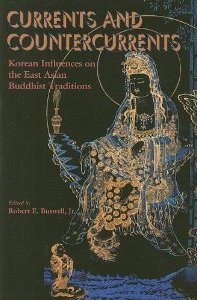



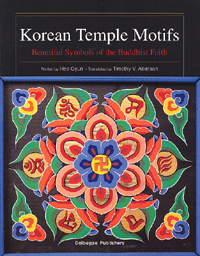

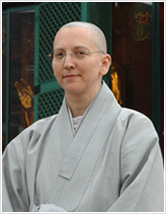

 The next time I met the Venerable Namgyal Rinpoche, I told him about this, and he said that I should consider becoming ordained, which meant going to Asia, as there was no monastic community in Canada. But after so many years of university study, I had almost no money. One day, a small ad in the newspaper caught my eye: “Teach English in Asia, no experience necessary, free air ticket, room and board”. So I got a job as an English instructor in Korea, not because of Korean Buddhism, which I had never heard of, but because of the free ticket to Asia. My idea was to save a little money and travel around Asia exploring the options for Buddhist study and ordination. However, not long after I arrived, I met some Korean nuns and was impressed with their dedication, their independence and the wonderful opportunities for study and practice. I found the Korean Seon tradition very clear and straightforward as well. That was in the spring of 1998, and I’ve been here ever since.