Wonhyo Sunim – Inspiring yourself to practice

Inspiring Yourself to Practice
             By the Korean Zen Master Wonhyo 

This English translation and introduction were done by Won-myong Sunim and Mark Mueller 


Inspiring Yourself to Practice was written by the Silla Monk Wonhyo (617-686). It consists of 706 characters, contained in one roll. In Korea, the text is one of the most important in the curriculum of the temple training. The text stresses the need to dissolve one’s worldly attachments and habits, and to begin immediately to practice. The original Chinese text is kept at Haein Temple, near Daegu, and the annotated version is kept at Songgwang Temple, in Sunchon. 

The twin pagodas at Kamun Temple site
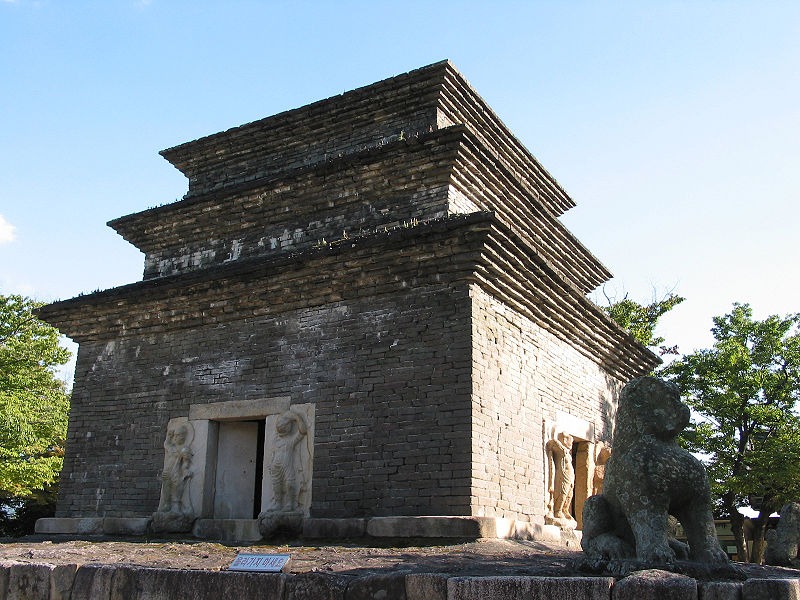
The stone pagoda from Bunhwang Temple, historically associated with Wonhyo. Photo by bifyu, on Wikipedia
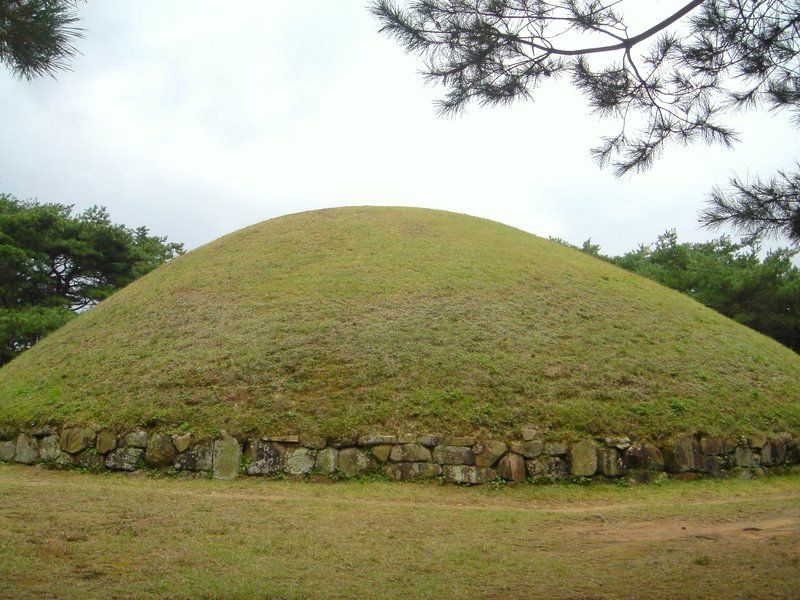
The grave of the Queen Seondeok (/sun-duck/). She was the ruler of the Silla Kingdom and known to Wonhyo

All the Buddhas
who reside within the splendid realm of Nirvana
have, throughout countless eons,
discarded their desires and undergone arduous training.
 

Sentient beings,
transmigrating within
the burning house of desire
have, for countless generations,
failed to discard their greed and desire. 

The gates to heaven (the Pure Land)
are not blocked;
yet, few are those who enter them.
This is because most people make their home
among the three poisons. (1) 

 The evil realms (2)
have no real power to seduce us,
yet many enter them.
The deluded mind values
the four elements (3) that make up the body
and the five desires (4)
as if they were jewels.

This being so,
is there anyone who does not long
to retire to the seclusion of the mountains
in order to practice the Way? (5) 

Yet people do not go there;
they remain caught up in desire. 

Although you do not
retire to the mountains
to cultivate your mind,
you should strive with all your energy
to perform good deeds. 

If you can renounce your own pleasure,
you will become as trusted and respected
as the sages. 

If you can undergo
that which is difficult,
you will become as respected
as the Buddha. 

Those who greedily seek after things
join the ranks of demons.
Those who give with compassion
are the disciples of the Dharma King. 

High mountains and lofty peaks
are where the wise reside.
Green pines and deep mountain valleys
are home to those who practice.
When hungry, such people pick fruit from trees
to calm their empty stomach.
When thirsty, they quench their thirst
with water from a stream. 

Although we eat fine foods
in an attempt to carefully preserve this body,
our bodies will definitely face destruction;
even though we cover this body
with soft cloth,
our lives are sure to come to an end. 

Make a small mountain cave where echoes resound
into a hall to chant the Buddha’s name.
Let the sad cry of a wild goose
be the heart-warming call of a friend. 

While bowing, your knees may become
as cold as ice,
but you must not long for a warm fire.
Your stomach may writhe with hunger,
but you must not give in to your thoughts of food. 

One hundred years pass like the blinking of an eye,
so why don’t you practice?
How long is a lifetime?
Can you afford to neglect practice,
wasting your time on leisure? 

It is only he who renounces
all of the desires in his heart
that is rightfully called a practicing monk.
Only he who no longer yearns for the ways of the world
is called “a monk who has renounced the house-holder’s life.” 

A practitioner who is caught
within the net of worldly desires
is like a dog who wears
elephant’s hide.
A man who practices the Way
yet remains attached to worldly desire
is like a hedgehog
who tries to enter a rat hole. 

Some people, in spite of their outstanding ability and wisdom,
choose to live in the busy atmosphere of the city.
All the Buddhas feel pity and concern for such people.
other people, although they have not yet developed
a deep practice,
choose to stay in the contemplative atmosphere of the mountains.
The sages feel a great joy
when they see such people. 

There are those who are skilled and learned,
but do not follow the precepts.
They are like men who are told of a cache of jewels
but do not get up and go to it. 

There are those who practice steadfastly
but lack wisdom.
They are like men who want to go east
but mistakenly walk towards the west. 

The actions of a wise man
are like steaming grains of rice
in order to make a bowl of rice.
The actions of a man who lacks wisdom
are like steaming grains of sand
in order to make a bowl of rice.
Everyone knows how to eat and drink
in order to satiate their hunger;
but no one seems to understand
the method of training —
the way to transform the ignorant mind. 

Practice and wisdom must exist side by side.
For they are like the two wheels of a cart.
Likewise, helping oneself and helping others
are like the two wings of a bird.
If you absent-mindedly chant for your donors
over the morning offering of porridge
without understanding the meaning,
you should feel ashamed
to face those who give alms. 

If you chant
during the lunch-time ceremony
without attaining the essence of the words you utter,
won’t you be ashamed to face
great people and sages? 

Everyone hates squirming insects
and those who can’t distinguish between the dirty and the clean.
Likewise, the sages feel disgust with those monks
who cannot distinguish between the defiled and the pure.
If you wish to be through with this world’s conflict,
good conduct is the ladder
that ascends to heaven. 

Therefore, one who violates the precepts
and yet wishes to help others
is like a bird with broken wings
that puts a turtle on its back and tries to fly. 

If you’re still not free from your own faults,
you will not be able to free others of their faults.
So why do you, who violate the precepts
receive that which is provided by others? 

It does not benefit you in the least
to merely maintain your physical body
if you neglect to practice.
And all your concern for this transient, fleeting life
will not preserve it. 

If you’ve set your sights
on the virtue of the great masters,
you must endure even the longest hardships.
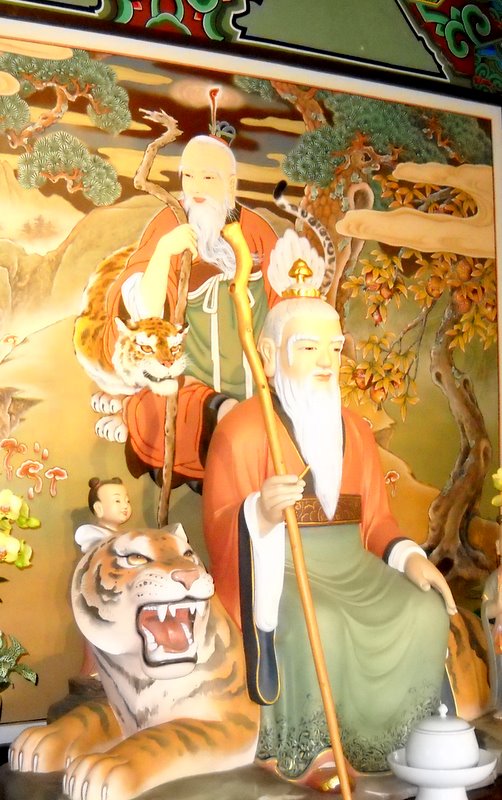
Once you’ve set out for the Tiger Throne, (6)
you must forever leave all your desires behind you. 

When the cultivator’s mind is pure,
all the devas (7) bow in praise of him.
When a follower of the Way loves lasciviousness,
the good spirits leave him. 

At death, when the four elements of the body scatter,
you cannot preserve the body and remain in it any longer.
Today, evening has already arrived;
tomorrow morning will soon be here.
So, practice now before it is too late. 

Worldly pleasures are unsatisfactory;
why do you greedily cling to them?
Enduring joy can be won through a single effort in patience;
why won’t you practice? 

Those who practice feel shame
to see a seeker of the Way who remains attached to greed.
The virtuous man laughs
at the seeker who forsakes the householder’s life
but is still wealthy. 

Words, such as these written here, go on and on,
yet clinging attachment does not come to an end.
“I’ll do it next time” — such words go on and on,
yet you fail to put an end to clinging.
Clinging goes on and on,
yet you fail to renounce worldly matters.
Your mind is filled with endless devious plans,
yet you do not make up your mind to put an end to them.
“Today will be different,” you say,
yet you continue to perform evil actions every day.
“Tomorrow, tomorrow,” you say,
yet few are the days when you really do something good.
“This year will be different,” you say,
yet your defilements are without end.
“Next year I’ll do it,” you say,
yet you don’t grow in wisdom. 

The hours pass,
snd too soon a day and night are over.
The days pass,
and soon it’s the last day of the month.
The months pass,
and suddenly another new year has come.
The years pass,
and in the blinking of an eye,
we find ourselves at death’s door. 

A broken cart
cannot be driven.
When you’re an old man,
you cannot begin to practice.
When you lie down,
you will succumb to laziness.
And when you sit,
your mind will be overwhelmed
with stray thoughts. 

 For many lifetimes, you have failed to practice,
passing your days and nights in vain.
Having lived many lifetimes in vain,
will you again fail to practice during this lifetime? 

This body will inevitably come to an end;
who knows what body you will have next time? 

Isn’t this an urgent matter?
Isn’t this an urgent matter? 

N o t e s
==============
1. Greed, hatred (anger) andignorance.
2. Durgati, the hell realm, the animal realm, etc.; there are 3, 4, or 5 according to text consulted.
3. Earth, water, fire and air are the four elements that everything is made of.
4. There are two meanings: 1) the objects of the 5 senses (eye, ear, nose, mouth, body); these defile the True Nature when the mind is filled with desire;  2) desire for wealth, sex, food, fame, and sleep.
5. The Way refers to the path to enlightenment.
6. This is a name for the Dharma Seat, the special platform that a great monk sits on to give a Dharma lecture. Someone aiming to sit on this seat is aiming for enlightenment and so needs to give up all attachments and desires.
7. The devas are the beings who live in the Heavenly realms.

the oppression of rules, and a bit of silliness

Karmic affinity probably plays a role, but when I was first starting out, I was never attracted to the Theravadan tradition.

In large part this was due to what I perceived as the strong, perhaps extreme, focus on the 250 precepts for monks (and 348 for nuns.) If I had to keep all of those straight in my head, I imagined that each and every day would be occupied with worries about which shoe I put on first, and whether I was holding my bowl in the right hand.

Well, I’ve since learned that it’s a lot more simple than that.
Basically, the precepts are there to help practitioners gather energy and motivation in their practice.

To this end, the situations they address fall into several categories:

1) avoiding things that will create karmic hindrances or damage our energy and faith

2) avoiding things that cause us stress and worry

3) not putting ourselves in the path of temptation

4) not creating the appearance of wrong doing

5) the appropriate situations for teaching the Dharma

6) rules to help a large community live together harmoniously
(there’s one or two more categories that I can’t remember just now!)

The additional rules for nuns basically address their safety in an era when an unescorted female was assumed to be a prostitute, and could be treated as such.

Also for nuns, it’s important to remember who the first nuns were:  they were from the noble classes, and were the family members of the Buddha and his great disciples. So when the Buddha said that an 80 year old nun had to bow to a 3 year old monk, these are the women he was addressing. It’s as if he was saying “your family status and connections with the leaders of the sangha don’t count here.” 
       I smile when I think of what might have happened otherwise: “Ananda! Come here and give your Auntie a shoulder rub!”  🙂 
o

p

Now for a bit of unrelated silliness:

Haein Temple to the Jiri Mountains

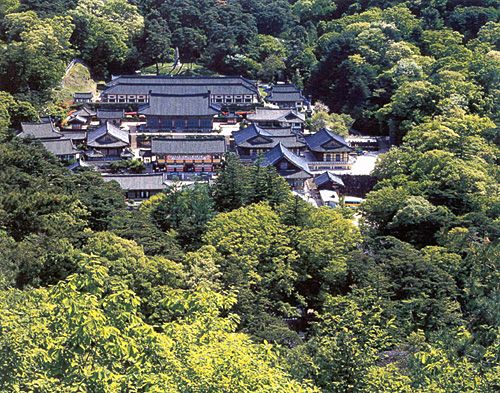
Haein Temple

Traveling towards the Jiri Mountains, I had spent the last few nights at Haein Temple, but was down to my last six or seven thousand Won. (It would have been about eight US dollars in those days.) I’d wanted to travel like the monks of old, going where circumstances took me. So I left without taking any extra money, determined to rely upon the kindness of the sunims at the temples I visited. Normally this isn’t a problem; visiting monks are traditionally given traveling money to take them to their next destination. In practice, it’s always more than enough, usually at least 30,000 Won (about thirty U.S. dollars), and often more. 

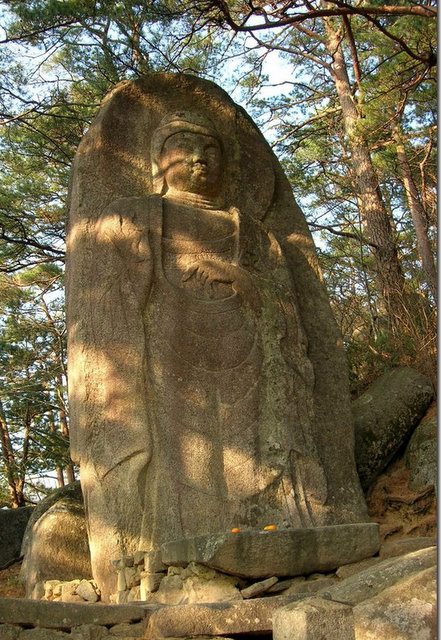
Standing Buddha on the mountain behind Haein Temple

However, upon leaving Haein Temple, I had been given nothing. In addition, while staying there, I’d been put in a dark, dirty room behind the kitchen and told to be careful that none of my personal belongings were stolen. (After thoroughly cleaning the room) I spent a few days at Haein Temple, paying my respects to the great wood-block collection of the Buddhist canon and attending most of the daily ceremonies. After the morning cleaning, I would hike the mountains behind the temple, and meditate before the huge rock carvings of Buddha. (This photo is from here, with thanks to the photographer.) 

But for some reason, the wonju sunim (the monk in charge of guests and shopping) seemed to take a strong dislike to me. On top of this, when I left, I was given no traveling money. It was such a contrast to my previous visits to Haein Temple that I was in foul mood as I headed for the valley’s entrance. With almost nothing in my pocket, I barely noticed the lotus lanterns stretching for miles along the road, or the beautiful spring flowers on the fruit trees. Anger really makes a fool out of me. 

Arriving at the bus stop on the main road, I went over to the small police station to ask for directions to a major temple in the Jiri Mountains called Hwaeom Temple. I suspected there might not be a direct bus, but I would be able to take a connecting bus from the nearest city. Bus fare in Korea is very cheap, and with what money I had, I might just make it if I stuck to the local buses. 

Strangely enough, the policeman didn’t know which city I needed to go to, nor did he even have a road map of Korea. I had started out the morning irritated and was rapidly progressing to downright angry. “How could this be?! A policeman who doesn’t know the cities in the area or even have a road map?! And what’s with that jerk at the temple treating visiting sunims so badly?!” Anger really makes a fool out of me. 

I knew I needed a bus going west, so as I stewed, I sat and waited. But part of me knew this anger was wrong. No matter how reasonable all of those justifications and descriptions, there was something fundamentally wrong with that anger and self-righteousness. I tried to let go of it, but I just couldn’t shake it. Finally I remembered what my teacher often said about aggressively entrusting the things that confront us. Determined to experiment with what she told us, I said “Okay Juingong, you’re taking care of all things, so take care of this anger too! I don’t want to carry this around any longer.” (“Juingong” is synonymous with true nature or Buddha-nature, and literally means the one that is truly doing things, but which has no fixed form.) I was still grumpy, but it seemed to help a bit. 

A few minutes later the bus came, but flew right past the bus stop. My body bolted up and I found myself shaking my fist at the bus. The driver, seeing me in the side mirror I suppose, hit the brakes and came to a squealing stop about 50 meters past the bus stop.   

I was still pretty hot, but managed to grunt thanks as I paid my fare and found a seat. A few kilometers further on, the road passed through some rice fields. Here the road bed was raised about two meters above the fields, with only about 30 centimeters of grassy shoulder on each side. Just ahead of us, a farmer had parked his car in our lane while he checked on something in a field. The only way around was for the bus to go into the oncoming lane. But as the bus barreled ahead towards the parked car, there was a car coming towards us in the oncoming lane. It was as if our driver didn’t realize that the car ahead was parked, and that he wouldn’t be able to go around it because of the oncoming car. We were closing fast on the car blocking our lane, and the oncoming car wasn’t slowing down either. In a moment two cars and a bus would be trying to occupy the same time and place. At the last instant, the oncoming driver seemed to realize that our bus had no intention of stopping behind the parked car. He slammed on his brakes as our driver wrenched the bus into the oncoming lane, passed the parked car, and then veered back again. 

It took me a minute to remember to breathe, but as I did, I noticed that our driver’s head was rolling from side to side. Now his left ear would almost be touching his left shoulder, now with a violent jerk his head would swing up, and a moment later be almost on his right shoulder, and then back again. Seeing his bright red face in the mirror, I realized that he was drunk. Not just tipsy, but a full three sheets to the wind drunk. 

My first thought was to get off at the next stop. But before I had a chance to, I remembered something I’d heard Daehaeng Sunim say about a plane crash, “This may be hard to believe, but if even one person on that plane had been practicing, it wouldn’t have crashed.” Ugh. 

I stayed on the bus, and focused on entrusting the situation, and my fear(!), to this Buddha-nature that connects and guides all things. Finally the bus reached the terminal in the city of Geochang, and the driver got off. As I watched him head for the break room to sleep it off, I ran into a friend I hadn’t seen in several years. He was living at a large meditation hall, Sudo Hermitage, about an hour away, and invited me to stay there. Later that night, as I settled in and prepared to spend a few days, I suddenly remembered about having been angry earlier in the day. 

The meditation hall at Sudo Hermitage. Photo by Chang, Dong Yeon

I couldn’t help laughing out loud, because with that terrifying bus ride, all of the anger I’d felt earlier in the day was utterly forgotten. I had raised the thought that I wanted to be free of that anger, and it had worked! By the time I got off that bus I had completely forgotten about being angry. I laughed again and thought to myself, “Be careful what you ask for!”

Occupying the same time and place as others

There’s an odd fact about non-duality, for while we each have our separate roles and appearances, we also share a common connection. Obviously this isn’t a physical connection, but it’s there nonetheless, and we can experiment with it and try to apply it to our daily life.

Jeanne, (with the Third Eye her students gave her)

I’d like to ask our readers help with something. Right now, there is a very sweet Buddhist blogger suffering from severe kidney failure. Her name is Jeanne, but she’s more commonly known as the Dalai Grandma.

Please experiment with sending her love and energy, clarity of awareness, peace, and perhaps even that her kidneys should regain more of their normal function.
       Whatever speaks to you, try and offer that. Raise that thought clearly, and then let it dissolve back into you and sink down heavily within you.

Daehaeng Kun Sunim sometimes describes our fundamental mind as a communications center; if we correctly input something into it, that input is communicated through this unseen connection. Or like an electric light, when the circuit is completed, energy freely flows back and forth. 

Because this isn’t a physical connection there is no physical limitation to this energy. The saying “there’s no near or far in the Buddha-dharma” isn’t just a philosophical statement.
 
     Let’s experiment with this and see what we can do to dissolve a bit of this world’s suffering.

Thank you,
Chong Go

Saving others, saving ourselves – part 2

Here’s one of my favorite folk tales from Korea, with a deep message about life and practice.

     A traveler had spent the night at a guest house deep in the mountains of Korea. He was eager to start out early the next day and get across the mountain range before dark. There was a little snow falling that morning, but it looked as if it would soon stop. As he was getting ready to leave, one of the other guests mentioned that he was going the same way, so they decided to travel together.

     They started up the mountains, and made good progress for a while. However, instead of stopping, the snow seemed to be increasing. By late in the afternoon the snow was getting deep and they were still far from the next village. It was about this time that they came across a man who had collapsed in the snow, apparently from hypothermia.
    The traveler started helping the man up, rubbing his arms and legs, trying to get some life back into him, “Come on,” he said to the other man, “give me a hand getting this guy up on my back. If we take turns, we should be able to get him down the mountain.”
    “Leave him. Carrying him will take too much effort, and he’ll slow us down. We’d better get to the next village, or we’ll be done for as well.”
    “Well, we can’t just leave him here to die.”
    “If you want to kill yourself looking after him, that’s your business. As for me, I’m getting out of here!” With this, the second man took off into the snowstorm.

     There were a few times the traveler wondered if he wasn’t being a fool. But he struggled on through the night with the man on his back. Finally, just after dawn he staggered into a village. 


     Later, he found out that the other man he started out with hadn’t yet arrived, nor was that man ever seen again. It turns out that in trying to save the man who collapsed, the traveler had saved his own life. For in that bitter snowstorm, carrying that man on his back had protected both men’s body heat from the wind and cold, while the effort he made had helped warm them both.
      Ultimately, the one who had focused on his life alone, lost his life. And the one who had been concerned with others, saved his life.

And if you believe that this Earth, this middle realm, functions to sort beings into higher or lower realms, the traveler gained much more than merely his life.

to the bones

Here’s a song that really touches me. It’s by Johnny Cash, near the end of his life.
It reminds me of the great love he had for his best friend, June, and how hard he was trying to hold to what’s true.

There’s a line or two in this song that I don’t really connect with, but overall this video has such a sense sincerity that after watching it, the usual background noise of whining and petty thoughts seems to fall away.

In saving others, we save ourselves

This is one of my all-time favorite cartoons; in English it’s published in “Zen Speaks,” by Tsai Chih Chung.*  This is from the original Taiwanese edition.
 

“One day, the Buddha Shakyamuni was meditating when he heard the sounds of beings crying out in great pain. As he looked throughout all realms, he saw that the cries were coming from a hell realm.

There, one man in particular was begging him for help.o

o

o

o

o

Using his sublime abilities, the Buddha looked into the man’s past:

He’d been an infamous brigand, for whom no deed was too evil.

“Alas,” thought the Buddha, “did he do no good?”

o

o

o

o

o

ooo

 o

oThere had been one time, after robbing a village, that he made an effort to avoid stepping on a spider.

o

o

o
 o

o

o

o

o

o
 

“So,” thought the Buddha, “let the spider save him now.”

o


o

o

o

With this the spider sent a single strand of silk down into the depths of hell.

o

o

o

The man grabbed ahold and began climbing out. However, everyone else was also trying to climb up that single strand.

“Hey! This is mine! Get lost!” And he cut the thread below him, dropping all those other people back into hell.

o

o


o


  However, in the next moment, the thread just above him broke, almost as if some hand, perhaps his hand, had reached down and cut it.


o

o

o

o

o


There’s no saving myself alone.
Only by including others, can I be saved.


* Tsai Chih Chung is a gifted artist, and an incredible interpreter of the Chinese classic texts of wisdom. If you were ever the least bit curious about the great philosophers of China, check out his books.

Behold, I am become Mara, destroyer of worlds*

A few days ago Barry from Oxherding commented on a verse of the Dhammapada (at Without Bounds) about the influence of Mara, otherwise known as the King of demons:

The one who lives for sensation,
Indulgent in eating,
Lazy, and lacking in energy,
The tempter Mara, breaks,
Just as the wind breaks a frail tree.**

 
I read this as a warning, that if I live without any self-restraint, I’ll eventually succumb to some temptation or situation that will break me (physically or spiritually).

 However, to Barry, it felt like something was missing: 
“…none of these translations really gets to the key point for me. That point is: To indulge in the pleasurable *is* to be overcome by Mara. Even that doesn’t feel quite right. Perhaps it’s not so much that Mara overcomes, as that we *become* Mara, our inherent Mara-nature co-arises with indulgence.”

Becoming the destroyer of worlds

This is a great point, because it feels like once I succumb to temptation, I am Mara.  I’m the one occupying that unwise thought or action, though there may be some disquiet telling me something’s wrong. You’ve probably heard the joke, “it seemed like a good idea at the time”? Sometimes it’s not so funny.

To be overcome by delusion — to succumb to Mara — is to be doing or thinking something that seems good, right, and pleasureable, and yet is unhealthy for myself, society, and the planet. At that moment, I am Mara, destroyer of worlds. While thinking I’m doing something good, I’m destroying the enviornment, other’s lives, and my own life.

 To be lost in ignorance,
mistaking delusion for truth,
the unhealthy for the healthy,
how to take even one step forward?

 
So, for me, the key question is how do we step back from this Mara-nature when we’re in the middle of it?  What do we do when we can’t be sure about which way is up and which is down, about what is good and what isn’t?

The only reliable method for me, is to let go of everything:
To let go of the things I don’t know, as well as what I know (which is probably incomplete, or incorrect), and to entrust it all to this bright, inherent Buddha-nature that we all have.

Daehaeng Kun Sunim often compares this true nature to a smelting furnace: it burns away all impurities, and what comes out the other side is pure gold. All I can do is entrust it with what I know, and what I don’t know, and go forward with empty hands, trusting in this empty place that is the source of everything.

This is what works for me, (although I’m not always successful at implimentation.)
What works for you? How do you recover from an incarnation as Mara?

with palms together,
Chong Go


–A bit beside the point, but still important, is the question “what is this Mara-nature?”

Obviously, any good Buddhist is going to know there’s no such fixed entity out there. (right? ;-)) In Korean Buddhism, there is the concept of “karmic consciousnesses,” that is, karmic states of consciousness, or echos of states of mind. When these return to us, they come out through our brains, our awareness, and so we identify with that feeling. “I’m the one who feels that.” Instead, it helps a bit if we realize this is just a karmic echo occupying the same time and place as us, much like a fart in the room. “That’s not me, that’s just here at the same time, and if I wait a bit, it will pass.”

*The actual quote, paraphrased by Robert Oppenheimer as he witnessed the first  atomic bomb, is “Behold, I am become Shiva, Destroyer of worlds.”

**This is from my favorite translation of the Dhammapada, by Balangoda Ananda Maitreya

Just a sunny day

It’s a sunny day here in Korea, and about 32 Celcius. Here are some photos of the main Hanmaum Seon Center, in Anyang City.

Sunrise, a little before 5am
The Gujeong Pagoda, which Marcus mentioned
courtyard wall
persimmons - all the detail is carved from clay bricks

hiking path behind the center
welcome home!

A True Human Being

The following is the short Dharma talk by Daehaeng Kun Sunim that Marcus mentioned in the previous post.  
 
A True Human Being

Our true mind is a great brightness that can lead us all.
This one mind, this one point
is the foundation of the Earth,
the foundation of the sun,
and the foundation of the universe.
With perfect wisdom it accepts everything and responds accordingly.
It is brightness itself,
what could possibly hinder it? 


Although this brightness is in everything,
people create divisions and labels,
and then let those rule their lives.
How could they not be hindered
and oppressed in all the things they do?


A true person is the same as a Buddha.
However, let go of even the desire to become such a person,
as well as the fear of not achieving this,
instead, take everything that arises from this empty place,
your inherent foundation,
and return it to this empty place.
If you entrust it there with sincere faith,
and are relentless about this,
then from that place, your true mind will reveal itself.
 

In this true mind,
a Buddha’s mind and an unenlightened being’s mind
are not separate,
there’s no clean or dirty, high or low,
nor the least hint of “I did” or “I know.”
This true mind,
this completely empty bowl,
manifests every instant,
and brightly shines upon all,
with hands that aren’t hands, feet that aren’t feet,
on the path that isn’t a path.
This is the mind of a true human being.
 
–Daehaeng Kun Sunim 


copyright 2010, the Hanmaum Seonwon Foundation