The future of Buddhism in the West

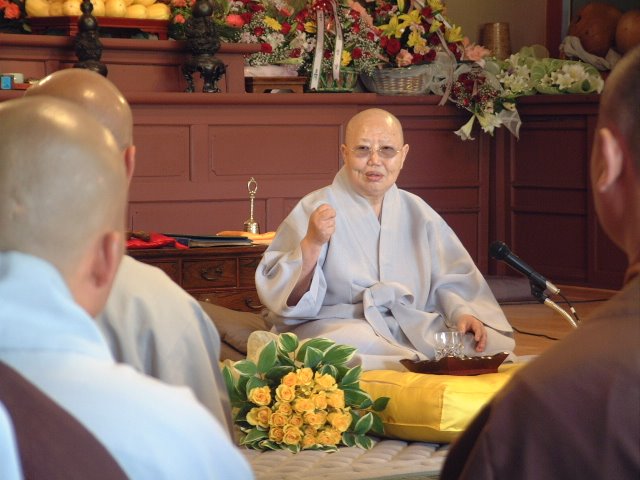
Here’s a talk by the Korean Seon Master, Hanam Sunim, given in 1935.* It’s a wonderful talk for anyone interested in growth and sprititual practice, and is also very relevant to everyone interested in seeing Buddhism flourish in the West.
 

Buddhism Exists in Experiencing and Applying

Hanam Sunim next to the Manjusri Statue at Woljong Temple

Thank you for coming such a long way to see me.

If you want to see Buddhism prosper, then experiencing and applying are the most important thing. There is a saying, “Cultivating mind isn’t done with the mouth.” Like this, modern people have an incredible amount of things that they’ve learned, but they don’t seem to be so good at actually applying and experiencing them.

People who practice sitting meditation should practice sitting meditation, those who study the sutras should study the sutras, those who practice chanting should practice chanting. If each one upholds their own practice very sincerely and diligently, then regardless of whether they are in the deep mountains or in the cities, regardless of whether many people are interested or just a few, there will always be people who want to learn and help. At this stage, you can truly be called a disciple of the Buddha. If, little by little, people put the things they experience and understand into practice, one person will become two people, two people will become three and so forth. Thus there’s no need to worry about whether Buddhism will prosper or not. In the not-to-distant future, I expect that there will be many people truly practicing Buddhism, and that Buddhism will flower throughout the Korean Peninsula.

I spoke about this before, but you have to make up your mind, tie your belt tightly, and put your understanding into practice. If you do this, then without any lectures or advertising, Buddhism will naturally prosper and spread. As you know, everyone has Buddha-nature, thus it all depends upon making up your mind and making an effort. Anyone can become a follower of Buddhism. There’s no reason why Buddhism shouldn’t prosper. It is just that people are so busy these days that practice isn’t easy, and they often forget about it. However, if you can just remember (about spiritual practice), then it’s possible for you to apply and experience, wherever you are, whether you’re working, standing, or sitting.

Everything is like this. I spoke about seon a little before, but seon isn’t something that is beyond understanding. Just make up your mind to do it and put (what you’ve been taught) into practice. My opinions or explanations about the meaning of seon won’t help you a bit. The essence of seon is determination and application, and in so doing, it’s something that one comes to know automatically. The essence of seon can’t be taught or explained. My only wish is that you give rise to determination and experience it for yourselves.

You asked me about people worshipping at shrines for the mountain god or the big dipper within the temple grounds, but although people are praying or bowing out of a desire to obtain something, even that is a type of faith. It seems to me that faith in those kinds of spirit shrines can naturally grow to include the Buddha. Because Buddhism can include everything, it’s not a problem. While praying at the mountain god shrine or the big dipper shrine, they may gradually develop faith in the teachings of the Buddha.

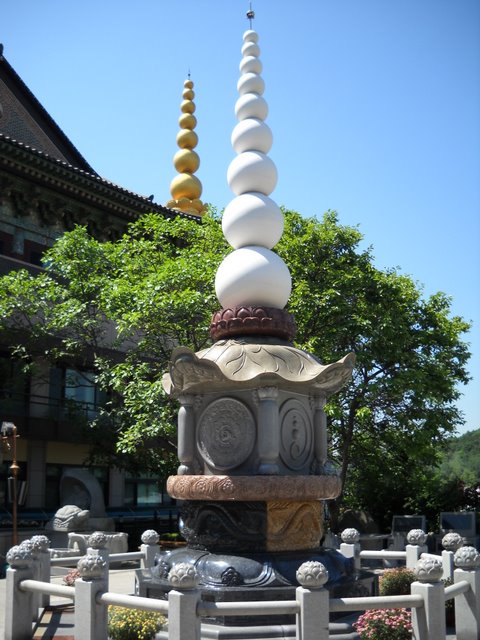
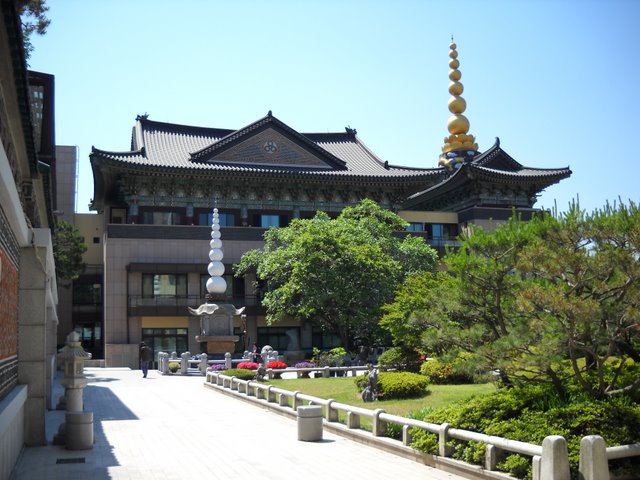
Manjusri and the 9-story pagoda at Woljong Temple

     I’ve rambled on, but the main point I can’t emphasize enough is that we must practice and apply our understanding.

 
* Hanam (
han-am) Sunim (1876 – 1951) was one of the leading practitioners in Korea. He was a main  disciple of Kyongho Sunim, Dharma brother of Mangong Sunim, and was elected the spiritual head of Korean Buddhism three times. (He kept resigning!) In this article, he had been asked how the Japanese government could “help” Korean Buddhism (what they meant was “control”.)  He wasn’t fooled, and yet still gave a wonderful talk. This interview was published in Japanese in 1936, and a few introductory remarks have been deleted.

The toilet paper wars, and reincarnation

Although a great deal of planning had gone into the preparations for the 23-day training session that preceded our ordination, apparently no one had thought of toilet paper. Existing supplies were quickly depleted and there were no provisions for providing more. The initial response was not encouraging:  “Just use less.”
“Umm, excuse me,” I wanted to say, “there is a certain, absolute minimum….”

Even eating just two meals a day, 150 men will go through a lot of toilet paper over the course of 23 days. 

The logic of this was hard to avoid, and before long the overseers relented. Of course, their idea of relenting amounted to a single roll in each bathroom. Its appearance on the window ledge would provoke a frenzy resembling a stock market panic, with everyone rushing to secure a couple of arm lengths of insurance. Latecomers were left with a choice between the empty cardboard tube or the shiny wrapping paper. 


For the next few days, everyone was walking around with at least one pocket stuffed full of toilet paper. Finally the overseers caved, and with a flood of heavenly whiteness, the nagging fear of being caught short was forever banished


Reincarnation
    This video has been making the rounds , and I thought I’d post it here for anyone who hasn’t seen it yet. The speaker is Wallace McRae, perhaps America’s greatest cowboy poet.

What will you rely upon: Raising up teachers

One of the things I’ve noticed about spiritual practice is the urge to see someone else as a perfect or enlightened practitioner.  But this has terrible consequences.

 I’m not sure where this desire comes from. Is it simply that they show our goal is possible? Or is it more insidious: that he or she is perfect, and so will take care of us.  Perhaps it’s wanting to see something divine, something other than this ordinary, human realm.  Or perhaps it’s a form of laziness, of subtly wanting someone else to do the work for me.

An odd thing I’ve noticed is that every time I try to say “He (or she) is a great practitioner,” they invariably disappoint me.  Why is this? Well, my judgement might not be very good….^^ However, I think it’s not that they failed me or betrayed me, but rather they and their qualities are not where I’m going to find my liberation. I’m looking in the wrong place, and what I need just can’t be found there. I have to do the work myself, and learn to discover and rely upon the divinity that has always been a fundamental part of myself.

“You will not fail to go unpunished”

I don’t remember where I heard this phrase, but I often think of it when I see a situation where it looks like people are abandoning their own, upright center.  I’m reminded of this when I think of the series of scandals American Zen centers experienced some years ago.  Looking back now, I think there were several contributing factors.

One was that people were given major teaching roles after only a few years of practice. Ordinarily this might not have been a huge problem, but it was also coupled with the idea that the teacher was infallible. This to me is where the real disaster started. It’s bad enough when the students are looking to put someone on a pedestal, but when the teacher is also encouraging it, look out. A more experienced teacher would, hopefully, have avoided this ego trap.

Another huge risk factor is when sustaining the center or lineage becomes too important. Corners get cut and people are kept around who normally wouldn’t have been. Chillingly, an Irish friend told me this is exactly what happened with the Catholic Church.

What is a teacher? 
 
Daehaeng Kun Sunim once said that taking refuge in the Sangha doesn’t mean blindly following teachers, monks, or nuns. She said you could take someone as a teacher when their words and actions all agreed, and were also consistent with your own good judgement.

A teacher is someone who got there first, or who is ahead of you on the path. And a realized teacher is someone who understands the pain of where you are, and wants to see you free and able to live for yourself. In my opinion, an awakened teacher never tries to foster dependencies. Things gather and separate according to their karmic affinity, according to where they are in their growth, so to try to force them beyond that is to invite disaster. This is something that all the great teachers I’ve met seem to understand.

That said, we can learn from everyone around us, those who are doing well, and those who aren’t behaving so well. The key to me is this upright center we are all part of. This is the thing that we must never abandon. While trying to be humble and uphold the precepts, we must always keep returning to this.

A tree lives by relying upon its root

To be frank, I really don’t like talking about others’ shortcomings. I’ve got enough of my own that I’m ashamed of, and which should be plenty to keep me busy. However, people interested in spiritual growth must absolutely be cautious about these points, so I’ve said a few words here. Please forgive me if I’ve misspoken.

with palms together,
Chong Go

Buddhism and Debt

Has anyone ever noticed anything in the teachings of Buddhism about the need to avoid financial debt?

There’s a great financial advisor in the US who really gives a lot of good practical and Biblical reasons to avoid debt, and I was wondering if there’s something similar in the Buddhist teachings. (He often brings up several quotes from the Bible, such as “The borrower is slave to the lender,” and “One who cosigns for another is stupid.”)

As a monk at a large center in Korea, debt is one of the three main reasons I see people coming here in crisis. (The other two are health and spiritual crisises).

My own teacher really comes down on debt as well, I suspect because of the suffering it causes. She doesn’t talk about it much, in part because avoiding stupid things may seem too obvious, and in part because most people may not want to listen.

 I’d like to know about any deeper, Dharmic connections related to debt that anyone may have heard of as well.

 The financial advisor I mentioned has a favorite saying “Broke, Desperate, and Stupid are three brothers that always hang out together. When one shows up, the others aren’t far behind.” From what I’ve observed that’s really true. Nearly all of the truly stupid (non-alcohol related) things I’ve seen have been a result of financial desperation.

with palms together,

Chong Go

Herding the Ox (Part 2)

(This is the second part of Daehaeng Kun Sunim’s version of the Tex Ox Herding verses. These are traditional verses that describe the progress of spiritual practice, with the ox symbolizing our inherent nature.)


6. Riding the Ox Home

As I ride the ox,
making my way home,
it turns out he already knows the way.
Sitting on his back
and playing the flute,
its harmonious melody goes far and wide.
Hearing this sound,
the villagers all come out to welcome me.


7.  Forgetting the Ox

At last the ox and I have returned home.
My mind is utterly at peace,
the ox too is resting,
and an auspicious light
fills the entire house.
This small, thatched-roof hut
knows no worry or suffering,
and at last I can lay down the whip and reins.


8. Myself and the Ox both Forgotten   

The whip and the rope,
even the ox and myself,
are all empty, gone without a trace.
Oh this sky, so wide and open
so vast and boundless.
There’s no place for even a single dust mote to settle.
How could I ever be ensnared again?
   

9. Returning to the Source 

 I’ve crossed over so many mountains
in order to return to this root.
Here is my true home
in appearance like the open sky
with nothing hindering it and nothing to be gotten rid of.
The waters of a stream just flowing,
the flowers so beautiful.


10. Returning to the Town

Although I’m wearing old rags,
there’s no sense of lack.
As I mix with the many people
on the streets and markets,
their suffering fades away,
and even dead trees come to life.
Such a deep valley,
yet the turbulent waters
cannot claim me.


Running Errands for the Dharma-realm

If you’re doing what the Universe needs done,
the Universe will support you.

Years ago I read this by the thinker and inventor R. Buckminster Fuller, and was really impressed.  He went on to say that if no support is forthcoming, you’re probably not working on what the Universe needs, and you need to change direction asap. 

My own teacher says something similar:

A practitioner is someone who is merely running errands for the Dharma-realm.

the all-reaching hands and feet of Buddha

I’ve found practicing like this has so many amazing aspects. One of the first is the feeling, the change in focus when I quietly ask, “What does the Dharma-realm need done?” 

Life also has a different feeling of worth when things are no longer about what “I” want, or just entertaining my desires. And I’ve found that when I’m making an effort to live like this, what I need seems to naturally appear.  [Need, not want :-)! ]

One of the effects of this is sometimes I’m called to do things or go places that don’t fit into “my” plans, or that “I” can’t stick an explanation onto. Sometimes I can later see why that was needed, but other times I still have no idea what was truly going on. Just that I met people I would never have met otherwise, or shared a kind word with someone I wouldn’t have encountered had things happened according “my” plans.

Of course, I have to be careful that I’m not just listening to my karma, (the precepts are real handy here!) but the analogy that comes to mind is water. You can’t make a hole in water for more than an instant, because the water all around it responds and fills in the hole. Likewise, you can’t pile up water, because where there is extra, it spreads out and automatically goes to places that need more.  I suspect that we also become like this as we learn to work on behalf of the whole, and dissolve the barriers of “I” and “mine” that imprison and cut us off.  With this wall gone (or at least weakened!), if we lack something it flows to us, and when we have extra, we naturally send it where there is lack.

working on behalf of the whole

doing what the Universe needs done

running errands for the Dharma-realm
 
These seem like such wonderful guides – please share your experiences!

Herding the Ox (part 1)

The Ten Ox Herding verses describe the process of uncovering our inherent, enlightened Buddha-nature, represented here by the ox. Variations of these are popular throughout East Asia as a way of describing the spiritual path. This translation is from Daehaeng Kun Sunim’s Korean version.  For Barry, at Ox Herding 🙂

 
1. Searching for the Ox
 
On plains that stretch forward without end,
pushing through the tall grass and brush,
looking for the ox.
Going here and there,
following a nameless river
and unknown paths deep into the mountains.
Utterly exhausted,
yet still no trace of the ox,
In the gathering dusk,
only the sounds of the crickets.


                                          2. Finding Tracks of the Ox

Suddenly,
on a river bank,
under a tree,
hoof prints of the ox!
And there,
under the sweetly flowing water,
an ox print clearly seen.
Stretching out before me
as plain as day,
hoof prints!
  
                                                                                         3. Glimpsing the Ox 

Somewhere a bird is singing.
Under the warm sun,
a peaceful breeze.
On the banks of the river,
the willow trees are brilliant green,
how could an ox hide here!
But look at that massive head,
and those wide horns.
What kind of strength will it take
to drag it back to the path?

4. Catching the Ox

It was a difficult fight,
but at last I’ve caught the ox.
So stubborn and willful,
its strength seemed endless,
like it could tear through mountains.
But at last the ox has come to a standstill.
Long accustomed to roaming here and there,
at last it has come to a stop.


5. Taming the ox

To tame this ox
requires a whip and some rope.
I tied the rope through its nose ring,
but still have to use the whip.
Otherwise the ox will rush about,
rolling in the mud,
or getting stuck in the marsh.
But when he’s tamed,
his gentle, true nature will show,
and he’ll follow me,
even without a nose ring.


(to be continued…)

Illuminating the Buddha Within

This is a short Dharma talk Daehaeng Kun Sunim gave for the Buddha’s Birthday.

We celebrate the Buddha’s Birthday every year,
but this year I feel strongly that we need to use this opportunity
to exert ourselves.

As you light lanterns this year,
and brighten and develop your mind,
think of the Buddha’s teachings, which showed us this path.
 

This life we cling to
lasts only for a season,
yet within an instant of our daily life
are all of the truths and principles
of the universe.

These are what we must awaken to;
this is what is truly urgent.
So don’t light lotus lanterns
trying to create
some small bit of good luck.

Lighting a lotus lantern reminds us that
our mind exists everywhere
throughout the universe,
and because you exist, others exist,
because others exist, everything exists.
 
This instant of our daily life,
where everything works together peacefully
to the extent we are harmonious,
shows us that, just as it is, light fills the world and
the Buddha is brightly present within each of us.

Each of you has the exact same Buddha-nature as Sakyamuni,
each of you was born in a Buddha realm and are being guided by the Buddha.
So just as the Buddha teaches us,
if you throw away “I,” if you throw away your egotism,
you can live brightly, free of suffering,
able to draw upon the unlimited ability within,
and send forth radiant energy.

Under the lotus lanterns

If you are continuously letting go of “I,”
if you’re truly living in the present moment,
the effects of a single thought
can reverberate
throughout the entire Dharma realm.
Living like this,
the true worth of life
becomes abundantly clear,
and as a disciple of the Buddha,
with gratitude towards the Buddha,
you can live freely, as a true human being,
able to take care of everything in creation. 

            –Daehaeng Kun Sunim

No Master Criminals Here

Tongdo Temple, one of the three treasures of Korean Buddhism

The Jogye Order had arranged for a professional nurse to be present during our 23-day ordination training session. A Buddhist nun herself, she had already probably saved the life of a male postulant. He had such a terrible cough I half wondered if he wasn’t there for some spiritual benefit that might come from dying as an ordained monk. Hearing him cough as she passed by, the nurse read the riot act to the overseers and had the trainee brought to her office, where she immediately started injections of antibiotics. By the time the training was over, his cough had almost completely disappeared.

           As time went on, she became concerned that some postulants weren’t getting enough calories. With over 1,000 full bows a day, and only two moderate meals, we were certainly going through the calories. On top of this, many of the men were already quite skinny when they arrived; I would have guessed that some had less than five percent body fat. Seeing this, the nurse began to surreptitiously give out food, usually pastries, chocolate, or bars of sweet, red bean-paste.  A trip to the nurse’s office became more and more popular!  Disappointingly, whenever I went, I was always escorted by one of the overseers. The result: no food for me. For which I was soon to be grateful.

             Sunims, I’ve noticed, are not particularly good at deception!

The hall where we had lectures, and did most of our bowing (photo by Jung Yeon)

Part of me, the one that spent my last year in high school trying to buy beer, shook my head in disapproval at seeing chocolate and bean-paste wrappers just sitting on top of the toilet wastebasket. “You have to hide the evidence better than that,” I wanted to tutor the unknown snacker.   The inevitable soon happened: A postulant was walking by the front doors, in front of everyone, eating a bean-paste snack. He walked right past an overseer, who twisted around so fast that he must have sprained something.             

        Within the hour, all 150 men were lined up with their grey backpacks in front of them. The overseers started with first person, thoroughly searching all of his belongings. We didn’t know what would happen to those caught with food, but we all knew it would be serious. Expulsion was a real possibility. But for all of the postulants’ incompetence at deception, the overseers had no better understanding of the sport. As four of them focused on the first few people, nobody was looking down the lines at the other postulants. At least a dozen of them were slipping pastries and other food out of their bag and down their pants legs where the material bugled out over their leggings. Further, while the overseers diligently checked the contents of pockets, it never occurred to them to actually frisk anyone.

             Disgraceful, I thought, as I stood there, with a rumbling stomach. I couldn’t help smiling though:  I suppose it speaks well of those choosing a spiritual path that they were so unpracticed in the ways of deception.

Dawn at Tongdo Temple. The pudo with the relics of Shakyamuni Buddha (photo by Jung Yeon)

Buddha’s Birthday parade

Here are some photos of the Buddha’s Birthday celebrations in Seoul on Sunday. It’s always amazing to see, and Korea feels like a crossroads of Buddhism. In addition to all of the Korean-flavored events, there were booths or floats from every Buddhist country, offering culture and information, food and art. These are a few pictures from the day, with some nice ones contributed by Joseph, of Somewhere in Dhamma.  Go ahead and click on the photos to see a larger image.

the street in front of Jogye Temple
Must be a convention somewhere!
playing a scaled-down version of a temple drum
Buddhists from Mongolia
Friendly folks! (by Joseph)
I really loved the horn section! (A great offering by the Tibetan monks of Korea)
Enthusiastic Nepalis! (by Joseph)
Make your own mini Lotus Lantern
or your own wrist mala
with beads for all ages!
or you could make your own incense (It was really good!)
sign me up!


Traditional Korean dance and music


A river of lanterns (by Joseph)
Watch out for the Dragon! (by Joseph)
Under the lanterns at Jogye Temple (by Joseph)