Here’s another poem by Daehaeng Kun Sunim that’s been turned into a Dharm song. The ideas she expresses in just a few lines have such nuances and depths to them…. “Start where you are, really, you have everything you need. *Really* you don’t need to go looking somewhere else. I’m not kidding! It’s not something you can grasp, but it’s there. Just learn to rely upon it. Discover the implications of this as you go, and learn to be a force for good in the world. Really! It’s all with you already!”
Always Flowing and Changing
This world is where the Buddha-dharma exists,
and where enlightenment is found.
Searching for great wisdom,
while ignoring what arises in this world,
is like looking for a rabbit with horns.
Take the idea
that transcending this world is the way,
or that involvement with the world is a deluded path,
and stomp both these ideas to pieces.
Then the great wisdom of your inherent nature
can freely flow forth.
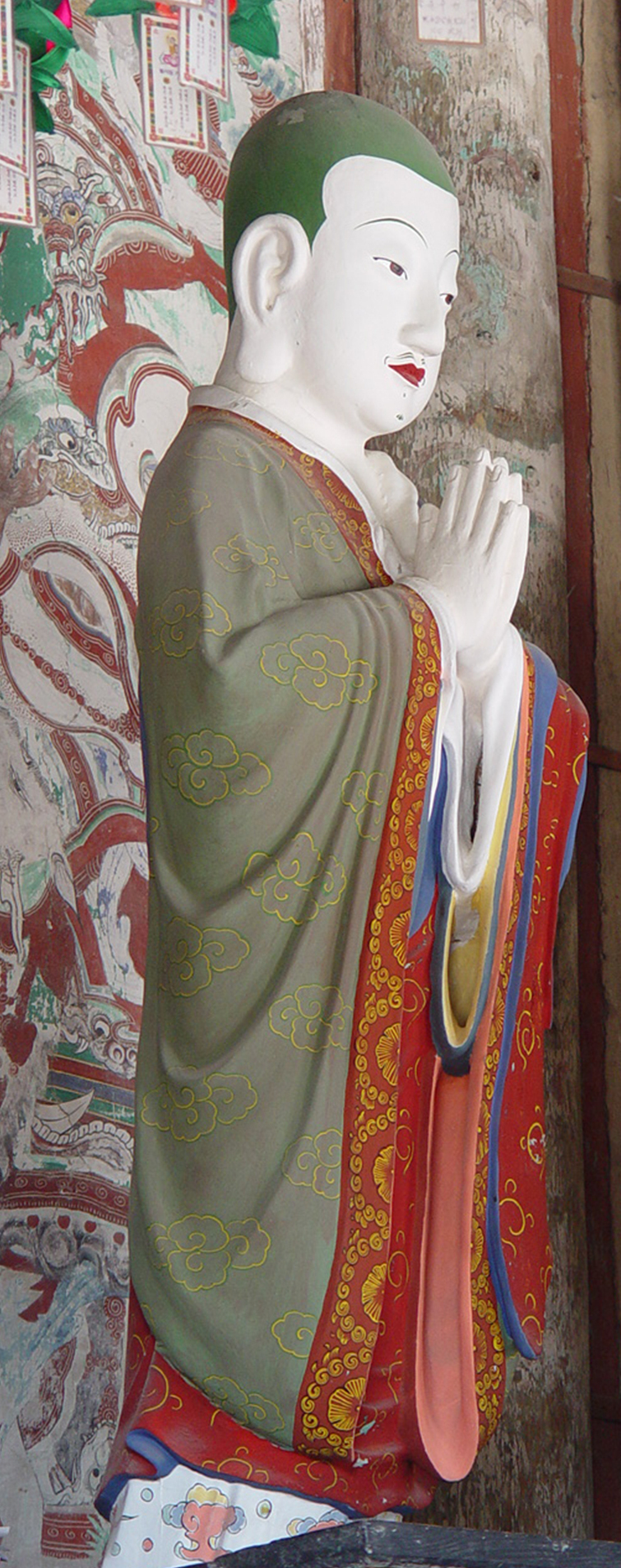
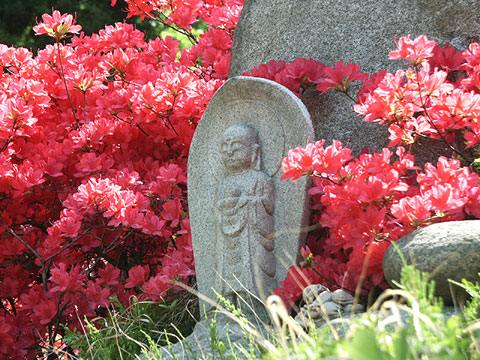
One of the popular Bodhisattvas in Korea and Japan is Jijang, or Jizo (Ksitigarbha, in Sanskrit.) Often he is portrayed as the Bodhisattva who saves beings in hell, or who helps extend short lives. In Japan, he’s often thought of as the Bodhisattva who looks after children or fetuses who’ve passed away.
But there’s an interesting thing about his name that I’ve only recently noticed: The first character, “ji”(地), means earth, and the second, “jang”(藏) means to conceal. While this is often translated as “Earth-womb,” “Earth-store,” or “Earth-treasury,” this can also be read as “concealed by earth”. Sound familiar? (“Only covered by dirt” is a common reference to the inherent, enlightened essence that we are each endowed with.)
That which is only “concealed by earth” can save us from hell, can bring the lives that make up our body into harmony, and can help even those who have passed away.
I’ve been typing up translations of Dharma songs today, but our office has been kind of noisy, so I used my headphones and some music to keep from getting distracted. By chance I’d selected the Lord of the Rings soundtrack, and the following track started playing as I began typing in this song. It’s a great teaching poem anyway, but try reading it slowly after the music starts!
With one mind as its foundation,
the whole of existence
has come into creation.
Buddhas and unenlightened beings
exist together,
throughout the heavens and earth,
everything is one.
Yet those ignorant of this
are seduced by outer things,
and cause their own pain
as they fall into evil paths.
Come to your senses,
before its too late and you leave your body.
Learn to travel freely on the path of mind,
where all phenomena and and action
become fragrant offerings,
become your sustenance.
Let’s all know this gateway of wisdom,
let’s all experience this gateway wisdom.
Everything is the manifestation of one mind,
and done by one mind.
Paradise is right here,
the inherent nature of men and women
is exactly the same.
Yet if you indulge in discriminations,
how will you ever understand the truth of emptiness?
Once born into this world,
people are trapped in a barless prison,
and just drug along to their deaths.
The path is blocked
by fixed ideas of “me,”
with one bound
just leap over these!!
Let’s all experience the gateway of seon,
let’s all experience the gateway of seon!
In this poem that’s become a Dharma song, Daehaeng Kun Sunim describes a bit of the nature of our fundamental mind. Understanding this isn’t enough, we have to take what bits we understand and do our best to keep applying them to our daily life. Then the nature of how things truly are will gradually become clear to us.
Living in this eternal moment is the reality of life,
throughout all creation,
there’s nothing that’s not the manifestation of one mind.
Even being born as a human is the manifestation of one mind,
the skillful means of one mind.
Awaken to this one mind,
escape from the suffering of samsara,
and discover what it means to truly be free.
There’s no reason to talk about the past or the future,
for this moment is eternal.
Throughout all this world,
every single thing is the manifestation of Buddha.
Across the heavens and the earth,
at each and every place,
the Buddha is fully present.
Everything is the unfolding of one mind,
it’s compassion,
it’s light.
This is a friend of ours who first came to the temple about nine years ago. He has the slight misfortunate of having a girlish name, Maeli (“Plums Blossoming,” poor guy), but he seems to be okay with it!
One of the interesting things about him is that he’s taken on the job of defending the temple, and here he’s actually on station at the entrance to the nun’s quarters. He’ll start barking if a layperson comes too close to the entrance, and sometimes, for no obvious reason at all, he’ll start barking at someone in the courtyard. The thing is, since he came here, there have been no instances of pick pockets or of people trying to rob the donation boxes.
Korean Buddhist texts and ceremonies occasionally mention something called “fragrance of mind.” Like the fragrance of incense, it weaves here and there, unseen and un-graspable. And it is the results of the efforts we make to transcend ourselves and to see everything as part of ourselves. It is this fragrance that moves amoung the people in our lives, lifting them up and brightening their path. It’s there all the time, whether we notice it or not.
Okay, that’s all I got so far! If you have any great ideas on how to end this (in a positive way), have at it in the commments!
(And thanks to Marcus for the awesome card!)
But have a happy and safe 2012, and may everyone grow and be at peace in the new year.
This is a famous temple site near the ancient Korean capital of Silla. One of my Dharma brothers lives nearby, and visits this site when opportunity presents. While it’s unquestionably beautiful, what draws him is the feeling of living energy. Sometime, far in the past, people practiced very sincerely and deeply here. And the echos of that can still be felt even now.
The Message of the Stone Statue(돌 장승 우는 소식, here’s a practice version Message of the Stone Statue(Korean 20111023). The levels for the piano are a bit off, but you can get a good feel for the song.)
There’s a chill in the air,
when the frost comes, white flowers will cover the earth.
Those who have no eyes must feel so sad, unable to see.
Those who have no ears must feel so frustrated, unable to hear.
Those who have no hands must feel so hungry, unable to lift food to their mouth.
Those who have no feet must feel so lonely, unable to go or come.
Over that mountain,
on the path that Spring travels,
a stone statue, with tears of joy in its eyes,
is telling everyone that Spring is on the way.
Ah! How could we not know this promise of ripened flowers?!
Warm Spring is coming!
When the flowers blossom,
their fragrance will fill the land.
What a wonderful sight for those who have eyes that see!
What freedom for those who have ears that hear!
What satisfaction for those who can easily lift many hands
and help beings far and wide!
And for those whose broad feet can carry them far and wide,
without hindrance!
Over that mountain, in a valley
blossoming arrowroot vines
spread the news of Spring.
Ah! From the white-peaked mountain,
streams of thoroughly ripe water flow forth!
Even with walking, seeing, and listening,
After putting a foot on the ground,
Before lifting another up,
nothing is there.
The moon shines in a thousand rivers,
reaching in and grabbing for it,
eh-he-hah, de-he-hah!
opening my hand again,
could I even say that it came and went?
(verses by Daehaeng Sunim, English translation copyright 2011 Hanmaum Seonwon Foundation)
Some of the earliest Buddhist songs in Korea were actually work songs, sung by farmers and their wives. I’m sure that the work songs were present long before Buddhism came to Korea (circa 500 C.E.), but gradually they became examples of skillful means, as lyrics were created that reflected deep truths.
Imagine how deeply input the teachings would become as you spent hours reciting them while working:
Die once and open your eyes.
See yourself,
see yourself,
see, see.
Observe how this body is a collection
of karmic states of consciousness,
gathered together
according to karmic affinities.
See!
this body contains billions of lives.
See!
how they cause us to suffer
as they go back and forth
every instant. o o
Take the suffering and hardships that arise
and gather them together in your one mind.
Do this!
and the lives within your body
will be transformed into Bodhisattvas.
To save all beings,
start with those already within you.
This one mind that we all share
is the source of everything and every life.
One mind,
one mind,
our one mind and all Buddhas exist together,
working together as one.
“All minds are my mind,
all bodies are my body,
not a thing is separate from me.”
Truly realize this for yourself,
truly bring forth this one mind.
Raise this unseen five-colored pillar high
and go forward entrusting everything to it.
Live magnificently throughout all the ups and downs of life.
Live magnificently!
Live magnificently!
(From the song “Live Magnificently,” by Daehaeng Sunim)
Koreans love to sing, and so the members of our temple have taken a number of poems and verses by Daehaeng Sunim and turned them into Dharma songs. This Saturday and Sunday we’ll even be having a festival of Dharma songs at the King Sejong Cultural Center in downtown Seoul. If you already have tickets, be sure to come! (I wanted to invite as many people as possible, but it sold out almost immediately.)
There will be a lot of performances by different lay choirs, as well as a sunims’ choir. Here’s one of the songs by the sunims during the 2004 Dharma Song festival, accompanied by traditional Korean instruments:
(This song is taken from a verse of Daehaeng Sunim’s translation of the Thousand Hands Sutra)
Sincerely entrusting everything to one mind, Determined to know the real and help all beings, Raising these great wishes, May my Samadhi wisdom swiftly brighten.
May I attain every kind of virtue. May the blessings arising from my practice guide and sustain all beings. May all beings attain Buddhahood
This second song is called That Mind, Just As It is. It’s sung by the nuns of Hanmaum Seon Center, and is actually just a practice version.(They’ll kill me if they know I posted this!) The translation I did still feels a bit off, but here it is:
When water is clear, we can see the moon, when water is murky, the moon is invisible, but the moon doesn’t rise because the water was clear, nor does it set when the water is murky. When we dissolve all defilements and delusions, mind becomes calm and clear, and Buddha spontaneously appears.
When our mind is clear, Buddha appears. When our mind is murky, Buddha is unseen. Buddha didn’t come from somewhere else, Buddha didn’t go anywhere else. If we calmly and flexibly guard the six senses so that they don’t become thieves, if we’re careful not to be caught by the functioning of the senses, unenlightened beings at once become Buddhas.
(Chorus) The green mountains use no words, running water isn’t caught by anything. Like nature, when mind remains solemn and settled, that mind itself is Buddha.