Children’s Dharma Talk

I really have to get with posting again! Sigh.  Things have been busy here with getting a manuscript ready for Wisdom Publications, and now the the Frankfurt Bookfair.  It also looks like there will be a Russian edition of “No River to Cross” coming out before the end of the year.
 
Here’s a Dharma talk that Daehaeng Kun Sunim gave to out center’s childrens group.

Children’s Dharma Talk  

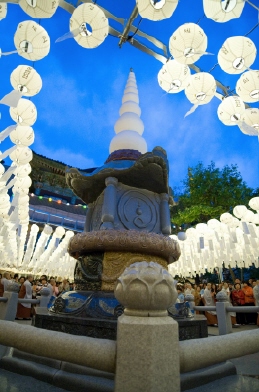
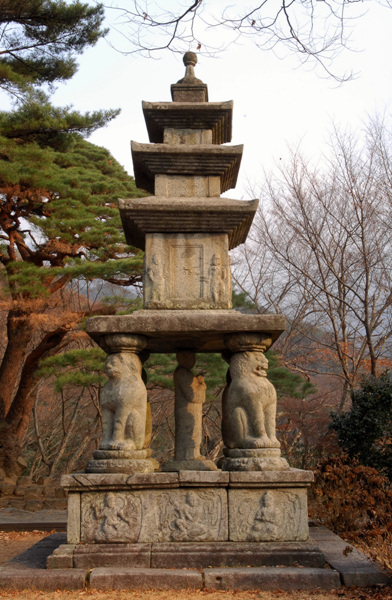
The Gugeong Pagoda on Buddha's Birthday (at Hanmaum Seon Center)

I can’t tell you how moved I am to see so many of you gathered together here today. Seeing you here today warms my heart. I was just like you when I was little. People may call you children, but you’re doing something very deep and significant when you gather here in front of the Buddha and learn about spiritual practice.

 You’re practicing, so you probably already heard that the minds of all life are connected as one. Stars have an essence that is also within us, so all of you are stars! You, stars, and this fundamental mind all respond to each other. This all happens without any wires or signals you can grab onto. When you eat something, and say “Thank you, Juingong (Buddha-nature)” your mother and father, Buddha, and sunims are all there inside of Juingong. When you take the things that come up in your life, and gather them all together at that one place, (Juingong), you can get a sense of this fundamental essence and can evolve your mind. Do this and bring forth this great power that’s within you.

             Keep practicing like this and become wonderful people. Become great beings who are able to bring peace to your family, who can guide your country, the world, and even the universe. This is all possible for you, according to how you practice. Okay?

 This Dharma talk was given by Daehaeng Kun Sunim during a Precepts ceremony for children.  

Do what makes you come alive

I happened to visit the Dalai Grandma the other day and found she had a great quote for me:

Howard Thurman 
Don’t ask yourself what the world needs. Ask yourself what makes you come alive and then go do that. Because what the world needs is people who have come alive.

Here’s another nice quote from Wikipedia:
community cannot feed for long on itself; it can only flourish where always the boundaries are giving way to the coming of others from beyond them — unknown and undiscovered brothers.

A lake in Russia, taken by my Dharma brother, Ilgyo Sunim

Guide to Korean temples.

Here’s a great guide to Korean temples, Dale’s Korean Temple Adventure. Set up by an expat in Busan, it focuses mainly on temples in the lower half of the country. (Which is fine, because that’s the heart of Korea’s Buddhist history and culture. )

He includes a lot of photos with each post, and relates the history of the temple, along with travel info and his overall impressions of how worthwhile it is to visit the temple.   Here’s what Dale wrote about Hwaeomsa (화엄사):
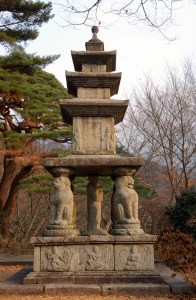
 Jirisan National Park was a place I long wanted to visit, but never got around to for one reason or another. I didn’t want to go hiking or camping, or anything like that at all. Instead, I wanted to visit two famous temples that sit on the side  : Hwaeomsa and Ssangyesa temples. And finally, in the fall of 2005, I visited with my wife.

The first of two postings will cover the most renowned temple at Jirisan National Park: Hwaeomsa (“Flower Garland Sutra Temple”).
Hwaeomsa (화엄사) was founded by Yeon-gi Josa in 544, when Buddhism was just gaining a hold ofKorea’s religious landscape. The temple was continuously expanded until its total destruction during the Imjin War of 1592. Fortunately for us temple lovers, it was rebuilt three decades later.  And today, it’s one ofKorea’s largest and most well-respected temples.
o
 
Once you’re dropped off at the bus stop at Hwaeomsa village, just south of the temple, you’ll have to walk about a kilometer up a beautiful and scenic valley road. You’ll pass through two gates, one of which is ensnared by dragons sculpted around the stone pillars. In the third gate are four largely sculpted heavenly kings protecting the temple from evil spirits. In the lower courtyard are two similar looking five-tier pagodas. As you continue walking straight, and on the upper level of the courtyard, is the main hall. Usually, the main hall is the largest structure at the temple; however, the main hall is dwarfed by the building that stands just left of it: Gakhwangjeon.  Gakhwangjeon has a two-tiered roof, and it’s also one of the largest and oldest buildings, dating back to 1703, in all of Korea. 
o

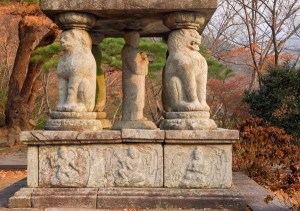
It’s a massive building that houses seven figures on its altar. Another strange feature about this temple is that the Seokgamoni Buddha (the historical Buddha) sits in Gakhwangjeon, and not in the main hall. Accompanying the Seokgamoni Buddha in this building are Amita and Dabo Buddhas, as well as the Gwaneum, Bohyeon, Munsu, and Jijeok bodhisattavas. Directly in front of this massive hall is the largest stone lantern in all of Korea, standing five metres tall. Next to this pagoda is an impressive “sari budo” with four fierce looking lions adorning it
.
o
 
But even more impressive than the massive Gakhwangjeon is what stands on the hill just above this building. On the hill stands the most uniquely designed pagoda (next to the ones at Bulguksa) and stone lantern. The five metre tall granite pagoda has three-tiers on top and four lion-shaped pedestals at its base. Each lion represents the four primary human emotions: love, sorrow, anger, and joy. At the centre of these lions stands a human figure with hands held to his chest. There are numerous other designs etched onto this pagoda, so take your time and enjoy the intricacies of this pagoda. And just in front of this pagoda is the equally unique stone lantern with a squatting figure at the centre of its base. Some have suggested that this is the founder of the temple kneeling in obedience to his mother.
o
HOW TO GET THERE:  To get to Hwaeomsa from Busan, there is a direct bus from Seobu bus terminal at the Sasang subway stop (#227). It costs about 14,000Won, and the trip takes about three hours. If you’re not getting to Hwaeomsa from Busan, you can take a bus to Gurye. From Gurye to Hwaeomsa, you can take a bus that goes to Hwaeomsa village for about 1,000 Won.
Admission to the temple is 3,000 Won (and trust me, it is well worth it!)
o
OVERALL RATING: 10/10.  For its historical significance alone, Hwaeomsa rates highly amongst Korean temples. But if you add the giant splendor that is Gakhwangjeon, and the temple rates that much higher. And to top it all off, on the hill stands two of the most uniquely designed pagodas and lanterns in all of Korea.  So if you couldn’t tell already, I highly, highly recommend a visit to Hwaeomsa for both its cultural significance and artistic beauty!
 
(Photos: These are from my collection. I didn’t take them, but I can’t remember who gave them to me. Sorry! – Chong Go  Sunim. As you can see, Dale has great info about these temples (and photos as well), so be sure to check out his blog.)
 

Seen and Unseen Connected as One

Here’s a nice Dharma talk by Seon Master Daehaeng.

Everything, throughout the entire universe and Dharma realm
is connected with each other,
and connected to everything in our lives.
Although unseen,
this connection is like a great net of the Dharma,
a thread that connects everything,,
and a path on which there is no coming or going.
Even this realm of ours is connected, in every way,
to all upper and lower realms.


 Our world faces so many difficulties.
Like sailors,
we have to be prepared to deal with whatever kinds of waves arise.
Yet if we can’t take care of what’s right in front of our eyes,
how will we be able to overcome the larger, underlying aspects?
Our bodies and material things have no power to truly resolve
these kinds of problems.

o

Should even the energy that fills the air around us be depleted,
more would flow in from outside the Earth.
It’s not for lack of energy that our planet suffers,
but because people don’t recognize the energy that’s already present,
and so are unable to use it.
To use this energy,
people who understand about our fundamental mind
have to all become one mind.
If we can do this, the whole will respond to the thoughts we raise.
We have to become one mind, we have to become a great pillar.

o

As I’ve always said, this isn’t about finding something,
somewhere else.
It’s about what we’ve always had,
it’s about our foundation.
We, the owners of the Earth, have to firmly rely upon our root.
Start with brightening your own light, and others will become brighter,
eventually filling the world with light.
How could the world become brighter if the people remain in darkness?
o

You have to bring together both the visible and the unseen-realms
and function using both.
This is the practice of finding your root,
while becoming one with everything that arises in the world.
It’s my sincerest hope that all of you will become fellow practitioners,
diligently practicing, becoming brothers and sisters through our one mind,
and help people throughout the world find their way.

                     -Daehaeng Kun Sunim


(Lotus photo is by Joseph.)

Looking on the bright side

One of the things I’ve learned from my teacher is importance of interpreting things positively. (Basically, the thoughts we give rise to lead directly to our future.)

So I found myself laughing as I woke up this morning, with this song playing over and over in my head. Even now this video puts a smile on my face!

(from Monty Python’s The Life of Brian):

Last view of a Korean army Dharma hall

Most large Korean army bases also have Dharma halls. This may strike some as strange, but Korea has the draft, and just about every man, regardless of religious faith, ends up in the military.

One of the Dharma halls I look after is on a base that’s relocating as part of a consolidation project. As a result, the entire base is being emptied and demolished. So last night, which was also Buddha’s Birthday, we had a concluding ceremony and Dharma talk. It was really a celebration of a place where people have been able meet and grow for the last 23 years. (Here are some pictures before the ceremony; I got distracted and forgot to ask someone to take pictures of the event itself. Sigh. 😉 You can see some photos of last year’s celebrations here, as well as a larger Korean Army Dharma hall.)


Waiting for things to start (and having a few laughs)


taking care of everyone


The people who supported the Dharma hall over the years


Just a "panel-made" building, but it keep people warm and dry for 23 years


Thank you

Buddha’s Birthday: Streetfair in Seoul

The Buddha’s Birthday is almost upon us, (tomorrow in fact) which means that yesterday was the street fair in front of Jogye Temple in Seoul. For an entire block, the road was filled with activities and booths set up by Buddhist organizations and NGO’s from around the world. I can’t imagine any other place in the world where one could see so many different types of Buddhism and Buddhist organizations. In fact, I have too many photos, and not enough time, so I’ll have to divide this post into two parts.  (You can see larger images of most photos by clicking on the image.)
 
For a great collection of night-time photos of Jogye Temple check out Robert’s photo blog.  In the next post I’ll cover the different Buddhist countries involved and some of the activities and NGOs.

Booths of the street fair stretching for a city block


you could hear these drums a block awayFarmer's band: one of the great things about the day are incredible traditional music groups


a booth for making miniature lotus lanterns (like the ones in the top of the photo)


There was all kinds of cool stuff for sale as well, here some incense holders
Incense being sold by Korea’s premier incense company, Neung In. They also provided the raw ingredients and showed people how to make their own incense.


One of the cool things about the street fair are the activities, here passersby participate in making a Buddhist painting


At Jogye Temple


Under the lanterns in Jogye Temple


Bathing the infant Buddha


"Between Heaven and Earth, there is nothing that is not this precious Self"


Buddha’s Birthday in Korea, a preview

The Buddha’s birthday celebrations won’t begin until this Saturday, but on Sunday we(Hanmaum Seon Center) had a preview of the activities our center’s groups are planning.  There’s nothing else for it, but to say they were incredible! The planning and effort they’ve put into the designs and rehearsals really show up. 

The Lantern Parade will begin at around 6pm or so from Dongguk University(Saturday, May 7). There will be performances beforehand, I think. The parade will go up to Dongdae-mun, and then down Jongno to Jogye Temple. On Sunday the 8th, there will be the street fair on the road in front of Jogye Temple, to be followed by more performances and a party in the evening. On the day itself, Tuesday May 10, there will be activities all day long at all the major temples in Korea.


the flowers are actually lanterns that light up


(for Fina^-^)
the Bodhisattva Samantabhadra


Advice from Me to Myself – Patrul Rinpoche

If you’ve been following this blog for a while, you know I like texts that encourage us to practice.  Over several months I posted a translation of the Ven. Ya-un’s Admonitions to MyselfNot too long ago, I came across a link on Reddit to a text by Patrul Rinpoche (1808-1887) that has a lot of the same spirit to it: very down to earth and get-with-it. (If you’re not familiar with Reddit, you should check it out. Its Buddhist community is quite good.)


Vajrasattva, sole deity, Master,
You sit on a full-moon lotus-cushion of white light
In the hundred-petalled full bloom of youth.

Think of me, Vajrasattva,
You who remain unmoved within the manifest display
That is Mahamudra, pure bliss-emptiness.

Listen up, old bad-karma Patrul,
You dweller-in-distraction.

For ages now you’ve been
Beguiled, entranced, and fooled by appearances.
Are you aware of that? Are you?
Right this very instant, when you’re
Under the spell of mistaken perception
You’ve got to watch out.
Don’t let yourself get carried away by this fake and empty life.

Your mind is spinning around
About carrying out a lot of useless projects:
It’s a waste! Give it up!

Thinking about the hundred plans you want to accomplish,
With never enough time to finish them,
Just weighs down your mind.
You’re completely distracted
By all these projects, which never come to an end,
But keep spreading out more, like ripples in water.
Don’t be a fool: for once, just sit tight.

Listening to the teachings
—you’ve already heard hundreds of teachings,
But when you haven’t grasped the meaning of even one teaching, What’s the point of more listening?
Reflecting on the teachings—even though you’ve listened,
If the teachings aren’t coming to mind when needed,
What’s the point of more reflection? None.

Meditating according to the teachings—
If your meditation practice still isn’t curing
The obscuring states of mind—forget about it!

You’ve added up just how many mantras you’ve done—
But you aren’t accomplishing the kyerim visualization.
You may get the forms of deities nice and clear—
But you’re not putting an end to subject and object.
You may tame what appear to be evil spirits and ghosts,
But you’re not training the stream of your own mind.
Your four fine sessions of sadhana practice,
So meticulously arranged—
Forget about them.

When you’re in a good mood,
Your practice seems to have lots of clarity—
But you just can’t relax into it.
When you’re depressed,
Your practice is stable enough
But there’s no brilliance to it.
As for awareness,
You try to force yourself into a rigpa-like state,
As if stabbing a stake into a target!

When those yogic positions and gazes keep your mind stable
Only by keeping mind tethered—
Forget about them!

Giving high-sounding lectures
Doesn’t do your mind-stream any good.
The path of analytical reasoning is precise and acute—
But it’s just more delusion, good for nothing goat-shit.
The oral instructions are very profound
But not if you don’t put them into practice.

Reading over and over those dharma texts
That just occupy your mind and make your eyes sore—
Forget about it!

You beat your little damaru drum—ting, ting—
And your audience thinks it’s charming to hear.
You’re reciting words about offering up your body,
But you still haven’t stopped holding it dear.
You’re making your little cymbals go cling, cling—
Without keeping the ultimate purpose in mind.

All this dharma-practice equipment
That seems so attractive—
Forget about it!

Right now, those students are all studying so very hard,
But in the end, they can’t keep it up.

Today, they seem to get the idea,
But later on, there’s not a trace left.
Even if one of them manages to learn a little,
He rarely applies his “learning” to his own conduct.

Those elegant dharma disciples—
Forget about them!

This year, he really cares about you,
Next year, it’s not like that.
At first, he seems modest,
Then he grows exalted and pompous.
The more you nurture and cherish him,
The more distant he grows.

These dear friends
Who show such smiling faces to begin with—
Forget about them!

Her smile seems so full of joy—
But who knows if that’s really the case?
One time, it’s pure pleasure,
Then it’s nine months of mental pain.
It might be fine for a month,
But sooner or later, there’s trouble.

People teasing; your mind embroiled—
Your lady-friend—
Forget about her!

These endless rounds of conversation
Are just attachment and aversion—
It’s just more goat-shit, good for nothing at all.
At the time it seems marvellously entertaining,
But really,
you’re just spreading around stories about other people’s mistakes.
Your audience seems to be listening politely,
But then they grow embarrassed for you.

Useless talk that just make you thirsty—
Forget about it!

Giving teachings on meditation texts
Without yourself having
Gained actual experience through practice,
Is like reciting a dance-manual out loud
And thinking that’s the same as actually dancing.

People may be listening to you with devotion,
But it just isn’t the real thing.
Sooner or later, when your own actions
Contradict the teachings, you’ll feel ashamed.
Just mouthing the words,
Giving dharma explanations that sound so eloquent—
Forget about it!

When you don’t have a text, you long for it;
Then when you’ve finally gotten it, you hardly look at it.
The number of pages seems few enough,
But it’s a bit hard to find time to copy them all.
Even if you copied down all the dharma texts on earth,
You wouldn’t be satisfied.
Copying down texts is a waste of time
(Unless you get paid)—
So forget about it!

Today, they’re happy as clams—
Tomorrow, they’re furious.
With all their black moods and white moods,
People are never satisfied.
Or even if they’re nice enough,
They may not come through when you really need them,
Disappointing you even more.

All this politeness, keeping up a
Courteous demeanor—
Forget about it!

Worldly and religious work
Is the province of gentlemen.
Patrul, old boy—that’s not for you.
Haven’t you noticed what always happens?
An old bull,
once you’ve gone to the trouble of borrowing him for his services, Seems to have absolutely no desire left in him at all—
(Except to go back to sleep).

Be like that—desireless.

Just sleep, eat, piss, shit.
There’s nothing else in life that has to be done.

Don’t get involved with other things:
They’re not the point.
Keep a low profile,
Sleep.

In the triple universe
When you’re lower than your company
You should take the low seat.

Should you happen to be the superior one,
Don’t get arrogant.

There’s no absolute need to have close friends;
You’re better off just keeping to yourself.
When you’re without any worldly or religious obligations,
Don’t keep on longing to acquire some!

If you let go of everything—
Everything, everything—
That’s the real point!

This advice was written by the practitioner Trime Lodro (Patrul Rinpoche) for his intimate friend Ahu Shri (Patrul Rinpoche), in order to give advice that is tailored exactly to his capacities.

This advice should be put into practice.

Even though you don’t know how to practice, just let go of everything—that’s what I really want to say. Even though you aren’t able to succeed in your dharma practice. don’t get angry.

May it be virtuous. 
 
Patrul Rinpoche (1808-1887) was a wandering Dzogchen master of Eastern Tibet, beloved by the people. He was renowned as the enlightened vagabond.

Translation by Constance Wilkinson

Photo:  The photograph at the top is from the book Himalaya: The Secret of the Golden Tara, by Dieter Glogowski.

Wonhyo’s Awakening

Lately I’ve been (slowly) revising a collection of stories told by Daehaeng Kun Sunim  during her Dharma talks. Here’s the story of the awakening of one of the most famous figures in Korean Buddhism, Wonhyo Daesa (617–686 CE).

Wonhyo Sunim and Uisang Sunim were Buddhist monks who had become close friends, and were on their way to China to find a great master under whom they could study.  They had left Gyeongju, the capital of the Silla Kingdom, and were headed to the southwest coast of Korea to find a boat that could take them across the sea to China.

After weeks of walking, they were deep in the rival kingdom of Baekje.  The sky had turned dark and the showers were fast becoming torrents.  Before long the rain was blowing sideways and the two friends could barely see in front of them.  They looked around for some kind of shelter and eventually stumbled across an abandoned hut.  It was too wet to start a fire and they were both so exhausted that they fell fast asleep as soon as they lay down.  In the middle of the night Wonhyo Sunim woke up with a burning thirst.  Half asleep, he found a broken bowl half full of rain water. He drank it down with a sigh, and fell back to sleep.

In the morning when Wonhyo Sunim awoke, he was shocked by what he saw: decayed bodies were scattered all around where the two sunims had been sleeping.  This was no ordinary hut – it was a place for getting rid of the bodies of people who had died of the plague.  And the bowl full of rain water?  It was half a skull, with flesh still inside and crawling with maggots.  Running outside, Wonhyo Sunim began to vomit as if his insides were going to come outside.

Kneeling there with his stomach tied in knots, he suddenly realized, “The water was the same – it’s my thoughts that were different. Last night it was pure and refreshing, and now it’s so disgusting that.… The only thing that’s changed are my thoughts.”

As he quietly sat there, Uisang Sunim said to him, “Why don’t we get going; you’ll feel better once we get away from this place.”

Wonhyo Sunim didn’t respond. After a moment he asked Uisang Sunim, “Why do you want to go to China?”

“To learn the path, of course.”

“The path isn’t someplace far away.  It’s within us, wherever we are.  Why go to China to look for what’s already with us?

With this, Wonhyo Sunim headed back to the lands of Silla.

Wonhyo Sunim had taken the first step:  he had realized that it was his thoughts that made heaven and it was his thoughts that made hell.  If he wanted to attain the enlightenment of the Buddhas and Patriarchs, he would have to start with himself.  And there was no point in going somewhere else to do it.  So he took activity of his own mind as his fundamental hwadu (koan) and returned home to Silla. 

 If you want to discover what’s true and what’s real, you’ll have to start with your own mind. All of the principles and truths of the universe are already contained within you. Our fundamental mind gives rise to thousand different manifestations, and our fundamental mind can combine ten thousand different manifestations into one. This mind that ceaselessly gives rise to things and causes them to subside, also gives rise to every kind of different person, and can combine all those people into one.

So take the functioning of your own mind as your hwadu. If you practice like this, you’ll come to know what binds your mind, and what frees your mind. You’ll discover where you are rich and where you are impoverished, and you’ll discover that it’s mind that makes things big, and mind that makes the same things small. You’ll know for yourself the unimaginable wonders that this fundamental mind can call forth. By ceaselessly taking everything that arises through mind as your hwadu, you’ll realize that among all the things in the world, the path to true freedom begins with your own mind. For this is the very place of Buddha.