New Dharma talk collection

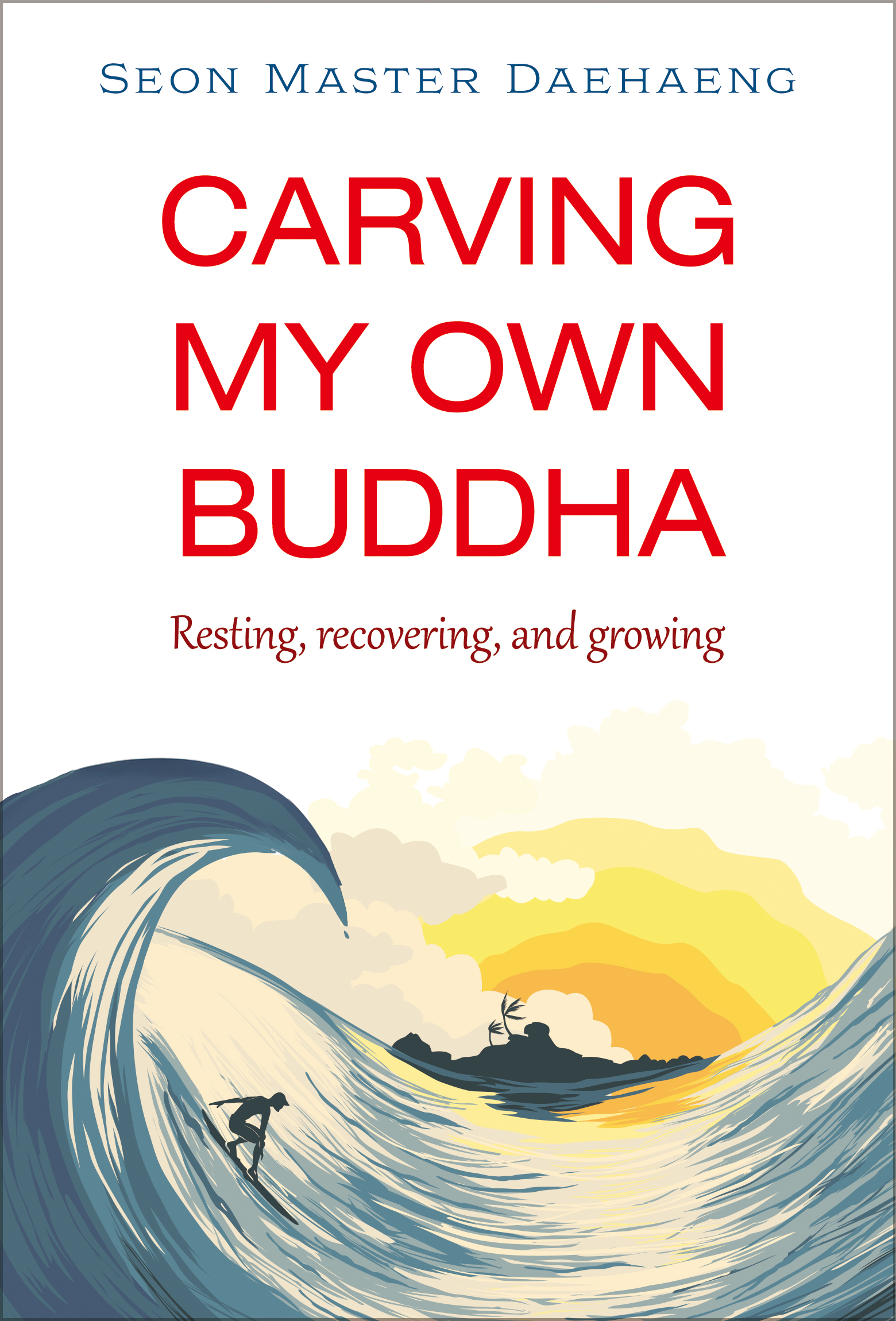
I’m excited today because we have a new collection of Daehaeng Kun Sunim’s Dharma talks out! I’m not sure if “collection” is quite the right word, because it’s only two talks, lol. But it’s 158 pages, and there’s a lot to digest there. It should be more than enough to keep someone busy!

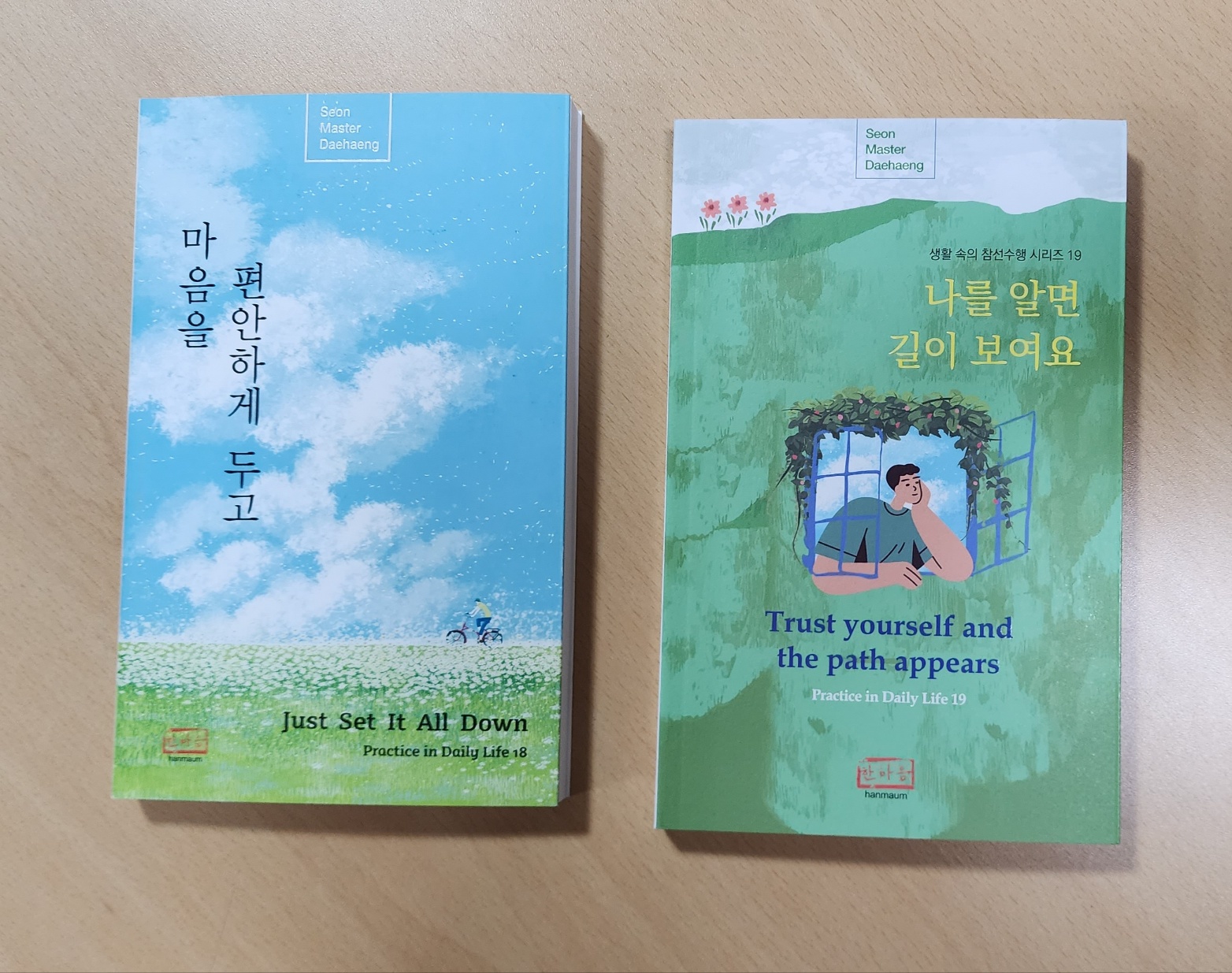
This is the combination of two previous Dharma talks that we first published in Korean/English editions. One was called, “Just set it all down,” and the other is “Trust yourself and the path appears.” Both are very nice talks.

On the one hand, the Korean/English format is popular in Korea, and it lets us get out a new Dharma talk soon after we finish translating it, but on the other hand, those are hard to make available to people outside of Korea. The Korean/English format doesn’t lend itself to an ebook format, and while it can, theoretically, be done as a print-on-demand format, it’s extremely time consuming.

But now just about anyone around the world can get these talks. The print edition is available through Amazon, and the ebook edition is available through just about every online store. And a huge shoutout to the cover designer, Su Yeon Park, who did an amazing job!

Print edition (Amazon)
Ebook edition (universal links)
Length: 158 pages
Price: $5.99 (ebook), $9.99 (paperback)

Here are the original books, in case you might already have these.

New editions of the Diamond Sutra, print and ebook!

Woohoo! We’ve just published two new editions of Daehaeng Kun Sunim’s translation of the Diamond Sutra! Both of these are designed for people outside of Korea, using stores that most people around the world can access. One is a 3-language print edition, and the other is an ebook edition.

As you may have guessed, I love this book so much. Kun Sunim’s Korean translation is so deep and lyrical. It’s nonduality from beginning to end, and even when you don’t quite understand what she’s saying, it still changes you. It nudges your consciousness forward, and it seems to do that every time I read it. I think we were able to capture some of this in the English, for it has the same effect on me. I hope you, too, will experience this and that its light will shine and brighten your mind and heart.

The English text has a few small changes from the first edition we published in Korea. Most are related to changing the layout from a poetry style structure to a paragraph style layout. The change was necessary for the ebook formatting, but it also fit the new print edition as well. The changes were mostly taking long paragraphs that used line breaks (instead of periods) for pauses and pacing, and breaking them into shorter sections. However, there were one or two sentences that we were inspired to retranslate, and I’ll try to post a change log of those before too long.

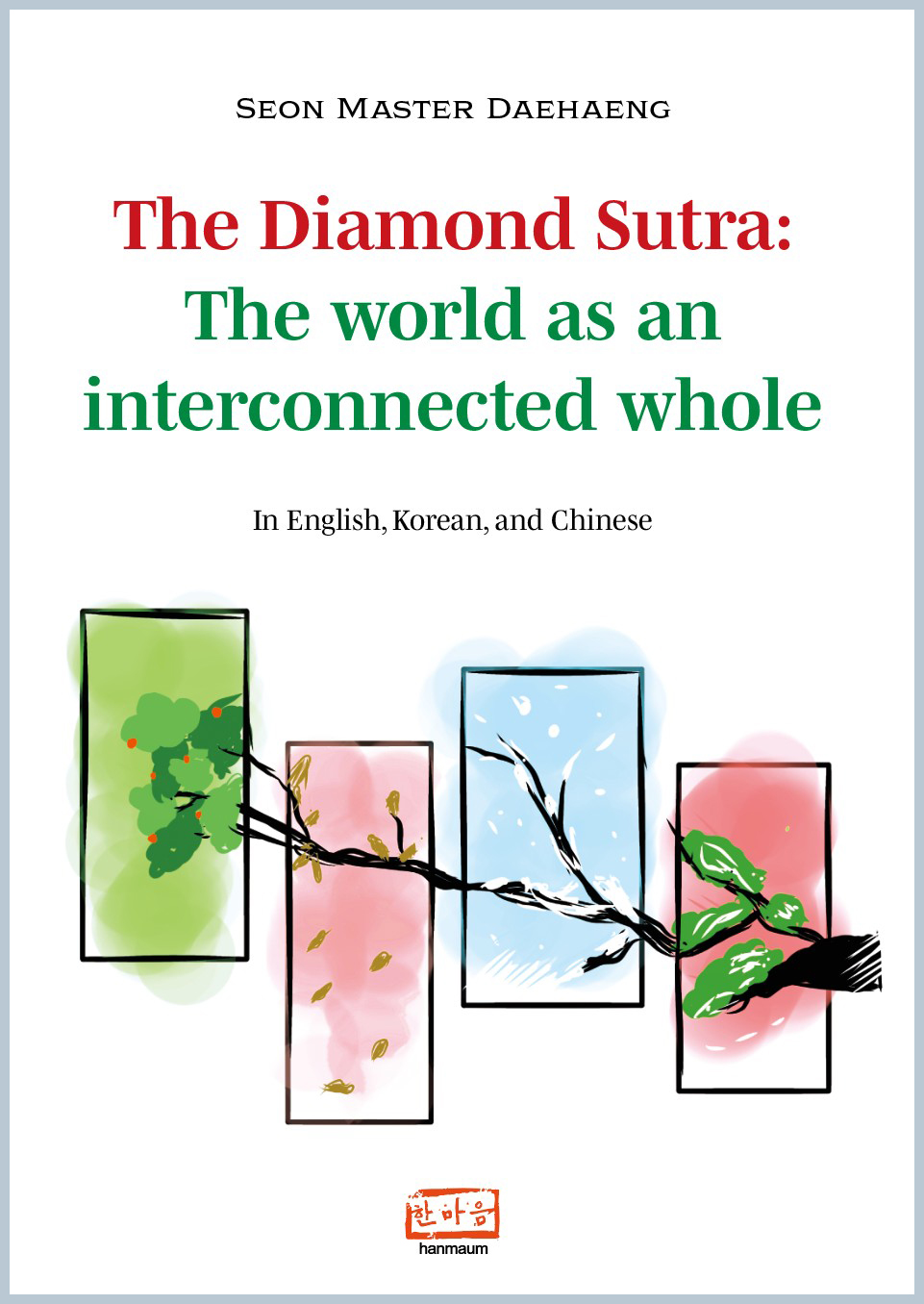
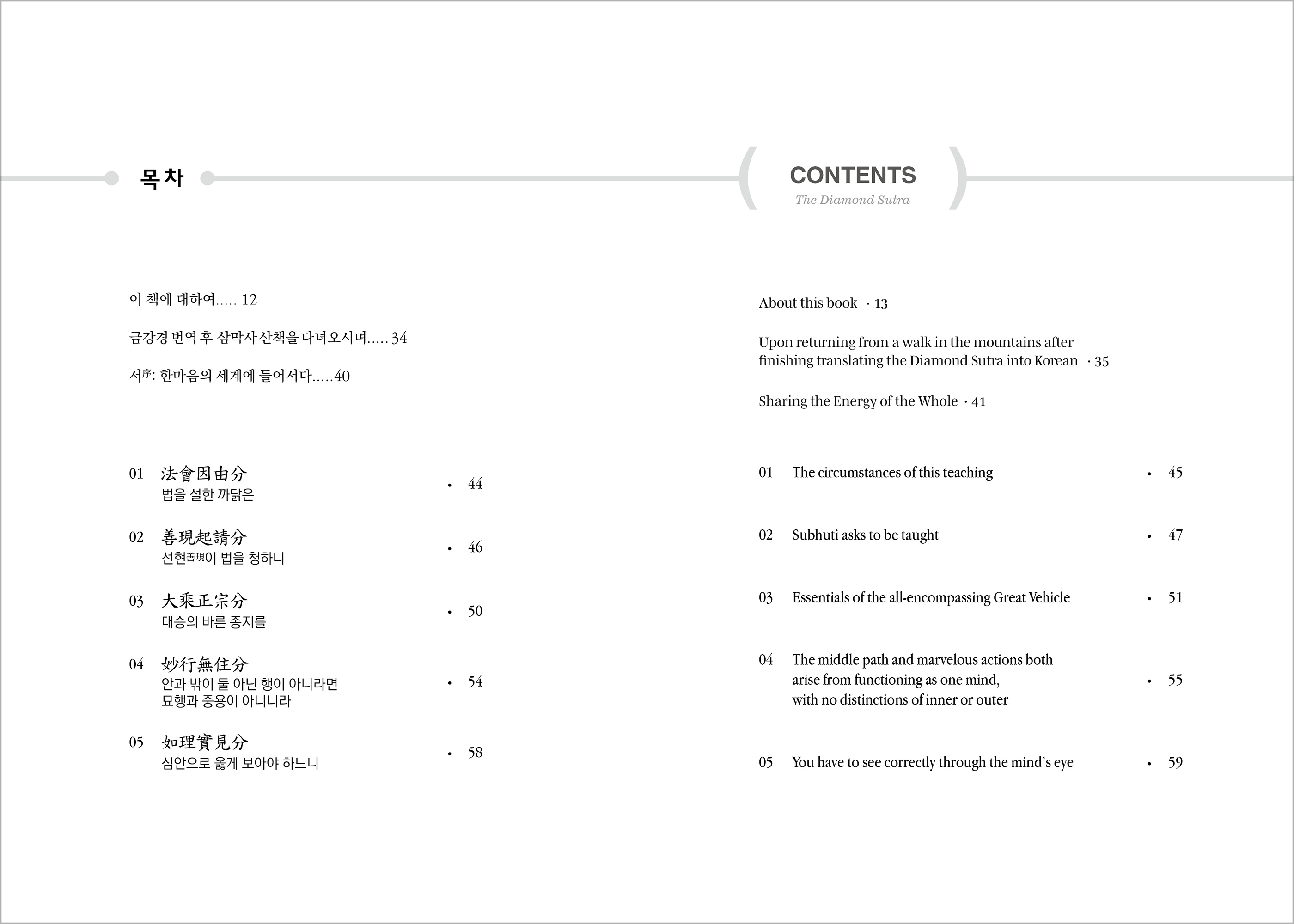
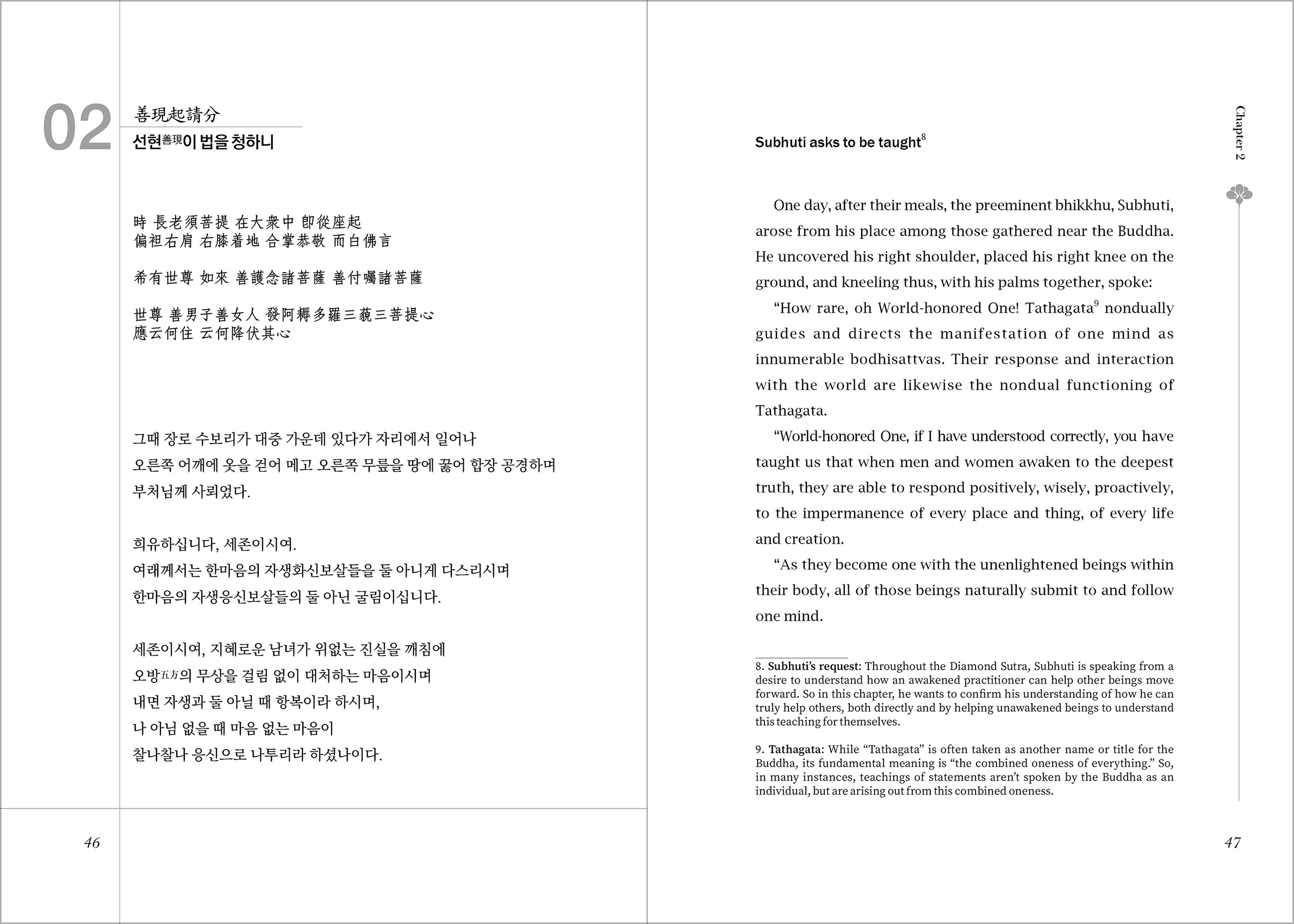
The Diamond Sutra: The world as an interconnected whole is a paper edition of Daehaeng Kun Sunim’s translation, with the Chinese and Korean on one side, and the English translation on the facing page. We’ve set this up to be printed and delivered through Amazon, and it’s come out very nice. (We used Amazon because it makes the print edition accessible around the world. The Chinese text is Kumarajiva’s translation.)

Length: 200 pages
Size: 178mm x 210mm (10 inches x 7 inches)
Cover: Paperback

Link to print edition

Here are some samples of the interior layout:

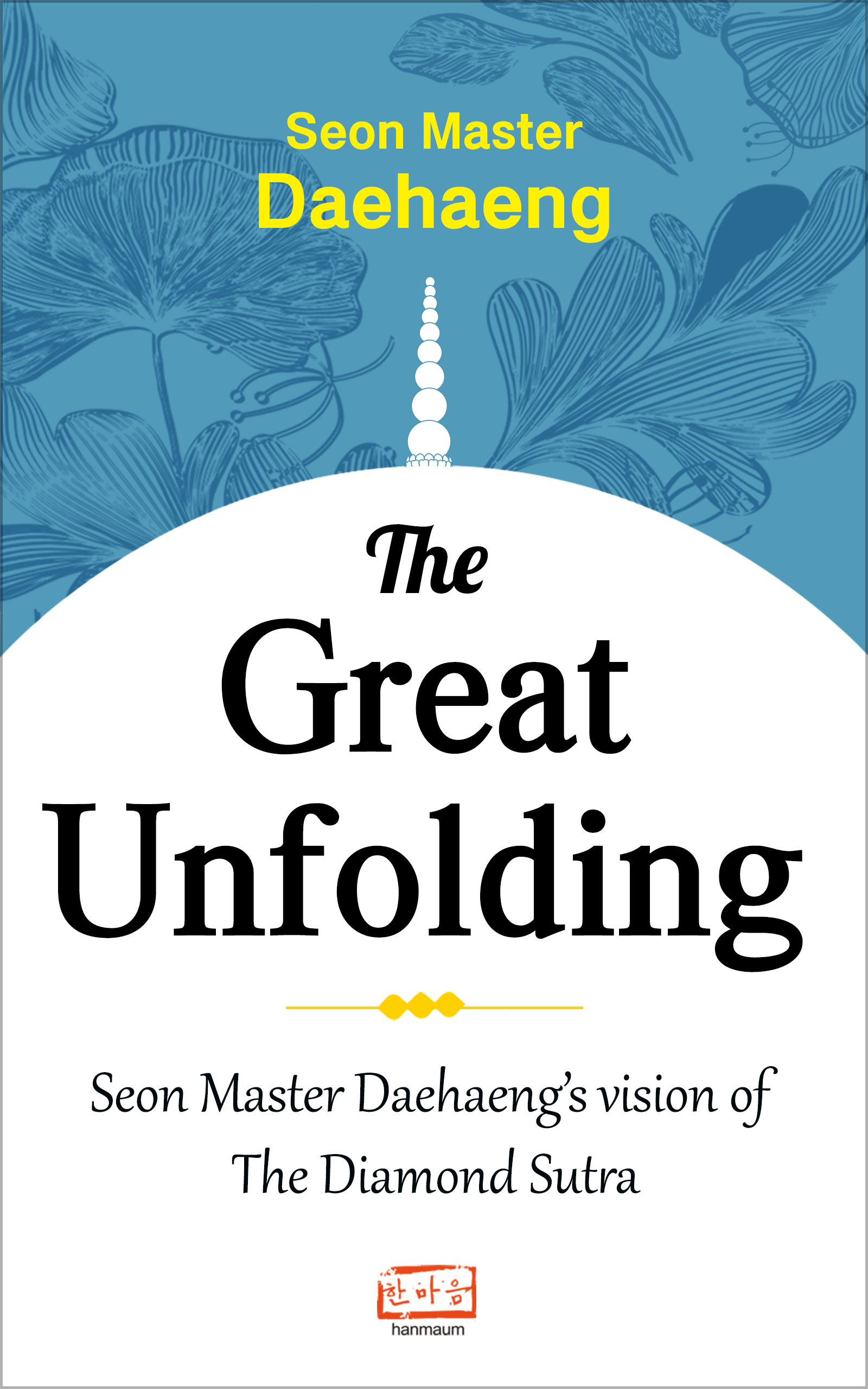
The Great Unfolding is the ebook edition, with the same text of the English and Korean translations. The English introduction and text are in the first half of the book, and the second half is Kun Sunim’s original Korean translation, 뜻으로 푼 금강경. The layout came out nice, and I really love the cover! I think this might be the best cover we’ve ever done. (We went with a different title because the structure of the text had to be so different to accommodate the ebook format. )

Link to online sellers


The new year

Happy New Year, everyone!
I hope it has found you all well. Things have been a bit hectic the last year, with us doing a lot of translation work, and trying to get a lot more done during the year. We now have several great new books and Dharma talks that have been translated, and are awaiting their turn in the layout process. Within a month or two, we hope to have the new, revised edition of  My Heart is a Golden Buddha available on Amazon as well. That should make ordering and shipping a lot easier, as well as lowering the shipping charges for lots of people.

x_0024-1


Song of Sharing the Same Mind and Body
(공심공체 둘 아닌 노래)

Mountains embrace the water,
along with all sentient beings.
Flowers and butterflies
embrace each other,
dancing and dancing.
The mountains whisper to us:

Deep waters have within them
every kind of treasure.
One mind,
our foundation is the guide they always follow;
leaving no tract of their passage,
they ceaselessly go back and forth into the world.
Grasp this essence,
live freely,
release everything into this flowing emptiness,
and live like water.

Water embraces the mountains,
along with all sentient beings.
Flowers and butterflies
together cause blossoms to become fruit.
Water whispers to us:

When a tree cherishes its root,
relies upon its root,
the fruit that ripens on this tree
can freely go back and forth
from the mountains to the world,
with no coming or going.
Grasp this essence,
live freely,
release everything into this living emptiness,
and live like the mountains.

A True Human Being

The following is the short Dharma talk by Daehaeng Kun Sunim that Marcus mentioned in the previous post.  
 
A True Human Being

Our true mind is a great brightness that can lead us all.
This one mind, this one point
is the foundation of the Earth,
the foundation of the sun,
and the foundation of the universe.
With perfect wisdom it accepts everything and responds accordingly.
It is brightness itself,
what could possibly hinder it? 


Although this brightness is in everything,
people create divisions and labels,
and then let those rule their lives.
How could they not be hindered
and oppressed in all the things they do?


A true person is the same as a Buddha.
However, let go of even the desire to become such a person,
as well as the fear of not achieving this,
instead, take everything that arises from this empty place,
your inherent foundation,
and return it to this empty place.
If you entrust it there with sincere faith,
and are relentless about this,
then from that place, your true mind will reveal itself.
 

In this true mind,
a Buddha’s mind and an unenlightened being’s mind
are not separate,
there’s no clean or dirty, high or low,
nor the least hint of “I did” or “I know.”
This true mind,
this completely empty bowl,
manifests every instant,
and brightly shines upon all,
with hands that aren’t hands, feet that aren’t feet,
on the path that isn’t a path.
This is the mind of a true human being.
 
–Daehaeng Kun Sunim 


copyright 2010, the Hanmaum Seonwon Foundation

Herding the Ox (Part 2)

(This is the second part of Daehaeng Kun Sunim’s version of the Tex Ox Herding verses. These are traditional verses that describe the progress of spiritual practice, with the ox symbolizing our inherent nature.)


6. Riding the Ox Home

As I ride the ox,
making my way home,
it turns out he already knows the way.
Sitting on his back
and playing the flute,
its harmonious melody goes far and wide.
Hearing this sound,
the villagers all come out to welcome me.


7.  Forgetting the Ox

At last the ox and I have returned home.
My mind is utterly at peace,
the ox too is resting,
and an auspicious light
fills the entire house.
This small, thatched-roof hut
knows no worry or suffering,
and at last I can lay down the whip and reins.


8. Myself and the Ox both Forgotten   

The whip and the rope,
even the ox and myself,
are all empty, gone without a trace.
Oh this sky, so wide and open
so vast and boundless.
There’s no place for even a single dust mote to settle.
How could I ever be ensnared again?
   

9. Returning to the Source 

 I’ve crossed over so many mountains
in order to return to this root.
Here is my true home
in appearance like the open sky
with nothing hindering it and nothing to be gotten rid of.
The waters of a stream just flowing,
the flowers so beautiful.


10. Returning to the Town

Although I’m wearing old rags,
there’s no sense of lack.
As I mix with the many people
on the streets and markets,
their suffering fades away,
and even dead trees come to life.
Such a deep valley,
yet the turbulent waters
cannot claim me.


Everyday Korean Buddhist Practices

Following on from my piece a week or so ago about entusting and devotion, I’d like to post an updated review I wrote last year of the little booklet called “Everyday Korean Buddhist Practices” by Seon Master Ilta, translated and very kindly gifted by Brian Barry. I think Master Ilta says so much better than I can just how there need be no contradiction at all in combining a very devotional approach with the practice of uncovering one’s own true nature.

‘Everyday Korean Buddhist Practices’ is a translation and abridgement of Saenghwal Sogui Gidobop by the late Zen Master Ilta, Grand Preceptor and member of the Elders Committee of the Jogye Order. Brian Barry, temple artist, Dharma Instructor, and translator of many key Korean Buddhist texts, translated, published and distributed this work free of charge as a Dharma gift dedicated to all beings throughout the universes. He is also active on the Seoul Dharma Group and is a thoroughly nice man.
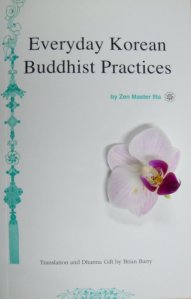
The book is divided into five sections. The first chapter is called ‘Effective Chanting’ and deals with the lay person’s approach, and the three empowerments practice brings. Part two is the main part of the book, and concerns daily practices. Many people outside of Korea who come across Seon Buddhism might perhaps think that this would deal with meditation, but most Buddhists, even many Zen Buddhists, do very little meditation at all, and this chapter deals mostly with the practices of prostrations and chanting.

I personally find it hard to maintain a prostration practice, especially here in Bangkok. There have been times I’ve started each day with 108 bows, and have benefitted enormously from it, but my favourite practice is Avalokitesvara chanting, about which Master Ilta has some interesting and useful things to say in this small book. He says it’s useful to have an image of the Bodhisattva while chanting, and I noticed with delight that Brian Barry generously included in each copy a postcard of one of his own gorgeous paintings of Kwan Seum Bosal.
Master Ilta talks about how, wishing to receive compassion, “it is both natural and essential that you lead a compassionate life yourself” and he emphases the importance of maintaining one’s resolve. He also discusses visualisation, prayer, and using beads. My own beads were a beautiful gift from my Dharma brother Joseph. Each one has the hangul for Kwan Seum Bosal carved into the wood, and they are a joy to hold. Not all the advice Master Ilta gives will apply to everyone of course, his suggestion about making as many repetitions as possible in a single breath, for example, is not something that works for me.

The final sections of the book are on special methods and spirit guidance, in which he talks about the practice of Namu Amitabul chanting, Namu Jijang Bosal chanting, chanting the Great Light Mantra, and reciting the Teaching for the Departed, the Musanggye, which Brain Barry adds as an appendix. Finally, Master Ilta concludes with a story, illustrating his central theme of one-minded devotional practice.

It is a book devoted to the everyday practices of, especially, chanting and prostrating, with a real ‘other-power’ feel to it. “In Buddhism” Master Ilta writes, “our practices are our very faith, and this faith is in the power of the buddhas and bodhisattvas to help us in times of need. So it is necessary to put our faith in them and their powers”. So how, it might be asked, does this fit in with the idea of relying upon one’s own inherant Buddha-nature?

For Seon Master Ilta there is no contradiction. The devotional practices he outlines exist for the very purpose of reaching one’s own foundation. “The nonduality of the practitioner and Buddha is the True Self” Master Ilta writes. “The only difference is that the Buddha recovered his essential nature, while we have not. The objective of our practice is to discover this true nature and to realize our full potential.”

This reminds me very much of what Daehaeng Kun Sunim also has to say about the practices of bowing and chanting. “True bowing” she writes “means keeping yourself humble and respecting Buddhas, Bodhisattvas and sages. But at the same time, know that their mind and your mind are not two, and never lose your determination and resolution.” In a section of ‘No River to Cross’ on reciting the Buddha’s name she warns against simply looking for light from outside. For Daehaeng Sunim the power of chanting is from the power of the foundation.

What ‘Everyday Korean Buddhist Practices’ does is provide a wealth of advice and suggestions on some of the technical aspects of these practices, in a way that never loses sight of the main goal – to, as Mastar Ilta puts it,  “bring about the force from within”. This marvellous little book has been widely distributed, entirely free of charge, to Seon centres around the world, and Brian even kindly sent some extra copies for the Hanmaum Seonwon here in Bangkok. It is well worth finding for both its insight into everyday Korean Buddhist practice, and for inspiration too. Thank you Brian.

Links:
Brian Barry’s webpage
Entrusting and Devotion

Herding the Ox (part 1)

The Ten Ox Herding verses describe the process of uncovering our inherent, enlightened Buddha-nature, represented here by the ox. Variations of these are popular throughout East Asia as a way of describing the spiritual path. This translation is from Daehaeng Kun Sunim’s Korean version.  For Barry, at Ox Herding 🙂

 
1. Searching for the Ox
 
On plains that stretch forward without end,
pushing through the tall grass and brush,
looking for the ox.
Going here and there,
following a nameless river
and unknown paths deep into the mountains.
Utterly exhausted,
yet still no trace of the ox,
In the gathering dusk,
only the sounds of the crickets.


                                          2. Finding Tracks of the Ox

Suddenly,
on a river bank,
under a tree,
hoof prints of the ox!
And there,
under the sweetly flowing water,
an ox print clearly seen.
Stretching out before me
as plain as day,
hoof prints!
  
                                                                                         3. Glimpsing the Ox 

Somewhere a bird is singing.
Under the warm sun,
a peaceful breeze.
On the banks of the river,
the willow trees are brilliant green,
how could an ox hide here!
But look at that massive head,
and those wide horns.
What kind of strength will it take
to drag it back to the path?

4. Catching the Ox

It was a difficult fight,
but at last I’ve caught the ox.
So stubborn and willful,
its strength seemed endless,
like it could tear through mountains.
But at last the ox has come to a standstill.
Long accustomed to roaming here and there,
at last it has come to a stop.


5. Taming the ox

To tame this ox
requires a whip and some rope.
I tied the rope through its nose ring,
but still have to use the whip.
Otherwise the ox will rush about,
rolling in the mud,
or getting stuck in the marsh.
But when he’s tamed,
his gentle, true nature will show,
and he’ll follow me,
even without a nose ring.


(to be continued…)

Illuminating the Buddha Within

This is a short Dharma talk Daehaeng Kun Sunim gave for the Buddha’s Birthday.

We celebrate the Buddha’s Birthday every year,
but this year I feel strongly that we need to use this opportunity
to exert ourselves.

As you light lanterns this year,
and brighten and develop your mind,
think of the Buddha’s teachings, which showed us this path.
 

This life we cling to
lasts only for a season,
yet within an instant of our daily life
are all of the truths and principles
of the universe.

These are what we must awaken to;
this is what is truly urgent.
So don’t light lotus lanterns
trying to create
some small bit of good luck.

Lighting a lotus lantern reminds us that
our mind exists everywhere
throughout the universe,
and because you exist, others exist,
because others exist, everything exists.
 
This instant of our daily life,
where everything works together peacefully
to the extent we are harmonious,
shows us that, just as it is, light fills the world and
the Buddha is brightly present within each of us.

Each of you has the exact same Buddha-nature as Sakyamuni,
each of you was born in a Buddha realm and are being guided by the Buddha.
So just as the Buddha teaches us,
if you throw away “I,” if you throw away your egotism,
you can live brightly, free of suffering,
able to draw upon the unlimited ability within,
and send forth radiant energy.

Under the lotus lanterns

If you are continuously letting go of “I,”
if you’re truly living in the present moment,
the effects of a single thought
can reverberate
throughout the entire Dharma realm.
Living like this,
the true worth of life
becomes abundantly clear,
and as a disciple of the Buddha,
with gratitude towards the Buddha,
you can live freely, as a true human being,
able to take care of everything in creation. 

            –Daehaeng Kun Sunim

The pillar of all work on behalf of Buddhism…

In a short letter, the Korean Seon master Hanam (han-am) Sunim, said something that’s stuck with me ever since:

The pillar of all work on behalf of Buddhism is harmony.

That’s all.  Nothing fancy.  But it packs such a wallop.  Everything about interconnectedness and nonduality is right there, together with tremendous power to guide.

Am I feeling harmonious as I approach this issue?
Am I viewing the others involved in a harmonious way?
Will my intentions and behavior result in a harmonious outcome?

Although obvious in hindsight, this is such a critical issue, for we are all inherently connected, as Daehaeng Kun Sunim says, sharing the same life, the same mind, the same body, and working together as one while freely giving and receiving whatever is needed. 

There’s only helping, not “helping her.”  There’s only loving, not “loving them.”  There’s only hating, not “hating them.”  There’s only defeat and humiliation, not “defeating them.” 

May all beings know happiness and harmony, joy and wisdom, virtue and merit.

with palms together,

Seon Master Hanam Sunim

Chong Go

Protein supplements in my dinner: or, The unhappy fate of rice bugs

Technically, those gray specks in my rice weren’t supposed to be there. Perhaps if they’d been millet, added to give the rice a nice multi-grain taste. Or maybe a little wild sesame. Alas, they were neither.


Tongdo Temple, where we were undertaking our ordination training, is beautiful.  Ancient and sprawling, it is one of the few large temples to survive the destruction of the Korean War. 


    Situated in a green valley with a soaring mountain range behind, Tongdo Temple is truly a treasure of Korean Buddhism.  It also has the worst food of any large temple in Korea!

    Normally, Korean housewives will soak and wash rice before boiling it.  This ensures the rice is clean and also rinses away any rice weevils that may have been enjoying a meal before they were interrupted. With an extra 300 mouths to feed for our training session, it appeared the kitchen monk had skipped this step.

    Picking the steamed weevils out of the rice wasn’t even an option: every last morsel had to be consumed, down to a single flake of red pepper or sesame seed. We would wash our bowls afterwards, and if even the tiniest bit of food was found in the bucket that collected the water, the twenty postulants in my row would have to drink the entire bucket of wash water.

    “Well,” I thought, as I looked at the gray specks in my rice, “eating these won’t kill me. And actually, it won’t even kill them.”

    With that I began to eat, letting go, as best I could, of my fixed ideas of right and wrong, which are more often than not manifestations of ego.

    Daehaeng Kun Sunim had once gently confronted my vegetarian moral superiority, saying about the beings whose cooked flesh was sometimes served to me, “Don’t hate them because they are poor and unfortunate. Become one with them and let them experience the human level of consciousness.”


Bugs in my rice! (at the Dharma Folk blog)