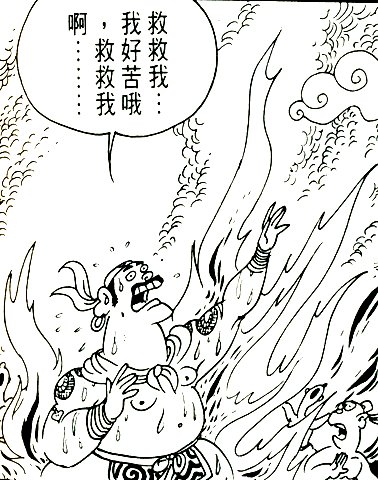
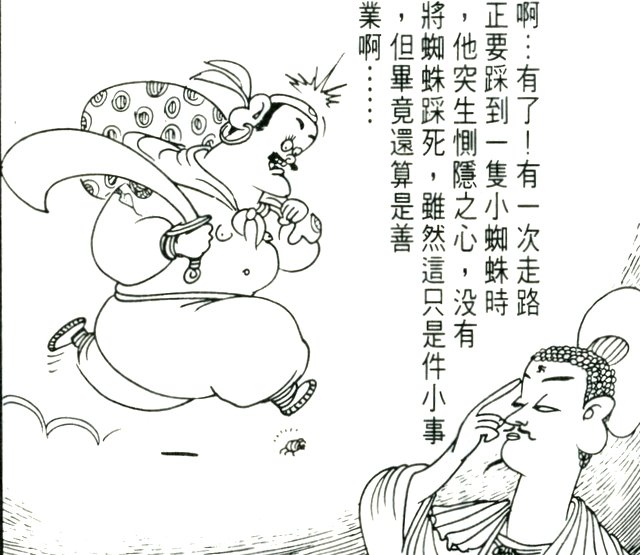
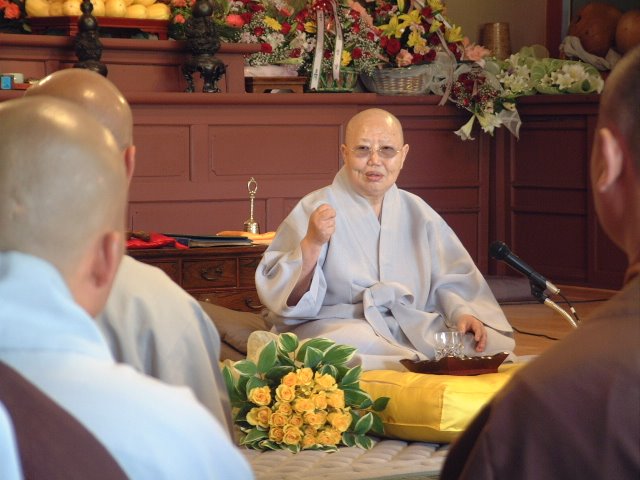
The Master, whom he had expected to be the very soul of compassion, begun to shout at him, “How dare you come here seeking the dead words of men! Why don’t you open your ears to the living words of nature?”
(from Dropping Ashes on the Buddha, the teachings of Zen Master Seung Sahn)
At first, these were in fact dead words to me. I recognized the presence of wisdom but didn’t really get it! I took it too literally, something that’s never got me very far in Zen understanding… I thought to myself, “So, how do I know which words in this book are dead, and which ones are still alive?” Well, they all seemed like worthwhile teachings, so maybe they’re all alive, but they’re just printed words on paper, maybe they’re all dead??
It was a while before another experience led me back to this teaching with better understanding, and it was just that which did it… experience!
Until I had that inner experience, changing my “dead word” conceptual knowledge into the experiential knowledge of life, no book, no teacher, no amount of thinking was going to teach me.
As we open our perceptions to the fundamental experience, then words will leap to life before our eyes!
Searching for the Dharma
You’ve traveled up ten thousand steps in search of the Dharma.
So many long days in the archives, copying, copying.
The gravity of the Tang and the profundity of the Sung make heavy baggage.
Here! I’ve picked you a bunch of wildflowers.
Their meaning is the same but they’re much easier to carry.
~ Xu Yun ~
from Empty Cloud: The Autobiography of the Chinese Zen Master, Trans. Charles Luck, ed. by Richard Hunn
Here’s a talk by the Korean Seon Master, Hanam Sunim, given in 1935.* It’s a wonderful talk for anyone interested in growth and sprititual practice, and is also very relevant to everyone interested in seeing Buddhism flourish in the West.
Buddhism Exists in Experiencing and Applying
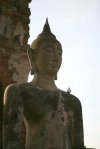
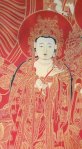
Hanam Sunim next to the Manjusri Statue at Woljong Temple
Thank you for coming such a long way to see me.
If you want to see Buddhism prosper, then experiencing and applying are the most important thing. There is a saying, “Cultivating mind isn’t done with the mouth.” Like this, modern people have an incredible amount of things that they’ve learned, but they don’t seem to be so good at actually applying and experiencing them.
People who practice sitting meditation should practice sitting meditation, those who study the sutras should study the sutras, those who practice chanting should practice chanting. If each one upholds their own practice very sincerely and diligently, then regardless of whether they are in the deep mountains or in the cities, regardless of whether many people are interested or just a few, there will always be people who want to learn and help. At this stage, you can truly be called a disciple of the Buddha. If, little by little, people put the things they experience and understand into practice, one person will become two people, two people will become three and so forth. Thus there’s no need to worry about whether Buddhism will prosper or not. In the not-to-distant future, I expect that there will be many people truly practicing Buddhism, and that Buddhism will flower throughout the Korean Peninsula.
I spoke about this before, but you have to make up your mind, tie your belt tightly, and put your understanding into practice. If you do this, then without any lectures or advertising, Buddhism will naturally prosper and spread. As you know, everyone has Buddha-nature, thus it all depends upon making up your mind and making an effort. Anyone can become a follower of Buddhism. There’s no reason why Buddhism shouldn’t prosper. It is just that people are so busy these days that practice isn’t easy, and they often forget about it. However, if you can just remember (about spiritual practice), then it’s possible for you to apply and experience, wherever you are, whether you’re working, standing, or sitting.
Everything is like this. I spoke about seon a little before, but seon isn’t something that is beyond understanding. Just make up your mind to do it and put (what you’ve been taught) into practice. My opinions or explanations about the meaning of seon won’t help you a bit. The essence of seon is determination and application, and in so doing, it’s something that one comes to know automatically. The essence of seon can’t be taught or explained. My only wish is that you give rise to determination and experience it for yourselves.
You asked me about people worshipping at shrines for the mountain god or the big dipper within the temple grounds, but although people are praying or bowing out of a desire to obtain something, even that is a type of faith. It seems to me that faith in those kinds of spirit shrines can naturally grow to include the Buddha. Because Buddhism can include everything, it’s not a problem. While praying at the mountain god shrine or the big dipper shrine, they may gradually develop faith in the teachings of the Buddha.
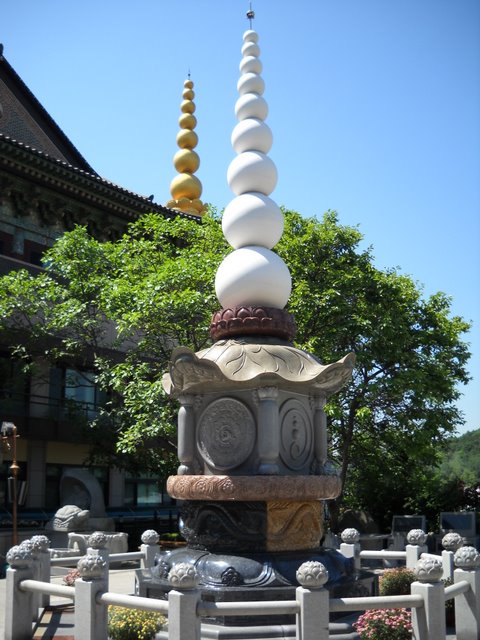
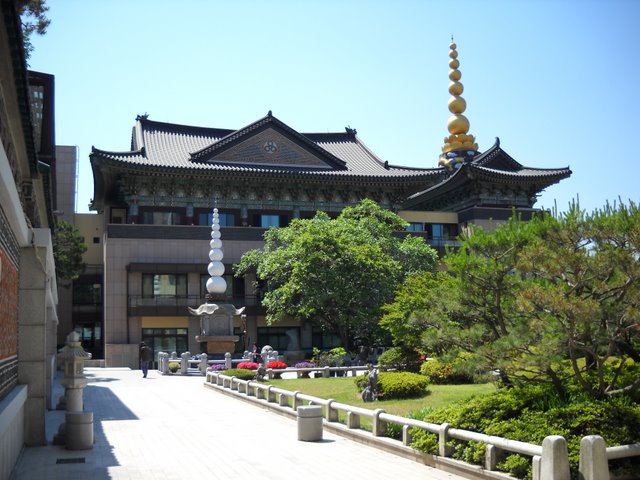
Manjusri and the 9-story pagoda at Woljong Temple
I’ve rambled on, but the main point I can’t emphasize enough is that we must practice and apply our understanding.
* Hanam (han-am) Sunim (1876 – 1951) was one of the leading practitioners in Korea. He was a main disciple of Kyongho Sunim, Dharma brother of Mangong Sunim, and was elected the spiritual head of Korean Buddhism three times. (He kept resigning!) In this article, he had been asked how the Japanese government could “help” Korean Buddhism (what they meant was “control”.)He wasn’t fooled, and yet still gave a wonderful talk. This interview was published in Japanese in 1936, and a few introductory remarks have been deleted.
One of the more influential aspects of my childhood was having three sisters. For the most part, they wanted a brother about as much as a cat wants fleas. For a long time, I couldn’t do anything right by my sisters. As we grew older, grievances grew increasingly pettier. I vaguely remember, around the age of ten, asking my mother if I could have a sex-change. I didn’t have a complete concept of what it meant, but I knew it would make my sisters like me!
Eventually, there was a big turning point. Although, at times, I admittedly was rather irritating, I realized that the more contributing factor was that they were also seriously irritable! Although, that realization didn’t directly change the situation, it did help me deal with it, which, in turn, helped resolve many things, internally and externally. As I matured more, I learned to remind myself of this also when I was feeling irritated or frustrated by something or someone.
-Is this annoying or am I just letting myself be annoyed?
There’s only one side of that I can truly act upon.
The colour of the mountain is the eye of Avalokitesvara Bodhisattva,
The sound of the river is the ear of Manjushri Bodhisattva,
Mr Chang and Mrs Lee are Vairochana Buddha.
– Seon Master Kyong Ho (1849 – 1912)
A few days ago my partner flew back to Japan, and after all the excitement of a week together, after far too long apart, I was left feeling sad and empty. Of course I know what I should have done, I should have sat on my meditation block and watched my breath, something I’ve done countless times before and which always makes me feel better. I could have watched the emotions and feelings rise and fall away, I could have allowed each to settle back from where they’d come. I could have practiced letting go, entrusting them all.
Instead I carried the loneliness around with me and tried to fill the gap I felt inside, and one of the ways I did that was in the spiritual section of the bookshop, looking through the latest books on Buddhism and browsing through the Christian section, trying to find the volume that contained the perfect teaching that would solve all my problems. Later, when I did finally manage to sit, I thought a little more about that search, and how it connects to what Chong Go Sunim was saying the other day about finding a teacher.
There are no shortage of teachers. Just the books I already have, each is a perfect teacher. On my desk right now I have stacks of wisdom from a number of traditions going back thousands of years. A simple click away and I have even more. Finding a teacher isn’t the problem. And not just books, I don’t know how many Dharma talks I’ve attended over the past few years. Plus, my oldest friend is a Catholic priest, my partner is a Pure Land practitioner, my best friend lives the very spirit of Zen, my Dharma brothers are just an email away.
The problem isn’t finding a teacher, I’m spoilt for choice, the problem is finding the willingness to learn. A single word of wisdom from any one of my teachers could be enough to sustain me for a lifetime, but instead I skim over spiritual advice in the same way I’d read a novel on the beach. I’m like the dried sponge that Father Laurence of New Skete talks about, “a sponge that is so old, that has sat around collecting the dust and grime of life, that when you throw it into a bathtub it simply floats! It doesn’t absorb water!”
The fact is, we really do live in a bathtub, an ocean even, of teachers – if we are willing to learn. With that willingness, every single thing, not just monks and spiritual books, can be our teacher. Daehaeng Sunim writes that the mountain teaches us to live resolute and unflinching, the flowing waters teach us to live like water, and weeds sprouting up through harsh soil teach us to live courageously in the midst of adversity. “Bad circumstances are, in fact,” Daehaeng Sunim writes elsewhere, “an opportunity to learn.”
Chong Go Sunim said last week that when learning from all that life gives us, the key “is this upright center we are all part of. This is the thing that we must never abandon. While trying to be humble and uphold the precepts, we must always keep returning to this.” For me, this means slowing down and letting go. It means accepting myself and the circumstances I find myself in. How else could I learn? It’s not in any book, it’s in my daily, moment by moment life. My practice is to open up to those lessons and allow them to flow through me.
Sources of quotations: – “Don’t Know Mind: The Spirit of Korean Zen”, Richard Shrobe
– “In the Spirit of Happiness”, the monks of New Skete
– “No River to Cross”, Zen Master Daehaeng Sunim
Although a great deal of planning had gone into the preparations for the 23-day training session that preceded our ordination, apparently no one had thought of toilet paper. Existing supplies were quickly depleted and there were no provisions for providing more. The initial response was not encouraging: “Just use less.”
“Umm, excuse me,” I wanted to say, “there is a certain, absolute minimum….”
Even eating just two meals a day, 150 men will go through a lot of toilet paper over the course of 23 days.
The logic of this was hard to avoid, and before long the overseers relented. Of course, their idea of relenting amounted to a single roll in each bathroom. Its appearance on the window ledge would provoke a frenzy resembling a stock market panic, with everyone rushing to secure a couple of arm lengths of insurance. Latecomers were left with a choice between the empty cardboard tube or the shiny wrapping paper.
For the next few days, everyone was walking around with at least one pocket stuffed full of toilet paper. Finally the overseers caved, and with a flood of heavenly whiteness, the nagging fear of being caught short was forever banished
Reincarnation This video has been making the rounds , and I thought I’d post it here for anyone who hasn’t seen it yet. The speaker is Wallace McRae, perhaps America’s greatest cowboy poet.
One of the things I’ve noticed about spiritual practice is the urge to see someone else as a perfect or enlightened practitioner. But this has terrible consequences.
I’m not sure where this desire comes from. Is it simply that they show our goal is possible? Or is it more insidious: that he or she is perfect, and so will take care of us. Perhaps it’s wanting to see something divine, something other than this ordinary, human realm. Or perhaps it’s a form of laziness, of subtly wanting someone else to do the work for me.
An odd thing I’ve noticed is that every time I try to say “He (or she) is a great practitioner,” they invariably disappoint me. Why is this? Well, my judgement might not be very good….^^ However, I think it’s not that they failed me or betrayed me, but rather they and their qualities are not where I’m going to find my liberation. I’m looking in the wrong place, and what I need just can’t be found there. I have to do the work myself, and learn to discover and rely upon the divinity that has always been a fundamental part of myself.
“You will not fail to go unpunished”
I don’t remember where I heard this phrase, but I often think of it when I see a situation where it looks like people are abandoning their own, upright center. I’m reminded of this when I think of the series of scandals American Zen centers experienced some years ago. Looking back now, I think there were several contributing factors.
One was that people were given major teaching roles after only a few years of practice. Ordinarily this might not have been a huge problem, but it was also coupled with the idea that the teacher was infallible. This to me is where the real disaster started. It’s bad enough when the students are looking to put someone on a pedestal, but when the teacher is also encouraging it, look out. A more experienced teacher would, hopefully, have avoided this ego trap.
Another huge risk factor is when sustaining the center or lineage becomes too important. Corners get cut and people are kept around who normally wouldn’t have been. Chillingly, an Irish friend told me this is exactly what happened with the Catholic Church.
What is a teacher?
Daehaeng Kun Sunim once said that taking refuge in the Sangha doesn’t mean blindly following teachers, monks, or nuns. She said you could take someone as a teacher when their words and actions all agreed, and were also consistent with your own good judgement.
A teacher is someone who got there first, or who is ahead of you on the path. And a realized teacher is someone who understands the pain of where you are, and wants to see you free and able to live for yourself. In my opinion, an awakened teacher never tries to foster dependencies. Things gather and separate according to their karmic affinity, according to where they are in their growth, so to try to force them beyond that is to invite disaster. This is something that all the great teachers I’ve met seem to understand.
That said, we can learn from everyone around us, those who are doing well, and those who aren’t behaving so well. The key to me is this upright center we are all part of. This is the thing that we must never abandon. While trying to be humble and uphold the precepts, we must always keep returning to this.
A tree lives by relying upon its root
To be frank, I really don’t like talking about others’ shortcomings. I’ve got enough of my own that I’m ashamed of, and which should be plenty to keep me busy. However, people interested in spiritual growth must absolutely be cautious about these points, so I’ve said a few words here. Please forgive me if I’ve misspoken.
I arrived yesterday afternoon just in time for the final rehearsals, with the altar looking just as gorgeous as it did for the Buddha’s Birthday last year, if not more so. Seeing all the offerings arranged before the Buddha image, fruit and flowers, candles and boxes, and so many people busy with the final touches for their performances, you’d never have believed this is just a small overseas branch temple with just two resident sunims. The energy was intense.
At six o’clock sharp everyone settled down for a short evening ceremony of chants, containing some refrains and mantras I found familiar and lovely, and then there was, just as the lantern lights were switched on, a circumambulation in the temple grounds and everyone chanted the Buddha’s name. With a short period of meditation too, this first part of the evening contained something for every style of practice. And then the festival began.
The stage doors were pulled back and first off was a choir with all the women in gorgeous hanboks and all the men in white shirts, and English translations to some of the Dharma songs on a screen to one side. In the audience, as well as dozens of Korean families, was our small English-language Seon Club, trying not to compare our upcoming efforts with the magnificent voices on stage!
The anticipation must have effected my memory because I can’t remember the order of the acts that followed, but I remember being stunned by the drumming performance, oooing and aaahing at the wonderful magic tricks some of the kids performed, and clapping along as some younger and very cute kids danced to a song about Superman. There was a traditional Thai dance and during a Korean dance the Seon Club slipped behind the stage door ready to go on.
Daily life in Bangkok has been much disrupted over the past few weeks and two of our regular members, both with superb voices, have recently had to leave, but, as our singing coaches Jo and Mrs Nam emphasised again and again during rehearsals, the point isn’t the sound of our voices, but the expression of the Dharma. And in the end we had a respectable little group with singers from England, Australia, and Japan, and Eun Young, our extraordinarily talented and enthusiastic translator from Korea, and we sang with all our hearts.
The Seon Club is only a year old, it was at the last Buddha’s Birthday celebration that we first discussed the idea of an English-language group, and during the second verse the whole audience joined in. I looked out and saw other Seon Club members in the audience giving us the thumbs up, and all over the hall so many familiar faces from the Seonwon singing along and wishing us well, and I understood that nothing is separate here, that every single one of us is together supporting each other.
So thank you to everyone that sang last night, thank you to everyone that attended rehearsals, even if you couldn’t make it on the night, thank you to those who coached us over the weeks of preparation, to everyone who supported us and watched us and joined in with us, and to all the wonderful people from the Hanmaum Seonwon in Bangkok and in Korea and throughout the world. Thank you all!
Our song finished and we bowed and hurried back into the audience smiling and elated and watched others take their turns. There was some acting, a wild but tightly controlled performance of swordmanship, and everything was rounded off with more singing and the handing out of some small gifts. And again I was left amazed at how this little community manages to find such time and such talent. It was a fabulous way to celebrate the coming of Buddha, and a lovely example for every day of the coming year of energy and joy and togetherness. Wonderful!
Has anyone ever noticed anything in the teachings of Buddhism about the need to avoid financial debt?
There’s a great financial advisor in the US who really gives a lot of good practical and Biblical reasons to avoid debt, and I was wondering if there’s something similar in the Buddhist teachings. (He often brings up several quotes from the Bible, such as “The borrower is slave to the lender,” and “One who cosigns for another is stupid.”)
As a monk at a large center in Korea, debt is one of the three main reasons I see people coming here in crisis. (The other two are health and spiritual crisises).
My own teacher really comes down on debt as well, I suspect because of the suffering it causes. She doesn’t talk about it much, in part because avoiding stupid things may seem too obvious, and in part because most people may not want to listen.
I’d like to know about any deeper, Dharmic connections related to debt that anyone may have heard of as well.
The financial advisor I mentioned has a favorite saying “Broke, Desperate, and Stupid are three brothers that always hang out together. When one shows up, the others aren’t far behind.” From what I’ve observed that’s really true. Nearly all of the truly stupid (non-alcohol related) things I’ve seen have been a result of financial desperation.
(This is the second part of Daehaeng Kun Sunim’s version of the Tex Ox Herding verses. These are traditional verses that describe the progress of spiritual practice, with the ox symbolizing our inherent nature.)
6. Riding the Ox Home
As I ride the ox,
making my way home,
it turns out he already knows the way.
Sitting on his back
and playing the flute,
its harmonious melody goes far and wide.
Hearing this sound,
the villagers all come out to welcome me.
7. Forgetting the Ox
At last the ox and I have returned home.
My mind is utterly at peace,
the ox too is resting,
and an auspicious light
fills the entire house.
This small, thatched-roof hut
knows no worry or suffering,
and at last I can lay down the whip and reins.
8. Myself and the Ox both Forgotten
The whip and the rope,
even the ox and myself,
are all empty, gone without a trace.
Oh this sky, so wide and open
so vast and boundless.
There’s no place for even a single dust mote to settle.
How could I ever be ensnared again?
9. Returning to the Source
I’ve crossed over so many mountains
in order to return to this root.
Here is my true home
in appearance like the open sky
with nothing hindering it and nothing to be gotten rid of.
The waters of a stream just flowing,
the flowers so beautiful.
10. Returning to the Town
Although I’m wearing old rags,
there’s no sense of lack.
As I mix with the many people
on the streets and markets,
their suffering fades away,
and even dead trees come to life.
Such a deep valley,
yet the turbulent waters
cannot claim me.
Form is no other than emptiness, emptiness no other than form.
-the Heart Sutra
During a trip to Thailand, I bought ‘A Brief History of Time’, by Stephen Hawking. Like the best Dharma books, it was written with the intention of being understood by any common layperson but also must be read several times for it to really sink in. One of the many interesting things I learned is that matter is constantly appearing and disappearing in space, out of apparently nothing. Particles and their corresponding anti-particles, arise for a moment, then, nearly immediately, collide back together into nonbeing.
Although at the time that Stephen Hawking wrote the book, he was only 95% sure that black-holes existed, he supposed that as these particles and antiparticles arose just on the edge of black-holes, one of them would be hauled into the black-hole, allowing the other to continue its existence, becoming the seed of form.
What does this mean for my practice? Well, probably nothing… but it does interest me that an ancient Buddhist text, which reads almost like a dream, would be echoed well over a thousand years later in contemporary theoretical physics.
The appearance of all Buddhas and Patriarchs in this world can be liked to waves arising suddenly on a windless ocean.
-Zen Master So Sahn
Similarly, as the Buddha sat in meditation, he was able to focus his awareness so acutely that he actually experienced his form on a subatomic level. He saw that everything is pulsing, appearing and disappearing countless times each moment. I think this experience helped him realize the extent of our impermanence. Thousands of times a second we regenerate. Thousands of times a second we’re given the chance to start all over. Personally, I find this very encouraging!
Again, this time about twenty-five hundred years later, science and technology caught up to Prajna Wisdom and built a scanning electron microscope that could observe the inside of an atom. Each time they focussed in on a particle, it seemed to melt into pulsing waves of rhythm and revealed an even smaller particle, which in turn, did the same.
Of what is the body made? It is made of emptiness and rhythm. At the ultimate heart of the body, at the heart of the world, there is no solidity. Once again, there is only the dance. At the unimaginable heart of the atom, the compact nucleus, we have found no solid object, but rather a dynamic pattern of tightly confined energy vibrating perhaps 1022 times a second: a dance…