I feel that how one views the universe (or, more simply, reality), and us in it–basically, what one believes and believes in, become the foundation of his or her mental health and personal happiness. I also feel that all of us are better off choosing what makes sense–in finding a belief (or beliefs), and that then we must confidently believe in that way. It seems to me this is natural, honest, and therefore, better for the heart and mind. Most importantly, belief that is chosen, I feel, is the true eye of one’s individual heart and mind, which show us what we believe, so it comes from within, is original, and is thus not contrived or forced. You could say that what we see as true, and thus believe, defines us. You are what you see?
In this article, I talk about belief-particulary personally found belief- and what caused me to find comfort in Zen, as opposed to another practice or faith. I do not wish to say, however, that one religion is better than another, for everyone. I do wish to tell my personal story, just as a painter, poet, novelist or film-maker attempts to show his personal vision, which is basically his or her mental experience.
As an example illustrating my frustration with those who might criticize a practitioner of a faith, and to draw an analogy between practitioners of a faith and artists (to show that belief is as personal as personal vision), let me digress and mention the film director Oliver Stone. He made the movie JFK to show what he and many see as a possible series of events explaining a part of history that has been unsatisfactorily explained by the government of the United States. He was criticized for poorly representing history. I heard him speak, and I was impressed with his detailed knowledge of the history and the era which he was a part of. He weaved together a story that was in shreds at all edges. A story that was left in a pile of uncertainty. He was not supposed to represent history. As an artist, his charge was/is to represent what his perceptions, available knowledge and his talents reflect. His responsibility was/is to himself, in showing what his mind and its perception of the world has shown him.
A Practioner of a faith, be it a celebrated one or one that is invented by oneself (or an amalgam of other faiths) has one obligation; to see it, understand it, follow it, and perhaps, express himself honestly about it. When you think about it, this is how Christianity and Buddhism came about; Hanmaum, and Interbeing, too. Through self-reflection, Jesus and Gautama found ways to express their truths, as truth was revealed to them, though it diverged or grew from practices of the day. Dae Heng Kun Sunim does this. Thich Nhat Hanh, does this. We all do this, to one degree or another. Spiritual individuals-whether they are great prophets, monks, or the sons of God or artists-change faiths–or at least practices of a faith-to present their perceptions of those faiths and reality as they see it. This is what the human mind should be able to do, without criticism.
I was raised Roman Catholic, with a heavy sprinkling of born again-ism, in Long Island’s sleepy New York suburb of Lynbrook. With it’s “prefix” and “suffix” reversed, Lynbrook is Brooklyn, so you can imagine who renamed it, from the original Pearsall’s Corners, and perhaps, who settled it, for the most part. I myself was born in Brooklyn. How did I wind up a “Zennist”, studying Buddhism in Korea?
I was taught to love everyone. And, in my opinion, I was raised in a country (and especially a state), where it is-as my friend Tony Watkins says-practically un-American not to criticize your nation. So I was brought up to be compassionate, but critical. My mother was the church-goer, my father the activist-democrat. So I grew up thinking. A lot. Thinking and writing, and going to church on Sundays. But church, the older I got, seemed to gather people with a less than compassionate practical philosophy and a very conservative style of politics.
As a teen-ager, I had taken up reading American cold war history, specifically about the Viet Nam “conflict”. I had become an Urgent Action letter-writer for Amnesty International’s Program to Abolish The Death Penalty. I marched against war and military Aid to Latin American countries. The biggest opponents of what I was doing seemed to all be people of the faith I was raised in. I couldn’t understand this.
It had seemed to me that everything that the Christian faith asked us not to do, we were actually making a part of our daily lives, and in fact, it seemed these were the real actions and concepts Christians believed (in practice, anyway) and this bothered me; specifically support of the death penalty, interventionist wars, a lack of compassion for the homeless, those with aids, those in jail, and policies that violated the sanctity of a woman’s right to choose what to do with her own body.
In short, no matter how I looked at it, most of the church people I knew were either in support of, or oblivious to the most egregious violations of compassion worldwide, and not on a small scale.
Then there was the religious view of science. The religion I was raised in had a history of going against common sense, empiricism, and reality, quite frankly. I haven’t mentioned it, but my passion as a boy was astronomy and I loved biology too, and I was always hearing “we didn’t come from monkeys” from religious people. Well, evolution doesn’t say we do, either. I was forced to see that many people of the church are victims and purveyors of gross ignorance.
One day in the bookstore, I came across a book by Thich Nhat Hanh. The Venerable Tich Nhat Hanh brought together spirituality and social action. This represented for me, responsible, and spiritually honest living.
When I was in high school, it was the church goers who were attacking free speech, trying to put prayer in schools (not fair in a nation that professes the idea that religion and state be separate), and trying to say we shouldn’t give condoms to people in Africa, where AIDS was running rampant.
The Buddhists I met and read about lived the lives they believed in. In fact, many were vegetarians, pacifists, and very open-minded and progressive. None were telling me I had to give up believing in the sensible laws of physics, or of evolution, or that I had to support one or another war. They didn’t teach through fear, or a greedy desire to go to Heaven.
I am aware that there are good Christians, that they have charities all over the world, and that there is much virtue in that faith and the many denominations of Christianity. In fact, I am still happy to say I have a Christian heart, while maintaining that I am attempting to cultivate a Buddhist mind. I still go to church, from time to time, and my girlfriend is a protestant, bringing much love and forgiveness into my life through her faith.
I even believe the Christian-Judaic foundation is part of what makes America and other Westernized democracies great in certain respects, for it instills the notion of the sanctity of the individual and his rights in society; something I feel is lacking to certain major degrees in Confucianist and other male-dominated societies, which has definite deleterious effects on the growth of the individuals in them, politically, maturation-wise, and spiritually.
Buddhism seems to conflict very little-if at all-with science, carries a major underlying message of love and compassion (with no exceptions), and seems to be practiced by people who show a great deal of peace of mind–more than the adherents in the God-based faiths in my observation–who always seem to be leading their nations to war.
So, I read Tich Nhat Hanh, and it made me peaceful. I read Suzuki, and it made me sit. I read Lao Tzu, and it made me see great wisdom (I still love the compassionate stories of Jesus, however, and think they are of prime importance in learning to be a humane human being).
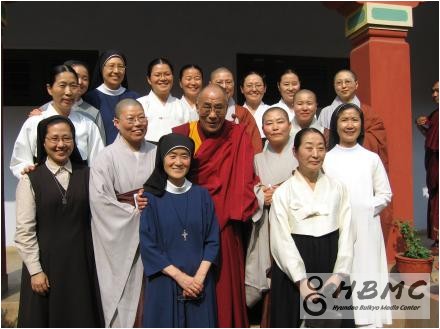
In my early twenties, I poured coffee for His Holiness The Dalai Lama at The Rainbow Room in New York City, and I realized I had never seen a spiritual or political leader more jovial and happy in my life. In fact, I had never seen anyone who laughed so heartily while shaking so many hands. Thoughts of Santa Clause entered my mind. ‘This man was at peace’, I thought.
I found people of a softer mind and infinitely less judgemental heart in the Buddhist friends I made, and finally, in Korea, I discovered a way to practice that showed a reflection of that idea I cherish: the importance of the “individual”.
Dae Heng Kun Sunim’s focus on the “Juingong”, or the True Doer of our actions, to me, advocates the bringing of salvation to the individual from the individual, so to speak. I don’t find it conflicts with theistic faith, either, in that Jesus, for example, taught that the kingdom of heaven is within, as is God.
The Buddha taught that man should take refuge in himself (not in The Buddha, or in a god). For many years, to my eyes, I had felt it was the process of supplication to an exterior source that was causing the apparent lack of true spiritual growth, open-heartedness, and open-mindedness (as well as an increase in greed and feelings of victim-hood) in the people around me who were dedicated to the theistic faiths.
*I do not actually claim to be a Buddhist. I find the sects of Buddhism, like those of Christianity, do not follow what the Buddha taught exactly, any more than Christians really follow Jesus, but what I like about being associated with this practice is that there are no real major divisions among Buddhists causing major strife over differences in opinion, and there is no hell-fire and brimstone talk that teaches out of fear. You don’t see Buddhists supporting war, or fist-fighting, for that matter. Well, not much, anyway.
Finally, I think of myself as a Zennist. Meditation was at the heart of The Buddha’s enlightenment, and his teaching, and it has been at the center of any self-induced growth I have had. That is what makes Buddhism a person and people-transforming practice; the sitting, the looking inward, and the cleaning of the mind’s “slate”, as it were; the opening of the heart, where truth comes in through a lack of arrogance and an increasing of peace, and where dogma plays no part.
To me, this is the true value of any religion or philosophy; how well it transforms individuals, and then, masses of those individuals, such that they are more peaceful, loving, kind, and open to learning and growth in all positive ways. Any belief that limits these virtues is to be questioned and examined, to the greatest possible depth, because, as I said, you are what you see; it becomes your belief, the foundation of your mental health and personal happiness, and affects those around you.
37.263573
127.028601

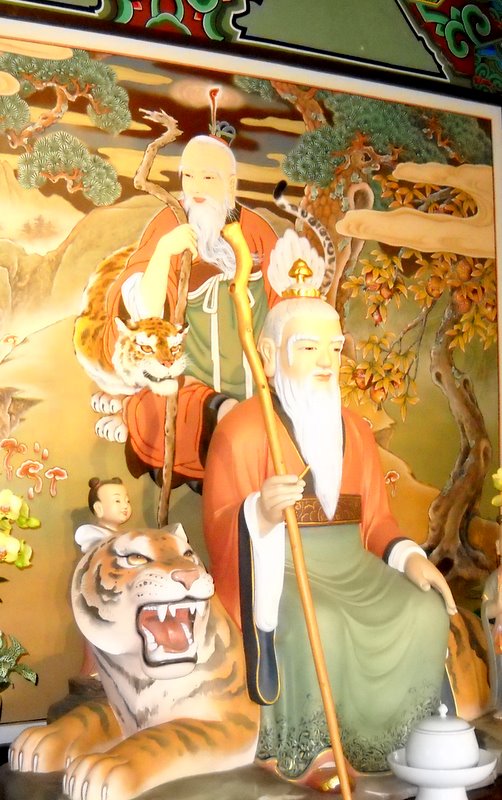
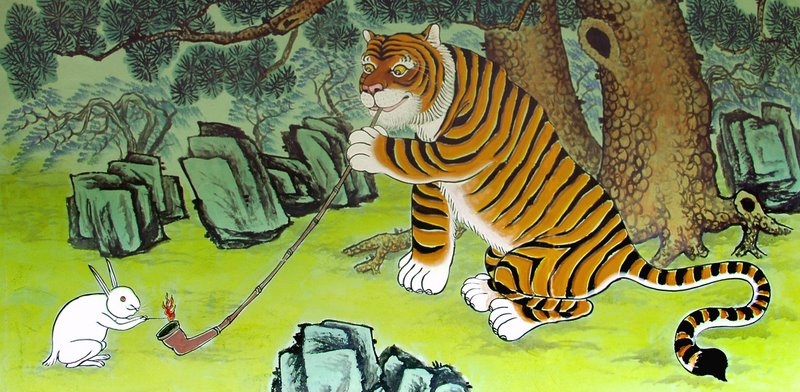
 He gave them garlic and mugwort, and they entered the cave. There they stayed, eating only garlic and mugwort. It wasn’t too long before the tiger began to have more and more difficulty with this. Soon she couldn’t resist the desire to roam and eat meat, and left the cave. The bear continued to eat the mugwort and garlic, and after just 21 days was transformed into a human being. Later, after marrying a heavenly prince, she gave birth to Tangun.




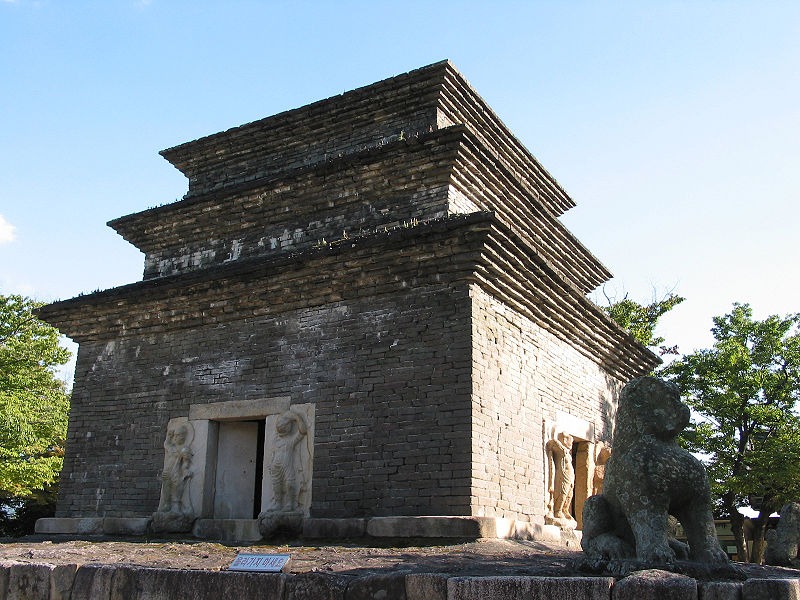


 It’s owned by the man who carved the amazing work at the main hall in Hanmaum and there are wonderful samples of his work as well as historical pieces he’s collected, including antique statues, malas, some very old monk’s robes, and other items associated with temple life.
 The grounds were scattered with Buddhas, Bodhisattvas, and even an image of Maria. It was a nice space, even the heavy, hot air felt a little fresher. On the way out, we passed some Nanking cherry bushes. I didn’t know about these before but my wife said they used to grow everywhere when she was younger. They used to sneak into their neighbor’s garden to pick them on the way to school.


 Behind the Dharma Hall, there is a huge meditation hall under construction. I always enjoy exploring temples that are under construction, the fresh smell of the massive beams, the intricate joints, not yet covered in paint. I was especial impressed by the large copper lotus on the roof supporting the Hanmaum style pagoda.