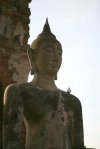
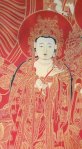
The Buddhas and Bodhisattvas are projections of our minds — and so is everything else. The idea that they don’t really exist is also a projection based on our high valuation of scholars, the modern historical method, and scientific materialism, in which we’ve been steeped since day one of our lives. Which is a more skillful projection? I’d take the former any day, because it reminds me of what’s possible, who I want to become — afterall, I am becoming something, may as well make it pleasant and beneficial for others.
If we look at our lives we can see these Bodhisattvas and Buddhas manifesting in various ways. Throughout my life certain teachers would manifest suddenly: Thich Nhat Hanh, Joko Beck, the Dalai Lama, Daehaeng Sunim, etc. (If I were to name all my kind teachers it would make a long list!) Isn’t it possible we may actually meet Amitabha or Kuan Yin? I couldn’t have imagined such a bodhisattva the magnitude of Thich Nhat Hanh, but he reached down low into samsara and is delivering countless beings with his skillful teachings and great compassion.
All my gratitude and praise to these Buddhas and Bodhisattvas emanating immense kindness, non-discriminating compassion, and stainless wisdom to us suffering fools. May they continue to turn the wheel of dharma and be our kind teachers forevermore.
Gulukhan Bucheonimke Gwiuihamnida
Gulukhan Galeuchime Gwiuihamnida
Gulukhan Sunimdulke Gwiuihamnida – The Three Refuges
I am constantly struck by just how valuable an opportunity we have here in Bangkok to study the Dharma. In order to practice Therevadan Buddhism in English there is the wonderful Littlebang Sangha, and for those of us drawn towards Korean Zen, there is the Bangkok Seon Club. Not only is it amazing to be able to study Seon Buddhism at a Korean temple while living in Thailand, but the friendliness and support of the group is something not often encountered, and very precious.
Hyaedan Sunim
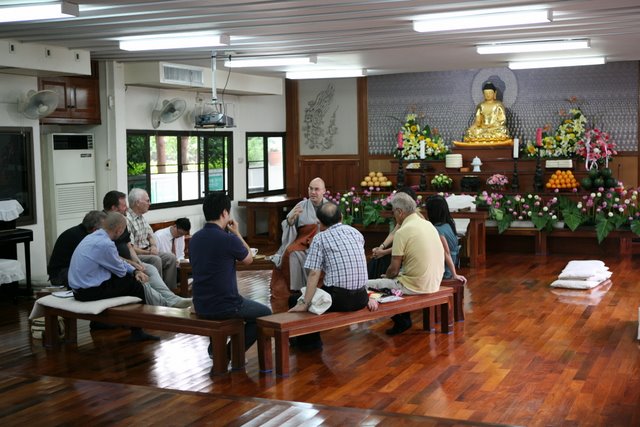
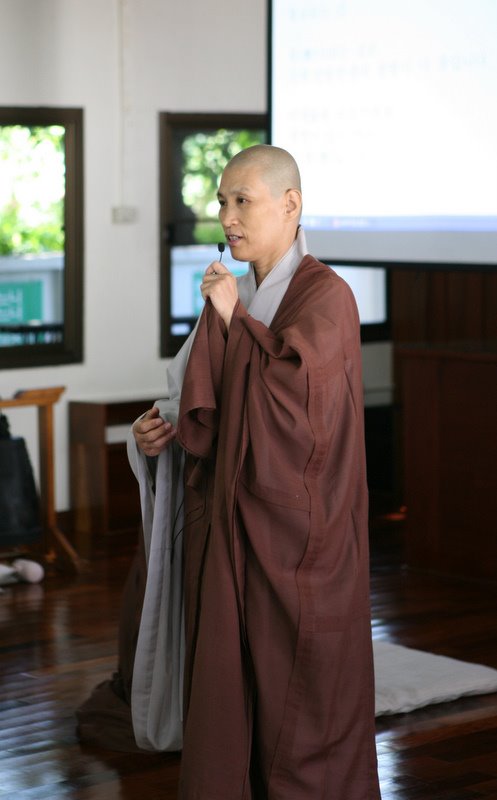
We start each meeting by chanting the three refuges, though in the Korean tradition it’s more of a song than a chant, then we bow and take our places for a short meditation. The sit is led by Hyaedan Sunim, who marks the start and finish with three strikes of the seon stick, and then we always place our cushions onto benches, which we move into a square, to briefly read a few pages of Kun Daehaeng Sunim’s book ‘No River to Cross’, and start the discussion.
Looking back through my notes from the past year of discussions, I see that we’ve covered a great deal of ground. One of the meetings that was most useful to me was from last August in which we talked about faith. I have a naturally devotional approach, and Kun Sunim’s teaching – to believe in, let go to, and observe the workings of Buddha-nature – has provided a better understanding of my faith, and a beautiful and adaptable practice I can go back to again and again.
Many of the people in the group have been studying Zen for decades in various traditions, and although I admit the discussions sometimes become a little too complicated for me to follow, I always enjoy what I am able to understand and I am impressed at how people are able to share ideas and experiences regardless of language differences. Eun Young, our wonderful translator and an inspiring practitioner, deserves huge thanks for this.
Bodhisattvas filling the sky around us
But, of course, discussion has its limits. As Kun Daehaeng teaches in chapter two, “The eternal self cannot be described by words, and it cannot be revealed through discussion. Trying to know it conceptually is like trying to know the world while trapped inside of a barrel.” Hyaedan Sunim describes it as being like a bird which has flown into a room. Banging its head against the window won’t free it.
Rather, the bird must stop its frantic activity, rest, and examine how it came to be in the room in the first place. Then the way out will be clear. This reminded me a lot of Phra Cittasamvaro Bhikkhu’s comments last year in his talks on ‘the way of wisdom’. He warned against too much conceptualisation and also suggested that simple resting, using time in practice to observe rather than engage, leads to peace and liberation.
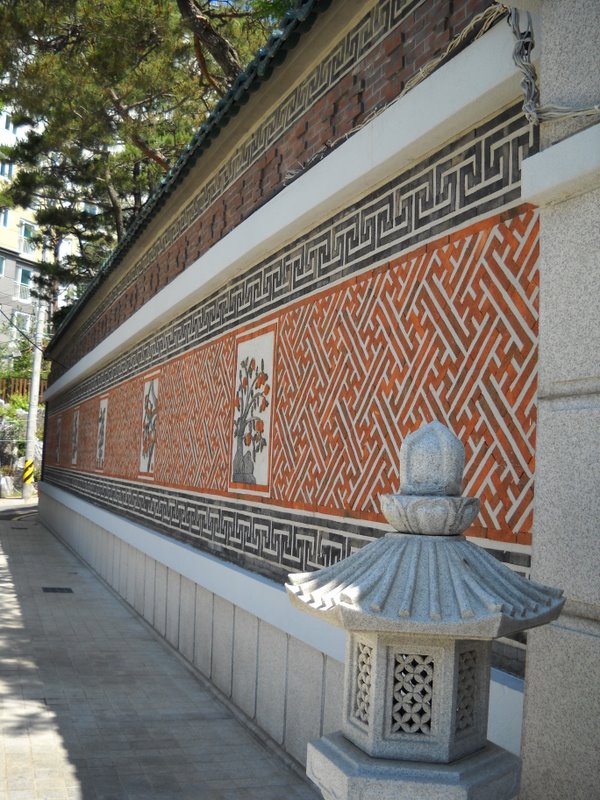
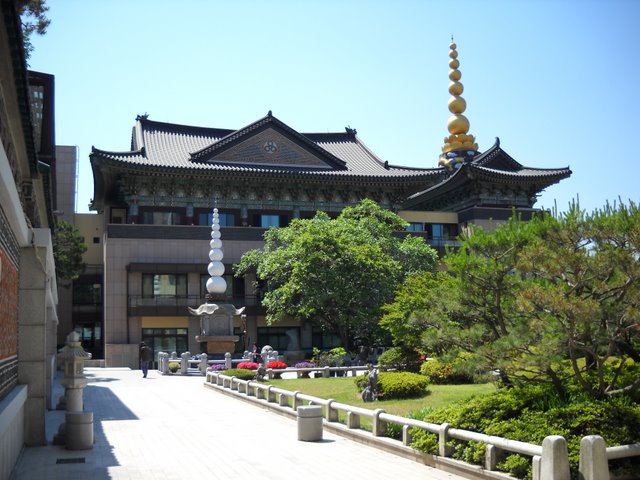
entrance to the Bangkok Hanmaum Seon Center
I’m glad I went back to look at this again. As well as that part of me that welcomes resting in faith, I also have a tendancy to try to work things out, to try to find the ‘right’ answer. Too often this ends up in pointless discussions, especially on the Internet. The beauty of our monthly Sangha meetings is that it is a place where real, meaningful discussion can happen, and where we can learn the practice of letting go. A practice I have had to return to again today, a practice I return to again and again.
Our meetings are also a lot of fun. After the discussions, and sometimes they go on very late, many people continue talking and sharing in a nearby restaurant till well after the last train has stopped running. Thank you again to everyone who makes these evenings possible. And click on the link below for details of the next one on June the 26th.
The following is the short Dharma talk by Daehaeng Kun Sunim that Marcus mentioned in the previous post.
A True Human Being
Our true mind is a great brightness that can lead us all.
This one mind, this one point
is the foundation of the Earth,
the foundation of the sun,
and the foundation of the universe.
With perfect wisdom it accepts everything and responds accordingly.
It is brightness itself,
what could possibly hinder it?
Although this brightness is in everything,
people create divisions and labels,
and then let those rule their lives.
How could they not be hindered
and oppressed in all the things they do?
A true person is the same as a Buddha.
However, let go of even the desire to become such a person,
as well as the fear of not achieving this,
instead, take everything that arises from this empty place,
your inherent foundation,
and return it to this empty place.
If you entrust it there with sincere faith,
and are relentless about this,
then from that place, your true mind will reveal itself.
In this true mind,
a Buddha’s mind and an unenlightened being’s mind
are not separate,
there’s no clean or dirty, high or low,
nor the least hint of “I did” or “I know.”
This true mind,
this completely empty bowl,
manifests every instant,
and brightly shines upon all,
with hands that aren’t hands, feet that aren’t feet,
on the path that isn’t a path.
This is the mind of a true human being.
Most temples in Korea publish newsletters, some just a few pages long, others big glossy things with a print-run of tens of thousands, and I think the fact that most include some English, and that the Jogye Order publishes a magazine entirely in English, is a real indication of the openness and forward-thinking of Korean Buddhism. The Hanmaum Journal, which is now in its 9th year and fifty-first edition in its current colourful format, is no exception. Through its fabulous photos and great articles and translations it provides a real connection to the Hanmaum Sangha, and is a delight to look through.
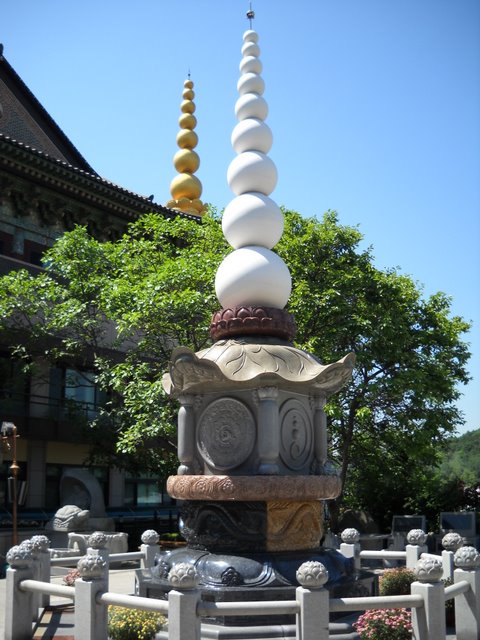
The current issue of the Journal has two main articles in English, the opening teaching by Seon Master Daehaeng Sunim, a regular feature of the magazine, and the second of a two-part article by Ki Sang Kim on the building of the Gujeong Pagoda at the Hanmaum Seon Centre in Anyang. I never realised just what a huge task building that pagoda was. Ki Sang describes in detail how he literally searched the globe, “led by unseen hands”, for just the right stone, finally finding marble of the right size, strength, quality, and whiteness in the Italian alps. Mr Kim will finish his account of how the stone was quarried and the pagoda built in the next edition of the journal.
The teachings from Kun Daehaeng Sunim toward the front of the journal are always something to look forward to. I’m told that they are not actually poems at all, but they always look like poems to me, and one day I’d love to see Hanmaum publish a small, good-quality, hardback edition of them. I’m sure that would be of great benefit to many people. This month’s teaching is called ‘A True Human Being’ and begins like this:
Our true mind is a great brightness that can lead us all.
This one mind, this one point
is the foundation of the Earth,
the foundation of the sun,
and the foundation of the universe.
With perfect wisdom it accepts everything and responds accordingly.
It is brightness itself, what could possibly hinder it?
A few weeks ago Chong Go Sunim posted another of these teachings from the Hanmaum Journal, called ‘Practicing through our Fundamental Mind’, on this blog, and so perhaps he’ll post this one too one day soon. In fact, that’s one of the things that’s so great about this blog – how it goes beyond being just a small group blog by a bunch of Dharma brothers and their teacher. Looking back over the past few months of posts I see that, right here, we have an Internet Hanmaum Journal, in English, which is updated almost every day!
So thank you to Chong Go Sunim and Joseph. Thank you to Carl and Joe, who helped set this blog up and who will soon be contributing articles, and thank you to everyone who has left comments and to everyone who reads. I hope that in the future we can bring in guest posts from across the entire Hanmaum Sangha and beyond. So if you feel inspired to write a post here that fits the theme of this blog, do get in touch, and help make ‘Wake Up and Laugh’ a journal for everyone.
The Master, whom he had expected to be the very soul of compassion, begun to shout at him, “How dare you come here seeking the dead words of men! Why don’t you open your ears to the living words of nature?”
(from Dropping Ashes on the Buddha, the teachings of Zen Master Seung Sahn)
At first, these were in fact dead words to me. I recognized the presence of wisdom but didn’t really get it! I took it too literally, something that’s never got me very far in Zen understanding… I thought to myself, “So, how do I know which words in this book are dead, and which ones are still alive?” Well, they all seemed like worthwhile teachings, so maybe they’re all alive, but they’re just printed words on paper, maybe they’re all dead??
It was a while before another experience led me back to this teaching with better understanding, and it was just that which did it… experience!
Until I had that inner experience, changing my “dead word” conceptual knowledge into the experiential knowledge of life, no book, no teacher, no amount of thinking was going to teach me.
As we open our perceptions to the fundamental experience, then words will leap to life before our eyes!
Searching for the Dharma
You’ve traveled up ten thousand steps in search of the Dharma.
So many long days in the archives, copying, copying.
The gravity of the Tang and the profundity of the Sung make heavy baggage.
Here! I’ve picked you a bunch of wildflowers.
Their meaning is the same but they’re much easier to carry.
~ Xu Yun ~
from Empty Cloud: The Autobiography of the Chinese Zen Master, Trans. Charles Luck, ed. by Richard Hunn
Here’s a talk by the Korean Seon Master, Hanam Sunim, given in 1935.* It’s a wonderful talk for anyone interested in growth and sprititual practice, and is also very relevant to everyone interested in seeing Buddhism flourish in the West.
Buddhism Exists in Experiencing and Applying
Hanam Sunim next to the Manjusri Statue at Woljong Temple
Thank you for coming such a long way to see me.
If you want to see Buddhism prosper, then experiencing and applying are the most important thing. There is a saying, “Cultivating mind isn’t done with the mouth.” Like this, modern people have an incredible amount of things that they’ve learned, but they don’t seem to be so good at actually applying and experiencing them.
People who practice sitting meditation should practice sitting meditation, those who study the sutras should study the sutras, those who practice chanting should practice chanting. If each one upholds their own practice very sincerely and diligently, then regardless of whether they are in the deep mountains or in the cities, regardless of whether many people are interested or just a few, there will always be people who want to learn and help. At this stage, you can truly be called a disciple of the Buddha. If, little by little, people put the things they experience and understand into practice, one person will become two people, two people will become three and so forth. Thus there’s no need to worry about whether Buddhism will prosper or not. In the not-to-distant future, I expect that there will be many people truly practicing Buddhism, and that Buddhism will flower throughout the Korean Peninsula.
I spoke about this before, but you have to make up your mind, tie your belt tightly, and put your understanding into practice. If you do this, then without any lectures or advertising, Buddhism will naturally prosper and spread. As you know, everyone has Buddha-nature, thus it all depends upon making up your mind and making an effort. Anyone can become a follower of Buddhism. There’s no reason why Buddhism shouldn’t prosper. It is just that people are so busy these days that practice isn’t easy, and they often forget about it. However, if you can just remember (about spiritual practice), then it’s possible for you to apply and experience, wherever you are, whether you’re working, standing, or sitting.
Everything is like this. I spoke about seon a little before, but seon isn’t something that is beyond understanding. Just make up your mind to do it and put (what you’ve been taught) into practice. My opinions or explanations about the meaning of seon won’t help you a bit. The essence of seon is determination and application, and in so doing, it’s something that one comes to know automatically. The essence of seon can’t be taught or explained. My only wish is that you give rise to determination and experience it for yourselves.
You asked me about people worshipping at shrines for the mountain god or the big dipper within the temple grounds, but although people are praying or bowing out of a desire to obtain something, even that is a type of faith. It seems to me that faith in those kinds of spirit shrines can naturally grow to include the Buddha. Because Buddhism can include everything, it’s not a problem. While praying at the mountain god shrine or the big dipper shrine, they may gradually develop faith in the teachings of the Buddha.
Manjusri and the 9-story pagoda at Woljong Temple
I’ve rambled on, but the main point I can’t emphasize enough is that we must practice and apply our understanding.
* Hanam (han-am) Sunim (1876 – 1951) was one of the leading practitioners in Korea. He was a main disciple of Kyongho Sunim, Dharma brother of Mangong Sunim, and was elected the spiritual head of Korean Buddhism three times. (He kept resigning!) In this article, he had been asked how the Japanese government could “help” Korean Buddhism (what they meant was “control”.)He wasn’t fooled, and yet still gave a wonderful talk. This interview was published in Japanese in 1936, and a few introductory remarks have been deleted.
One of the more influential aspects of my childhood was having three sisters. For the most part, they wanted a brother about as much as a cat wants fleas. For a long time, I couldn’t do anything right by my sisters. As we grew older, grievances grew increasingly pettier. I vaguely remember, around the age of ten, asking my mother if I could have a sex-change. I didn’t have a complete concept of what it meant, but I knew it would make my sisters like me!
Eventually, there was a big turning point. Although, at times, I admittedly was rather irritating, I realized that the more contributing factor was that they were also seriously irritable! Although, that realization didn’t directly change the situation, it did help me deal with it, which, in turn, helped resolve many things, internally and externally. As I matured more, I learned to remind myself of this also when I was feeling irritated or frustrated by something or someone.
-Is this annoying or am I just letting myself be annoyed?
There’s only one side of that I can truly act upon.
The colour of the mountain is the eye of Avalokitesvara Bodhisattva,
The sound of the river is the ear of Manjushri Bodhisattva,
Mr Chang and Mrs Lee are Vairochana Buddha.
– Seon Master Kyong Ho (1849 – 1912)
A few days ago my partner flew back to Japan, and after all the excitement of a week together, after far too long apart, I was left feeling sad and empty. Of course I know what I should have done, I should have sat on my meditation block and watched my breath, something I’ve done countless times before and which always makes me feel better. I could have watched the emotions and feelings rise and fall away, I could have allowed each to settle back from where they’d come. I could have practiced letting go, entrusting them all.
Instead I carried the loneliness around with me and tried to fill the gap I felt inside, and one of the ways I did that was in the spiritual section of the bookshop, looking through the latest books on Buddhism and browsing through the Christian section, trying to find the volume that contained the perfect teaching that would solve all my problems. Later, when I did finally manage to sit, I thought a little more about that search, and how it connects to what Chong Go Sunim was saying the other day about finding a teacher.
There are no shortage of teachers. Just the books I already have, each is a perfect teacher. On my desk right now I have stacks of wisdom from a number of traditions going back thousands of years. A simple click away and I have even more. Finding a teacher isn’t the problem. And not just books, I don’t know how many Dharma talks I’ve attended over the past few years. Plus, my oldest friend is a Catholic priest, my partner is a Pure Land practitioner, my best friend lives the very spirit of Zen, my Dharma brothers are just an email away.
The problem isn’t finding a teacher, I’m spoilt for choice, the problem is finding the willingness to learn. A single word of wisdom from any one of my teachers could be enough to sustain me for a lifetime, but instead I skim over spiritual advice in the same way I’d read a novel on the beach. I’m like the dried sponge that Father Laurence of New Skete talks about, “a sponge that is so old, that has sat around collecting the dust and grime of life, that when you throw it into a bathtub it simply floats! It doesn’t absorb water!”
The fact is, we really do live in a bathtub, an ocean even, of teachers – if we are willing to learn. With that willingness, every single thing, not just monks and spiritual books, can be our teacher. Daehaeng Sunim writes that the mountain teaches us to live resolute and unflinching, the flowing waters teach us to live like water, and weeds sprouting up through harsh soil teach us to live courageously in the midst of adversity. “Bad circumstances are, in fact,” Daehaeng Sunim writes elsewhere, “an opportunity to learn.”
Chong Go Sunim said last week that when learning from all that life gives us, the key “is this upright center we are all part of. This is the thing that we must never abandon. While trying to be humble and uphold the precepts, we must always keep returning to this.” For me, this means slowing down and letting go. It means accepting myself and the circumstances I find myself in. How else could I learn? It’s not in any book, it’s in my daily, moment by moment life. My practice is to open up to those lessons and allow them to flow through me.
Sources of quotations: – “Don’t Know Mind: The Spirit of Korean Zen”, Richard Shrobe
– “In the Spirit of Happiness”, the monks of New Skete
– “No River to Cross”, Zen Master Daehaeng Sunim
Although a great deal of planning had gone into the preparations for the 23-day training session that preceded our ordination, apparently no one had thought of toilet paper. Existing supplies were quickly depleted and there were no provisions for providing more. The initial response was not encouraging: “Just use less.”
“Umm, excuse me,” I wanted to say, “there is a certain, absolute minimum….”
Even eating just two meals a day, 150 men will go through a lot of toilet paper over the course of 23 days.
The logic of this was hard to avoid, and before long the overseers relented. Of course, their idea of relenting amounted to a single roll in each bathroom. Its appearance on the window ledge would provoke a frenzy resembling a stock market panic, with everyone rushing to secure a couple of arm lengths of insurance. Latecomers were left with a choice between the empty cardboard tube or the shiny wrapping paper.
For the next few days, everyone was walking around with at least one pocket stuffed full of toilet paper. Finally the overseers caved, and with a flood of heavenly whiteness, the nagging fear of being caught short was forever banished
Reincarnation This video has been making the rounds , and I thought I’d post it here for anyone who hasn’t seen it yet. The speaker is Wallace McRae, perhaps America’s greatest cowboy poet.