Haein Temple to the Jiri Mountains

Haein Temple

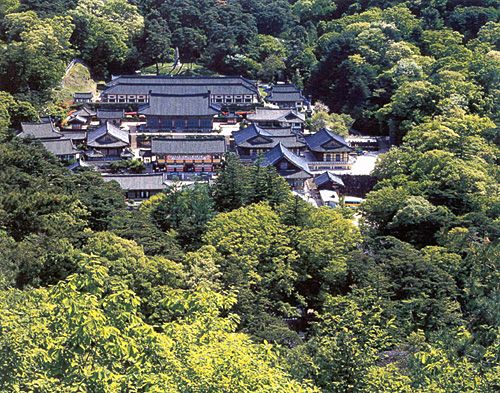
Traveling towards the Jiri Mountains, I had spent the last few nights at Haein Temple, but was down to my last six or seven thousand Won. (It would have been about eight US dollars in those days.) I’d wanted to travel like the monks of old, going where circumstances took me. So I left without taking any extra money, determined to rely upon the kindness of the sunims at the temples I visited. Normally this isn’t a problem; visiting monks are traditionally given traveling money to take them to their next destination. In practice, it’s always more than enough, usually at least 30,000 Won (about thirty U.S. dollars), and often more. 

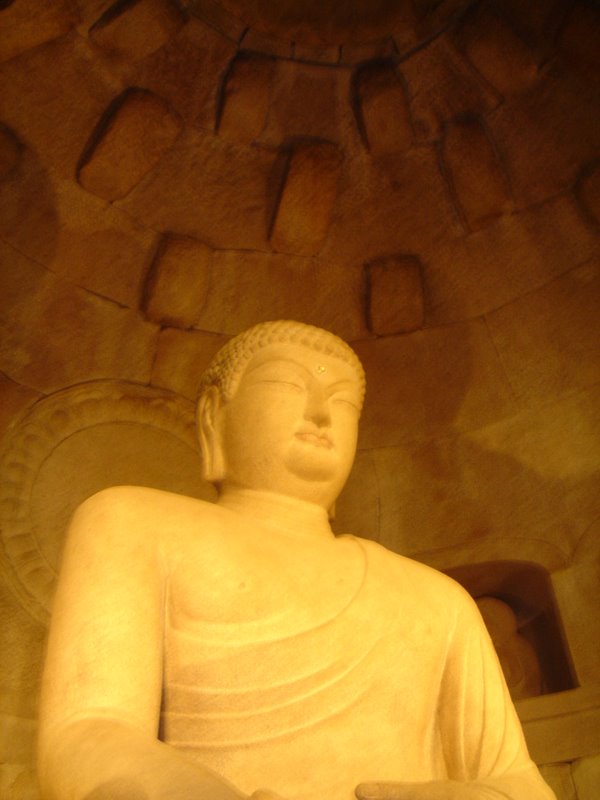
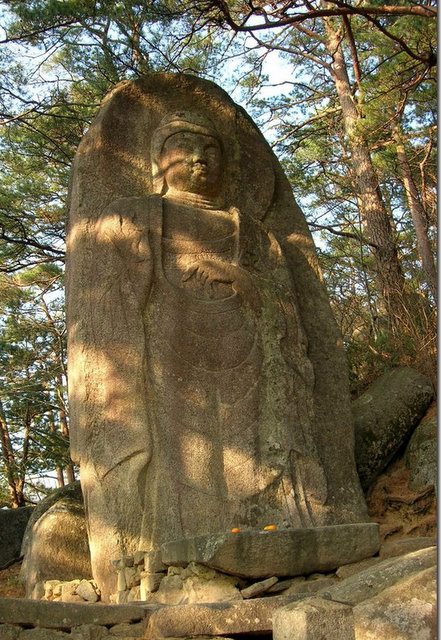
Standing Buddha on the mountain behind Haein Temple

However, upon leaving Haein Temple, I had been given nothing. In addition, while staying there, I’d been put in a dark, dirty room behind the kitchen and told to be careful that none of my personal belongings were stolen. (After thoroughly cleaning the room) I spent a few days at Haein Temple, paying my respects to the great wood-block collection of the Buddhist canon and attending most of the daily ceremonies. After the morning cleaning, I would hike the mountains behind the temple, and meditate before the huge rock carvings of Buddha. (This photo is from here, with thanks to the photographer.) 

But for some reason, the wonju sunim (the monk in charge of guests and shopping) seemed to take a strong dislike to me. On top of this, when I left, I was given no traveling money. It was such a contrast to my previous visits to Haein Temple that I was in foul mood as I headed for the valley’s entrance. With almost nothing in my pocket, I barely noticed the lotus lanterns stretching for miles along the road, or the beautiful spring flowers on the fruit trees. Anger really makes a fool out of me. 

Arriving at the bus stop on the main road, I went over to the small police station to ask for directions to a major temple in the Jiri Mountains called Hwaeom Temple. I suspected there might not be a direct bus, but I would be able to take a connecting bus from the nearest city. Bus fare in Korea is very cheap, and with what money I had, I might just make it if I stuck to the local buses. 

Strangely enough, the policeman didn’t know which city I needed to go to, nor did he even have a road map of Korea. I had started out the morning irritated and was rapidly progressing to downright angry. “How could this be?! A policeman who doesn’t know the cities in the area or even have a road map?! And what’s with that jerk at the temple treating visiting sunims so badly?!” Anger really makes a fool out of me. 

I knew I needed a bus going west, so as I stewed, I sat and waited. But part of me knew this anger was wrong. No matter how reasonable all of those justifications and descriptions, there was something fundamentally wrong with that anger and self-righteousness. I tried to let go of it, but I just couldn’t shake it. Finally I remembered what my teacher often said about aggressively entrusting the things that confront us. Determined to experiment with what she told us, I said “Okay Juingong, you’re taking care of all things, so take care of this anger too! I don’t want to carry this around any longer.” (“Juingong” is synonymous with true nature or Buddha-nature, and literally means the one that is truly doing things, but which has no fixed form.) I was still grumpy, but it seemed to help a bit. 

A few minutes later the bus came, but flew right past the bus stop. My body bolted up and I found myself shaking my fist at the bus. The driver, seeing me in the side mirror I suppose, hit the brakes and came to a squealing stop about 50 meters past the bus stop.   

I was still pretty hot, but managed to grunt thanks as I paid my fare and found a seat. A few kilometers further on, the road passed through some rice fields. Here the road bed was raised about two meters above the fields, with only about 30 centimeters of grassy shoulder on each side. Just ahead of us, a farmer had parked his car in our lane while he checked on something in a field. The only way around was for the bus to go into the oncoming lane. But as the bus barreled ahead towards the parked car, there was a car coming towards us in the oncoming lane. It was as if our driver didn’t realize that the car ahead was parked, and that he wouldn’t be able to go around it because of the oncoming car. We were closing fast on the car blocking our lane, and the oncoming car wasn’t slowing down either. In a moment two cars and a bus would be trying to occupy the same time and place. At the last instant, the oncoming driver seemed to realize that our bus had no intention of stopping behind the parked car. He slammed on his brakes as our driver wrenched the bus into the oncoming lane, passed the parked car, and then veered back again. 

It took me a minute to remember to breathe, but as I did, I noticed that our driver’s head was rolling from side to side. Now his left ear would almost be touching his left shoulder, now with a violent jerk his head would swing up, and a moment later be almost on his right shoulder, and then back again. Seeing his bright red face in the mirror, I realized that he was drunk. Not just tipsy, but a full three sheets to the wind drunk. 

My first thought was to get off at the next stop. But before I had a chance to, I remembered something I’d heard Daehaeng Sunim say about a plane crash, “This may be hard to believe, but if even one person on that plane had been practicing, it wouldn’t have crashed.” Ugh. 

I stayed on the bus, and focused on entrusting the situation, and my fear(!), to this Buddha-nature that connects and guides all things. Finally the bus reached the terminal in the city of Geochang, and the driver got off. As I watched him head for the break room to sleep it off, I ran into a friend I hadn’t seen in several years. He was living at a large meditation hall, Sudo Hermitage, about an hour away, and invited me to stay there. Later that night, as I settled in and prepared to spend a few days, I suddenly remembered about having been angry earlier in the day. 

The meditation hall at Sudo Hermitage. Photo by Chang, Dong Yeon

I couldn’t help laughing out loud, because with that terrifying bus ride, all of the anger I’d felt earlier in the day was utterly forgotten. I had raised the thought that I wanted to be free of that anger, and it had worked! By the time I got off that bus I had completely forgotten about being angry. I laughed again and thought to myself, “Be careful what you ask for!”

Occupying the same time and place as others

There’s an odd fact about non-duality, for while we each have our separate roles and appearances, we also share a common connection. Obviously this isn’t a physical connection, but it’s there nonetheless, and we can experiment with it and try to apply it to our daily life.

Jeanne, (with the Third Eye her students gave her)

I’d like to ask our readers help with something. Right now, there is a very sweet Buddhist blogger suffering from severe kidney failure. Her name is Jeanne, but she’s more commonly known as the Dalai Grandma.

Please experiment with sending her love and energy, clarity of awareness, peace, and perhaps even that her kidneys should regain more of their normal function.
       Whatever speaks to you, try and offer that. Raise that thought clearly, and then let it dissolve back into you and sink down heavily within you.

Daehaeng Kun Sunim sometimes describes our fundamental mind as a communications center; if we correctly input something into it, that input is communicated through this unseen connection. Or like an electric light, when the circuit is completed, energy freely flows back and forth. 

Because this isn’t a physical connection there is no physical limitation to this energy. The saying “there’s no near or far in the Buddha-dharma” isn’t just a philosophical statement.
 
     Let’s experiment with this and see what we can do to dissolve a bit of this world’s suffering.

Thank you,
Chong Go

A Buddhist Christian pilgrimage

A few weeks ago, on the Tricycle Community, I was delighted to see some pictures of HE Gregorios, of the Eastern Orthodox Church, and Sung-Jin Sunim, from the Jogye Order, together during the anniversary celebrations of the Eastern Orthodox Church in Korea, visiting a temple and drinking tea. As Jack, who so kindly posted the pictures, originaly taken by his friend Fr Daniel Na, said, the contrast, and lack of contrast, between these two monks is amazing.

HE Gregorios and Sung-Jin Sunim

It reminded me a lot of last year’s 400-kilometer silent ochetuji pilgrimage, carried out with prostrations after every three steps, from Jirisan to Imjingak, jointly undertaken by Venerable Su Kyung, head monk at Hwagyesa Temple, and two Korean Catholic priests, Fathers Paul Moon Kyu-hyon and Simon Chun Jong-hun. They were joined in the pilgrimage by some 10,000 people, and the purpose of their journey was to help promote the cherishing of life and peace.

Father Mark Kim In-kook, from the Catholic Priests’ Association for Justice, said that the pilgrims “showed what religious communities in our society can do for the common good”, and their joint action seems to me to be a fine example of how Buddhists and Christians often work together in a spirit of friendship.

In contrast, many of the English-language Buddhist blogs often express a surprising degree of hostility towards Christianity. But this mostly comes from young converts with little experience of life in Buddhist countries and often with uncomfortable experiences of the Church. Such people are naturally keen to draw boundaries between the Buddhism they’ve adopted and the faiths they’ve left behind.

Of course sometimes it is perfectly necessary to point out differences between Buddhism and Christianity, especially when addressing an audience unfamiliar with one or the other. It is often thought necessary to explain, for example, that Christianity is a religion in which the Truth is revealed, with the job of the follower being to believe, whereas in Buddhism one is to experience truth for oneself.

And yet even this, one of the most basic distictions often drawn, if looked at from a slightly different angle, seems almost to disappear. Yes, Buddhists are to experience truth directly through the practice of wisdom, ethics and meditation, but the Dharma was first revealed through the Buddha. Is that really so different from Christianity, in which the central truth, of God’s love in this case, is first revealed, but which is then to be experienced in the everyday lives of Christians, and developed in ongoing daily practice?

a multi faith, benefit concert for the children of Ethiopia (photo from the Hyundae Bulgyo newspaper)
A pilgrimage to visit the holy sites of different religions and learn from their teachers (photo from the Hyundae Bulgyo newspaper)


Father Laurence, in The Good Heart, describes this practice:  

through meditation, we begin to experience the indwelling, the fact that Jesus is not only a historical teacher from the past, but now has an inner existence within each human being, as well as a cosmic presence.

The Dalai Lama, in the same book, talks about Buddha-nature and how to perfect it, and compares the Christian ideal of becoming one with the father with how enlightenment is described as becoming of one taste with the dharmakaya.  

But my central point here is not about the nature of enlightenment or the relationship between revealed and experienced truths, or even about the ways in which Buddhism and Christianity share certain features. My point is that Buddhism stands on its own three feet, and while some western practitioners automatically and instinctively look for points of contrast with Christianity, focusing on areas of convergence is a much healthier approach.  

So whilst I had a very different experience of the Church to Carl (during my similarly left-wing youth I often found myself on peace marches and marches for freedom in South Africa and Latin America etc, side by side with good church people, and the Church certainly does more to help the poor than any other organisation I can name), I very much welcome the way he embraces his spiritual heritage.  

Thich Nhat Hanh, in a book called called Teachings on Love, has written that: Buddhist practice can offer effective means to heal, reconcile, and reunite with one’s blood and spiritual families, in order to discover the precious gems in one’s own traditions. Thanks to the practice, people will see that Buddhism and their own spiritual tradition have many things in common, and therefore it is not necessary to reject their own spiritual tradition.  

I don’t think Thich Nhat Hanh here is calling for waves of western Buddhists to return to Christianity. What he’s suggesting is that practitioners make peace with all our traditions, to look for what we can embrace. In this we are lucky to have so many great examples. Father Laurence and the Dalai Lama. Venerable Sukyung and Fathers Paul Moon Kyu-hyon and Simon Chun Jong-hun silently walking across Korea. HE Gregorios and Sung-Jin Sunim. People whose default position is to find areas of convergence and genuine friendliness.  

Links:
Tricycle Community: HE Gregorios and Sung-Jin Sunim
UCAN: Buddhist, Catholic clergy complete 400-km pilgrimage

What Drew Me to Buddhism: You Are What You See

I feel that how one views the universe (or, more simply, reality), and us in it–basically, what one believes and believes in, become the foundation of his or her mental health and personal happiness.  I also feel that all of us are better off choosing what makes sense–in finding a belief (or beliefs), and that then we must confidently believe in that way.  It seems to me this is natural, honest, and therefore, better for the heart and mind. Most importantly, belief that is chosen, I feel, is the true eye of one’s individual heart and mind, which show us what we believe, so it comes from within, is original, and is thus not contrived or forced. You could say that what we see as true, and thus believe, defines us. You are what you see?

In this article, I talk about belief-particulary personally found belief- and what caused me to find comfort in Zen, as opposed to another practice or faith. I do not wish to say, however, that one religion is better than another, for everyone. I do wish to tell my personal story, just as a painter, poet, novelist or film-maker attempts to show his personal vision, which is basically his or her mental experience.

As an example illustrating my frustration with those who might criticize a practitioner of a faith, and to draw an analogy between practitioners of a faith and artists (to show that belief is as personal as personal vision), let me digress and mention the film director Oliver Stone. He made the movie JFK to show what he and many see as a possible series of events explaining a part of history that has been unsatisfactorily explained by the government of the United States. He was criticized for poorly representing history. I heard him speak, and I was impressed with his detailed knowledge of the history and the era which he was a part of. He weaved together a story that was in shreds at all edges. A story that was left in a pile of uncertainty.  He was not supposed to represent history. As an artist, his charge was/is to represent what his perceptions, available knowledge and his talents reflect. His responsibility was/is to himself, in showing what his mind and its perception of the world has shown him.

A Practioner of a faith, be it a celebrated one or one that is invented by oneself (or an amalgam of other faiths) has one obligation; to see it, understand it, follow it, and perhaps, express himself honestly about it. When you think about it, this is how Christianity and Buddhism came about; Hanmaum, and Interbeing, too. Through self-reflection, Jesus and Gautama found ways to express their truths, as truth was revealed to them, though it diverged or grew from practices of the day. Dae Heng Kun Sunim does this. Thich Nhat Hanh, does this. We all do this, to one degree or another. Spiritual individuals-whether they are great prophets, monks, or the sons of God or artists-change faiths–or at least practices of a faith-to present their perceptions of those faiths and reality as they see it. This is what the human mind should be able to do, without criticism.

I was raised Roman Catholic, with a heavy sprinkling of born again-ism, in Long Island’s sleepy New York suburb of Lynbrook. With  it’s “prefix” and “suffix”  reversed, Lynbrook is Brooklyn, so you can imagine who renamed it, from the original Pearsall’s Corners, and perhaps, who settled it, for the most part. I myself was born in Brooklyn. How did I wind up a “Zennist”, studying Buddhism in Korea?

I was taught to love everyone. And, in my opinion, I was raised in  a country (and especially a state), where it is-as my friend Tony Watkins says-practically un-American not to criticize your nation. So I was brought up to be compassionate, but critical. My mother was the church-goer, my father the activist-democrat. So I grew up thinking. A lot. Thinking and writing, and going to church on Sundays. But church, the older I got, seemed to gather people with a less than compassionate practical philosophy and a very conservative style of politics. 

As a teen-ager, I had taken up reading American cold war history, specifically about the Viet Nam “conflict”.  I had become an Urgent Action letter-writer for Amnesty International’s Program to Abolish The Death Penalty. I marched against war and military Aid to Latin American countries.  The biggest opponents of what I was doing seemed to all be people of the faith I was raised in. I couldn’t understand this.

It had seemed to me that everything that the Christian faith asked us not to do, we were actually making a part of our daily lives, and in fact, it seemed these were the real actions and concepts Christians believed (in practice, anyway) and this bothered me; specifically support of the death penalty, interventionist wars,  a lack of compassion for the homeless, those with aids, those in jail, and policies that violated the sanctity of a woman’s right to choose what to do with her own body.

In short, no matter how I looked at it, most of the church people I knew were either in support of, or oblivious to the most egregious violations of compassion worldwide, and not on a small scale. 

Then there was the religious view of science. The religion I was raised in had a history of going against common sense, empiricism, and reality, quite frankly.  I haven’t mentioned it, but my passion as a boy was astronomy and I loved biology too, and I was always hearing “we didn’t come from monkeys” from religious people. Well, evolution doesn’t say we do, either. I was forced to see that many people of the church are victims and purveyors of gross ignorance.

One day in the bookstore, I came across a book by Thich Nhat Hanh.  The Venerable Tich Nhat Hanh brought together spirituality and social action. This represented for me, responsible, and spiritually honest living.

When I was in high school, it was the church goers who were attacking free speech, trying to put prayer in schools (not fair in a nation that professes the idea that religion and state be separate), and trying to say we shouldn’t give condoms to people in Africa, where AIDS was running rampant.

The Buddhists I met and read about lived the lives they believed in. In fact, many were vegetarians, pacifists, and very open-minded and progressive. None were telling me I had to give up believing in the sensible laws of physics, or of evolution, or that I had to support one or another war. They didn’t teach through fear, or a greedy desire to go to Heaven.

I am aware that there are good Christians, that they have charities all over the world, and that there is much virtue in that faith and the many denominations of Christianity. In fact,  I am still happy to say I have a Christian heart, while maintaining that I am attempting to cultivate a Buddhist mind. I still go to church, from time to time, and my girlfriend is a protestant, bringing much love and forgiveness into my life through her faith. 

I even believe the Christian-Judaic foundation is part of what makes America and other Westernized democracies great in certain respects, for it instills the notion of the sanctity of the individual and his rights in society; something I feel is lacking to certain major degrees in Confucianist and other male-dominated societies, which has definite deleterious effects on the growth of the individuals in them, politically, maturation-wise, and spiritually.

Buddhism seems to conflict very little-if at all-with science, carries a major underlying message of love and compassion (with no exceptions), and seems to be practiced by people who show a great deal of peace of mind–more than the adherents in the God-based faiths in my observation–who always seem to be leading their nations to war.

So, I read Tich Nhat Hanh, and it made me peaceful. I read Suzuki, and it made me sit.  I read Lao Tzu, and it made me see great wisdom (I still love the compassionate stories of Jesus, however, and think they are of  prime importance in learning to be a humane human being).

In my early twenties, I poured coffee for His Holiness The Dalai Lama at The Rainbow Room in New York City, and I realized I had never seen a spiritual or political leader more jovial and happy in my life. In fact, I had never seen anyone who laughed so heartily while shaking so many hands. Thoughts of Santa Clause entered my mind. ‘This man was at peace’, I thought.

I found people of a softer mind and infinitely less judgemental heart  in the Buddhist friends I made, and finally, in Korea, I discovered a way to practice that showed a reflection of that idea I cherish: the importance of the “individual”.

Dae Heng Kun Sunim’s focus on the “Juingong”, or the True Doer of our actions, to me, advocates the bringing of  salvation to the individual from the individual, so to speak. I don’t find it conflicts with theistic faith, either, in that Jesus, for example, taught that the kingdom of heaven is within, as is God.

The Buddha taught that man should take refuge in himself (not in The Buddha, or in a god). For many years, to my eyes, I had felt it was the process of supplication to an exterior source that was causing the apparent  lack of true spiritual growth, open-heartedness, and open-mindedness (as well as an increase in  greed and feelings of victim-hood) in the people around me who were dedicated to the theistic faiths.

*I do not actually claim to be a Buddhist. I find the sects of Buddhism, like those of Christianity, do not follow what the Buddha taught exactly, any more than Christians really follow Jesus, but what I like about being associated with this practice is that there are no real major divisions among Buddhists causing major strife over differences in opinion, and there is no hell-fire and brimstone talk that teaches out of fear. You don’t see Buddhists supporting war, or fist-fighting, for that matter. Well, not much, anyway.

Finally, I think of myself as a Zennist. Meditation was at the heart of The Buddha’s enlightenment, and his teaching, and it has been at the center of any self-induced growth I  have had. That is what makes Buddhism a person and people-transforming practice; the sitting, the looking inward, and the cleaning of the mind’s “slate”, as it were; the opening of the heart, where truth comes in through a lack of arrogance and an increasing of peace, and where dogma plays no part.

To me, this is the true value of any religion or philosophy; how well it transforms individuals, and then, masses of those individuals, such that they are more peaceful, loving, kind, and open to learning and growth in all positive ways. Any belief that limits these virtues is to be questioned and examined, to the greatest possible depth, because, as I said, you are what you see; it becomes your belief, the foundation of your mental health and personal happiness, and affects those around you.

Saving others, saving ourselves – part 2

Here’s one of my favorite folk tales from Korea, with a deep message about life and practice.

     A traveler had spent the night at a guest house deep in the mountains of Korea. He was eager to start out early the next day and get across the mountain range before dark. There was a little snow falling that morning, but it looked as if it would soon stop. As he was getting ready to leave, one of the other guests mentioned that he was going the same way, so they decided to travel together.

     They started up the mountains, and made good progress for a while. However, instead of stopping, the snow seemed to be increasing. By late in the afternoon the snow was getting deep and they were still far from the next village. It was about this time that they came across a man who had collapsed in the snow, apparently from hypothermia.
    The traveler started helping the man up, rubbing his arms and legs, trying to get some life back into him, “Come on,” he said to the other man, “give me a hand getting this guy up on my back. If we take turns, we should be able to get him down the mountain.”
    “Leave him. Carrying him will take too much effort, and he’ll slow us down. We’d better get to the next village, or we’ll be done for as well.”
    “Well, we can’t just leave him here to die.”
    “If you want to kill yourself looking after him, that’s your business. As for me, I’m getting out of here!” With this, the second man took off into the snowstorm.

     There were a few times the traveler wondered if he wasn’t being a fool. But he struggled on through the night with the man on his back. Finally, just after dawn he staggered into a village. 


     Later, he found out that the other man he started out with hadn’t yet arrived, nor was that man ever seen again. It turns out that in trying to save the man who collapsed, the traveler had saved his own life. For in that bitter snowstorm, carrying that man on his back had protected both men’s body heat from the wind and cold, while the effort he made had helped warm them both.
      Ultimately, the one who had focused on his life alone, lost his life. And the one who had been concerned with others, saved his life.

And if you believe that this Earth, this middle realm, functions to sort beings into higher or lower realms, the traveler gained much more than merely his life.

Bongeunsa and a thousand days of prayer

I first posted this on my now deleted personal website (‘Marcus’ Journal’) in September, 2009. Apologies to all those who have read this before.

Founded in 794, I first went to Bongeunsa temple in 2002 and was amazed at such beauty in the centre of Gangnam. At that time I was in Korea with Dao, from Thailand, and sometimes went with her, and once I went with my best friend Colin when he came to stay on a visa run from Bangkok. And I’d often go alone. I’d find a quiet place to sit and I’d listen to the chanting going on in the halls and look up at the trees and the temple roofs.

I started going more regularly, this time with Ikumi (from Japan), when I went back to Korea in 2007. We’d go whenever we were in the area and one time, while we were still finding our way around the order of chants in the evening services, a kind Korean woman came over to us who could speak Japanese and penciled in for us what and when to chant, when to sit, when to stand, and when to bow.

Later, I used to go every week with my Dharma friends after Saturday Sangha discussions at the Buddhist English Library. We’d travel across the city together, stopping for coffee before going into the temple, and almost always pick up some Buddhist nick-knacks in the temple shop. I can still remember the smell of the main hall, a smell of evening sunshine, warm wood and incense.

The temple drums would be sounded outside as everyone settled into quietness, with laypeople sitting towards the sides of the temple and the monks on cushions of a different colour in the middle. The deep sound of bells marked the start of the service and the first chant was the Heart Sutra. That was followed by the Thousand Hands Sutra and then came the Kwan Seum Bosal chant with 108 bows, a practice I always dedicated to my sons.

To make a full prostration, oh-che-tu-ji, in a Korean temple, you start from a standing position and, with your palms together in front of you and your back upright, kneel on the floor. Then place your hands on the floor and bend until your forehead rests between them. Next turn your palms upwards and lift them from your elbows to the level of your ears. Put your hands back down and lift your body back into a kneel. Then stand and repeat.

I remember the very first time Ikumi and I tried to do a full 108 bows during the Kwan Seum Bosal chanting. After just fifteen minutes I’d totally lost count of the number of prostrations and my admiration for the mainly elderly temple regulars had skyrocketed. My leg muscles were trembling and I was worried I’d be sick. The ajumas in front of me were making two perfect bows to every one of my sloppy ones, and I redoubled my efforts.

We made it, but only just. After some half-bows, ju-doo, to the people around us with the wish that they may become Buddhas and three final painful full prostrations to the Buddha, Ikumi and I clung to each other as we shakily approached the temple steps. The slope down to the gate was agony. We crossed the road and headed straight for the nearest coffee shop, glad to be able to sit for a while and take the whole experience in.

Over the following months I got better at it, and by the time I took formal refuge in May 2008, performing 108 bows was a lot less of a challenge. That’s not to say I could do it particularly skillfully, and I certainly couldn’t match the incredible bowing of the monk with the glasses who was always there at the back of the hall every time we ever went to a service at Bongeunsa.

I later learnt his name was Venerable Myeongjin and that he was the abbot of the temple. His bows were perfect. Every prostration identical to the one before and the one after, and all in perfect timing. He was like a metronome for the rest of the hall, the model that everyone aspired to copy. He also looked like a really nice person, with a ready smile and a calm manner.

What I didn’t know was that Ven. Myeongjin was carrying out a 1000-day prayer retreat confined to the temple and performing not 108, but a full 1000 prostrations each day. This incredible practice started on December 5, 2006, and ended on August 30, 2009. During that period he left only once, to attend the funeral of the former President on May 29, 2009.

“To keep this promise with Bongensa Temple members as well as Korean Buddhists,” Myeongjin said in an interview just before he completed his retreat “I would often set two alarm clocks on the days I went to bed late. There has not been a single day that has passed in leisure. There were times of distress, but with the faith and support of the faithful I will finish in good shape.”

The aim, he said, was to make the temple a place of genuine practice. And from what I saw and experienced there, he achieved his goals. The people I met in that temple, both the regulars and others, were not just welcoming, but also clearly committed to practice. The main hall was always full of people bowing, sitting, and quietly chanting, and there was never any noise and always a feeling of complete devotion.

Venerable Myeongjin’s period of practice also saw membership of the temple rise from 200,000 in 2006 to 250,000 members now. Likewise, temple income also rose and, under Myeongjin’s leadership, all financial records were made available to the public. Again it seems to confirm what has been my overall impression of Korean Buddhism, an impression of openness, strength and a seriousness about the Dharma and its future.

Ikumi used to wait for me on the bench outside the shop before going together to the main hall, and after the service we’d walk around the temple buildings, or sit together quietly.  Joseph met a woman there one week who later became his wife. Carl performed prostrations with a determination we all admired. And Joe knew the chants off by heart, and I’d follow his voice as I stumbled through them myself. There are very few places in this world I love more.

Photo: The amazing picture at the top of this post was taken by my friend Joseph and is used here with permission. For more of Joseph’s great pictures of Bongeunsa, and many other places too, follow the link below. Highly recommended.

Links:

Jogye Order: Bongeunsa Abbot’s 1000-day Prayer Retreat


Wikipedia: Bongeunsa


Bongeunsa Temple English site

Joseph Bengivenni’s incredible photos

Hanmaum Seonwon Choir Festival

The Hanmaum Seonwon Choir Festival was held a few years ago in support of a cancer charity. A CD of the concert, with English subtitles, was released and is available, I think, from the Hanmaum International Centre for anyone who would like to purchase a copy.

Tanya reminded me of this in yesterday’s discussion about music, and she kindly uploaded this You-tube video of two of the songs from the concert. The second is especially close to my heart as this is the song the Bangkok Zen Club sang (in Korean!) for Buddha’s Birthday this year. I still know the words off by heart!

Thank you Tanya for providing this, and thank you Chong Go Sunim for kicking off the discussion – and for your singing contribution in the Festival itself! Look closely, and you’ll see our very own Chong Go Sunim singing in the video!

While living this life of one brief season,
if you cultivate your mind and awaken,
your one thought manifests in the world,
and saves your country.
Ice melts and water flows down ten thousand valleys,
fish dance and play, flowers bloom and birds sing,
the fruit of practice ripens naturally
– let me know all ten thousand flavours.

While living this life
in which everything changes every instant,
if you cultivate your mind and awaken,
a single thought becomes wisdom,
and saves the village of our earth.
All over the world innumerable beings are opening their eyes,
rising above the sea of mind, spontaneously bright.
You yourself become the source of light
– awakened to your foundation.

(Translation is copyright 2010, the Hanmaum Seonwon Foundation)

Link: Buddha’s Birthday at Bangkok Hanmaum

to the bones

Here’s a song that really touches me. It’s by Johnny Cash, near the end of his life.
It reminds me of the great love he had for his best friend, June, and how hard he was trying to hold to what’s true.

There’s a line or two in this song that I don’t really connect with, but overall this video has such a sense sincerity that after watching it, the usual background noise of whining and petty thoughts seems to fall away.

In saving others, we save ourselves

This is one of my all-time favorite cartoons; in English it’s published in “Zen Speaks,” by Tsai Chih Chung.*  This is from the original Taiwanese edition.
 

“One day, the Buddha Shakyamuni was meditating when he heard the sounds of beings crying out in great pain. As he looked throughout all realms, he saw that the cries were coming from a hell realm.

There, one man in particular was begging him for help.o

o

o

o

o

Using his sublime abilities, the Buddha looked into the man’s past:

He’d been an infamous brigand, for whom no deed was too evil.

“Alas,” thought the Buddha, “did he do no good?”

o

o

o

o

o

ooo

 o

oThere had been one time, after robbing a village, that he made an effort to avoid stepping on a spider.

o

o

o
 o

o

o

o

o

o
 

“So,” thought the Buddha, “let the spider save him now.”

o


o

o

o

With this the spider sent a single strand of silk down into the depths of hell.

o

o

o

The man grabbed ahold and began climbing out. However, everyone else was also trying to climb up that single strand.

“Hey! This is mine! Get lost!” And he cut the thread below him, dropping all those other people back into hell.

o

o


o


  However, in the next moment, the thread just above him broke, almost as if some hand, perhaps his hand, had reached down and cut it.


o

o

o

o

o


There’s no saving myself alone.
Only by including others, can I be saved.


* Tsai Chih Chung is a gifted artist, and an incredible interpreter of the Chinese classic texts of wisdom. If you were ever the least bit curious about the great philosophers of China, check out his books.

Behold, I am become Mara, destroyer of worlds*

A few days ago Barry from Oxherding commented on a verse of the Dhammapada (at Without Bounds) about the influence of Mara, otherwise known as the King of demons:

The one who lives for sensation,
Indulgent in eating,
Lazy, and lacking in energy,
The tempter Mara, breaks,
Just as the wind breaks a frail tree.**

 
I read this as a warning, that if I live without any self-restraint, I’ll eventually succumb to some temptation or situation that will break me (physically or spiritually).

 However, to Barry, it felt like something was missing: 
“…none of these translations really gets to the key point for me. That point is: To indulge in the pleasurable *is* to be overcome by Mara. Even that doesn’t feel quite right. Perhaps it’s not so much that Mara overcomes, as that we *become* Mara, our inherent Mara-nature co-arises with indulgence.”

Becoming the destroyer of worlds

This is a great point, because it feels like once I succumb to temptation, I am Mara.  I’m the one occupying that unwise thought or action, though there may be some disquiet telling me something’s wrong. You’ve probably heard the joke, “it seemed like a good idea at the time”? Sometimes it’s not so funny.

To be overcome by delusion — to succumb to Mara — is to be doing or thinking something that seems good, right, and pleasureable, and yet is unhealthy for myself, society, and the planet. At that moment, I am Mara, destroyer of worlds. While thinking I’m doing something good, I’m destroying the enviornment, other’s lives, and my own life.

 To be lost in ignorance,
mistaking delusion for truth,
the unhealthy for the healthy,
how to take even one step forward?

 
So, for me, the key question is how do we step back from this Mara-nature when we’re in the middle of it?  What do we do when we can’t be sure about which way is up and which is down, about what is good and what isn’t?

The only reliable method for me, is to let go of everything:
To let go of the things I don’t know, as well as what I know (which is probably incomplete, or incorrect), and to entrust it all to this bright, inherent Buddha-nature that we all have.

Daehaeng Kun Sunim often compares this true nature to a smelting furnace: it burns away all impurities, and what comes out the other side is pure gold. All I can do is entrust it with what I know, and what I don’t know, and go forward with empty hands, trusting in this empty place that is the source of everything.

This is what works for me, (although I’m not always successful at implimentation.)
What works for you? How do you recover from an incarnation as Mara?

with palms together,
Chong Go


–A bit beside the point, but still important, is the question “what is this Mara-nature?”

Obviously, any good Buddhist is going to know there’s no such fixed entity out there. (right? ;-)) In Korean Buddhism, there is the concept of “karmic consciousnesses,” that is, karmic states of consciousness, or echos of states of mind. When these return to us, they come out through our brains, our awareness, and so we identify with that feeling. “I’m the one who feels that.” Instead, it helps a bit if we realize this is just a karmic echo occupying the same time and place as us, much like a fart in the room. “That’s not me, that’s just here at the same time, and if I wait a bit, it will pass.”

*The actual quote, paraphrased by Robert Oppenheimer as he witnessed the first  atomic bomb, is “Behold, I am become Shiva, Destroyer of worlds.”

**This is from my favorite translation of the Dhammapada, by Balangoda Ananda Maitreya