The Passing of Daehaeng Kun Sunim

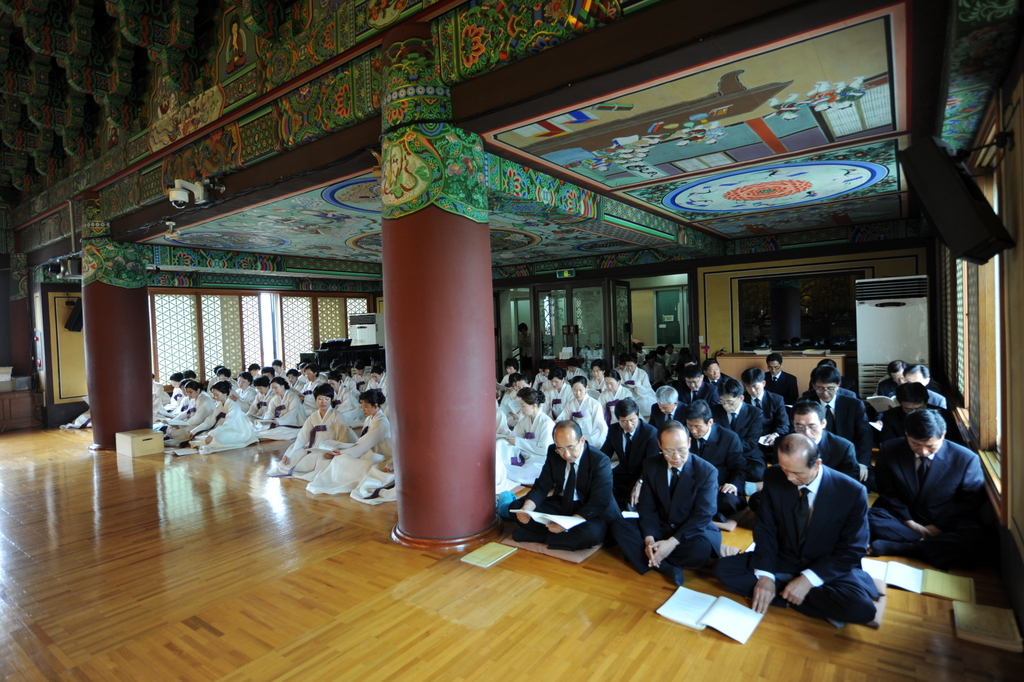
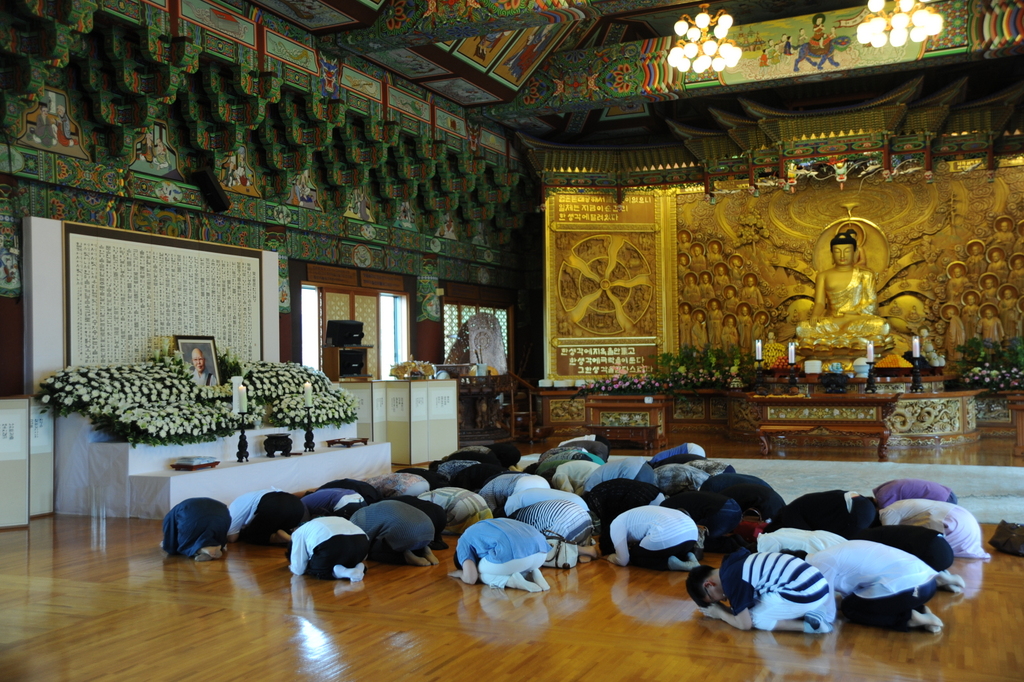
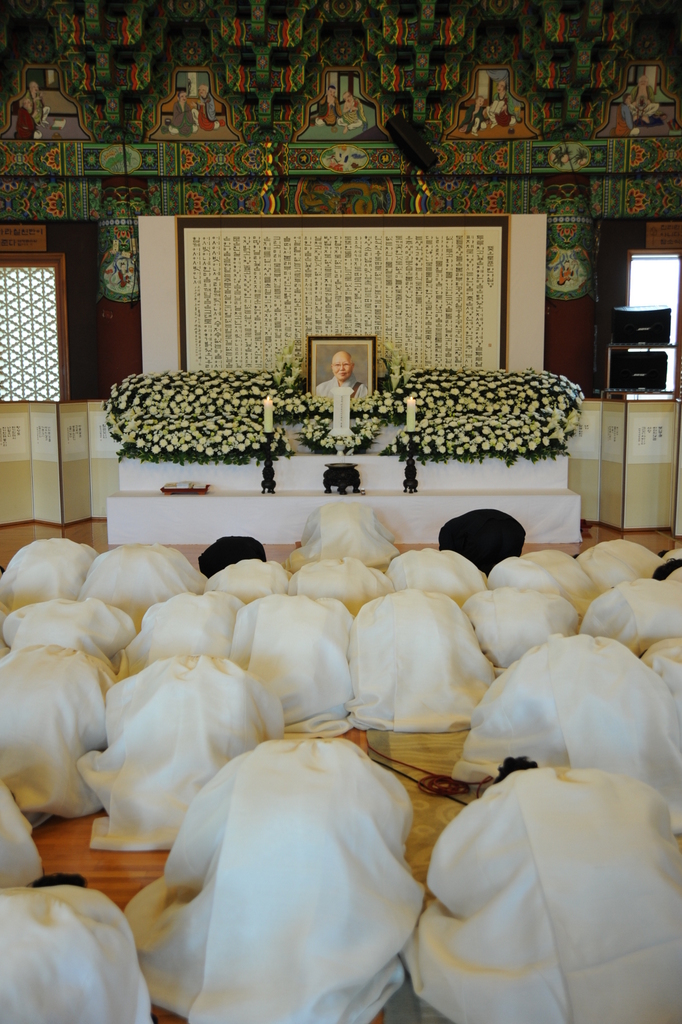
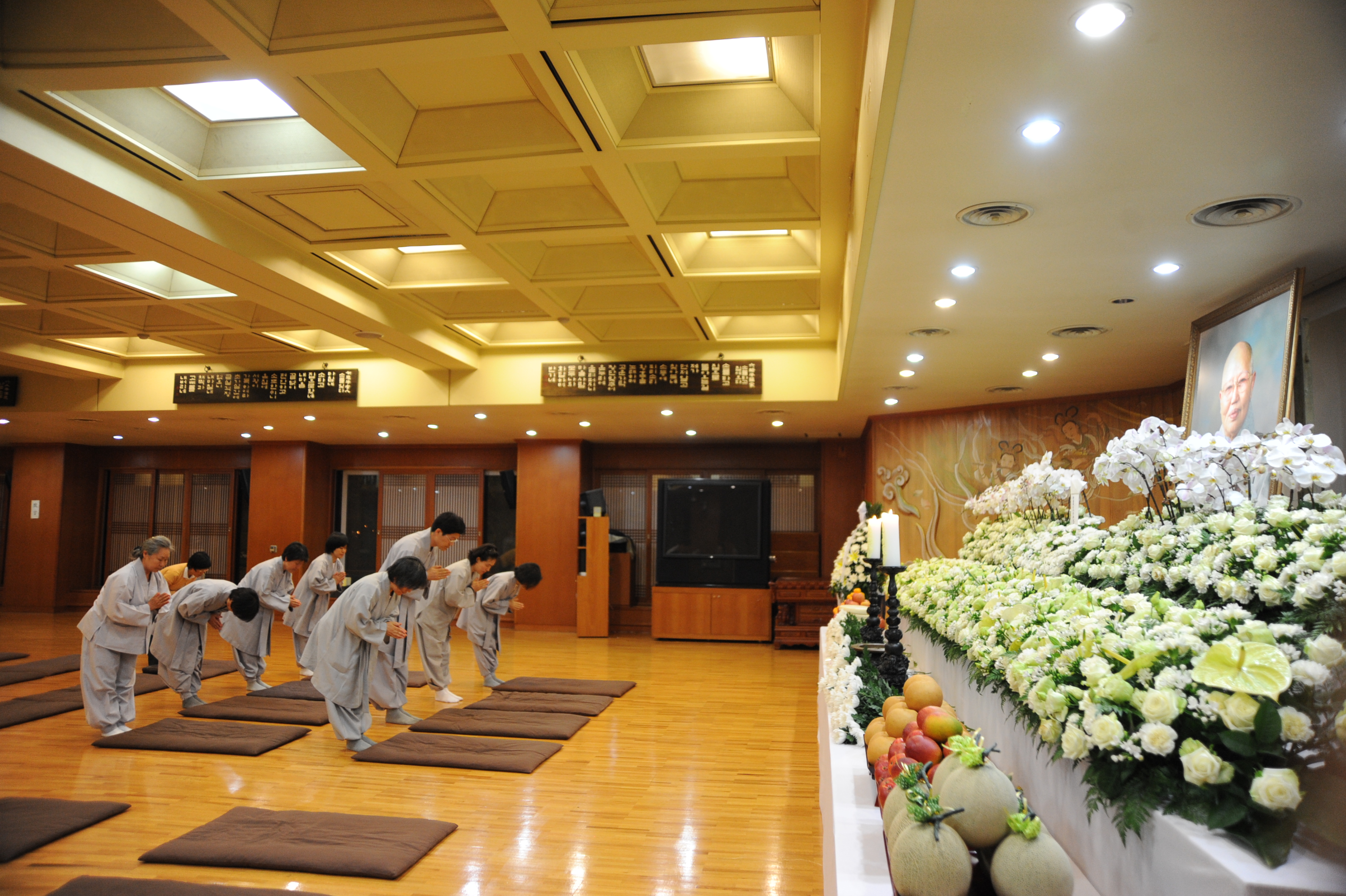
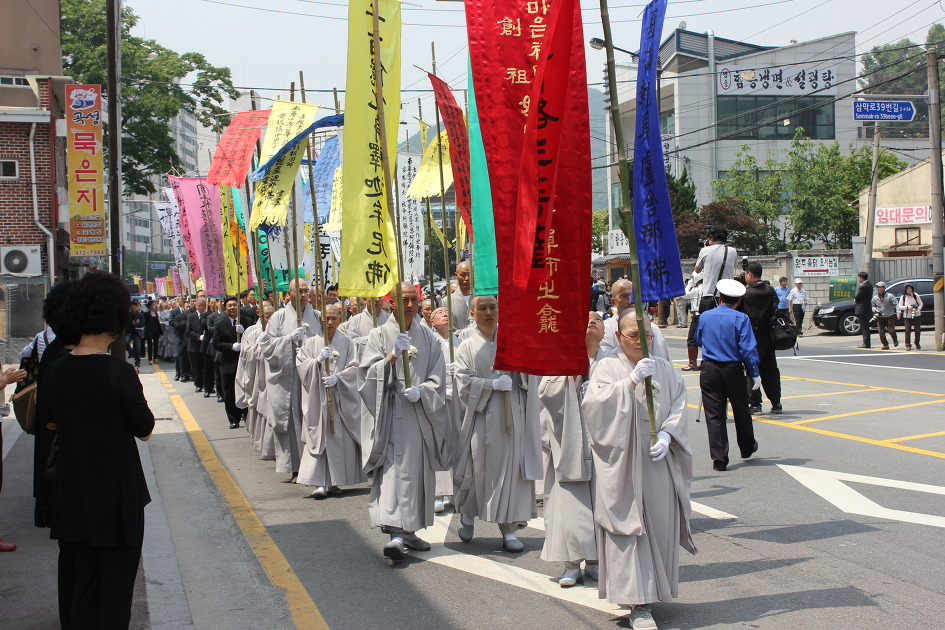
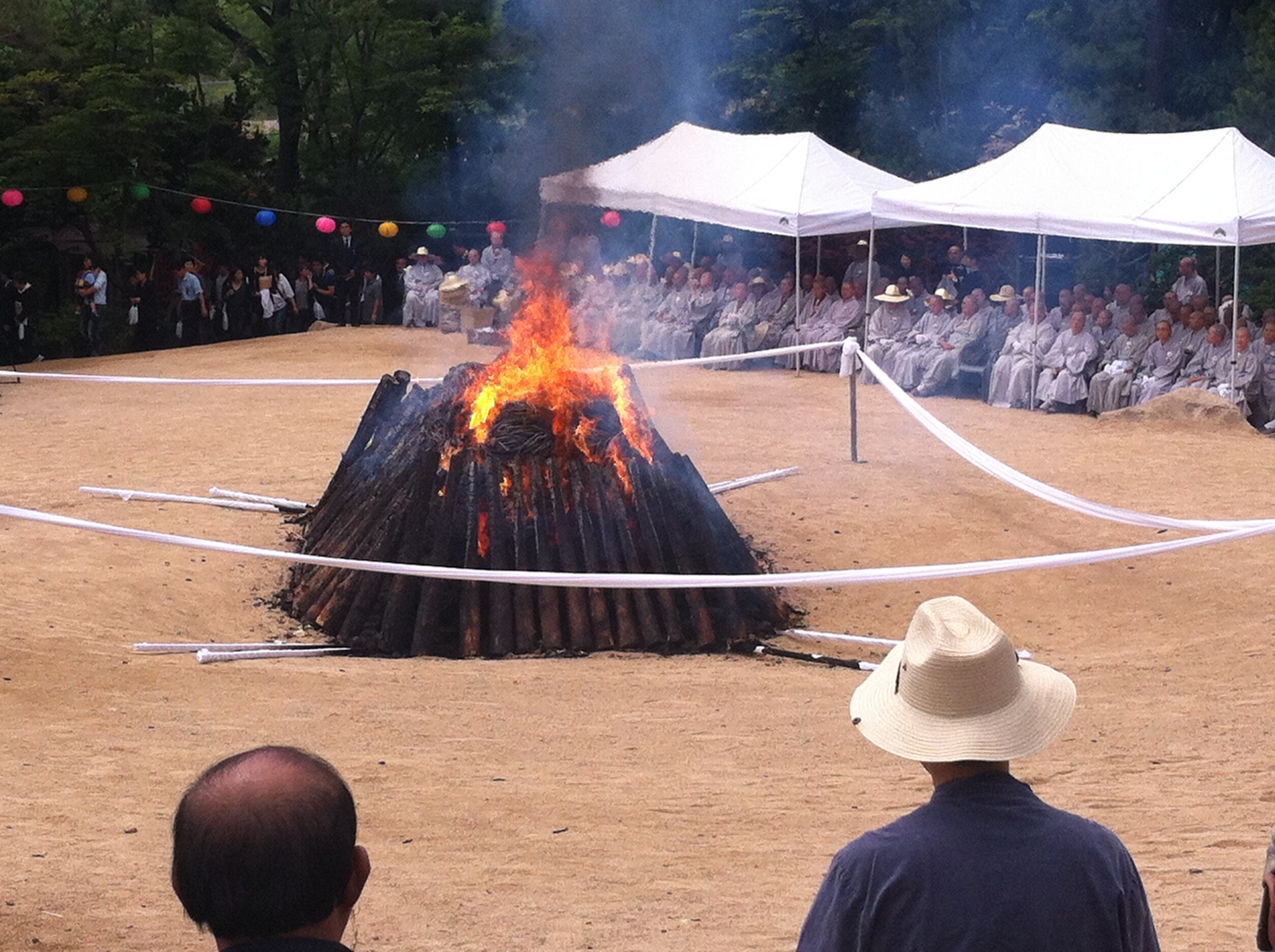
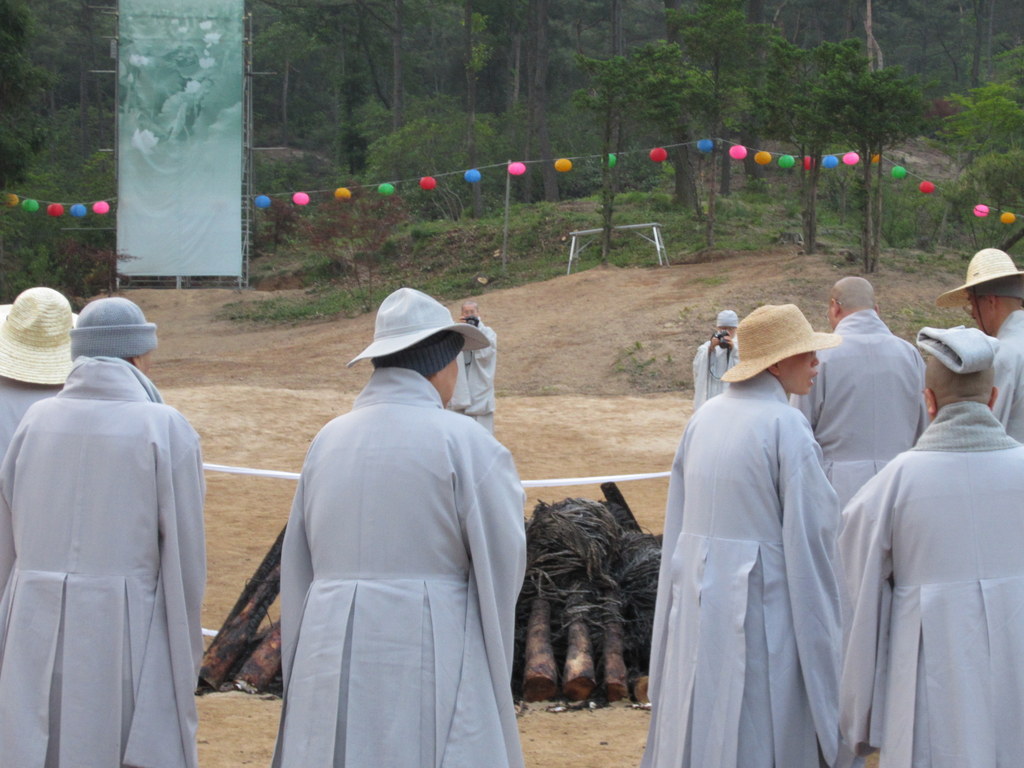
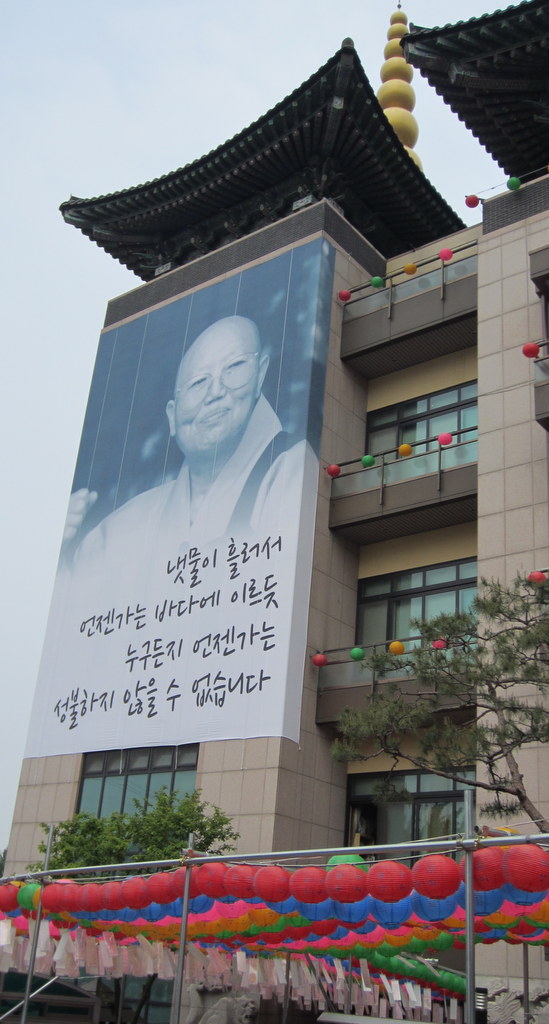
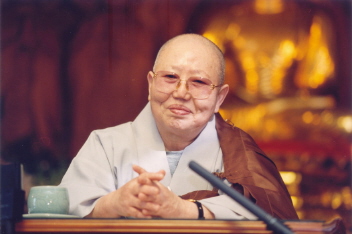
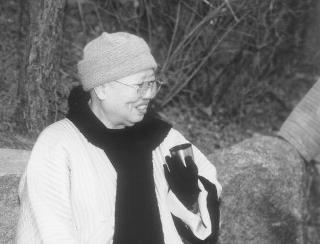
(Seoul, Korea) Hanmaum Seon Center regrets to announce the passing of our beloved teacher, the venerable Daehaeng, on Tuesday, May 22, 2012. She was 85 years old, and was ordained as a Buddhist nun 63 years ago. The funeral will be held on Saturday, May 26th, with more details to follow as they become available.

Daehaeng Kun Sunim* was a rare teacher in Korea: a female seon(zen) master, a nun who also taught monks, and a teacher who helped revitalize Korean Buddhism by dramatically increasing the participation of young people and men.

She made laypeople a particular focus of her efforts, and broke out of traditional models of spiritual practice to teach in such a way that anyone could practice and awaken. At the same time, she was a major force for the advancement of Bhikkunis (nuns), heavily supporting traditional nuns’ colleges, as well as the modern Bhikkuni council of Korea.

Born in Seoul, Korea, in 1927, she awakened when she was around 7 years old, and spent the years afterwards learning to put her understanding into practice. She would wander the mountains of Korea, wearing a ragged set of clothes and eating only what was at hand. Years later, she said that she wasn’t pursuing some type of asceticism; rather she was just completely absorbed in returning everything to her fundamental Buddha essence, and seeing how that affected what she entrusted.

This greatly affected her teaching style later, for she could clearly see the great potential, energy, and wisdom inherent within each of us, but saw that people suffered because they don’t know about this, and instead were looking outside of themselves. Clearly seeing the great light we each have, she taught people to rely upon this inherent foundation, and refused to teach anything that distracted people from that.

Her deep compassion made her a legend in Korea long before she formally started teaching people. She was known for having the spiritual power to help people in all circumstances with every kind of problem. She compared compassion to freeing a fish from a drying puddle, putting a homeless family into a home, or providing the school fees that would allow a student to finish high school. And when she did things like this, and much more, few knew that she was behind it.

She supported many social welfare projects, founded centers in seven countries around the world (15 centers in Korea, and 10 in other countries), and her teachings have been translated from Korean into English, German, Spanish, Russian, Italian, Chinese, Japanese, French, and Vietnamese.

*Kun Sunim is the Korean Buddhist title of respect for a senior nun or monk.

The Buddha’s Birthday: Lantern Parade and Street Fair

The Buddha’s Birthday is almost here, (Monday, May 28th this year). This means that the Lantern Parade in Seoul will be this Saturday, and with the street fair on Sunday.

The lantern parade will begin around dusk, and will start at Dongguk University’s stadium, and head north to Dongdae-mun gate, and from there along Jong-no to Jogye temple. The lanterns are amazing, so don’t miss it if this is your first time. (I’m terrible at night-time photography, so all I have in the way of photos are colorful blurs!)

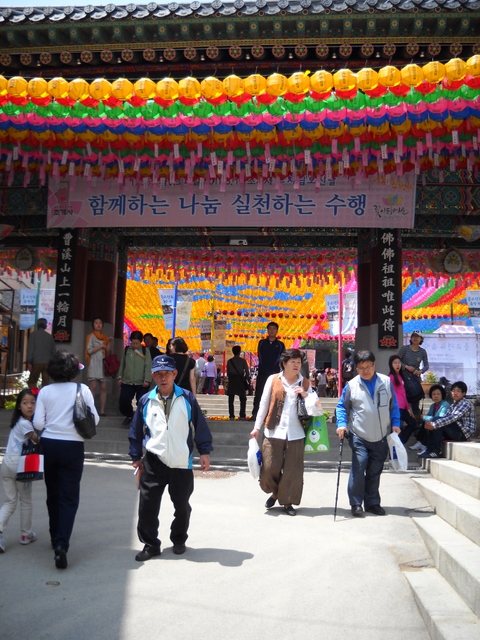
The street fair will take up the entire street in front of Jogye temple, and will start at 10-ish on Sunday morning. For an entire block, the road will be filled with activities and booths set up by Buddhist organizations and NGO’s from around the world. I can’t imagine any other place in the world where one could see so many different types of Buddhism and Buddhist organizations. Here are some photos from last year.  (You can see larger images of most photos by clicking on the image.)   For a great collection of night-time photos of Jogye Temple check out Robert’s photo blog.

Booths of the street fair stretching for a city block
you could hear these drums a block away
Farmer’s band: one of the great things about the day are incredible traditional music groups
a booth for making miniature lotus lanterns (like the ones in the top of the photo)


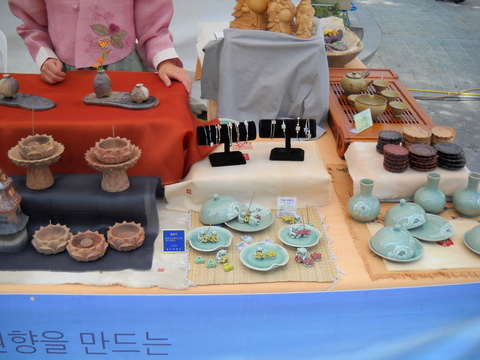
There was all kinds of interesting stuff for sale as well, here some incense holders
Incense being sold by Korea’s premier incense company, Neung In. They also provided the raw ingredients and showed people how to make their own incense.

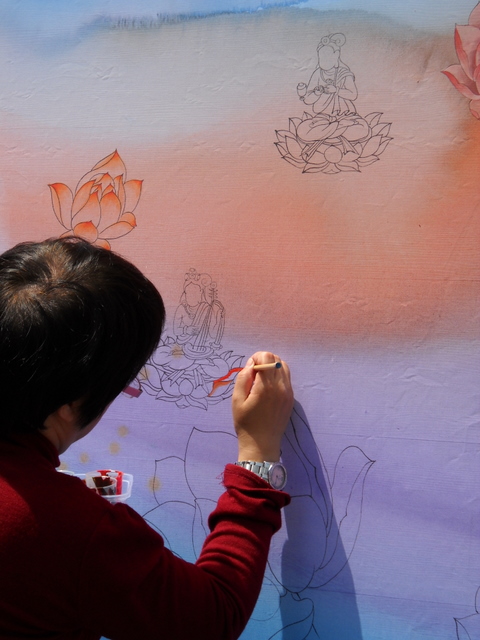
One of the cool things about the street fair are the activities, here passersby participate in making a Buddhist painting
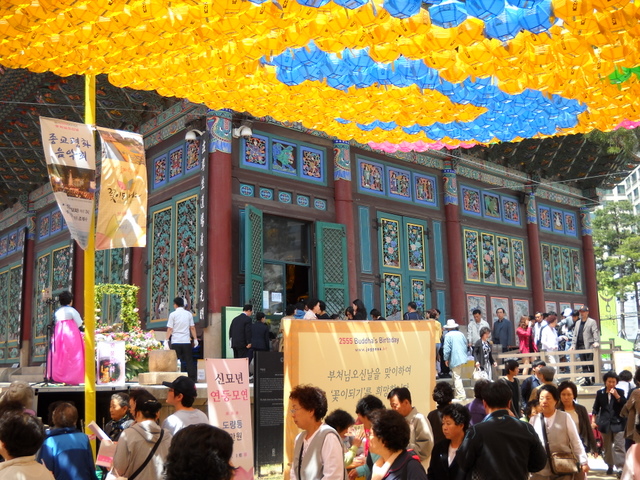
At Jogye Temple


Under the lanterns in Jogye Temple
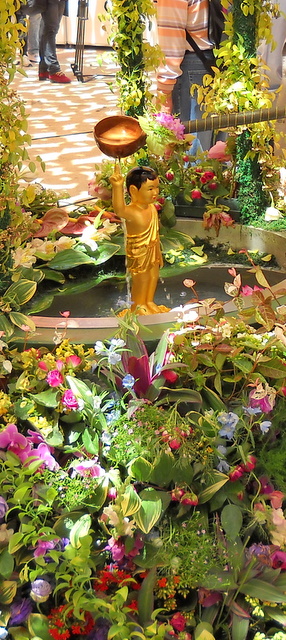
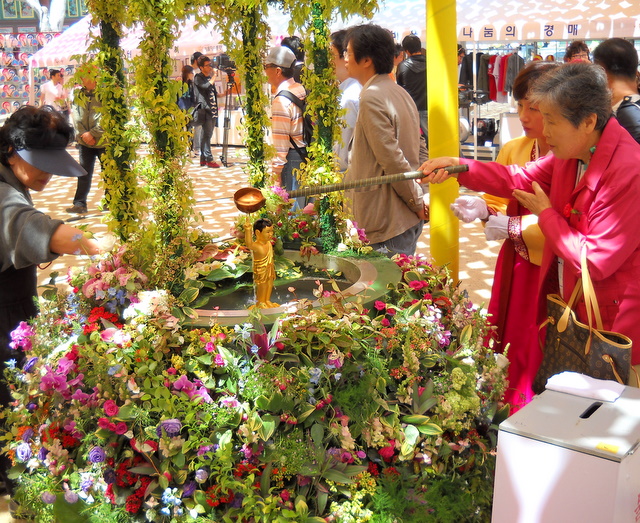
Bathing the infant Buddha
“Between Heaven and Earth, there is nothing that is not this precious Self”


Daehaeng Kun Sunim:
Each of us has to believe in our potential to became a Buddha.
Deeply believe in your fundamental mind, the one that is doing everything, and make that your refuge.
For decades I’ve been repeating only this,
and going forward, I’ll keep saying it.
Even though I’ve said this for so long,
I’m not bored or tired of it,
and I’ll keep saying it
because I have deeply experienced for myself,
that this is the one true thing I’ve found.

“Know that you are Buddha,
return to and rely upon your Buddha essence,
and realize the full potential of a Buddha.”

I could emphasize this ten million times!

Translation and Spiritual Practice

Here’s part of a reply I sent to a friend, who asked how we were to come up with what he considered very good translations, and what he could do to improve his own work.
       Translation is an interesting topic to me, because while one form is from Korean to English, another equally difficult form is from general concept to our daily life. How do you turn one idea into ten applications? 
I’m a native English speaker, so that helps some, but not a lot, really. The main thing is practice. One has to be putting the teachings into practice, and then understanding begins to arise. Without this, they won’t make any sense.
The first step we do, is make sure everyone in the translation group (those who are actually working every day on the translation) all agree what the Korean means (English, in your case). This turns out to be a surprisingly long and hard step.

We basically discuss, argue, persuade, etc, until we arrive at an understanding of each sentence and paragraph that is at least 70-80% acceptable to everyone.  The situation is that people bring all their other life experiences into their understanding, so often they’re looking through different lens. And Dharma talks like Daehaeng Kun Sunim’s happen on many different levels at the same time.

People may also have a feeling that they understand what the text says, but then when they have to express it, and especially put it into another language, they can’t do it so well. Which also implies that their understanding wasn’t as clear as they felt it was. So people have to explain why they think a certain way of putting things is correct, and also to set aside their understanding and try to see it from the other persons point of view, to see if that way might be better.
o
o
Because it often means looking at things from the perspective of experiences I don’t have, it can be quite exhausting. If I still disagree, I try to think of a way that might explain why another expression or understanding is more appropriate. There’s a lot of chances for bruised egos in this process, but it works for us because everyone is trying to apply Daehaeng Sunim’s teachings, and working on letting go of “I”. Once we have a version of the original, with notes that express the general undrestanding, then we can begin to translate it into English. Again, this is a bit of a hard process, because people will often not like the english sentence or description, but they don’t have to skills to suggest the right (for them) alternative. So we keep working at it!

p
The other huge thing about the process is that when discussing what the text means, we have to set aside normal ideas of high and low. So even though I’m ordained, and the others are laypeople, everyone’s view has to be treated equally. And I have to accept that I may be wrong in my understanding. This way of working is very important here in Korea, because normally, once the senior person speaks, all the junior people stop taking. It’s normally hard for a junior person to argue about the meaning with a senior person. But this has to be possible to produce the best possible translation, because seniority or ordained status does not guarentee a complete understanding of the Dharma.

o
These are some thoughts about our work process that have come to mind. I’m sure I’m leaving something out, so feel free to ask if you have questions.  The key part of this is when I’m searching for what the text means, or how to express it in English, or how to understand what someone else is trying to explain, or how to explain my perspective in a way that they understand, I let all of those sink deep down inside me, and keep looking there until some idea arise. What arises then often tends to be very good, and brings everyone (suddenly!) together in agreement.

Always Flowing and Changing

 Here’s another poem by Daehaeng Kun Sunim that’s been turned into a Dharm song.  The ideas she expresses in just a few lines have such nuances and depths to them…. “Start where you are, really, you have everything you need. *Really* you don’t need to go looking somewhere else. I’m not kidding! It’s not something you can grasp, but it’s there. Just learn to rely upon it. Discover the implications of this as you go, and learn to be a force for good in the world. Really! It’s all with you already!”


Always Flowing and Changing

This world is where the Buddha-dharma exists,
and where enlightenment is found.
Searching for great wisdom,
while ignoring what arises in this world,
is like looking for a rabbit with horns.

Take the idea
that transcending this world is the way,
or that involvement with the world is a deluded path,
and stomp both these ideas to pieces.
Then the great wisdom of your inherent nature
can freely flow forth.

                     -Daehaeng Kun Sunim

Jijang – Jizo, the Earth-womb Bodhisattva

One of the popular Bodhisattvas in Korea and Japan is Jijang, or Jizo (Ksitigarbha, in Sanskrit.) Often he is portrayed as the Bodhisattva who saves beings in hell, or who helps extend short lives. In Japan, he’s often thought of as the Bodhisattva who looks after children or fetuses who’ve passed away.

But there’s an interesting thing about his name that I’ve only recently noticed:  The first character, “ji”(地), means earth, and the second, “jang”(藏) means to conceal. While this is often translated as “Earth-womb,” “Earth-store,” or “Earth-treasury,” this can also be read as “concealed by earth”.  Sound familiar?  (“Only covered by dirt” is a common reference to the inherent, enlightened essence that we are each endowed with.)

That which is only “concealed by earth” can save us from hell, can bring the lives that make up our body into harmony, and can help even those who have passed away.

Jijang Bosal
Jijang Bosal
Jijang Bosal

The Gateway of Seon

I’ve been typing up translations of Dharma songs today, but our office has been kind of noisy, so I used my headphones and some music to keep from getting distracted.  By chance I’d selected the Lord of the Rings soundtrack, and the following track started playing as I began typing in this song. It’s a great teaching poem anyway, but try reading it slowly after the music starts!

 Lord of the Rings_07

With one mind as its foundation,
the whole of existence
has come into creation.
Buddhas and unenlightened beings
exist together,
throughout the heavens and earth,
everything is one.
Yet those ignorant of this
are seduced by outer things,
and cause their own pain
as they fall into evil paths.

Come to your senses,
before its too late and you leave your body.
Learn to travel freely on the path of mind,
where all phenomena and and action
become fragrant offerings,
become your sustenance.

Let’s all know this gateway of wisdom,
let’s all experience this gateway wisdom.

Everything is the manifestation of one mind,
and done by one mind.
Paradise is right here,
the inherent nature of men and women
is exactly the same.
Yet if you indulge in discriminations,
how will you ever understand the truth of emptiness?

Once born into this world,
people are trapped in a barless prison,
and just drug along to their deaths.
The path is blocked
by fixed ideas of “me,”
with one bound
just leap over these!!
Let’s all experience the gateway of seon,
let’s all experience the gateway of seon!

The Reality of Life

 In this poem that’s become a Dharma song, Daehaeng Kun Sunim describes a bit of the nature of our fundamental mind. Understanding this isn’t enough, we have to take what bits we understand and do our best to keep applying them to our daily life. Then the nature of how things truly are will gradually become clear to us.


Living in this eternal moment is the reality of life,
throughout all creation,
there’s nothing that’s not the manifestation of one mind.

Even being born as a human is the manifestation of one mind,
the skillful means of one mind.
Awaken to this one mind,
escape from the suffering of samsara,
and discover what it means to truly be free.

There’s no reason to talk about the past or the future,
for this moment is eternal.

Throughout all this world,
every single thing is the manifestation of Buddha.
Across the heavens and the earth,
at each and every place,
the Buddha is fully present.

Everything is the unfolding of one mind,
it’s compassion,
it’s light.

Dog days…

This is a friend of ours who first came to the temple about nine years ago. He has the slight misfortunate of having a girlish name, Maeli (“Plums Blossoming,” poor guy), but he seems to be okay with it!

One of the interesting things about him is that he’s taken on the job of defending the temple, and here he’s actually on station at the entrance to the nun’s quarters. He’ll start barking if a layperson comes too close to the entrance, and sometimes, for no obvious reason at all, he’ll start barking at someone in the courtyard. The thing is, since he came here, there have been no instances of pick pockets or of people trying to rob the donation boxes.

Korean Buddhist texts and ceremonies occasionally mention something called “fragrance of mind.” Like the fragrance of incense, it weaves here and there, unseen and un-graspable. And it is the results of the efforts we make to transcend ourselves and to see everything as part of ourselves.  It is this fragrance that moves amoung the people in our lives, lifting them up and brightening their path.  It’s there all the time, whether we notice it or not.

So, the Buddha and Santa walk into a bar….

Okay, that’s all I got so far! If you have any great ideas on how to end this (in a positive way), have at it in the commments!
(And thanks to Marcus for the awesome card!)

But have a happy and safe 2012, and may everyone grow and be at peace in the new year.

with palms together,
Chong Go Sunim