Rest Deeply

Here’s a letter from Michael, a very nice practitioner from Australia.

Greetings to you all
I have noticed a bit of a gap in recent postings, the last being Feb13. I have been a student of Chong Go Sunim for about two or so years (I think) and have thoroughly enjoyed and learnt from the many postings for longer. I have been a traveller along the Way for several decades, sometimes looking for the path while standing on it. I will be taking precepts in Korea in Sep 13, I have previously taken them through Vietnamese Thien (Zen) tradition.  I normally do not post online due to not thinking I have anything to add, and to avoiding arguments over perceptions, opinions, mental formation etc. which I have in abundance but now try to see as puffs of smoke, and try to relinquish my attachments to an I, Me, Mine world view – changing a personal mantra of “be reasonable see it my way’ to “don’t know/none of my business”.   Back to the point – gladly taking and enjoying the offerings of your web site while never giving, might be a tad selfish. So here goes:

When last visiting South Korea with my wife Elze, we had the pleasure of spending a morning with my teacher. On a later visit I was lucky to be given some calligraphy (from him not drawn by him).
rest deeply
I was told it meant rest deeply (I can’t remember the Korean), I have it on the wall in our bedroom and regularly think about it and what a wonderful gift to my practice it would be if I could incorporate into my being.
Chong Go Sunim recently advised me that I’m glad to hear that you’ve been practicing with everything that comes up, and handling it as well as can be expected. As I’m sure you know, it’s all about facing things while completely emptying yourself of everything you think you know.

And

I’ve been thinking a lot about emptiness and something Daehaeng Kun Sunim said, that if you think about your foundation in the morning, and again in the evening, it’s as if all the time in between is seamlessly connected to both.

My perfectionist mind kind of went, “well, okay, I guess.” but these days I’m thinking it really is true. I’m not sure what this means for you, but it’s what came to mind as I was reading your letter.”

To me it means my peacefulness can be measured by the amount of the I, Me , Mine I can relinquish – at least I have something to occupy myself with for next few centuries 🙂

Cheers and with Metta

An experiement with sitting meditation

Simon is a regular at my Saturday Dharma talk at the Buddhist English library of Seoul. Here’s his experience with trying to sit everyday for a year.

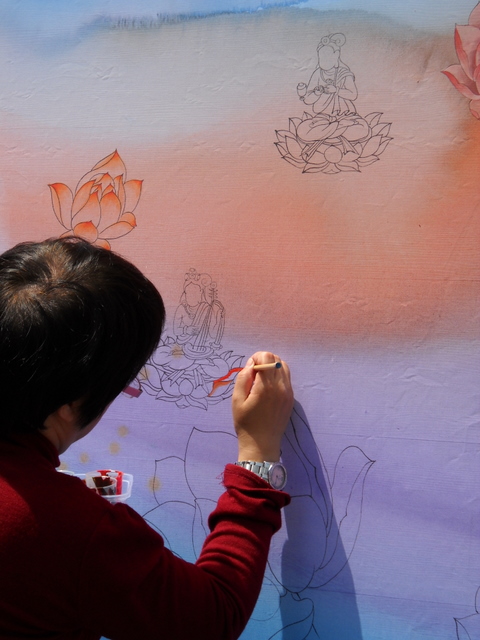
While I enjoy sitting meditation, and feel that it is of benefit to me, I have found that making time in my daily life for sitting One of the cool things about the street fair are the activities, here passersby participate in making a Buddhist paintingpractice is not something that comes naturally. Sometimes I’m not “in the mood,” and often I don’t think I can put aside enough time to “do it right.” Weeks can go by until it all comes together and I actually engage in sitting meditation. In an effort to make this practice a part of my daily life, my New Year’s resolution for 2011 was to practice sitting mediation every day for the year. I was quite successful, missing only one day: the day before I got married.

In order to give myself the best chance of succeeding with my resolution, “sitting meditation” was defined quite broadly. This definition did not include how long each day’s meditation should be. The result was that while some sessions lasted about an hour, the vast majority were only ten or fifteen minutes, or even shorter. (Which was not even enough time to allow my thoughts to settle.) While some meditation was done on park benches and in airport lounges, the vast majority was done at home, just before bed. Because I was not waiting to have lots of free time or to be in a “meditative mood,” I feel that the “quality” of my meditation actually decreased.

One (the only?) result that I was hoping for from this year of meditation was that daily sitting practice would become a habit, and that the habit would continue through 2012 (when it was not part of a resolution) and beyond. This did not happen. In 2012 I sat only a handful of times. Again, I sat only when I was in the mood and felt that I could spare enough time to have a productive session. The following is a reflection on a few of the differences in my overall experiences of 2011 (sitting every day) and 2012 (virtually no sitting meditation).

I did not notice a difference in my overall stress level between the two years. However, looking back, 2011 was unquestionably a more stressful year (getting engaged, getting married in Korea (with family and friends all visiting Korea for the first time), an incredibly hostile work environment, much longer work hours, writing three papers towards a Master’s degree). Perhaps the fact that I felt equally stress-free in both years was due to the daily sitting practice in 2011.

I did notice a difference in my relationships with people, especially at work. (Though certainly not limited to work: this effect was also clear when communicating with my family.) As I mentioned before, work in 2011 was pretty tough. Yet, I found that most of the time that I engaged with co-workers I was doing so without “baggage” from the previous encounter. I approached each meeting with fewer expectations (of any kind) and with an openness which was not there in 2012. In 2011 it was really clear that some people came into work each day with a fresh outlook, and others just picked up exactly where they had left off the day before. I doubt all of the “fresh people” were practicing sitting meditation each evening, but do I have to tell you which group of people were happier at work?

Related to the difference in my relationships with people, I think, was a change in my relationship with my daily life. In 2011, for the first time, there seemed to be both time and space between myself and the events in my life. This is not easy to explain. I would not say that I was distant, or disengaged, just that there was usually room to breathe and observe and reflect on what was happening at each moment. This disappeared in 2012, when everything just seemed to be right on top of me. Again, I’m not saying that 2012 was more stressful. I’m saying that in 2012 I was my daily life, while in 2011 my daily life was a part of me. I suppose one could interpret this as positive or negative (or neither), but for me the space was a positive thing.

Related to the change in the relationship between myself and my daily life, I think, was something even more difficult to explain. Despite approaching people free(er) of expectations, and having more space between myself and my daily life, I actually felt more connected. To what? Well, I’m way out of my depth here. Part (but not all) of what makes it so difficult to explain is that it was so subtle. I’m not talking about a specific experience. More about something constantly in the background, that you don’t even notice until your year of meditation is over and it gradually fades away and is gone. Maybe it was just the sense of well-being that sitting meditation has been reported to develop.

I imagine I experienced many benefits (and possibly some negative effects??) during my year of sitting meditation of which I was not conscious. I did learn that whatever little time I can spare is long enough to experience positive effects from sitting meditation. (Five minutes of sitting meditation is worth more than an extra five minutes of sleep.) Also, because of this “resolution approach,” I feel that rarely, if ever, did I go to meditate with any expectations or goals either than that I would be engaging in sitting practice. I think that for me this was a fairly healthy approach to sitting meditation. The idea of a New Year’s resolution to meditate every day seemed to me like a bit of a gimmick at first, but hey, whatever works.

Hope everyone has a great 2013!

Simon.
The new year

Happy New Year, everyone!
I hope it has found you all well. Things have been a bit hectic the last year, with us doing a lot of translation work, and trying to get a lot more done during the year. We now have several great new books and Dharma talks that have been translated, and are awaiting their turn in the layout process. Within a month or two, we hope to have the new, revised edition of  My Heart is a Golden Buddha available on Amazon as well. That should make ordering and shipping a lot easier, as well as lowering the shipping charges for lots of people.

x_0024-1


Song of Sharing the Same Mind and Body
(공심공체 둘 아닌 노래)

Mountains embrace the water,
along with all sentient beings.
Flowers and butterflies
embrace each other,
dancing and dancing.
The mountains whisper to us:

Deep waters have within them
every kind of treasure.
One mind,
our foundation is the guide they always follow;
leaving no tract of their passage,
they ceaselessly go back and forth into the world.
Grasp this essence,
live freely,
release everything into this flowing emptiness,
and live like water.

Water embraces the mountains,
along with all sentient beings.
Flowers and butterflies
together cause blossoms to become fruit.
Water whispers to us:

When a tree cherishes its root,
relies upon its root,
the fruit that ripens on this tree
can freely go back and forth
from the mountains to the world,
with no coming or going.
Grasp this essence,
live freely,
release everything into this living emptiness,
and live like the mountains.

Magok Temple

This is the back entrance, on the path from the continuing education center

I recently returned from a stay near one of the oldest extent temples in Korea, Magok Sa. It’s near Kongju, in South Chung Chong Province, and if you’re nearby, be sure to stop in.

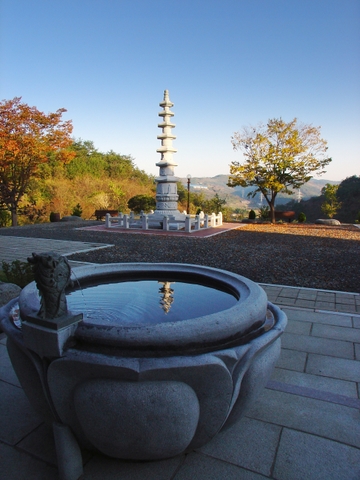
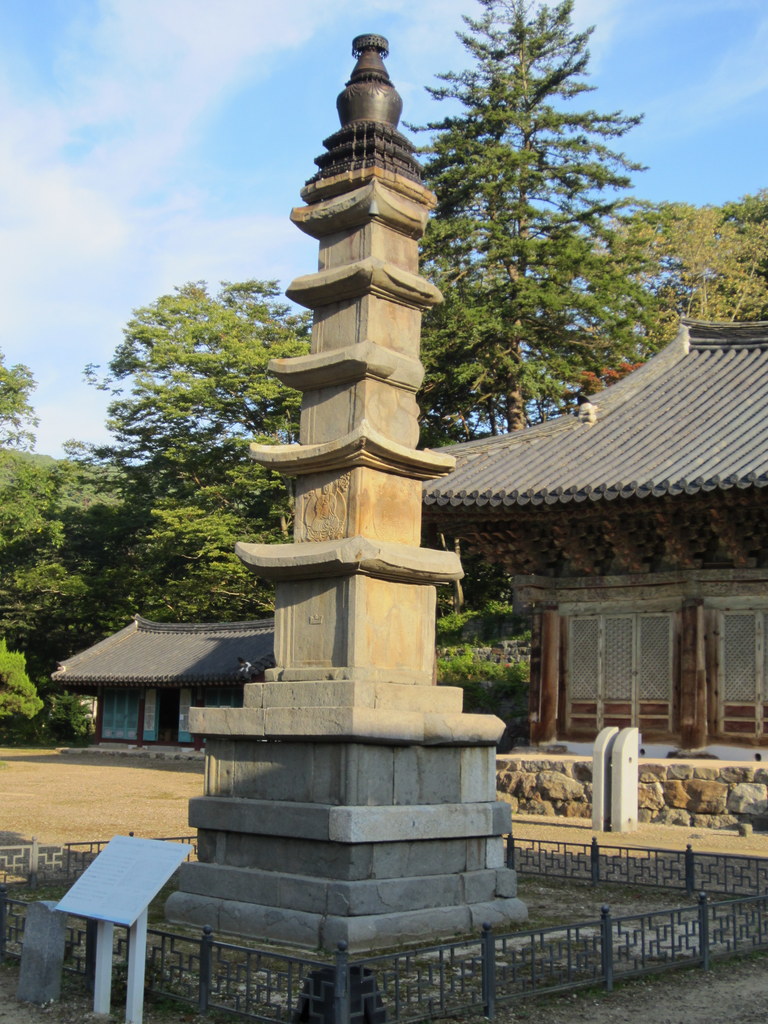
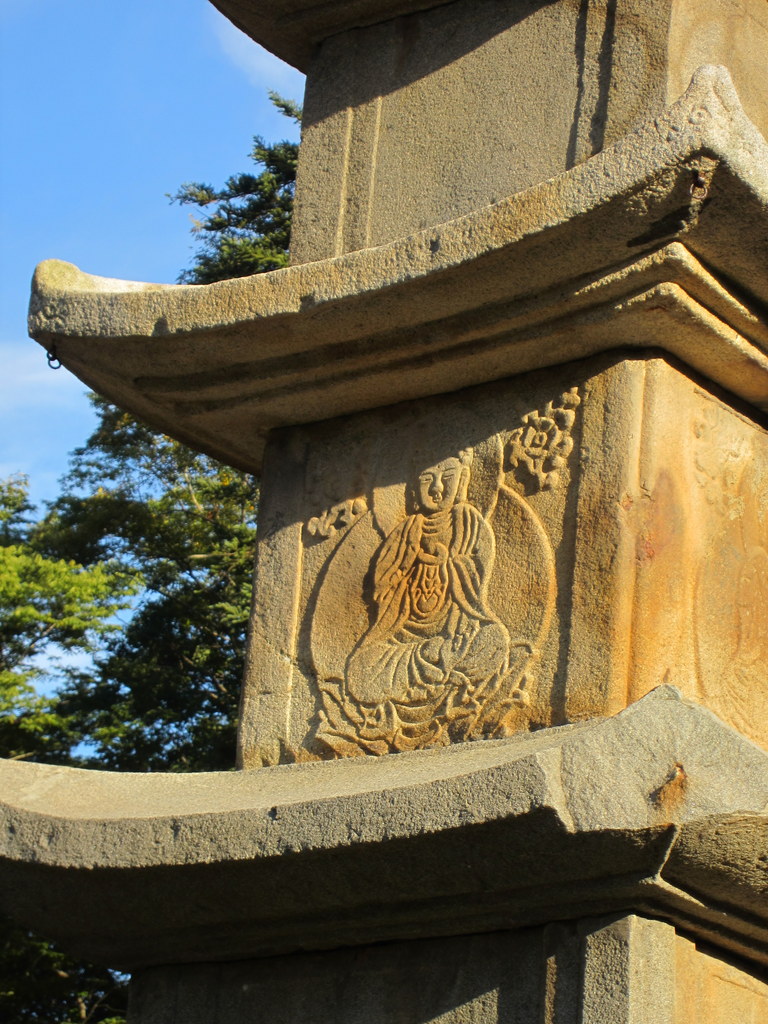
This pagoda has a lot of very unique elements, and is believed to have been influenced by Tibetan Buddhism. It was built some time in the 1300’s


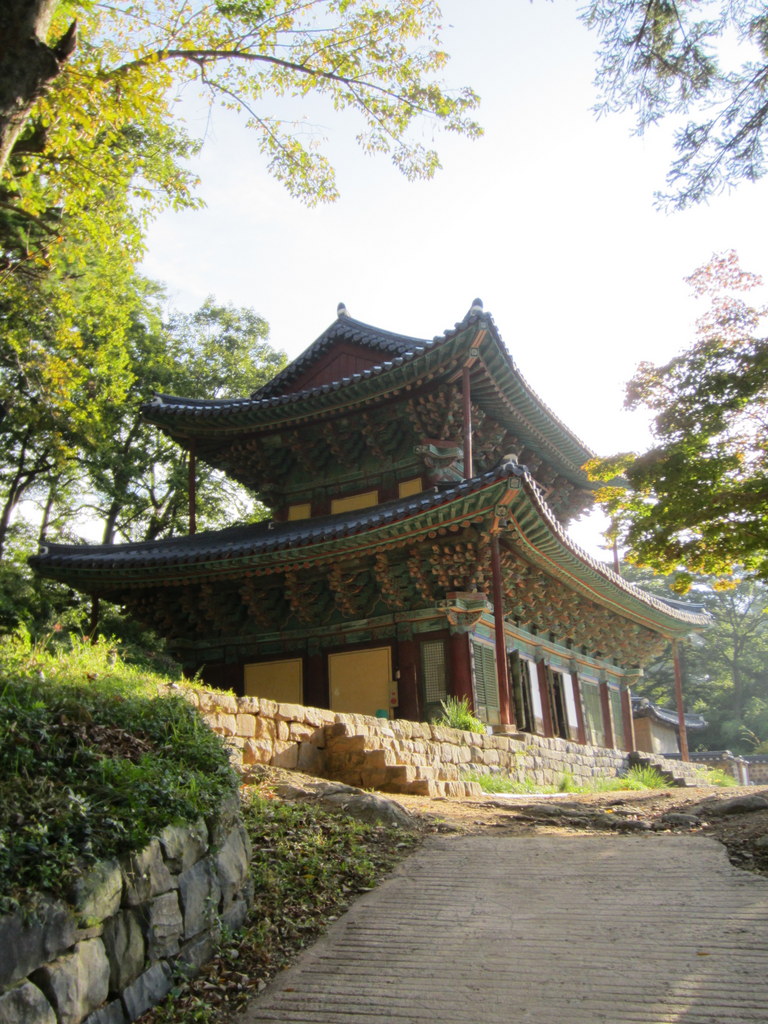
The two story Dharma Hall of Magok Temple


Continuing Education for Monks and Nuns

I recently returned from a new(ish) continuing education program that’s been instituted within the Jogye Order. They’re now offering nearly fifty 3 day classes throughout the year, covering topics from managing temples to social welfare projects to counseling skills. Everyone’s now required to take one class a year, but I’ve taken two so far, and that seems to be the norm. This is quite a nice step up for the Jogye Order, where these kinds of skills tended to be learned or passed along in a fairly haphazard fashion.

This was the room where apparently they teach tea ceremonies. I think I might know a few people who’d love to play with some of those tea sets!

This was all done at a new training center set up near Ma-gok Temple, in South Chung Chong Province. And by “near,” I mean a five minute walk!

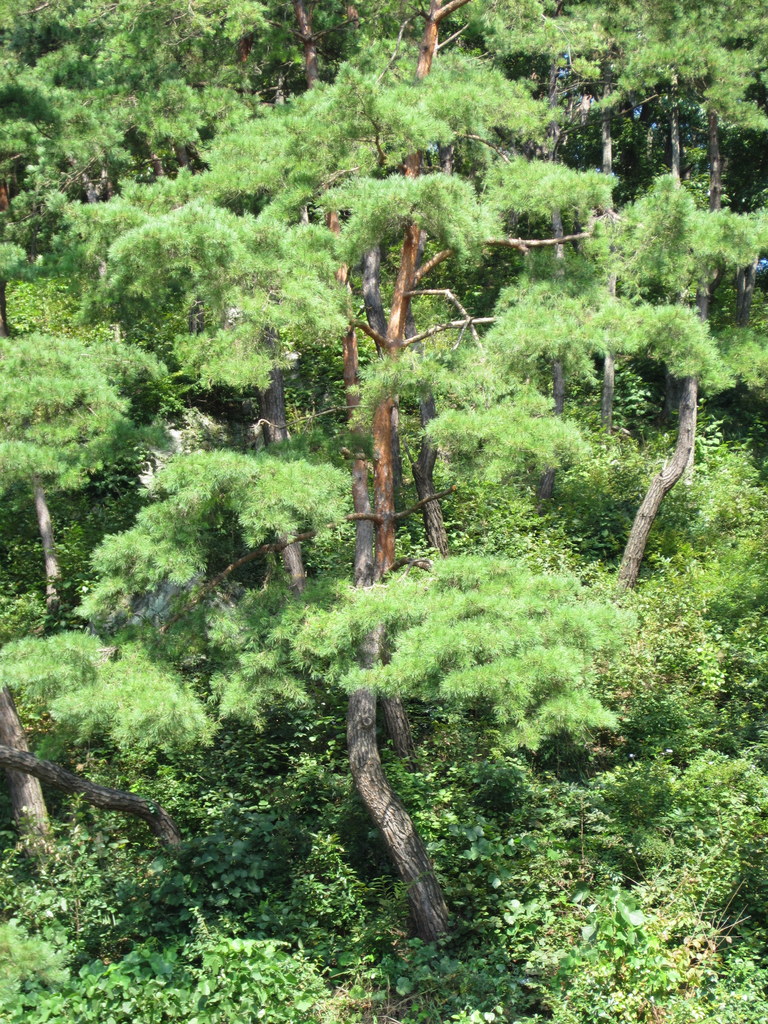
This pine tree really was this vivid. I haven’t adjusted the color at all.

Two of a Kind

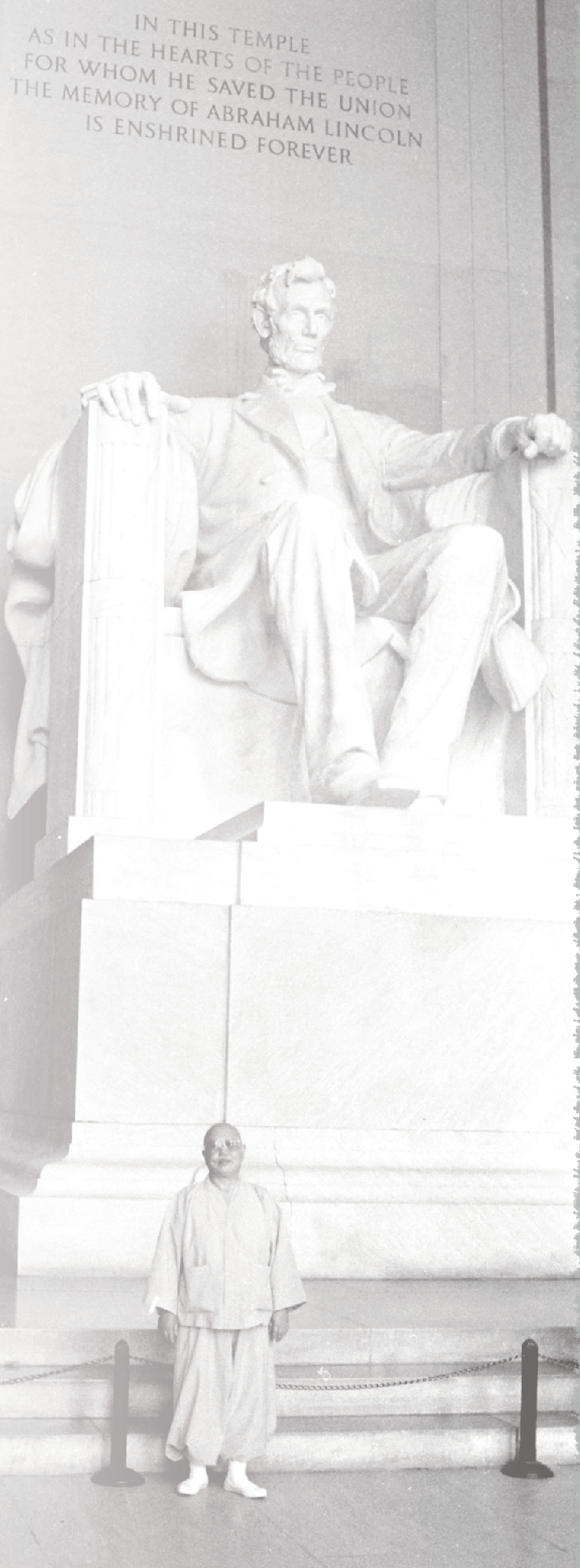
This photo always touches something deep inside me. I think there are many things that apply to both people here. In allowing her picture to be taken like this, I also suspect that Kun Sunim thought there was something very deep and special about Abraham Lincoln. It was taken around 1995 when our center near Washington DC opened. (Generally she very grudging about having her picture taken, and we usually had to ambush her!)

The Spark

I’m currently working on the introduction for a collection of Dharma songs, but some of the songs are so beautiful and profound that it’s hard for me to know where to begin. Anything I write about them seems shallow by comparison. Sometimes all I can do is exhale and say “thank you.”  

At the center of our vast
and completely empty mind,
there is an eternal spark.

With this spark
I quietly light the sublime lantern
that so faithfully guides me.
I’ll take this lantern
and spread it’s light
all over the world,
sharing its boundless compassion
with all I meet.

This one mind,
deep and deep,
so deep,
so profound and mysterious,
within this is the truth of “embracing everything,”
within this one mind
flows the sweet water
that can truly save all beings,
the water that has the power of all the sincere tears ever cried.
I’ll drink deeply of this spring water,

and no longer be caught by life and death,
and together with all beings,
I’ll take the path of this truth
that transcends all fixed forms and ideas.

–Daehaeng Kun Sunim

Unconditionally Letting Go

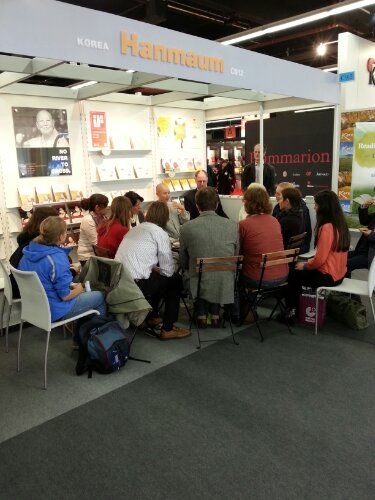
Some of you may be wondering what’s happened to me (or not!) but this is the time of year when we get ready for the Frankfurt book fair.  Book contents have to be finished so that layouts and artwork can be finished in August in order for everything to get to the printer’s in September.

One of the new books we’re finishing up is a collection of Daehaeng Kun Sunim’s poems that have been set to music and used as Dharma songs. They all have deep meaning, and this one talks about an idea that Daehaeng Kun Sunim sometimes mentions: Unconditional letting go expressed as dying. For when we deeply let go of the things we want and the things we fear, it does feel a bit like dying, like a kid denied Christmas. And yet when we entrust all of this to our inherently bright essence, the places that we are stuck seem to lose their hold on us and we can move forward with a fresh heart.

That which I’m fighting with, that which I’m clinging to, is a part of myself.

Die Three Times and Truly See Yourself
(세 번 죽어야 나를 보리라)

Vast beyond imaging
filled with an infinite variety of life,
yet everything in this universe
is but a shadow of one mind.
From an inherently empty place
appear empty things
being empty,
they all vanish.
If I truly realize that everything I interact with is empty,
this is dying one time.

From great Buddhas who rule the heavenly realms,
to tiny weeds alongside the road,
without excluding a single one,
die together with them all
die together with this empty “me,”
and realize that everything, just as it is,
is the truth.
This is dying a second time.

Among all the people, plants, and animals,
among the stones and the clouds,
there is nothing that is not me.
You and I, all of us together,
are sharing the same place
and the same body.
Everything is the manifestation of this inherent Buddha,
so when can you freely take care of everything with life,
and without life,
this is called dying a third time.

My one mind, which brings in and sends out everything
is my true foundation, that which is truly doing things.
We have to die in order to truly live,
die three times and see yourself.

– Daehaeng Kun Sunim

Building a New Dharma Hall

For the last several years, my Dharma brothers have been working on building a new Dharma Hall. I’m quite proud of them both because they’ve been doing such an incredible job, and because they’ve been waiting untill they have all of the money necessary before starting each phase. (No borrowing money!) It’s taken seven or eight years now, (I can’t remember), but the work is nearing completion. They’re just finishing the painting and artwork, and the next step will be installing the flooring and then the Buddha statue. Here are some photos I took yesterday; click on the images to see a larger version.

Here’s the Dharma Hall
Here you can see part of the carved wooden panel that will stand behind the Buddha statue

The interior scaffoding goes up the ceiling, and provides a rare opportunity to examine the artwork on the ceiling and the supporting beams
Every single aspect of the artwork has great meaning. Here the colored bands represent waves of energy radiating outward into the world, from our fundamental Buddha essence. (perhaps you noticed the golden bat? Traditionally bats are regarded as Dharma protectors in Korean Buddhism. Hmm, so when I was reading all the comic books, I was actually studying the Dharma!)
Did I mention that this was a bit high off the ground?!
Details of the ceiling artwork

The ceiling panels