reminders

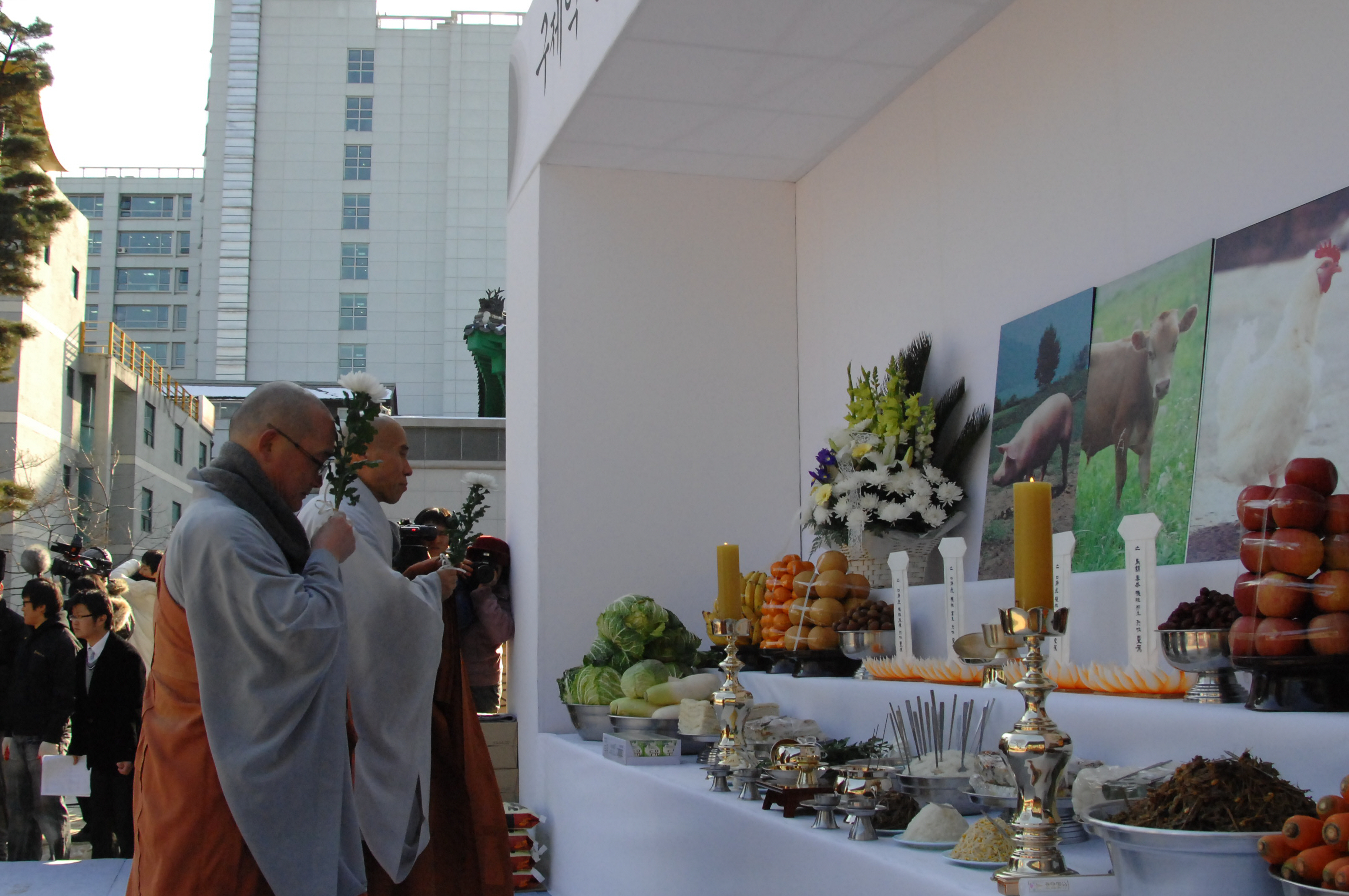
Yesterday, at the Bangkok Seonwon, in a truly beautiful and deeply meaningful ceremony, everyone renewed their five lay Buddhist precept vows.  Half a dozen people also took them for the first time, and so gained a new Buddhist name reflecting their new paths and aspirations.

The proceedings were led by Haewon Sunim, who had especially and kindly flown in from Korea, and before precepts were given she delivered a short teaching. Luckily for us non-Korean speakers, we had Young there to jot down some instant translations as Sunim spoke.

The part that jumped out most significantly for me was the bit about everything in life being a teaching – but only if you are making an effort and paying attention. If not, there’s no teaching at all. So, yes, everyday life is itself the Dharma, but you must be an active student.

The problem, for me, is remembering. I mean, just hours later I was engaged in a coffee shop debate with all awareness gone, desperate to get my points across. One minute I was saying how most discussions are a waste of time, the next minute I’d lost all sense of my foundation in the middle of one!

But, as Sunim had said at the start of her talk, the very nature of learning is difficult. And that’s why I’m so grateful to all those in the Sangha around me, lay and ordained, that support me so richly. Sometimes we just need that reminder, that our inner teacher is there and is always available.

As Seon Master Daehaeng Sunim says in the latest Hanmaum Journal, in words that seem to apply especially to this weekend: “Coming to the Dharma Hall regularly will help you a lot in grasping this fundamental essence, and while relying upon it, whatever you need will come forth.”


(Here’s a post with a bit more about the Five Precepts.)

Sunday Photo; Buddhas in the snow

At Saturday Sangha yesterday, we discussed the beginning of chapter seven, in No River to Cross. It’s a part that really stood out the first time I read the book, and continues to drift a considerable distance above my understanding.

One term that really jumped out at me was, “manifesting nondually”. It reminded me of something Chong Go Sunim told us back when Saturday Sangha first began.

The Dalai Lama has a policy of meeting any Tibetan refugee who crosses the Himalayas into India. Apparently, upon greeting him, many people thank him for rescuing them at some point during their journey. If they’d fallen into a crevasse in the snow, for example, they say that he appeared there to help pull them out.

Manifesting nondually, what a wonderful to open yourself to the world!

The Venerable Ya-un: Don’t forget about freeing yourself from desires

This is the eighth of Ya-un’s admonitions: Don’t lounge about in the realms of desire. It’s also a caution for monastics to remember why they originally became a monk or nun, and to not end up living like an ordinary lay person.

The person who renounces the desires of their heart is called a practitioner. Not longing for the worldly life is called leaving home. Having ended desire and left the mundane world behind, how could you possibly associate and amuse yourself with lay people? To miss and yearn for the mundane world is called “intense craving,” which has always been incompatible with the path.

When longing and attachment arises, the determination to achieve the way begins to fade. Therefore, cut off all longing and attachment and never look back. If you do not want to betray the reason you left home(to became a monk or nun), then you should go to an outstanding temple and uncover the profound meaning. If you go forward with your robe and bowl, and dissolve all worldly desires, without any concern for hunger or safety, then your practice will automatically deepen.

                 Even good actions done for yourself or others
                 are the cause of the cycle of birth and death.
                Among the pine trees and arrowroot vines,
                the light of the moon illuminates all.
                Diligently enter the true meditation of the Patriarchs.

Gratitude

If you are grateful,

Grateful for you root,

The entire Universe and Dharma realm feel that gratitude

And move and work together

And manifest your intention into the phenomenal world.

The entire Universe looks after you;

Is there anything that can’t be done.

Daehaeng Kun Sunim

As we enter a new year and reflect on the old one, I find myself thinking about the importance of gratitude in my daily practice.  I personally, have found plenty to be grateful for and can attest to the blissful state that easily arises as I nurture a grateful heart. Gratitude, however,  is more than just a feel good state and  I would echo Marcus‘ sentiment that it is a virtue that could easily find itself among the six perfections of practice.

Daehaeng Sunim’s words speak to the transformative and creative powers of gratitude.  In cultivating a grateful heart, we acknowledge the generosity of our root, even before our needs manifest.  This softens ours hearts, making them lighter, more receptive and generous; hearts that humbly acknowledge the gifts bestowed on us and boldly recognize the potential inherent in us.  With gratitude we open a portal to the eternal, omniscient source of our creativity and sustenance. A whole universe of possibility becomes available to us with a wealth of knowledge and inspiration drawn from our collective Being.  Anything and everything becomes possible.

So as you go about your daily activities, take time to cultivate this beneficial virtue.  When you sit in meditation or prayer, let the corners of your mouth curl up in a gentle smile of gratitude, confident that your foundation is looking after your every need.  On your next out-breath, be grateful for the next in-breath, that brings life and energy to animate your desires.   As you contemplate your circumstances, be grateful for the experiences that will serve as lessons for growth and development on your path.  Be grateful for your foundation.

As we close the door on 2010, lets give thanks and gratitude for everything 2011 will bring.

With palms together.

born again

The first stage of practice, letting go of the self that is an unenlightened being, lasts until you know your true self. At this stage, a practitioner ‘dies’ for the first time and, at the same time, is newly born.
 – Seon Master Daehaeng Sunim

Buddhists don’t talk much about being born again, and yet death and re-birth is at the core of our spiritual practices and paths, both literally and as metaphor. However, such language isn’t entirely missing and I remember a few years ago reading an excellent article in Tricycle by Clark Strand, at an earlier point in his spiritual development and within the Pure Land framework, entitled ‘Born Again Buddhist’ in which he rightly claims the term.

“For too long” he writes, in words I can identify with and which have stuck with me, “I used Buddhism to convince myself that I understood something I did not, but now I know the truth. I do not know anything at all. But then, that is precisely the kind of being that Amida Buddha saves — the one who has no choice but to surrender to a power beyond his own.” Daehaeng Sunim describes that surrendering as letting go, and that power as one’s own Buddha-nature.

Of course the giving up of the small self, the letting go of all its concerns and attachments, is the essential teaching of all Buddhist schools. Sometimes it can take dramatic ritual form, as in the Therevadan temple not far from where I live in which people literally step into coffins in order to be re-born anew, but whatever form it takes, when you entrust all your thoughts and concerns and pains and joys to something greater, then, as Daehaeng Sunim puts it, “what you have thought of as yourself dies.”

And this takes faith. Faith in Amida Buddha perhaps, or in the efficiency of the ritual, or in Juingong, the True Self. Faith and practice. Those that have been there have described this death as a return to a previous condition, back to our ‘original face’, a state before we learnt to create and operate and defend a separate and self-centered self. They describe it as a re-birth. And, like all births, it brings with it feelings of great joy and happiness.

The Christian tradition is familiar with this and familiar with the forms it can take, from sudden and dramatic born-again experiences, to something a lot more subtle. Jesus, in Luke’s Gospel, tells his followers they need to take up their cross (the symbol of death) “daily”. And as anyone who has ever meditated knows, re-awakening, the re-birth of attention, awareness, and surrender, needs to be practiced even from moment to moment.

“Whether it happens suddenly or gradually, says Marcus J.Borg in ‘The Heart of Christianity’, “we can’t make it happen, either by strong desire and determination or by learning and believing the right beliefs. But we can be intentional about being born again. Though we can’t make it happen, we can midwife the process.” And one way of doing that is through practice. As Thich Nhat Hanh puts it in his commentary on the Lotus Sutra, “When we come to the practice, we are reborn into our spiritual life, thanks to the Buddha.”

Another way of midwifing our re-birth, as well as through faith, mindfulness and letting go, is through ritual and participation in significant markers. New Year, in my opinion, as a time when people re-consider and re-direct their lives, is such an event. Here in Bangkok I went to my favourite temple for New Year and sat and chanted with thousands of people, all linked together into one community with sacred thread. The next day thousands more visited the temple again to make merit and receive a blessing. To be, in some small way, born again.

And next week at the Seon Centre, the Bangkok Korean Buddhist community, and a small group of non-Korean Buddhists, will gather to participate in a formal refuge and precept ceremony, a truly significant communal event that marks a real moment of re-birth for all those involved. This is just the beginning of course, it will feel beautiful, blissful even, but “you must still continue to practice and go forward” Kun Sunim writes. The process of re-birth is ongoing. It is our practice.

Our heart’s garden is sown with attachment, hatred, and pride.
In us are seeds of killing, stealing, sexual misconduct, and lies.
Our everyday deeds and words do damage.
Al these wrong actions are obstacles to our peace and joy.
Let us begin anew.
 – Thich Nhat Hanh, ‘Beginning Anew’

Links:
Clark Strand: Born Again Buddhist
NYTimes: Thai Temple Offers a Head Start on Rebirth

Sunday Photo; Christmas tree lantern at Jogye Temple

This year, the head temple of the Jogye Order, in Seoul, put three Christmas tree lanterns by the street in front of the main gate into the temple.

It’s a nice display of the friendship maintained between Jogye and the Catholic Church in Korea.


How can I become a more spiritual person?

— Here’s another of the questions that Daehaeng Kun Sunim was asked. It’s quite nice because she clearly emphasizes where the focus of where our practice needs to be. I’ve highlighted a few of the really important points.
 
 
I’m trying to become a more spiritual person, and would like to know about spiritual practice and sitting meditation. 

Just physically sitting down is not the way to practice Zen, because spiritual practice is done through your mind, not through your body.  In this age, when people’s lives are so busy, our living itself– eating, working, driving, loving, sleeping – should all become practicing Zen. If sitting meditation were the only way to know your fundamental mind, there could be no more practice once you stood up.

A long time ago, when Ma-tsu was sitting in meditation, Zen master Huai-jang saw him, picked up a piece of roof tile, and began to polish it. Ma-tsu asked, “Why are you polishing a tile?” Huai-jang replied, “I’m polishing it into a mirror.” (In that age, mirrors were made out of polished bronze.)  Huai-jang then asked Ma-tsu why he was sitting there.  Ma-tsu answered, “I’m trying to become a Buddha.”  Huai-jang replied, “Then, you shouldn’t stand up, you shouldn’t eat, and you shouldn’t go to the toilet!  Otherwise, your practice will stop as soon as you move your body!” Ma-tsu awakened as soon as he heard this. The Buddha also tried practicing through his body for six years, but then realized that practice should be done through mind.

What is spiritual practice? What is Zen? It’s having faith in your foundation, and entrusting everything to it and observing the results while living your normal daily life.  Have you noticed what happens after a car accident?  The drivers stand around arguing about whose fault it was.  No matter whose fault it was, the drivers were the cause, not the cars.

Likewise, our fundamental mind, not our body, is the source of our every word and deed. Your fundamental mind is the driver; it can take care of every thing and guide you in your daily life.  In other words, the driver is taking care of every thing and resolving every problem in your life, so entrust everything to your fundamental mind and live smoothly.

Who makes you think, talk, and move? You may think it is obvious: “I do.”  But is that “I” the one that caused you to be born into this world?  Is that “I” responsible for your birth and death? W hat is responsible for the birth and death of every other being in this world? It is not the sense of “I” that you tend to think of as yourself. It is your true self, which is doing everything.  When you realize this truth, you can leave behind thoughts like “He did that to me,” “I’m doing…,” “I did…,” “I deserve….”  By the way, always view things positively.  If you keep interpreting things negatively or always criticize and blame others, this will lower your own spiritual level.

When you live with faith in your true self, which is taking care of every thing in your life, then your life itself becomes practicing Zen. You can practice while sitting, or if you are busy, you can practice while working or driving, and you can even practice while lying down: all of this is practicing Zen. Sitting meditation, standing meditation, lying- down meditation, and working meditation are not different.

No matter what you do in your daily life, if you believe in your true self, and entrust everything to it, you are practicing meditation. There is nothing in life that is not the cultivation of mind. So you should not think that practicing Zen and learning Buddhism are separate from your daily life.  Not ever!

Entrust all things to your true self. Then your daily life itself becomes practicing Zen. In everything you undertake, you should trust your true self to solve the problems you face and know that only it can lead you in the right direction.  This is the way to develop unwavering faith, to direct your attention inwardly, and to take refuge in your true self. If the thoughts of “I,” “me,” and “mine” die at every moment, then even though you do not sit down, everything you do becomes practicing meditation. 
 

Sunday Photo; Boxing Day Bodhisattva

I must say, my father was always very generous with gifts at Christmas… He just didn’t have the best talent at picking out anything any of us liked! By the time my sisters and I were all out of elementary school, it was an established tradition for my dad to buy us the tackiest school clothes he could find with the understanding that we would exchange them on Boxing Day and buy something we really liked. He was particularly good at picking out particularly bad clothes for my mom! I haven’t been home for Christmas in six years, so I should ask my mom if the tradition is still alive and well.

I’m not sure if it’s a traditon that will be carried through the generations. We’ll wait and see when my daughter is older how impressed she is with the gifts I choose for her!

The Bodhisattva Jesus

 Here in Korea, the Buddhists take the Christmas holidays in good spirit, and when talking about Jesus, occasionally say Yesu Bosalnim: The Bodhisattva Jesus.

The general feeling is that there are a lot of teachings by Jesus that one couldn’t go wrong with. It may not be the direct path to enlightenment and Nirvana, but if one did his or her best to apply them, one would certainly become a blessing for those around them. 

Nor would they have to worry too much about what would happen to them after death. For kindness will naturally be attracted to kindness, generosity to generosity. If your mind/heart is broad and generous, it will naturally be drawn to such places and people. Unfortunately, if it’s cold and narrow, that’s the sort of place that will also feel most like home.

So the efforts we make are never in vain. Nothing is ever wasted. 

Ask and it will be given to you; seek and you will find; knock and the door will be opened to you.  For everyone who asks receives; those who seek find; and to those who knock, the door will be opened. (Matthew 7: 7-8)


  Merry Christmas and a happy New Year from everyone at Wake Up and Laugh! 


 Images: These actually started out as Christmas cards. The top one is from Japan, by way of Marcus, and the second is by an artist living in Thailand, Nancy Chandler (www.nancychandler.net)

the embodiment of love

If we wish to use our life to benefit the world,
then we must become of the world.
– Barry Briggs, ‘Generosity and Transparency

Every year, at this time of year, I am re-drawn to, and re-connect with, the religious tradition of my personal and cultural heritage. I am glad of it and I welcome this amazing time to learn from others, because there is so much good stuff in Christianity that I can draw from and which can enliven my Buddhist practice, especially in the central Christmas image of the Nativity.

Because Buddhas are born kings, in palaces, sheltered from suffering, wheras Bodhisattvas, those beings that embody Love and Compassion, can take on any form. Bodhisattvas are closer to us, we can imagine them as shepherds or carpenters, with dirty robes and work-hardened hands, or as a baby born in the toughest of circumstances come to show us how to live.

I went to a carol service this week at the small Anglican church here in Bangkok, and in one of the teachings someone quoted a passage from a writer called Max Lucado setting the Nativity scene, which I later looked up. Lucado writes: “The stable stinks like all stables do. The stench of urine, dung, and sheep reeks pungently in the air. The ground is hard, the hay scarce.”

The beauty of the Christian message is, for me, this very real embodiment of the otherwise abstact notions of Wisdom and Compassion. How else are we to understand these ideas if not in our very lives? Jesus’ birth represents the unfailing possibility of love, kindness, and understanding right where we are. It’s always here, we simply have to wake up. As Max Lucando writes, “Those who missed His Majesty’s arrival that night missed it not because of evil acts or malice; no, they missed it because they simply weren’t looking.”

When is the time for love to be born?
The inn is full on the planet earth
And by greed and pride the sky is torn –
Yet Love still takes the risk of birth.
 – Madeleine L’Engle

Happy Christmas to all you Christians, to all you Buddhists, to all you Bodhisattvas (and that’s all of you) everywhere!
– From everyone at Wake Up and Laugh!

———

Links:
Barry Briggs: Generosity and Transparency
Max Lucado: God Came Near

Picture:
The gorgeous image used here, with permission, is by the artist and Pastor John Stuart. His amazing art blog is well worth checking out: http://stushieart.wordpress.com/

———