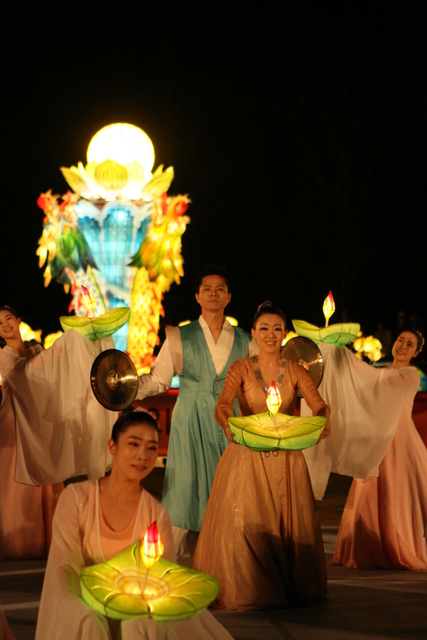
We had the unveiling of the lanterns for Buddha’s Birthday last Sunday, and they are magnificent!! It was a bit damp, but we figured that since it’s the year of the dragon, the dragon must have stopped by to check things out and brought some rain with it, lol. The Buddhist Television Network just ran a segment about it, and it’s up on YouTube, so check it out! The interviews and voice overs are in Korean, but you don’t really need to know Korean to appreciate the lanterns. The main lantern reflects the energy of the unseen interconnected whole working together as one with all the seen and unseen realms, manifesting into the work with an infinite variety of shapes.
Getting ready for the Buddha’s birthday
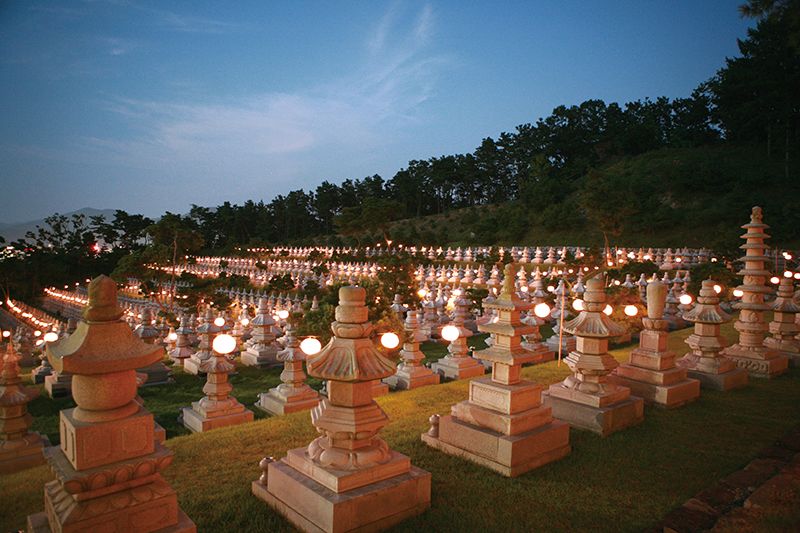
Here at the Anyang Hanmaum Seon Center, the next two weeks will be busy!
On Sunday the 5th, at 7pm (Seoul timezone), we’ll be having the big reveal for this year’s lanterns, parade floats, and the accompanying performances. You can see it in person at the Anyang Seon Center, or live on YouTube. I can’t guarantee they’ll be remain posted there afterwards, but they might be.
On Wednesday, the 8th, we’ll be having the 12-year memorial for Daehaeng Kun Sunim at 10:30 am, at Anyang. The overseas branches will be doing something as well, possibly on the weekend.
The 15th of this month (May) will be Buddha’s Birthday this year, with a 10:30am ceremony at Anyang, and a 7pm ceremony for lighting the lanterns on the 15th, 16th, and 17th. This may also be live on YouTube.
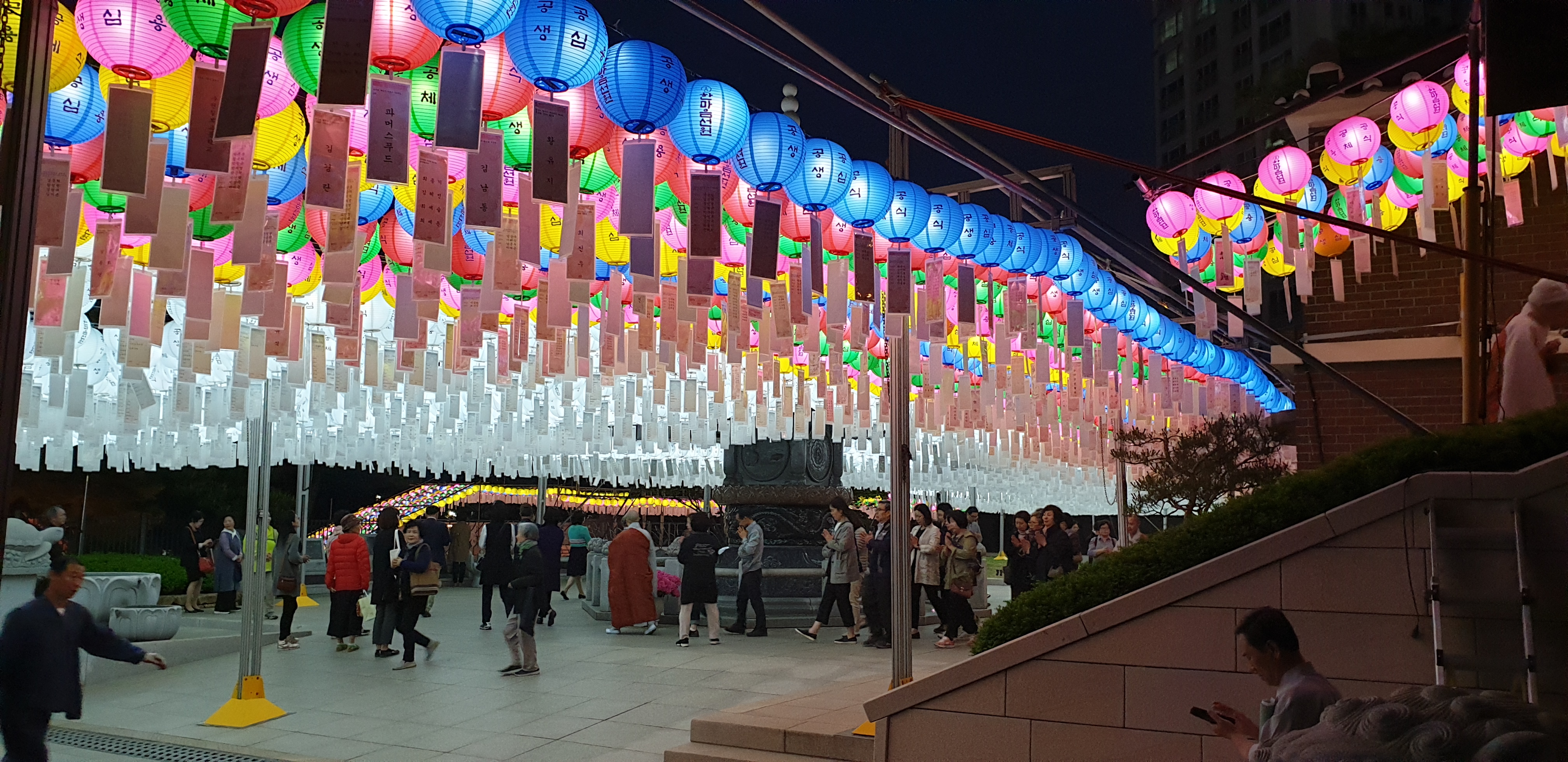
Here’s a short Dharma talk for the Buddha’s Birthday.
“If I want to be someone who grows and learns,
I need to realize that every single thing is my teacher,
and every single person is my benefactor.
In light of all of the kindnesses and support I’ve received,
I won’t take even a single step out of line.
If it wasn’t for all things and lives,
I wouldn’t be able to see, hear, and learn.
If others weren’t here,
I couldn’t learn,
I couldn’t eat,
I couldn’t live.
Every person, every life,
is someone who guides and supports me.”
If you keep all of this in mind,
you’ll be able to repay the blessings you’ve been given,
and you’ll be able to develop and progress in tune
with the underlying truth of this world.
— Daehaeng Kun Sunim
A Truly Free Person

“A truly free person: In this context, a truly free person is someone who is one with their foundation, not controlled by karmic states of consciousness, and able to freely manifest as needed in order to help others.” – footnote from “The Diamond Sutra: The great unfolding”
We’re getting ready to send the Korean-English translation of Daehaeng Kun Sunim’s translation of the Diamond Sutra to the printers, (it should be out by Buddha’s Birthday, May 15), and this footnote really stood out.
One of the terms that Kun Sunim uses a lot is “free person,” or in Korean, 대자유인, literally “great free person.” But how to express that? In English, unless you are obviously imprisoned in some place or situation, it comes across as “free to do whatever you want.” But that’s obviously not it either, because you wouldn’t want people to think that karma, and cause and effect don’t apply to them.
My sense of what Daehaeng Kun Sunim means is this: In awakening to our foundation, and diligently working at relying upon this, we can become free, free from the chains of craving and the situations, and rebirths, they push us into. Free from the ruts and limitations of habitual patterns of thought. And the big one, free to take the energy around us and use it to respond to what’s in front of us.
One thing about Kun Sunim, she never spoke about what she hadn’t experienced and verified for herself, and if she said this kind of freedom is possible for all of us, then it is. Take everything you know, don’t know, are feeling, and especially those situations that seem hopeless or impossible, and entrust them to this connection, this Buddha-nature, that we all have. Let them quietly sink down within you and pay attention. Start with the little stuff and the stuff that’s right here, right now, and see what happens!
Practical Buddhism
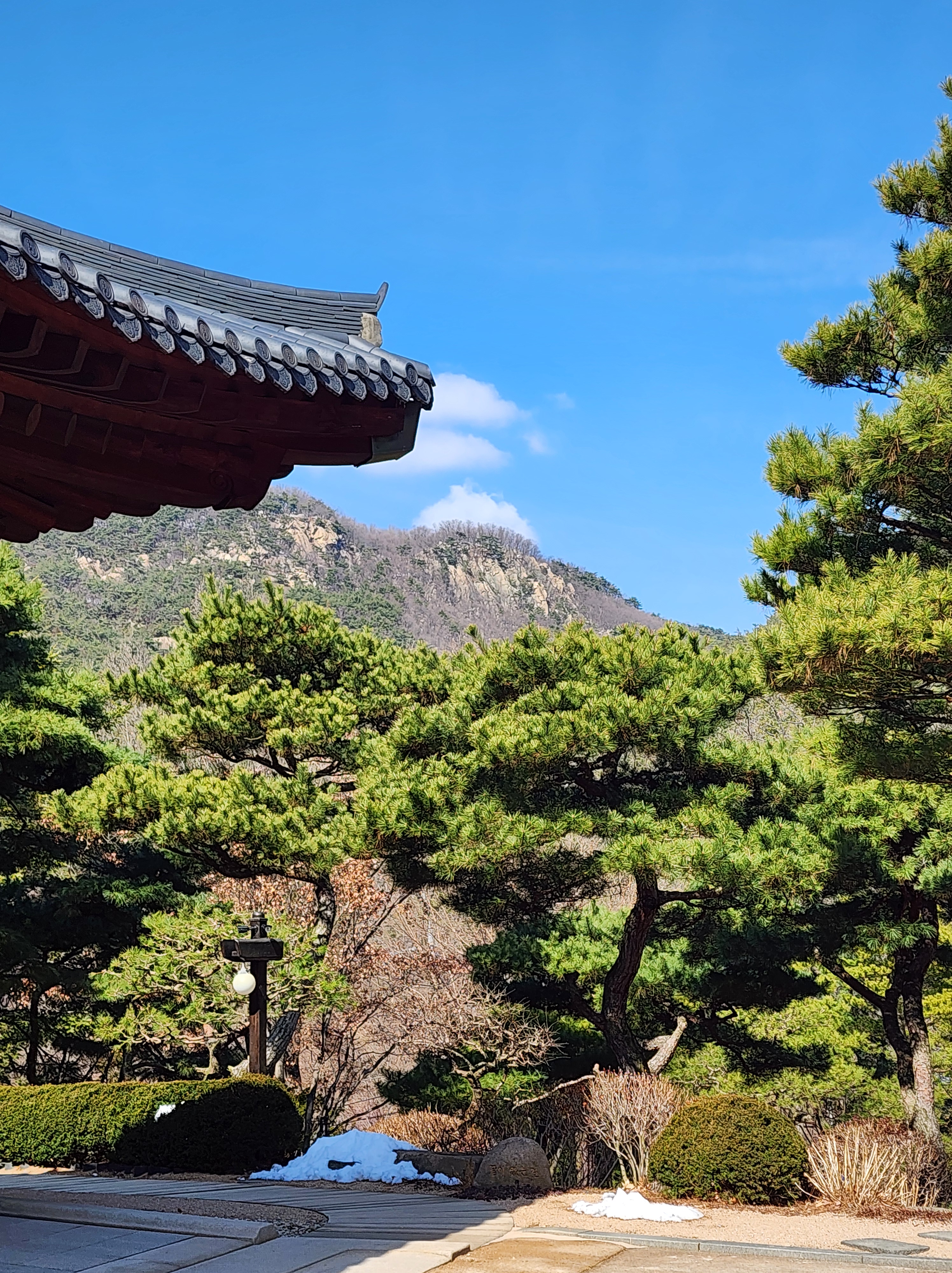
Here’s the beginning of a Dharma talk Daehaeng Kun Sunim gave to the Young Adults group on November 1, 1998. This is a very direct talk, with nothing complicated about it. Not necessarily easy to do, but nothing complicated, and within the ability of all of us.
If you’re sitting with your legs crossed, please straighten them and sit comfortably. This may seem like a trivial issue, but no one else will take care of your legs, and no one else can keep them from hurting.
This practice of relying upon our fundamental mind is the practice of transcending ourselves. It’s the practice of transcending the level we’re currently at by means of working through our fundamental mind to respond to what we’re facing and make a positive difference in our daily life. It’s easy to say that everything depends on how we use our minds, but in reality, not many people are able to actually use their minds to overcome what they’re facing.
My style of speaking isn’t particularly exciting or entertaining, but I can do is tell you about what’s deeply true, so please listen carefully and think about how you can apply it to your life.
If you think about various different Buddhist teachings, you’ll realize that they’re saying that we have to always practice in daily life. They’re also saying that sitting meditation, meditation while laying down, and meditation while working don’t exist apart from your life. They teach that even sitting on the toilet and having a bowel movement can be spiritual practice.
Really. There’s not a single thing in your life that can’t be part of your spiritual practice. All of the things you’re doing, the thoughts you’re giving rise to, the actions you’re doing with your body, and all that you’re experiencing can all become spiritual practice when you entrust everything to this foundation that’s your source. But in the beginning, this is probably going to be a bit difficult.
So, whenever you have a few minutes, practice entrusting everything to your Juingong, your fundamental mind, with the thought that, “Juingong! You’re the one who has to show that you exist.” I’m not talking about doing this with words, you have to actually entrust everything to your fundamental mind, “Okay, now take care of this and prove you exist!” It’s like going straight to the door and knocking loudly.
Take whatever you face in your daily life, and as it comes up, entrust it to your fundamental mind, Juingong. “Only you can clear the path in front of me, only you can clear away the brush and logs blocking the way!” Take all the different things and situations you experience and return them like this.
Sometimes, according to the circumstances, you may need to stay focused on raising a particular intention and continuously returning that. If you keep returning things like this you will be able to experience the one ocean, and will be able to practice acting and experimenting through this one ocean.
One way of living wisely

Happy new year, everyone! I hope you are all having a great start to the year! Here in Korea, we’ve had lots of rain, and even some very cold weather, but very little snow.
This Dharma talk by Daehaeng Kun Sunim is very short, but there’s a lot going on here to reflect upon. Start by returning what you’re feeling and thinking inwardly, and let them sink deep down inside you, and then pay attention and see what comes out. This is how to melt down our old gunk and turn it into something bright and shiny that can help us move forward and evolve.
Because humans are the pinnacle of evolution,
we have within us all the aspects of beings born through wombs,
through eggs, through moisture, and through transformation.
How they go about their lives
is the same as how we go about our lives.
You need to thoroughly understand this.

Going forward in the new year,
if we are even more kind and compassionate,
such that we can share everything,
put down every burden,
and set free every life we meet,
then none of what we encounter
will cause us harm.
인간은 만물의 영장이라고 했으니
알로 낳는 거나 태로 낳는 하下의 동물이나
또는 질척한 데서 낳는 거 화해서 낳는 거,
이러한 사생들의 그 모든 살림살이가
우리네 살림살이와 같다는 그 점을
우리는 상세히 알아야 합니다.
올해는 우리 마음가짐 하나하나를
더욱더 인의롭고 자비하게 가진다면,
전부 나누어 줄 수 있는 마음,
버리는 마음, 일체 방생하는 마음을 갖는다면
모두가 나한테 해害가 되어 들어오지는 않을 겁니다.
New Korean ebooks and audiobook

How’s everyone been? I hope you’ve been having a good year!
We’ve been working on a couple of different things and hope to have a new Korean-English Dharma talk out by the end of the year.
In the meanwhile, the ebooks are out for the Korean editions of “My Heart is a Golden Buddha” (내 마음은 금부처) and “No River to Cross” (건널 강이 어디 있으랴). Likewise, the Korean audiobook for “My Heart is a Golden Buddha” is also now available as a streaming/downloadable audiobook. (Before it was only available as a CD that came with the Korean edition. But, it turns out that no one has CD players anymore!) Here are some links to the books: Kyobo Books, Yes24.
Those two are major booksellers in Korea, but if you don’t have an account there and want just a downloaded file, you can order them from our “store” at Gumroad:
내 마음은 금부처 (ebook),
내 마음은 금부처 (audiobook),
건널 강이 어디 있으랴 (ebook).
It should work okay, and is probably easier for people outside of Korea who have a bit of tech know-how.


To Your Very Last Breath, Entrust Everything Inwardly: Interview with Hye Gak Sunim, Part One

Hye Gak Sunim completed the traditional sutra study hall, before going to Dongguk University and finishing the coursework for a Ph.D. in English translation. She currently works with the Hanmaum International Culture Institute at Anyang, as well as the Seon Center’s Document and Reference department. This interview originally appeared in Korean in the Jan/Feb 2015 (#79) issue of Hanmaum Journal.
Getting our present consciousness to follow our foundation
My life was about as ordinary as it gets. There was no great drama or tragedy. As a child, I followed my mother to the local temple, and in high school I belonged to the Buddhist students club. After graduating from college, I encountered the Daegu branch of Hanmaum Seon Center, and three years later, I became a sunim. All in all, it’s a fairly ordinary story.
When I think back on how constantly I participated in my high school’s Buddhist group, I can’t help but wonder about some sort of a past life connection. In those days, I didn’t particularly know anything about Buddhism, nor was I in awe of the sunims I’d met, but nonetheless, I never missed a meeting. For some reason, the atmosphere at the local temple felt very comfortable to me.
It was a friend from college who first led me to the Daegu Hanmaum Seon Center. That was about 1995, and the Seon Center was in an ordinary building. They did things a bit differently from the traditional temples I was used to, so I was a little doubtful about just what kind of a place I’d come to. But when it was time for the Dharma talk and they showed a video of one of Daehaeng Kun Sunim’s dharma talks, I was so moved.
I’m not a particularly emotional person, but as I listened to Kun Sunim speak, I cried and cried. I didn’t know anything about spiritual practice, but her words were what my foundation had been longing for. It was like my foundation had used the karmic affinity from my past life to lead me to Kun Sunim, even though my present consciousness had no idea what was going on.
After that, going to the Seon Center was a natural part of my life. I went to the youth group Dharma talk every Wednesday, and eventually became the vice president of the group. I taught the younger groups, and every summer and winter, I went on retreats with the other students during the vacation. Although I was a “teacher,” there was definitely a limit to what I understood! I just tried to do my best with the different roles that came to me.
I never had any real doubts about Kun Sunim’s teachings. I tried to focus inwardly, and if the situation was a bit urgent, I tried entrusting that, and things seemed to work out pretty good. For example, at one of the big Dharma talks Kun Sunim gave in the summer, it was extremely hot. The air conditioning couldn’t keep up, and everyone was busily fanning themselves. I entrusted the thought, “Juingong, it’s you that doing this, and it’s also you that can keep me cool, right?”
I entrusted that thought, and then forgot about it. But a few moments later, I started to feel a lot cooler. My first thought was, “Ah, they’ve turned up the air conditioning!” But then as I looked around me, I realized that everyone else was still sweating and fanning themselves. I think that this was my foundation showing me how the thoughts we give rise to can affect anything. At that time, I expected everything to change according to the thoughts I gave rise to and entrusted, but when things didn’t go well, I just let go of that too, without getting too bothered about them.
Later, as well, there was a habit that I really wanted to overcome, and so I worked diligently at entrusting it to my foundation in order to dissolve it. One night I had a dream where a grandfatherly old man appeared. He had long white hair, and was squeezing a lot of black gunk out of my body! I was so surprised, “Is all that really inside me?” and then woke up. When I reflected upon myself, that habit was gone. I still work with habits like this; there seems to be no end to the habits I created over the course of evolving to this point.
Sincerely entrusting my future
I’d been coming to the Seon Center for about two years, when the sunim in charge of the youth group suggested I consider the possibility of becoming a sunim. I had never even considered it before. Even when I told a friend that studying and practicing at the temple was everything to me, and they asked why I didn’t become a sunim, I completely dismissed the idea, saying “That’s not my path.” So when the youth group sunim suggested becoming a sunim, that was the first time I ever seriously looked at the possibility of becoming a sunim.
In those days, I was often quite moved by Kun Sunim’s Dharma talks. I’d be swept away by emotions just reading one of her talks. One day, my foundation showed up in my dream, and in the dream, I realized that it had been waiting for me to finally have faith in it and entrust it with the stuff of my daily life. It also felt like my foundation had been somewhere nearby, wailing, as it waited for me to connect with it. The next morning I was feeling bad, and made up my mind to practice harder. And about a year later I left to become a sunim.
After I entered the temple, it was about two weeks before they cut my hair. The abbess took me to see Kun Sunim. That was the very first time I’d ever met Kun Sunim in a one-on-one setting. She asked me how long I’d been at the temple, so I told her, and she asked why I’d waited so long to get my hair cut. The Abbess explained that I’d taken a couple of weeks because of my father, who was very traditional and opposed to women going out on their own, and had been coming to the temple to try to talk me out of becoming a sunim.
Kun Sunim replied that I was the most loyal of children. And then she cut three snips of my hair. (Kun Sunim was implying that by becoming a sunim and learning more about her fundamental mind and how to apply it, Hye Gak Sunim was the greatest position to truly help her parents. – Translator)
We went back to our own bathroom, and the other sunims helped us fully shave off our hair, and then went back to greet Kun Sunim.
Kun Sunim asked me, “When water flows, where does it go?
“To the ocean,” I answered.
“Exactly. When it becomes the ocean, it then transforms into clouds, and returns to the earth, feeding every kind of life. Big things drink big amounts, and small things drink small amounts, according to their capacity, and even though they are all sustained, there is plenty remaining.”
“You have to study English”
I didn’t have any real problems with life as a sunim, although it was quite different than the vague impressions of it that I’d had. In part, I was used to living with my rather strict father, but I also seemed to just accept that this was what life is like in a temple, and got on with things. After my time as a postulant, I worked at the Seon Center for several years, and then started a four year program at a sutra study hall in order to receive full ordination.
During one of the breaks in the school year, we greeted Kun Sunim, and she said to me, “If your English isn’t up to speed, you should study further. If you’re going to be able to handle your future roles, you’ll need to go to graduate school. If possible, you should go to Dongguk University’s program.”
Inwardly, I was a dubious, because Dongguk was known for their regular English Literature program. It didn’t seem like the place to learn to kind of English that would be necessary at the Seon Center, or the verbal translation skills she implied I’d need.
Without me actually saying anything, Kun Sunim said, “If there’s another program that you think would be better, you can go to that instead. You’re the one who has to ensure that you grow in capacity. So think carefully about what you need. This is going to be your (all of the sunims) temple, as well as your problems, so every last thing will be up to you to take care of, and it will be up to you all to teach newcomers. All of that, and those problems, will be yours.”
I took this very, very seriously. One of my jobs after becoming a sunim was to help Kun Sunim’s assistant, so I’d spent a fair amount of time around Kun Sunim, and knew she didn’t say things like this very often. So, I thought very carefully about what she said, reflecting on it from time to time, and in what little spare time I had at the sutra study hall, I studied English.
My college major had been English Literature, so I often found myself translating for foreigners when they visited the Seon Center. I think this might be why Kun Sunim singled me out to study English further.
It turned out that by the time I finished the four year sutra study course, Dongguk University had begun a master’s degree program in simultaneous translation, and it turned out to be an excellent program for what Kun Sunim wanted me to do. So I completed that course, and then went on to finish the coursework for a Ph.D. in their English Literature program with a focus on translation.
Because of this preparation, I was able to join the team at the Hanmaum International Culture Institute, and even help introduce Kun Sunim’s teachings to foreigners at the Frankfurt Book Fair.
In October 2014, I went to the Frankfurt Book Fair as part of my work with the Hanmaum International Culture Institute, and I was so impressed with how diligently the members of the German branch approached everything, and I really wanted to reach out to them. As practitioners, we have to firmly grasp our foundation, and learn to rely upon it, and then share with others how to do this. Both aspects are so important, and if we are going to do this, then we need language skills. This is why Kun Sunim was always encouraging us sunims to study foreign languages.
When I was at the Book Fair, a lady came up to me and started speaking in a language I’d never heard before. It wasn’t English, and I had no idea what she was saying. It suddenly reminded me of something Kun Sunim had said, “When you thoroughly understand English, go ahead and learn one more language.” Seeing so many people from around the world, I couldn’t help thinking how wonderful it would be if I could communicate with all of them!
All over the world, there are people waiting for a chance to learn about spiritual practice and our inherent connection. There are so many good teachings that could really help them, but that good information is closed off to them because of language. Isn’t this a terrible thing? Even in other countries, there are people who studied and practiced relying upon this fundamental mind, and who need to encounter these teachings. They would have such an impact on the lives of such people!
Not too long ago, SBS had a documentary about members of our German branch, the Epple family, and how they have been working at spiritual practice. When people from other countries are interested in and practice teachings from Korea, it tends to inspire other Koreans to become interested in those teachings as well. So, helping foreigners learn about this practice benefits Koreans as well.
Working on Behalf of the Whole
Looking back, I see just how thoughtful and considerate Kun Sunim was. Many of the sunims have stories that we’ve shared among ourselves of times when we were taking care of some ordinary chore, when unexpectedly Kun Sunim would show up and say or do something. It felt like she had deeply examined us, and then addressed some aspect that we really needed to know.
One time, I had sprained a finger, and was entrusting the thought, “Juingong, take care of this so that it doesn’t hurt,” and it wasn’t hurting that much. But whenever I did laundry, it really bothered me. About three days later, I was doing something in Kun Sunim’s room, when she reached out to me and grasped my sprained finger. She quietly held it for about three minutes, and then let go of it. Before I could think of anything to say, a sunim called me from the kitchen to help move a large, heavy pot. She needed me to move it to the basement storeroom, so I picked up the pot, and after two or three steps, a loud popping sound came from my sprained finger, and I could bend it normally again, without any pain at all.
I was aware that Kun Sunim was always looking out for us, but after this I could really feel the affection she had for all of us as she paid attention to even tiny things like my fingers. Even though I didn’t speak about what I might be going through, she already knew. Even when I couldn’t sense it, she was still there, guiding me. And when I stood in front of her, it was like everything about me was completely revealed. She saw everything, exactly as I am. She was that much of a true teacher.
One time, I had been speaking with Kun Sunim about an upcoming performance of Dharma songs, and told her that we had obtained the use of the Sejong Cultural Center in Seoul, which is one of the best performance halls in Korea. She asked me, “What kind of place is that?”
So I gave her the details about the hall, saying that it was the largest concert hall in Korea, it could hold over 3,000 people, and that it had the best acoustics and sound system of anyplace. Our choir was going to be giving three performances, and we expected nearly 10,000 people to attend.
The thing was, our choir had performed there before, so this was all information that Kun Sunim already knew. But she asked, so I gave as detailed an answer as I could. But then she asked me again, “What kind of place is that?”
She asked me this three times, and each time I gave as detailed an answer as I could. Finally, she said, “In the future you (the sunims) will be people who can go forward on a great stage.”
Whether You Live or Die, Believe in Your Foundation
One difference I’ve discovered between sunims and lay people is that no matter how serious the situation is, sunims tend to think of it in terms of only practice. That’s how they look at things. Whereas with lay people, some of them are more likely to start looking around for something else if their practice doesn’t immediately show the results they want. They’ll practice diligently for a while, and then look for something else. This isn’t everyone, of course, but it is more common with laypeople. On the other hand are the people who will keep coming back to their foundation, even until the end of their days.
The most important element in solving what confronts us is whether or not we can truly entrust that. Even when faced with life and death, can we entrust that? Even with things that seem small, small doesn’t mean insignificant. Again, can we completely let go of it? Can we unconditionally let go of it? Can we let go of everything, even our life? This letting go and entrusting is what really counts.
This is such a precious teaching. Anyone can learn it and through it, gain all kinds of deep experiences. Through those, they can save not on their own life, but also the entire planet.
We all know what we need to do for spiritual practice, so now we need to put that into practice and rely upon our foundation, regardless of what we encounter, regardless of what we go through, and regardless of even if we are about to die.
One night when I was helping take care of Kun Sunim, she said to us, “I’m going to return to higher realms. Will you follow me?”
I wish I could have, but I knew I wasn’t advanced enough to be able to follow her.
We all have to develop our ability to interact with our foundation to the point where we can freely move like this. I hope that everyone develops this kind of practice, and so experiences the deep faith in their foundation that arises from this.
Dharma talk for Buddha’s Birthday, 2023

Here’s the translation of the Dharma talk for Buddha’s Birthday, I *think* this was given by Daehaeng Kun Sunim in 1999, but I might be wrong about the year. It was a beautiful day, there were tons of people, and the choir was simply incredible, although I wasn’t in a position to take many pictures.
2023 Buddha’s Birthday Dharma Talk by Daehaeng Kun Sunim (originally in 1999, iirc)
We call this day the Buddha’s Birthday,
but the Buddha was never born or left,
and always exists together
in the one place,
with everything.
With every kind of being,
all material things,
all together
sharing the same life,
the same body,
the same mind,
working together as one,
and freely giving and receiving whatever is needed,
the Buddha said,
“Treat everything of the unseen realm
and the material realm as not two,
function as one with the universe
and every aspect of it,
think of other’s life as your own,
see their body as your own body,
know their pain as your pain,
and treat everything as part of this one whole.”
But, all over the world,
there is conflict and fighting,
wars, destruction, and killing each other,
and brutality beyond description.
All over the world,
we can see men and women,
the old and the young,
starving and dying,
sick and dying,
wrapped in pain
and unable to escape.
The world is like this because
this truth that the Buddha showed us
hasn’t been put into practice.
What should we do then?
All of us,
whether our spiritual awareness is great or weak,
or somewhere in between,
must work diligently through our one mind,
and discover our Buddha-nature,
our Juingong.
The outer work is to love each other.
Help each other out,
unconditionally,
when others hurt,
treat that as your own,
help them through mind
and material means,
letting go of any trace of “me” that’s helping.
In this one life that barely lasts a season,
let’s walk together on the eternal path
the path that runs through life after life,
going forward letting go of all traces of “I’m doing,”
and through one mind,
let’s light a flame
that brightens all existence.
We pay homage to Shakyamuni Buddha,
We pay homage to the inherent Buddha within us,
We pay homage to the foundation within us that is our teacher,
and none other than Shakyamuni Buddha.
On this Buddha’s Birthday of 2023, let everyone here,
everyone throughout all realms,
receive this wonderful truth give to us by Daehaeng Kun Sunim,and work diligently to brighten the great lantern within ourselves
11th Anniversary of Daehaeng Kun Sunim’s passing
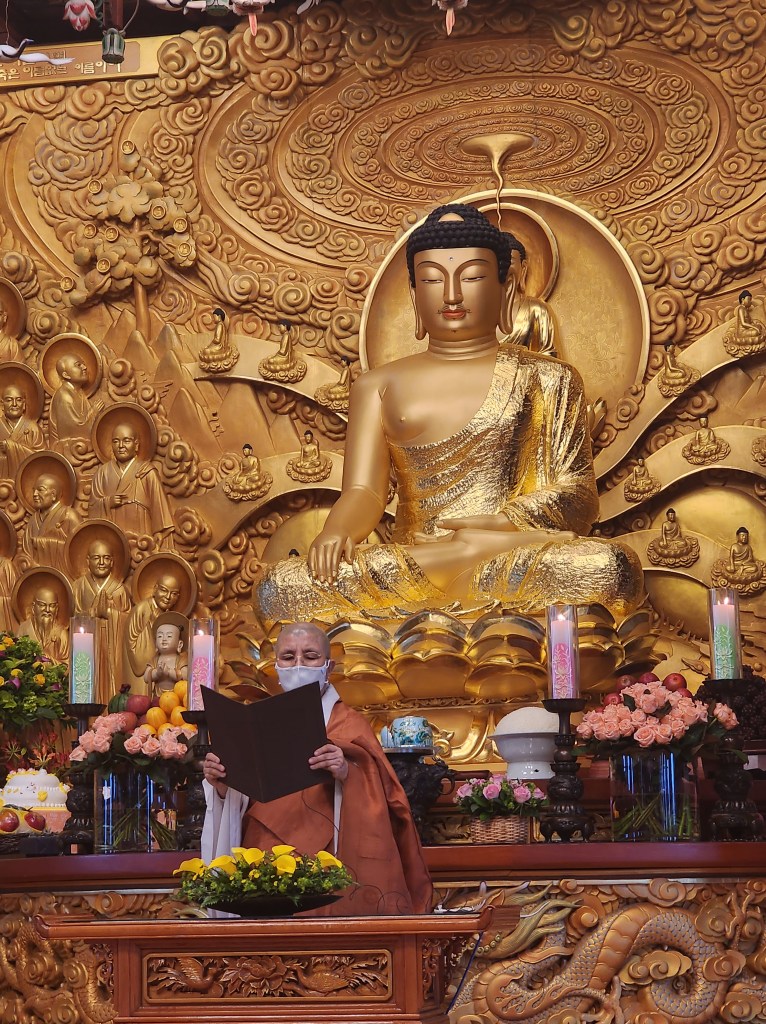
Tomorrow, May 27 (April 1 on the lunar calandar) will be the 11th anniversary of Daehaeng Kun Sunim’s passing, though it’s probably better to say, “when she was finished with her body!”
We’ll have a ceremony here at the Anyang Hanmaum Seon Center at 10:30 am Seoul time, which will probably be live on the Seon Center’s YouTube channel. https://www.youtube.com/@HanmaumTemple

It won’t be too long (by Korean standards!) and there should be something interesting for the video memorial. That said, here is the text of one of her favorite Dharma songs, where she talks of how we can dissolve our old karmic input by taking it and entrusting it inwardly so that it can dissolve. It speaks of becoming free of those, knowing our existence as part of the whole, and the positivity and hope that arises from this!
Live Magnificently
Through similar karma,
consciousnesses have gathered together
and formed a body.
Billions of lives make up this body,
with every instant
they leave and return,
and cause us to suffer.
Take the suffering and hardships that arise
and gather them together in your one mind.
Do this!
Then lives within your body will be transformed
into bodhisattvas.
Then the lives within your body will all be saved,
will all be saved.
Our one mind and all Buddhas
exist together,working together as one.
“All minds are my mind,
all bodies are my body,
not a thing is separate from me.”
Truly realize this for yourself,
truly bring forth this one mind.
Raise high this invisible, five-colored pillar
and go forward entrusting everything to it.
Live magnificently
throughout all life’s ups and downs,
live magnificently!
Live magnificently!
And a bit of silliness by the monks after a group photo on Teacher’s Day!

Unveiling the parade lanterns
This Sunday at 7pm, we’ll be unveiling the parade lanterns for Buddha’s Birthday, as well as the group performances (May 7, 7pm Seoul time). It will be broadcast live on YouTube, and *might* be left up, or some version of it. Here are some photos from years past. The lanterns this year will all be new.
https://www.youtube.com/@HanmaumTemple