Occupying the same time and place as others

There’s an odd fact about non-duality, for while we each have our separate roles and appearances, we also share a common connection. Obviously this isn’t a physical connection, but it’s there nonetheless, and we can experiment with it and try to apply it to our daily life.

Jeanne, (with the Third Eye her students gave her)

I’d like to ask our readers help with something. Right now, there is a very sweet Buddhist blogger suffering from severe kidney failure. Her name is Jeanne, but she’s more commonly known as the Dalai Grandma.

Please experiment with sending her love and energy, clarity of awareness, peace, and perhaps even that her kidneys should regain more of their normal function.
       Whatever speaks to you, try and offer that. Raise that thought clearly, and then let it dissolve back into you and sink down heavily within you.

Daehaeng Kun Sunim sometimes describes our fundamental mind as a communications center; if we correctly input something into it, that input is communicated through this unseen connection. Or like an electric light, when the circuit is completed, energy freely flows back and forth. 

Because this isn’t a physical connection there is no physical limitation to this energy. The saying “there’s no near or far in the Buddha-dharma” isn’t just a philosophical statement.
 
     Let’s experiment with this and see what we can do to dissolve a bit of this world’s suffering.

Thank you,
Chong Go

A Buddhist Christian pilgrimage

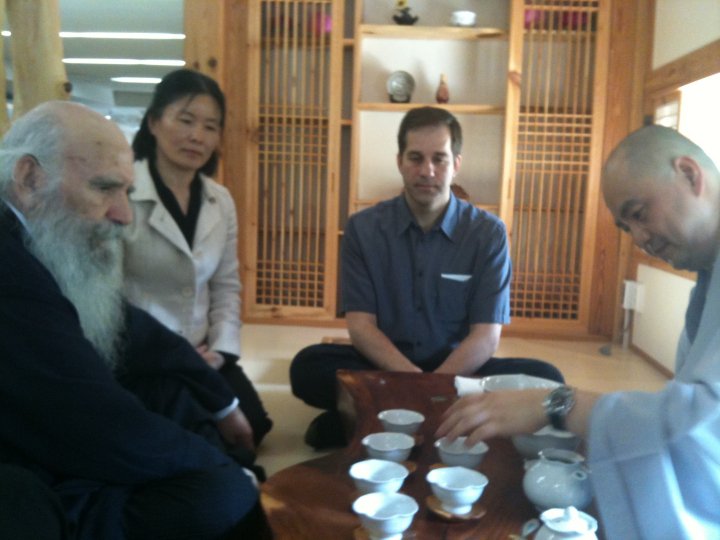
A few weeks ago, on the Tricycle Community, I was delighted to see some pictures of HE Gregorios, of the Eastern Orthodox Church, and Sung-Jin Sunim, from the Jogye Order, together during the anniversary celebrations of the Eastern Orthodox Church in Korea, visiting a temple and drinking tea. As Jack, who so kindly posted the pictures, originaly taken by his friend Fr Daniel Na, said, the contrast, and lack of contrast, between these two monks is amazing.

HE Gregorios and Sung-Jin Sunim

It reminded me a lot of last year’s 400-kilometer silent ochetuji pilgrimage, carried out with prostrations after every three steps, from Jirisan to Imjingak, jointly undertaken by Venerable Su Kyung, head monk at Hwagyesa Temple, and two Korean Catholic priests, Fathers Paul Moon Kyu-hyon and Simon Chun Jong-hun. They were joined in the pilgrimage by some 10,000 people, and the purpose of their journey was to help promote the cherishing of life and peace.

Father Mark Kim In-kook, from the Catholic Priests’ Association for Justice, said that the pilgrims “showed what religious communities in our society can do for the common good”, and their joint action seems to me to be a fine example of how Buddhists and Christians often work together in a spirit of friendship.

In contrast, many of the English-language Buddhist blogs often express a surprising degree of hostility towards Christianity. But this mostly comes from young converts with little experience of life in Buddhist countries and often with uncomfortable experiences of the Church. Such people are naturally keen to draw boundaries between the Buddhism they’ve adopted and the faiths they’ve left behind.

Of course sometimes it is perfectly necessary to point out differences between Buddhism and Christianity, especially when addressing an audience unfamiliar with one or the other. It is often thought necessary to explain, for example, that Christianity is a religion in which the Truth is revealed, with the job of the follower being to believe, whereas in Buddhism one is to experience truth for oneself.

And yet even this, one of the most basic distictions often drawn, if looked at from a slightly different angle, seems almost to disappear. Yes, Buddhists are to experience truth directly through the practice of wisdom, ethics and meditation, but the Dharma was first revealed through the Buddha. Is that really so different from Christianity, in which the central truth, of God’s love in this case, is first revealed, but which is then to be experienced in the everyday lives of Christians, and developed in ongoing daily practice?

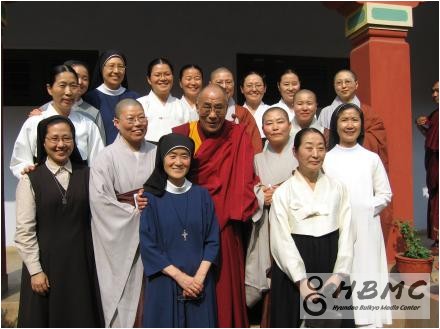
a multi faith, benefit concert for the children of Ethiopia (photo from the Hyundae Bulgyo newspaper)
A pilgrimage to visit the holy sites of different religions and learn from their teachers (photo from the Hyundae Bulgyo newspaper)


Father Laurence, in The Good Heart, describes this practice:  

through meditation, we begin to experience the indwelling, the fact that Jesus is not only a historical teacher from the past, but now has an inner existence within each human being, as well as a cosmic presence.

The Dalai Lama, in the same book, talks about Buddha-nature and how to perfect it, and compares the Christian ideal of becoming one with the father with how enlightenment is described as becoming of one taste with the dharmakaya.  

But my central point here is not about the nature of enlightenment or the relationship between revealed and experienced truths, or even about the ways in which Buddhism and Christianity share certain features. My point is that Buddhism stands on its own three feet, and while some western practitioners automatically and instinctively look for points of contrast with Christianity, focusing on areas of convergence is a much healthier approach.  

So whilst I had a very different experience of the Church to Carl (during my similarly left-wing youth I often found myself on peace marches and marches for freedom in South Africa and Latin America etc, side by side with good church people, and the Church certainly does more to help the poor than any other organisation I can name), I very much welcome the way he embraces his spiritual heritage.  

Thich Nhat Hanh, in a book called called Teachings on Love, has written that: Buddhist practice can offer effective means to heal, reconcile, and reunite with one’s blood and spiritual families, in order to discover the precious gems in one’s own traditions. Thanks to the practice, people will see that Buddhism and their own spiritual tradition have many things in common, and therefore it is not necessary to reject their own spiritual tradition.  

I don’t think Thich Nhat Hanh here is calling for waves of western Buddhists to return to Christianity. What he’s suggesting is that practitioners make peace with all our traditions, to look for what we can embrace. In this we are lucky to have so many great examples. Father Laurence and the Dalai Lama. Venerable Sukyung and Fathers Paul Moon Kyu-hyon and Simon Chun Jong-hun silently walking across Korea. HE Gregorios and Sung-Jin Sunim. People whose default position is to find areas of convergence and genuine friendliness.  

Links:
Tricycle Community: HE Gregorios and Sung-Jin Sunim
UCAN: Buddhist, Catholic clergy complete 400-km pilgrimage

Saving others, saving ourselves – part 2

Here’s one of my favorite folk tales from Korea, with a deep message about life and practice.

     A traveler had spent the night at a guest house deep in the mountains of Korea. He was eager to start out early the next day and get across the mountain range before dark. There was a little snow falling that morning, but it looked as if it would soon stop. As he was getting ready to leave, one of the other guests mentioned that he was going the same way, so they decided to travel together.

     They started up the mountains, and made good progress for a while. However, instead of stopping, the snow seemed to be increasing. By late in the afternoon the snow was getting deep and they were still far from the next village. It was about this time that they came across a man who had collapsed in the snow, apparently from hypothermia.
    The traveler started helping the man up, rubbing his arms and legs, trying to get some life back into him, “Come on,” he said to the other man, “give me a hand getting this guy up on my back. If we take turns, we should be able to get him down the mountain.”
    “Leave him. Carrying him will take too much effort, and he’ll slow us down. We’d better get to the next village, or we’ll be done for as well.”
    “Well, we can’t just leave him here to die.”
    “If you want to kill yourself looking after him, that’s your business. As for me, I’m getting out of here!” With this, the second man took off into the snowstorm.

     There were a few times the traveler wondered if he wasn’t being a fool. But he struggled on through the night with the man on his back. Finally, just after dawn he staggered into a village. 


     Later, he found out that the other man he started out with hadn’t yet arrived, nor was that man ever seen again. It turns out that in trying to save the man who collapsed, the traveler had saved his own life. For in that bitter snowstorm, carrying that man on his back had protected both men’s body heat from the wind and cold, while the effort he made had helped warm them both.
      Ultimately, the one who had focused on his life alone, lost his life. And the one who had been concerned with others, saved his life.

And if you believe that this Earth, this middle realm, functions to sort beings into higher or lower realms, the traveler gained much more than merely his life.

to the bones

Here’s a song that really touches me. It’s by Johnny Cash, near the end of his life.
It reminds me of the great love he had for his best friend, June, and how hard he was trying to hold to what’s true.

There’s a line or two in this song that I don’t really connect with, but overall this video has such a sense sincerity that after watching it, the usual background noise of whining and petty thoughts seems to fall away.

In saving others, we save ourselves

This is one of my all-time favorite cartoons; in English it’s published in “Zen Speaks,” by Tsai Chih Chung.*  This is from the original Taiwanese edition.
 

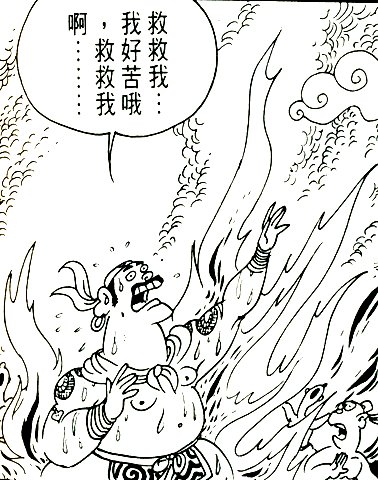
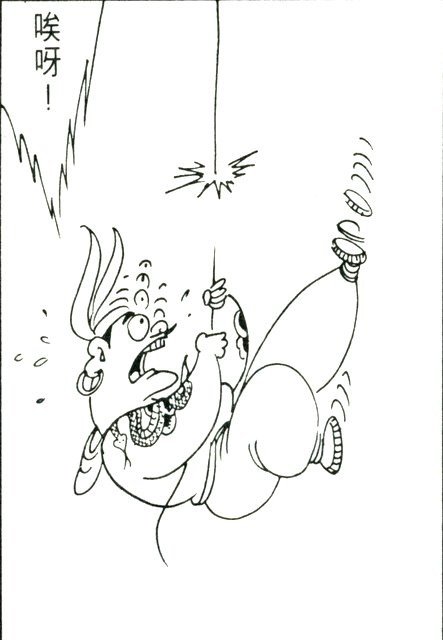
“One day, the Buddha Shakyamuni was meditating when he heard the sounds of beings crying out in great pain. As he looked throughout all realms, he saw that the cries were coming from a hell realm.

There, one man in particular was begging him for help.o

o

o

o

o

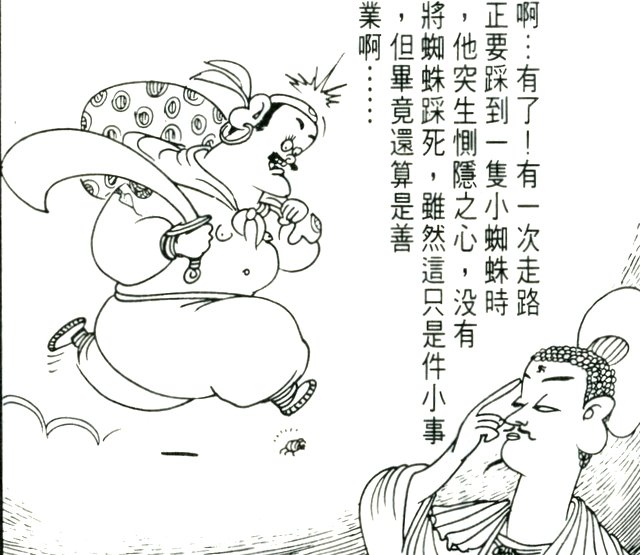
Using his sublime abilities, the Buddha looked into the man’s past:

He’d been an infamous brigand, for whom no deed was too evil.

“Alas,” thought the Buddha, “did he do no good?”

o

o

o

o

o

ooo

 o

oThere had been one time, after robbing a village, that he made an effort to avoid stepping on a spider.

o

o

o
 o

o

o

o

o

o
 

“So,” thought the Buddha, “let the spider save him now.”

o


o

o

o

With this the spider sent a single strand of silk down into the depths of hell.

o

o

o

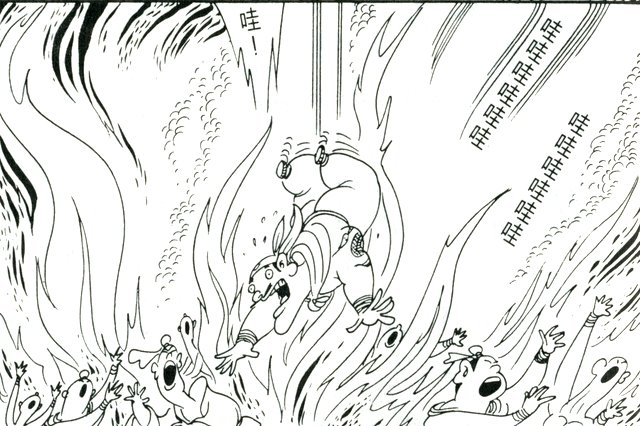
The man grabbed ahold and began climbing out. However, everyone else was also trying to climb up that single strand.

“Hey! This is mine! Get lost!” And he cut the thread below him, dropping all those other people back into hell.

o

o


o


  However, in the next moment, the thread just above him broke, almost as if some hand, perhaps his hand, had reached down and cut it.


o

o

o

o

o


There’s no saving myself alone.
Only by including others, can I be saved.


* Tsai Chih Chung is a gifted artist, and an incredible interpreter of the Chinese classic texts of wisdom. If you were ever the least bit curious about the great philosophers of China, check out his books.

Behold, I am become Mara, destroyer of worlds*

A few days ago Barry from Oxherding commented on a verse of the Dhammapada (at Without Bounds) about the influence of Mara, otherwise known as the King of demons:

The one who lives for sensation,
Indulgent in eating,
Lazy, and lacking in energy,
The tempter Mara, breaks,
Just as the wind breaks a frail tree.**

 
I read this as a warning, that if I live without any self-restraint, I’ll eventually succumb to some temptation or situation that will break me (physically or spiritually).

 However, to Barry, it felt like something was missing: 
“…none of these translations really gets to the key point for me. That point is: To indulge in the pleasurable *is* to be overcome by Mara. Even that doesn’t feel quite right. Perhaps it’s not so much that Mara overcomes, as that we *become* Mara, our inherent Mara-nature co-arises with indulgence.”

Becoming the destroyer of worlds

This is a great point, because it feels like once I succumb to temptation, I am Mara.  I’m the one occupying that unwise thought or action, though there may be some disquiet telling me something’s wrong. You’ve probably heard the joke, “it seemed like a good idea at the time”? Sometimes it’s not so funny.

To be overcome by delusion — to succumb to Mara — is to be doing or thinking something that seems good, right, and pleasureable, and yet is unhealthy for myself, society, and the planet. At that moment, I am Mara, destroyer of worlds. While thinking I’m doing something good, I’m destroying the enviornment, other’s lives, and my own life.

 To be lost in ignorance,
mistaking delusion for truth,
the unhealthy for the healthy,
how to take even one step forward?

 
So, for me, the key question is how do we step back from this Mara-nature when we’re in the middle of it?  What do we do when we can’t be sure about which way is up and which is down, about what is good and what isn’t?

The only reliable method for me, is to let go of everything:
To let go of the things I don’t know, as well as what I know (which is probably incomplete, or incorrect), and to entrust it all to this bright, inherent Buddha-nature that we all have.

Daehaeng Kun Sunim often compares this true nature to a smelting furnace: it burns away all impurities, and what comes out the other side is pure gold. All I can do is entrust it with what I know, and what I don’t know, and go forward with empty hands, trusting in this empty place that is the source of everything.

This is what works for me, (although I’m not always successful at implimentation.)
What works for you? How do you recover from an incarnation as Mara?

with palms together,
Chong Go


–A bit beside the point, but still important, is the question “what is this Mara-nature?”

Obviously, any good Buddhist is going to know there’s no such fixed entity out there. (right? ;-)) In Korean Buddhism, there is the concept of “karmic consciousnesses,” that is, karmic states of consciousness, or echos of states of mind. When these return to us, they come out through our brains, our awareness, and so we identify with that feeling. “I’m the one who feels that.” Instead, it helps a bit if we realize this is just a karmic echo occupying the same time and place as us, much like a fart in the room. “That’s not me, that’s just here at the same time, and if I wait a bit, it will pass.”

*The actual quote, paraphrased by Robert Oppenheimer as he witnessed the first  atomic bomb, is “Behold, I am become Shiva, Destroyer of worlds.”

**This is from my favorite translation of the Dhammapada, by Balangoda Ananda Maitreya

Buddhas and Bodhisattvas

Namo Amitabul (Amitabha)

Namo Kwan Se Eum Bosal (Kuan Yin)

Namo Ji Jang Bosal (Ksitigarbha)

Namo Seokeomoni Bul! (Shakyamuni)


oooooooooooooooooooooooo

oooooooooooooooooooooooo


The Buddhas and Bodhisattvas are projections of our minds — and so is everything else. The idea that they don’t really exist is also a projection based on our high valuation of scholars, the modern historical method, and scientific materialism, in which we’ve been steeped since day one of our lives. Which is a more skillful projection? I’d take the former any day, because it reminds me of what’s possible, who I want to become — afterall, I am becoming something, may as well make it pleasant and beneficial for others.

If we look at our lives we can see these Bodhisattvas and Buddhas manifesting in various ways. Throughout my life certain teachers would manifest suddenly: Thich Nhat Hanh, Joko Beck, the Dalai Lama, Daehaeng Sunim, etc. (If I were to name all my kind teachers it would make a long list!) Isn’t it possible we may actually meet Amitabha or Kuan Yin? I couldn’t have imagined such a bodhisattva the magnitude of Thich Nhat Hanh, but he reached down low into samsara and is delivering countless beings with his skillful teachings and great compassion.

All my gratitude and praise to these Buddhas and Bodhisattvas emanating immense kindness, non-discriminating compassion, and stainless wisdom to us suffering fools. May they continue to turn the wheel of dharma and be our kind teachers forevermore.

The Bangkok Seon Club

Gulukhan Bucheonimke Gwiuihamnida
Gulukhan Galeuchime Gwiuihamnida
Gulukhan Sunimdulke Gwiuihamnida
– The Three Refuges 
 

I am constantly struck by just how valuable an opportunity we have here in Bangkok to study the Dharma. In order to practice Therevadan Buddhism in English there is the wonderful Littlebang Sangha, and for those of us drawn towards Korean Zen, there is the Bangkok Seon Club. Not only is it amazing to be able to study Seon Buddhism at a Korean temple while living in Thailand, but the friendliness and support of the group is something not often encountered, and very precious. 

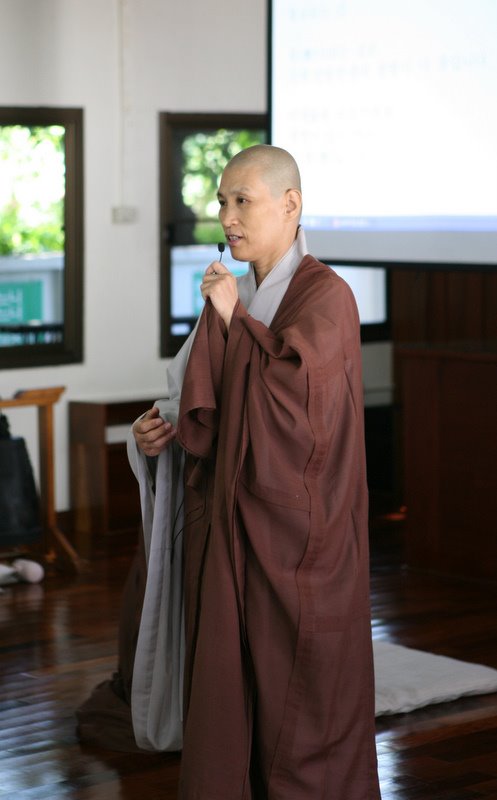
Hyaedan Sunim

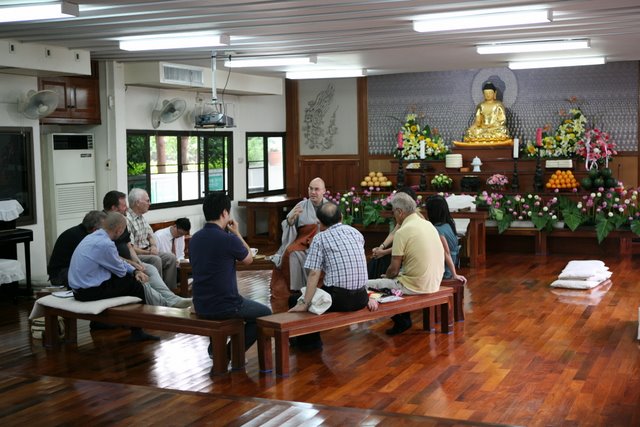
We start each meeting by chanting the three refuges, though in the Korean tradition it’s more of a song than a chant, then we bow and take our places for a short meditation. The sit is led by Hyaedan Sunim, who marks the start and finish with three strikes of the seon stick, and then we always place our cushions onto benches, which we move into a square, to briefly read a few pages of Kun Daehaeng Sunim’s book ‘No River to Cross’, and start the discussion. 

Looking back through my notes from the past year of discussions, I see that we’ve covered a great deal of ground. One of the meetings that was most useful to me was from last August in which we talked about faith. I have a naturally devotional approach, and Kun Sunim’s teaching – to believe in, let go to, and observe the workings of Buddha-nature – has provided a better understanding of my faith, and a beautiful and adaptable practice I can go back to again and again. 

Many of the people in the group have been studying Zen for decades in various traditions, and although I admit the discussions sometimes become a little too complicated for me to follow, I always enjoy what I am able to understand and I am impressed at how people are able to share ideas and experiences regardless of language differences. Eun Young, our wonderful translator and an inspiring practitioner, deserves huge thanks for this. 

Bodhisattvas filling the sky around us

 But, of course, discussion has its limits. As Kun Daehaeng teaches in chapter two, “The eternal self cannot be described by words, and it cannot be revealed through discussion. Trying to know it conceptually is like trying to know the world while trapped inside of a barrel.” Hyaedan Sunim describes it as being like a bird which has flown into a room. Banging its head against the window won’t free it. 

Rather, the bird must stop its frantic activity, rest, and examine how it came to be in the room in the first place. Then the way out will be clear. This reminded me a lot of Phra Cittasamvaro Bhikkhu’s comments last year in his talks on ‘the way of wisdom’. He warned against too much conceptualisation and also suggested that simple resting, using time in practice to observe rather than engage, leads to peace and liberation. 

entrance to the Bangkok Hanmaum Seon Center

I’m glad I went back to look at this again. As well as that part of me that welcomes resting in faith, I also have a tendancy to try to work things out, to try to find the ‘right’ answer. Too often this ends up in pointless discussions, especially on the Internet. The beauty of our monthly Sangha meetings is that it is a place where real, meaningful discussion can happen, and where we can learn the practice of letting go. A practice I have had to return to again today, a practice I return to again and again. 

Our meetings are also a lot of fun. After the discussions, and sometimes they go on very late, many people continue talking and sharing in a nearby restaurant till well after the last train has stopped running. Thank you again to everyone who makes these evenings possible. And click on the link below for details of the next one on June the 26th. 

Links:
Littlebang: home page
Littlebang: details of next Seon Club

Just a sunny day

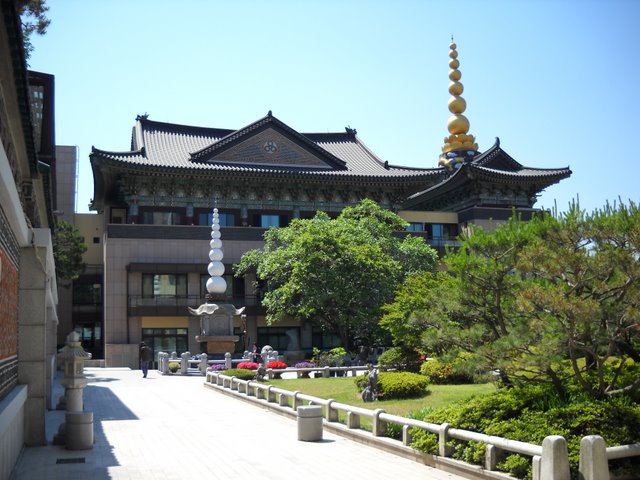
It’s a sunny day here in Korea, and about 32 Celcius. Here are some photos of the main Hanmaum Seon Center, in Anyang City.

Sunrise, a little before 5am
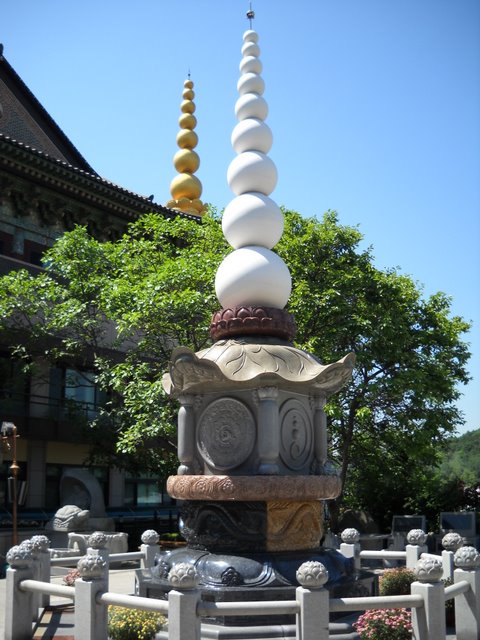
The Gujeong Pagoda, which Marcus mentioned
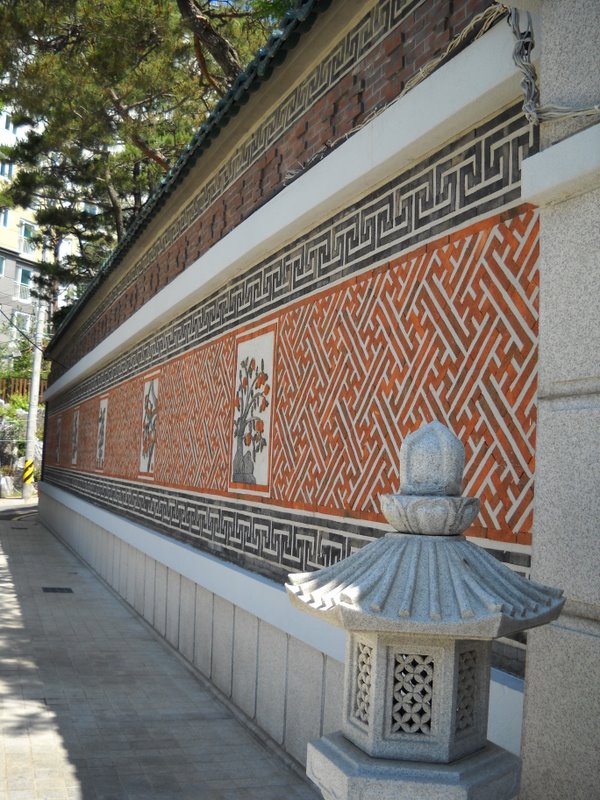
courtyard wall
persimmons - all the detail is carved from clay bricks

hiking path behind the center
welcome home!

A True Human Being

The following is the short Dharma talk by Daehaeng Kun Sunim that Marcus mentioned in the previous post.  
 
A True Human Being

Our true mind is a great brightness that can lead us all.
This one mind, this one point
is the foundation of the Earth,
the foundation of the sun,
and the foundation of the universe.
With perfect wisdom it accepts everything and responds accordingly.
It is brightness itself,
what could possibly hinder it? 


Although this brightness is in everything,
people create divisions and labels,
and then let those rule their lives.
How could they not be hindered
and oppressed in all the things they do?


A true person is the same as a Buddha.
However, let go of even the desire to become such a person,
as well as the fear of not achieving this,
instead, take everything that arises from this empty place,
your inherent foundation,
and return it to this empty place.
If you entrust it there with sincere faith,
and are relentless about this,
then from that place, your true mind will reveal itself.
 

In this true mind,
a Buddha’s mind and an unenlightened being’s mind
are not separate,
there’s no clean or dirty, high or low,
nor the least hint of “I did” or “I know.”
This true mind,
this completely empty bowl,
manifests every instant,
and brightly shines upon all,
with hands that aren’t hands, feet that aren’t feet,
on the path that isn’t a path.
This is the mind of a true human being.
 
–Daehaeng Kun Sunim 


copyright 2010, the Hanmaum Seonwon Foundation