
“If you don’t know that your inherant nature is fundamentally bright, how can you save yourself and how can you give light to people around you?”
– Seon Master Daehaeng Sunim
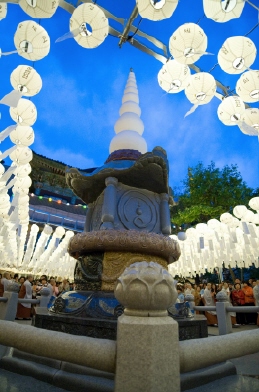
A short walk from Roppongi, an energetic upmarket area of Tokyo, is a truly beautiful temple. It was first established in 1598 as an expansion of a small roadside Kannon shrine, but you won’t find it mentioned in any guide books – probably because the buildings, destroyed in 1945, are all, as far as I understand, post-war reconstructions. And yet it is large, traditional, serene, and contains a couple of items that make it my favourite temple in the city.
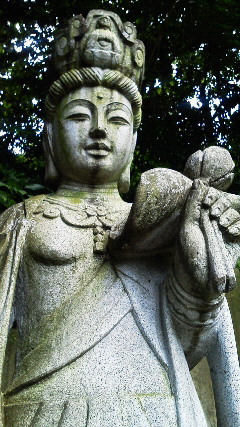
The first is the statue, the largest wooden statue of Kannon in Tokyo, rebuilt in the 1970s but gorgeous. It is a standing eleven-headed Kannon with two arms holding a vase, a lotus plant, a staff, and beads. The wooden nimbus contains a number of Buddhas and the hall is built around the statue in such a way as to really give an impression of size and a sense of awe. It is lovely.
The other thing I love most about Chokokuji is the main hall. Unlike so many other Japanese temple halls which are more often than not locked and inaccessible, the huge tatami mat hall here is open and is infused with a real sense of devoted practice. It reminded me so much of Korean temples, and performing some prostrations and spending some time sitting came naturally and effortlessly.
It is, I believe, Soto-Zen (in fact, the Tokyo Branch Temple of Diahozan Eiheji, but I’m not really very sure quite what that means!) and I understand they have some meditation classes open to all on Monday nights (see the link below), but what appealed most to me (with my devotional approach to these things) was the Kannon Ceremony on the 18th of every month.
I went along with Ikumi and got there good and early, and good thing we did as the seats were soon all taken! The monks sat around the statue and chanted (the Heart Sutra and the Kannon Sutra were both delivered so fast that few laypeople there could match the pace) and went through various ritual movements and everyone had the chance to go up and burn some powdered incense and pray.
And at the end, before the monks filled out, the head monk talked to everyone there. It had been a tough time for Japan this year he said, with Ikumi kindly translating for me, but the essential thing was to move forward. “Remember” he said, “Kannon is not just a statue, Kannon lives within each one of us and is always with us, and so we have the power to set our course, set our goals, and move forward.”
Link: http://global.sotozen-net.or.jp/eng/temples/foreigner/Chokoku-ji.html
 Okay, that’s all I got so far! If you have any great ideas on how to end this (in a positive way), have at it in the commments!



 Wake Up and Laugh!