a post from Japan

“If you don’t know that your inherant nature is fundamentally bright, how can you save yourself and how can you give light to people around you?”
 – Seon Master Daehaeng Sunim

A short walk from Roppongi, an energetic upmarket area of Tokyo, is a truly beautiful temple.  It was first established in 1598 as an expansion of a small roadside Kannon shrine, but you won’t find it mentioned in any guide books – probably because the buildings, destroyed in 1945, are all, as far as I understand, post-war reconstructions. And yet it is large, traditional, serene, and contains a couple of items that make it my favourite temple in the city.

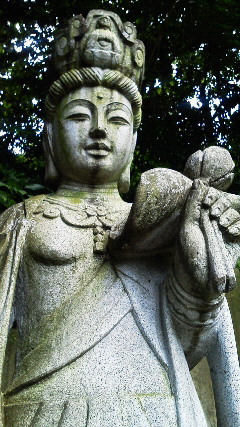
The first is the statue, the largest wooden statue of Kannon in Tokyo, rebuilt in the 1970s but gorgeous. It is a standing eleven-headed Kannon with two arms holding a vase, a lotus plant, a staff, and beads. The wooden nimbus contains a number of Buddhas and the hall is built around the statue in such a way as to really give an impression of size and a sense of awe. It is lovely.

The other thing I love most about Chokokuji is the main hall. Unlike so many other Japanese temple halls which are more often than not locked and inaccessible, the huge tatami mat hall here is open and is infused with a real sense of devoted practice. It reminded me so much of Korean temples, and performing some prostrations and spending some time sitting came naturally and effortlessly.

It is, I believe, Soto-Zen (in fact, the Tokyo Branch Temple of Diahozan Eiheji, but I’m not really very sure quite what that means!) and I understand they have some meditation classes open to all on Monday nights (see the link below), but what appealed most to me (with my devotional approach to these things) was the Kannon Ceremony on the 18th of every month.

I went along with Ikumi and got there good and early, and good thing we did as the seats were soon all taken! The monks sat around the statue and chanted (the Heart Sutra and the Kannon Sutra were both delivered so fast that few laypeople there could match the pace) and went through various ritual movements and everyone had the chance to go up and burn some powdered incense and pray.

And at the end, before the monks filled out, the head monk talked to everyone there. It had been a tough time for Japan this year he said, with Ikumi kindly translating for me, but the essential thing was to move forward. “Remember” he said, “Kannon is not just a statue, Kannon lives within each one of us and is always with us, and so we have the power to set our course, set our goals, and move forward.”

Link: http://global.sotozen-net.or.jp/eng/temples/foreigner/Chokoku-ji.html

Children’s Dharma Talk

I really have to get with posting again! Sigh.  Things have been busy here with getting a manuscript ready for Wisdom Publications, and now the the Frankfurt Bookfair.  It also looks like there will be a Russian edition of “No River to Cross” coming out before the end of the year.
 
Here’s a Dharma talk that Daehaeng Kun Sunim gave to out center’s childrens group.

Children’s Dharma Talk  

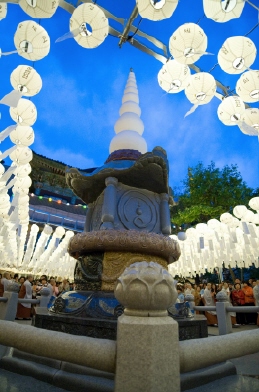
The Gugeong Pagoda on Buddha's Birthday (at Hanmaum Seon Center)

I can’t tell you how moved I am to see so many of you gathered together here today. Seeing you here today warms my heart. I was just like you when I was little. People may call you children, but you’re doing something very deep and significant when you gather here in front of the Buddha and learn about spiritual practice.

 You’re practicing, so you probably already heard that the minds of all life are connected as one. Stars have an essence that is also within us, so all of you are stars! You, stars, and this fundamental mind all respond to each other. This all happens without any wires or signals you can grab onto. When you eat something, and say “Thank you, Juingong (Buddha-nature)” your mother and father, Buddha, and sunims are all there inside of Juingong. When you take the things that come up in your life, and gather them all together at that one place, (Juingong), you can get a sense of this fundamental essence and can evolve your mind. Do this and bring forth this great power that’s within you.

             Keep practicing like this and become wonderful people. Become great beings who are able to bring peace to your family, who can guide your country, the world, and even the universe. This is all possible for you, according to how you practice. Okay?

 This Dharma talk was given by Daehaeng Kun Sunim during a Precepts ceremony for children.  

Tongdosa’s Nine Dragon Pond


Nine Dragon Pond

[ Some of you may have read this on my other site, but I just got back from a busy weekend looking at our new house in the countryside and have to get to sleep soon, so hope you don’t mind me reposting this!]

 In Korea, there are three special temples know as the “Three Jewel”, each representing one of the Three Jewels of Buddhism, the Buddha, Dharma, and Sangha.

Deep in the southern mountains is Tongdosa, the temple representing the Buddha, splendid in both atmosphere and spirit. But when the temple was founded in the year 646, there were nine evil dragons occupying the pond that the monk JaJang had to contend with.

At first, he tried chanting a mantra to make them leave but they refused, so he brushed the character for fire on a sheet of paper and, tossing it into the air, whacked the pond with his stick. With this, the water began to boil. Soon, three of the dragon flew out from the water, but collided into a cliff and died. Five other dragons flew south, and settled permanently in what is now known as Five Dragon Valley. Finally, the last dragon emerged, blinded by the boiling water. He made a vow to JaJang that if his life were spared he would be the temple guardian. JaJang accepted his offer, and the dragon remains as the temple’s guard.


letting go, being happy


There are times when I have more (impossible) questions and complaints than answers. Times I struggle so hard to reconcile all the theories and practices of all the different traditions I’m familiar with that I feel frustrated and quite angry.
 
And sometimes this bubbles over. Like a child raging in the supermarket, I pick fault, stamp my feet, and bewail the fact that there is no perfect philosophy, no perfect community, crying out in pain that I don’t know what I’m doing!
 
Thankfully, my friends respond. Carl, Young, Joe. “About the philosophical questions you raised, I wouldn’t worry too much”, Chong Go Sunim wrote. “They are all just skillful means aimed at untying the knots some people get stuck in…. so if they don’t click with you, it’s not a problem.”
 
Young, from the Bangkok Hanmaum group, wrote about how the experiences and insights we have and the words we use to describe them are two quite different things – and of course she’s right; all my confusion last week came from getting tangled up in words rather than simply relying on the practice.
 
The funny thing is, the trick to overcoming all this, the practice itself, is really very simple – the trick of letting go! Funny how I so often forget it, am still a complete beginner, prefering most of the time instead to live out never-ending intellectual and conceptual dramas.
 
The other trick is even simper (but boils down to the same thing) – to just do what makes you happy (combined with awareness of course!) … or, as Chong Go Sunim put it the other day, what makes you feel alive! I know that if I just let go and do what makes me fully alive, life is much simpler and better.
 
Today I practiced, and in the afternoon we went to a temple. The hall was empty and we bowed and sat, wandered around a little, talked to a monk, got some calligraphy done, then joined the service – just me and Ikumi and a single monk in a huge tatami shrine room with open windows, trees and sky.
 
Gorgeous, just gorgeous. No thinking, no worrying, no trying to work it all out – just letting go, just happiness!
 

teaching Fina “letting go”

A few months ago, Chong Go Sunim presented me with the idea (challenge) of teaching Fina “letting go,” an important theme throughout Seon Master Daehaeng’s teachings.

I think my mouth said something like, “Yeah, good idea,” but my mind was going, “Yeah, right! I’m not even good at letting go!” But in the end, that’s half the point. The best way to teach a baby to let go is to do it yourself and let the baby pick up on that.

After trying several times, when Fina would grab something, to try to emit a sense of, “I don’t want that…” I wasn’t sure how far I was getting. Then one day Fina spotted a big, stuffed Pororo (her favorite Korean character) doll in the toy section and squeezed it tight her arms, swinging back and forth, excitedly shouting, “Pololo! Pololo! Pololo!” (She learned Pororo’s name about two months before she learned to say “Papa”, even if she couldn’t quite get the r’s).

At first, I thought, “Well, we haven’t bought her too many toys, she’ll really enjoy this one”, then I saw the $70 price tag and almost choked. I had a feeling that mentally mimicking “let it go” wasn’t going to cut this one, and was in no mood for a baby-breakdown, then I thought of something different.

Fina was getting used to saying “Hi” when we say people we knew, but she was even better at saying “Bye!” so I tried it. I encouraged her to give the doll a kiss on the cheek, then waved to it and said, “Byyye~”

Just like that, Fina waved with one little hand, said bye to Pororo and carefully put him back on the pile of other Pororos.

Woo hoo! I’d never bothered keeping score with Fina, it would’ve been too humiliating! but score 1 for Papa anyway!

Do what makes you come alive

I happened to visit the Dalai Grandma the other day and found she had a great quote for me:

Howard Thurman 
Don’t ask yourself what the world needs. Ask yourself what makes you come alive and then go do that. Because what the world needs is people who have come alive.

Here’s another nice quote from Wikipedia:
community cannot feed for long on itself; it can only flourish where always the boundaries are giving way to the coming of others from beyond them — unknown and undiscovered brothers.

A lake in Russia, taken by my Dharma brother, Ilgyo Sunim

Guide to Korean temples.

Here’s a great guide to Korean temples, Dale’s Korean Temple Adventure. Set up by an expat in Busan, it focuses mainly on temples in the lower half of the country. (Which is fine, because that’s the heart of Korea’s Buddhist history and culture. )

He includes a lot of photos with each post, and relates the history of the temple, along with travel info and his overall impressions of how worthwhile it is to visit the temple.   Here’s what Dale wrote about Hwaeomsa (화엄사):

 Jirisan National Park was a place I long wanted to visit, but never got around to for one reason or another. I didn’t want to go hiking or camping, or anything like that at all. Instead, I wanted to visit two famous temples that sit on the side  : Hwaeomsa and Ssangyesa temples. And finally, in the fall of 2005, I visited with my wife.

The first of two postings will cover the most renowned temple at Jirisan National Park: Hwaeomsa (“Flower Garland Sutra Temple”).
Hwaeomsa (화엄사) was founded by Yeon-gi Josa in 544, when Buddhism was just gaining a hold ofKorea’s religious landscape. The temple was continuously expanded until its total destruction during the Imjin War of 1592. Fortunately for us temple lovers, it was rebuilt three decades later.  And today, it’s one ofKorea’s largest and most well-respected temples.
o
 
Once you’re dropped off at the bus stop at Hwaeomsa village, just south of the temple, you’ll have to walk about a kilometer up a beautiful and scenic valley road. You’ll pass through two gates, one of which is ensnared by dragons sculpted around the stone pillars. In the third gate are four largely sculpted heavenly kings protecting the temple from evil spirits. In the lower courtyard are two similar looking five-tier pagodas. As you continue walking straight, and on the upper level of the courtyard, is the main hall. Usually, the main hall is the largest structure at the temple; however, the main hall is dwarfed by the building that stands just left of it: Gakhwangjeon.  Gakhwangjeon has a two-tiered roof, and it’s also one of the largest and oldest buildings, dating back to 1703, in all of Korea. 
o

It’s a massive building that houses seven figures on its altar. Another strange feature about this temple is that the Seokgamoni Buddha (the historical Buddha) sits in Gakhwangjeon, and not in the main hall. Accompanying the Seokgamoni Buddha in this building are Amita and Dabo Buddhas, as well as the Gwaneum, Bohyeon, Munsu, and Jijeok bodhisattavas. Directly in front of this massive hall is the largest stone lantern in all of Korea, standing five metres tall. Next to this pagoda is an impressive “sari budo” with four fierce looking lions adorning it
.
o
 
But even more impressive than the massive Gakhwangjeon is what stands on the hill just above this building. On the hill stands the most uniquely designed pagoda (next to the ones at Bulguksa) and stone lantern. The five metre tall granite pagoda has three-tiers on top and four lion-shaped pedestals at its base. Each lion represents the four primary human emotions: love, sorrow, anger, and joy. At the centre of these lions stands a human figure with hands held to his chest. There are numerous other designs etched onto this pagoda, so take your time and enjoy the intricacies of this pagoda. And just in front of this pagoda is the equally unique stone lantern with a squatting figure at the centre of its base. Some have suggested that this is the founder of the temple kneeling in obedience to his mother.
o
HOW TO GET THERE:  To get to Hwaeomsa from Busan, there is a direct bus from Seobu bus terminal at the Sasang subway stop (#227). It costs about 14,000Won, and the trip takes about three hours. If you’re not getting to Hwaeomsa from Busan, you can take a bus to Gurye. From Gurye to Hwaeomsa, you can take a bus that goes to Hwaeomsa village for about 1,000 Won.
Admission to the temple is 3,000 Won (and trust me, it is well worth it!)
o
OVERALL RATING: 10/10.  For its historical significance alone, Hwaeomsa rates highly amongst Korean temples. But if you add the giant splendor that is Gakhwangjeon, and the temple rates that much higher. And to top it all off, on the hill stands two of the most uniquely designed pagodas and lanterns in all of Korea.  So if you couldn’t tell already, I highly, highly recommend a visit to Hwaeomsa for both its cultural significance and artistic beauty!
 
(Photos: These are from my collection. I didn’t take them, but I can’t remember who gave them to me. Sorry! – Chong Go  Sunim. As you can see, Dale has great info about these temples (and photos as well), so be sure to check out his blog.)
 

Seen and Unseen Connected as One

Here’s a nice Dharma talk by Seon Master Daehaeng.

Everything, throughout the entire universe and Dharma realm
is connected with each other,
and connected to everything in our lives.
Although unseen,
this connection is like a great net of the Dharma,
a thread that connects everything,,
and a path on which there is no coming or going.
Even this realm of ours is connected, in every way,
to all upper and lower realms.


 Our world faces so many difficulties.
Like sailors,
we have to be prepared to deal with whatever kinds of waves arise.
Yet if we can’t take care of what’s right in front of our eyes,
how will we be able to overcome the larger, underlying aspects?
Our bodies and material things have no power to truly resolve
these kinds of problems.

o

Should even the energy that fills the air around us be depleted,
more would flow in from outside the Earth.
It’s not for lack of energy that our planet suffers,
but because people don’t recognize the energy that’s already present,
and so are unable to use it.
To use this energy,
people who understand about our fundamental mind
have to all become one mind.
If we can do this, the whole will respond to the thoughts we raise.
We have to become one mind, we have to become a great pillar.

o

As I’ve always said, this isn’t about finding something,
somewhere else.
It’s about what we’ve always had,
it’s about our foundation.
We, the owners of the Earth, have to firmly rely upon our root.
Start with brightening your own light, and others will become brighter,
eventually filling the world with light.
How could the world become brighter if the people remain in darkness?
o

You have to bring together both the visible and the unseen-realms
and function using both.
This is the practice of finding your root,
while becoming one with everything that arises in the world.
It’s my sincerest hope that all of you will become fellow practitioners,
diligently practicing, becoming brothers and sisters through our one mind,
and help people throughout the world find their way.

                     -Daehaeng Kun Sunim


(Lotus photo is by Joseph.)

Nonviolent Communication group, in Seoul

I just thought I’d share this with those of you in the Seoul area, there is a Nonviolent Communication (NVC) practice group in Seoul.

A friend of mine has been involved with the group for a few years and what she’s told me of her learning has been very inspirational. (Especially considering that of all the things that come out of our bodies, words can be some of the most troubling!)

On their website (http://krnvc.org/eng/index.aspx), nonviolent communication is described as, “a way of relating to ourselves and others, moment to moment, free of past reactions.”

A big part of NVC is actually learning to listen, to understand the other’s needs as much as learning to express your own.

For more information on the group, here is a link: What We Do

And if you’d like to visit: Direction

Looking on the bright side

One of the things I’ve learned from my teacher is importance of interpreting things positively. (Basically, the thoughts we give rise to lead directly to our future.)

So I found myself laughing as I woke up this morning, with this song playing over and over in my head. Even now this video puts a smile on my face!

(from Monty Python’s The Life of Brian):