The pillar of all work on behalf of Buddhism…

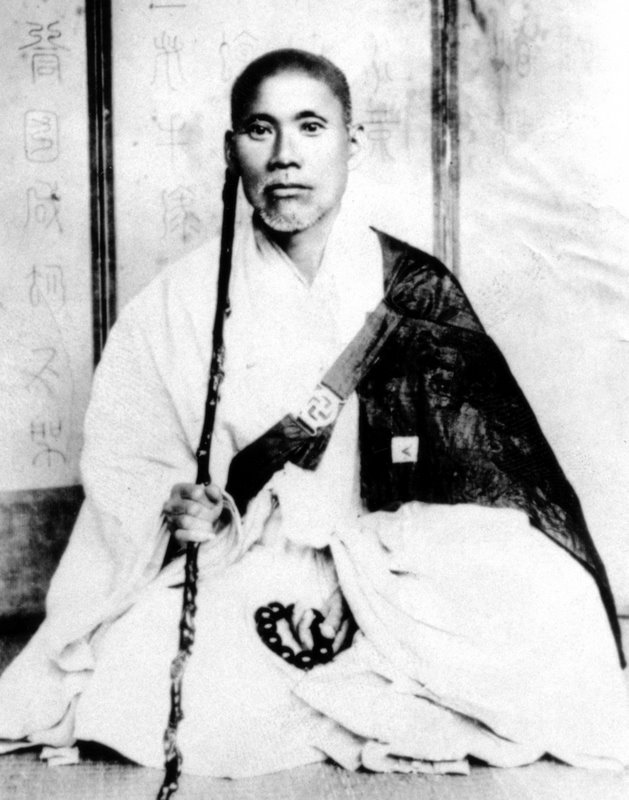
In a short letter, the Korean Seon master Hanam (han-am) Sunim, said something that’s stuck with me ever since:

The pillar of all work on behalf of Buddhism is harmony.

That’s all.  Nothing fancy.  But it packs such a wallop.  Everything about interconnectedness and nonduality is right there, together with tremendous power to guide.

Am I feeling harmonious as I approach this issue?
Am I viewing the others involved in a harmonious way?
Will my intentions and behavior result in a harmonious outcome?

Although obvious in hindsight, this is such a critical issue, for we are all inherently connected, as Daehaeng Kun Sunim says, sharing the same life, the same mind, the same body, and working together as one while freely giving and receiving whatever is needed. 

There’s only helping, not “helping her.”  There’s only loving, not “loving them.”  There’s only hating, not “hating them.”  There’s only defeat and humiliation, not “defeating them.” 

May all beings know happiness and harmony, joy and wisdom, virtue and merit.

with palms together,

Seon Master Hanam Sunim

Chong Go

Protein supplements in my dinner: or, The unhappy fate of rice bugs

Technically, those gray specks in my rice weren’t supposed to be there. Perhaps if they’d been millet, added to give the rice a nice multi-grain taste. Or maybe a little wild sesame. Alas, they were neither.


Tongdo Temple, where we were undertaking our ordination training, is beautiful.  Ancient and sprawling, it is one of the few large temples to survive the destruction of the Korean War. 


    Situated in a green valley with a soaring mountain range behind, Tongdo Temple is truly a treasure of Korean Buddhism.  It also has the worst food of any large temple in Korea!

    Normally, Korean housewives will soak and wash rice before boiling it.  This ensures the rice is clean and also rinses away any rice weevils that may have been enjoying a meal before they were interrupted. With an extra 300 mouths to feed for our training session, it appeared the kitchen monk had skipped this step.

    Picking the steamed weevils out of the rice wasn’t even an option: every last morsel had to be consumed, down to a single flake of red pepper or sesame seed. We would wash our bowls afterwards, and if even the tiniest bit of food was found in the bucket that collected the water, the twenty postulants in my row would have to drink the entire bucket of wash water.

    “Well,” I thought, as I looked at the gray specks in my rice, “eating these won’t kill me. And actually, it won’t even kill them.”

    With that I began to eat, letting go, as best I could, of my fixed ideas of right and wrong, which are more often than not manifestations of ego.

    Daehaeng Kun Sunim had once gently confronted my vegetarian moral superiority, saying about the beings whose cooked flesh was sometimes served to me, “Don’t hate them because they are poor and unfortunate. Become one with them and let them experience the human level of consciousness.”


Bugs in my rice! (at the Dharma Folk blog)

Entrusting

 Several people have asked me to talk more about entrusting, and what Daehaeng Kun Sunim means by it.  Let me start off by saying that entrusting is probably the second-most important aspect of all spiritual practice. There’s so much that revolves around this topic, so I’ll just jump in, and if you all have questions unanswered, let’s continue the topic in the comments section.
 

What is entrusting?
The easy explanation is that it means trusting your root.

It’s trusting your inherent Buddha-nature, and turning over to it everything that arises, along with the things you get hung up on.  
 

To be even more accurate, you’re returning them back to the place they came from. Everything arises from there, so that’s the place they need to be returned to. If you want the answer to a problem, look for it at the source of the problem. If a bee or fly comes into your room, the only way for it to get back outside is the way it came in. If it came in through the doorway, and looks for the solution at the window, it will die there, hitting the window again and again. This is the feeling I get from looking for solutions in the wrong places.
 
Just off the top of your head, how many examples can you think of where things are made worse by searching for a solution somewhere outside the problem? If you have a relationship problem, is looking for the answer in the arms of another really going to make things better? If you’re stressed or lonely or bored, is there really any long-term relief in repeatedly looking for comfort in a bottle,  a pizza box, or the internet? Ultimately, it arose from this foundation, so that’s where we have to return it.

 
Root, Foundation, Buddha-nature, God, the master within, Mind

      Awakening is to know your root.
It’s got a lot of names, but it’s that which is your source and destination, your sustenance and support.

Sometimes I feel like people (unconsciously) misunderstand awakening  as a blissed-out feeling,  or a clear(er) intellectual understanding of what’s really going on in the world. This is probably there, to be sure, but this isn’t the main thing.

Your root is your source and your refuge. To paraphrase the words of the Sixth Patriarch, “Who would have guessed that my foundation was inherently complete, endowed with every kind of knowledge and ability, and able to perceive everything and respond appropriately through both the spiritual and material realms.”  This root of ours is the source of all energy, wisdom, courage, compassion, and is continuously taking care of everything. It seems that only our clinging and insistence on relying upon “me” and “my” thoughts and ideas can hinder it. 

         Daehaeng Kun Sunim gives the example of assigning a task to someone: if you give them a job, and then constantly bug them about how it’s going, they’ll throw the job back in your face. “Here, you do it!”  Or, if you keep calling to them and asking how it’s going, or give them something new to do every few minutes, how can they set about getting the task done?

 
What do we entrust?

We entrust everything, unconditionally.

What we know, along with what we don’t know. What we understand, and what we don’t understand. Things that go well, and things that are going badly. We have to entrust both sides, otherwise we end up (trying to) cling to those aspects that represent our fixed ideas of good and bad, pleasant and unpleasant.

 
Roy, at Return to the Center, asked “how to discern entrusting to my foundation / Buddha-nature from entrusting to my ego-driven storyline? Trust me on this – I have a very convincing storyline…” This is a great question, and I think this unconditional entrusting is a huge part of the answer. Somewhere in letting go of what I know and what I don’t know, I transcend this storyline. If (when!) I find myself caught up in the storyline, I let go of that too.

 
Barry, from Ox Herding, touched on the problem of carelessly thinking “things will turn out for the best.” Things don’t always turn out as good as they needed to be.  A big cause on the personal level, is me not entrusting both sides of the situation, or hoping for one result over another. And sometimes “best” is just a reflection of my own fixed ideas. But our root can still fill in the gaps and help things for the best in our current circumstances. However, this is often the second-best outcome. (Or third, or fourth!^^)

 
Similarly, how do we know what we’re feeling or sensing from within is arising from our true nature, versus our bad karma? This one isn’t easy. For one thing, we have to let go of even the things that arise from inside. Both the good and the blissful, and the wise. If they are true, they’ll return when we need them. Another sign is the tone of this inner “voice.” Is it something that violates the precepts? Is it something harsh and cruel? Something argumentative or spiteful? Those are really strong indications that what I’m sensing is just a karmic echo. No need to feel bad about them, just let go of them too, and don’t be deceived by them any longer.

 
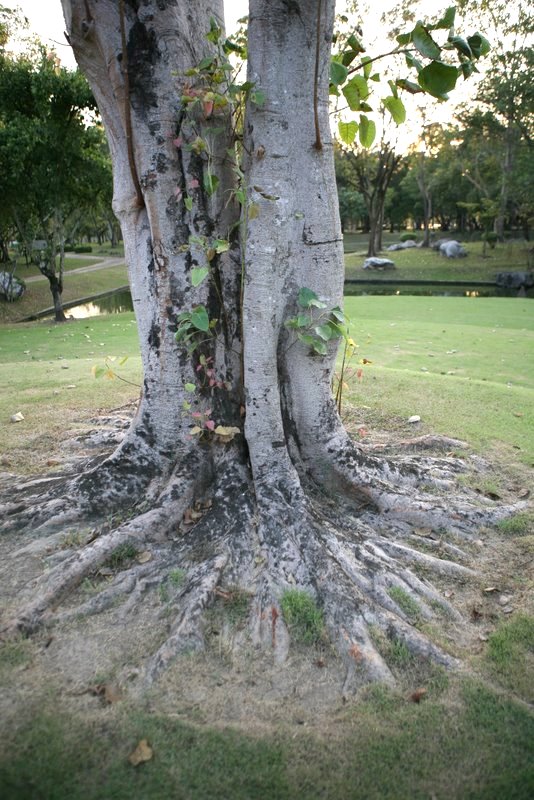
Whether we see it or not, whether we can feel it or not, our Buddha-nature is there taking care of things. You don’t see the root of a living tree, yet it’s there supporting and feeding the tree. So a lot of what entrusting is, is simply getting out of the way and letting it work. Even when I don’t know it’s there, it’s still there, supporting me and sustaining me. Every breath, every cycle of our blood, every exactly produced hormone and enzyme is a miracle of the highest order.  A 100 billion lives are magically working together within just this one body.

Entrusting is a step off a hundred foot bamboo pole. It’s stepping beyond my own fixed ideas. It’s dying and traveling through that gray land where there’s nothing to grasp onto.

(Perhaps that’s why I used to love skydiving!)

However, for eons we’ve mistaken “I know,” “me,” and “mine” for a support, for something safe to stand on.

“So Neo, you think that’s ground you’re standing on right now?”


You think that floor is safer?  Far more skydivers die in plane crashes than skydiving accidents. You’re safer out of the plane than you are in it!

 
It was truly said that when you let go of everything you gain everything. When you’ve let go of all dualities, you become a channel for all the creativity, love, and wisdom in the universe.  

There are so many aspects to entrusting that it’s hard for me to address them all, and my own practice is still incomplete (by a lot!) so if there’s something I haven’t addressed, let’s go ahead and discuss it in the comments section.

with palms together,
Chong Go 

(The skydiving photos came from here and here. Thanks to the original posters.) 

Come to Korea for the Buddha’s Birthday!

Hi everyone,

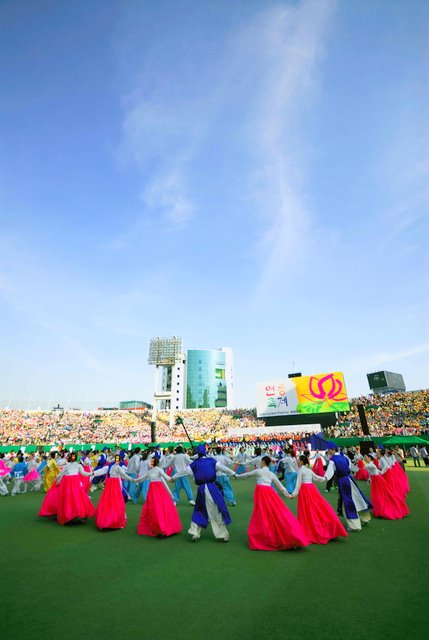
The Buddha’s Birthday is going to be celebrated here in Korea on the 21st, with the main lantern parade in Seoul on Sunday the 16th. The lanterns are spectacular, as are the performances and dancing, and shouldn’t be missed. I took this photo Sunday night at a review our temple was holding.  This lantern is about 10 feet high (3m) and will be used as a parade float. Like most of the lanterns it’s made from traditional paper over a wire framework, with electric lighting within. The paper is hand painted, with a weather-coating varnish of some kind.

There will be a street fair all day on the street in front of Jogye Temple, with the main parade starting from Dongguk University once it begins to get dark. The parade will move down Jongno road, ending in front of Jogye Temple. There will also be a shorter review held in front of Jogye Temple on Saturday, the 15th, again at dusk.

Here’s a close up of the leg:

So if you’re going to be in Korea, be sure to stop by Seoul on the 16th. Busan will also be having a parade, although I don’t know when. (It’s nice, but not as spectacular.) Likewise, there will be smaller parades at nearly every temple in the country on the 21st.

with palms together,

Chong Go

For an idea of the size of these lanterns, look at the peoples’ heads at the base of the elephant.

Ads on blogs

We’ve had some reports of large ads appearing on this blog, but haven’t been able to figure out if this is a spam program or WordPress’ doing. If you’ve seen an ad while visiting us, would you drop a line  in the “Comments” section? Thanks, we’re trying to get more info about this, and would like to know what people are seeing.

with palms together,
Chong Go

Inherently sharing the same life and body

    Towards the opening of Daehaeng Kun Sunim’s translation of the Heart Sutra it says:

Inherently all beings
are sharing the same life,
the same mind,
the same body,
working together as one
and free giving
and receiving
whatever is needed.
They are endlessly
manifesting and
changing every instant,
but because they are unaware
of this,
they walk the path of suffering.

     I’m always amazed at how the implications of this continue to unfold. It explains the idea of “one mind” as well as “interbeing,” and has so many practical implications:


If I want to save myself, I can’t exclude or hate anyone else, for they’re also part of me.

Everything’s constantly changing, yet it’s denying this that causes one to suffer.

Everything I need is there, if I just stop building walls of self and other…

If you do what everyone else is doing…

I posted this elsewhere, but Evelyn in Germany offered such an insightful comment that I thought it was worth reposting here.

A few weeks ago, I overheard Daehaeng Kun Sunim say the following sentence during an interview:
 

 If you just do what everyone else is doing, you’ll be screwed.*   
 

How’s that for a to-the-point Dharma talk! She was talking about the cost of following the herd, but even more than that, the cost of not making an effort to find your own, true root; and the cost of not listening to this root, your Buddha-nature.

Evelyn:
Following the herd – in the beginning it may seem the easiest way… you don’t offend, you aren’t blamed. there are many places and opportunities ‘following the herd’ isn’t just wished but wanted from you – at school, in your job, at home. not to follow the herd implicates annoyance, dismissive treatment and a general uncertainty. you’ll think twice to dare! you try to please everybody. you run… up to the day you are at point zero. you are shattered. and yes, you are screwed. you feel desperately helpless. finally you start thinking again. who’s to blame if you aren’t where you want to be? who’s to blame when you aren’t doing what you want to do? how to untangle this situation and not to destroy everything?

You have to be brave. you have to take the risk. and you have to take the responsibility. then maybe you’ll find out wherefore you are here. it’s worth the effort…
 

   *The word Daehaeng Kun Sunim used was ‘mang-ha-da’, which could be literally “ruined,” but the nuance was much more like “screwed” or “up a creek.”

Practicing through our fundamental mind

Practitioners don’t get caught up in labels
such as “man” or “woman,”
nor the preconceptions that go with such labels.
They’re focused on going forward while relying upon this fundamental mind.
Even if their situation seems unfair,
they see it in a positive light, and are at peace.
They don’t stir up the intellect and “I,” or give rise to plans and goals,
instead, they take the events of their daily life,
and entrust them to their fundamental mind.
While entrusting these things,
if they give raise a thought free of “I” and “mine,”
that thought will manifest into the world.
This is why this practice is so convenient and practical,
it reaches everywhere and communicates with everything.


It’s so hard to be born as a human,
but it’s even more difficult
to become a true human being.
It’s not something that someone else
can give you,
nor are great physical hardships necessary.
Listen often to Dharma talks,
try to practice through mind,
experience what happens
and know for yourself.


Belief and confidence are essential to this process.
Don’t worry about whether your practice is going better or worse than others.
Don’t try to achieve everything all at once,
steady and consistent is the key.
Steadfast faith in your fundamental Buddha-nature,
and consistently entrusting everything to it
is the most important thing.

In this new year,
I hope that you all will live together non-dually,
living as one,
working together as one,
and freely giving and receiving whatever’s needed.

                                        —Daehaeng Kun Sunim
 
 
copyright 2010, The Hanmaum Seonwon Foundation

What feeds your spirit?

The great Korean Buddhist teacher Hanam Sunim (1876-1951) once said that the things we do in our lives either brighten our minds, or darken them. (He said that there’s really no neutral ground, just effects that are too subtle for us to notice.) 

I thought of this the other day, when I came across this great line :

Another washing machine, a bigger car, a nicer house to live in? Not much to feed the spirit in all that.  (Bangkok Tattoo, 179)

So here’s an open question for everyone: What feeds your spirit?

The Metta Sutta

The Metta Sutta, by Al Greene

This song kept running through my head just before I woke up this morning. It seemed like a 20th Century version of the Metta Sutta!

The subject of love in Buddhism is kind of interesting, because I think love is often mistaken for clinging or lust, and so people think it needs to be rejected. However, there is the non-dual love taught by the Buddhas.  Daehaeng Sunim pointed this out to me one morning as I was preparing to return to the US, saying, “Love your family, just don’t be attached to them.”

 The Metta Sutta, by Al Greene, and Anne Lennox

Think of your fellow man
Lend him a helping hand
Put a little love in your heart

You see it’s getting late
Oh please don’t hesitate
Put a little love in your heart

And the world will be a better place
For you and me
You just wait and see

Another day goes by
And still the children cry
Put a little love in you heart
If you want the world to know
We won’t let hatred grow
Put a little love in your heart

And the world will be a better place
For you and me
You just wait and see
Wait and see

Take a good look around
And if you’re lookin’ down
Put a little love in your heart

I hope when you decide
Kindness will be your guide
Put a little love in your heart

And the world will be a better place
For you and me
You just wait and see

Put a little love in your heart
Put a little love in –
Put a little love in your heart…