Being drawn to outward things

Although everything is part of our practice, we still have to make an effort to rein in our ADD, ordinary consciousness. Until we do this, it’s difficult to connect with our fundamental nature. Here are some words of gold by Daehaeng Kun Sunim about this. Although the idea seems simple, it contains deapths that are unimaginable. In this same Dharma talk, she pleaded with listeners, “Please, please don’t mistake intellectual understanding for the ability to do this.” Like developing good handwriting, we need to keep trying to apply the following until it becomes second nature.

A tree has its root, and is alive because of that root. Our every movement happens because of our root. So no matter what you confront, if you focus everything on one place, your fundamental mind, this becomes true samadhi, precepts, and wisdom. This is what’s called the “fragrance of precepts, samadhi, and wisdom.”
      Take care of everything in this way. Sunims practice by entrusting everything to their fundamental mind. Then they don’t end up causing problems for themselves, for their teacher, the temple, or their fellow practitioners. Of course, laypeople as well need to practice like this.

However, when problems occur, many people just react to those, and run around looking for solutions in the material realm. Unless we first entrust things to our foundation, nothing will go right. Accidents will happen, big disagreements will arise, you’ll meet people determined to hinder you, and leading a normal life becomes impossible. Do you think you can solve all of these through your intellect and sweat? When you’re able to truly return and entrust everything you encounter to this foundation, such that what you input changes and manifests back into the world, then your life will become very relaxed and so many problems will cease to be.


 A few days ago, The Zennist included the following quote by Szu-hsin Wu-shin. It’s definitely worth repeating:


While still alive, be therefore assiduous in practicing Dhyana (contemplation).  The practice consists in abandonments.  ‘The abandonment of what?’ you may ask. Abandon your four elements (bhuta), abandon your five aggregates (skandha), abandon all the workings of your relative consciousness (karma-vijnana), which you have been cherishing since eternity; retire within your inner being and see into the reason of it.  As your self-reflections grows deeper and deeper, the moment will surely come upon you when the spiritual flower will suddenly burst into bloom, illuminating the entire universe.  The experience is incommunicable, though you yourselves know perfectly well what it is (Szu-hsin Wu-shin of Huang-lung [1044–1115]).  
 
  
 Quotes by Daehaeng Kun Sunim copyright 2010 The Hanmaum Seonwon Foundation

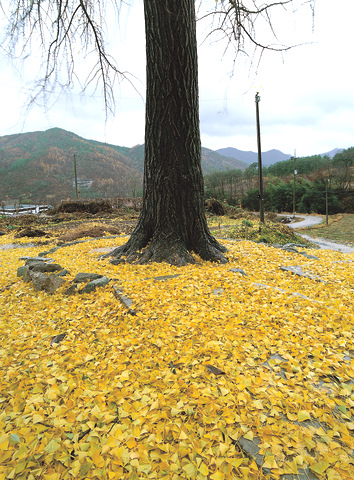
Korean Autumn

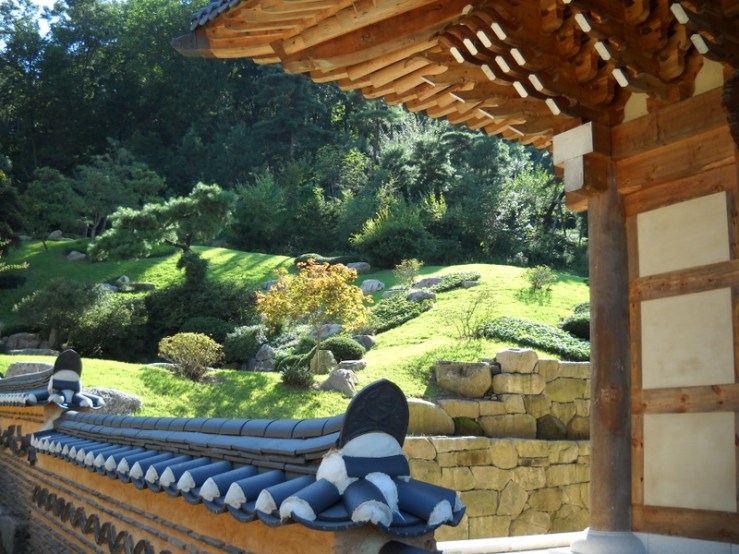
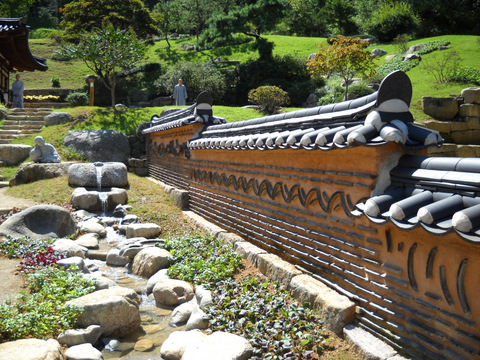
Yesterday I had the good fortune to be at our main temple for monks, Kwang-myong Sa. Daehaeng Kun Sunim  had gone there for a visit, and it also turned out to be one of the nicest days of the year.  


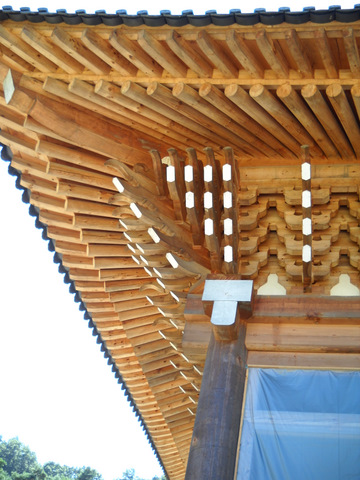
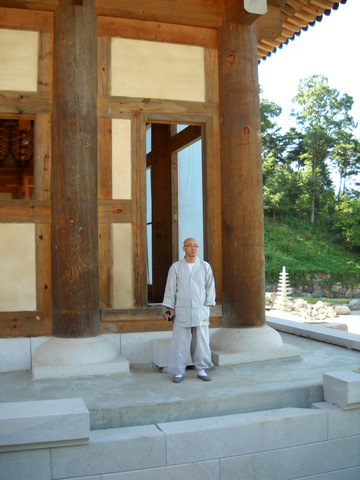
We’ve been working for a few years on building a new Dharma hall, completing each phase as money is saved to pay for it.


To give you a sense of the scale, the monk in this photo is about six feet tall

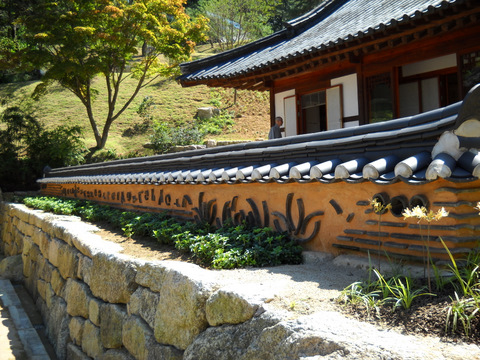
more fun with old roof tiles!


Hye Su Sunim, Kun Sunim's attendant
Touring the construction with the Abbess of the Anyang Hanmaum Seon Center
My Dharma brother, Chong Hyup Sunim


the fundamental thing

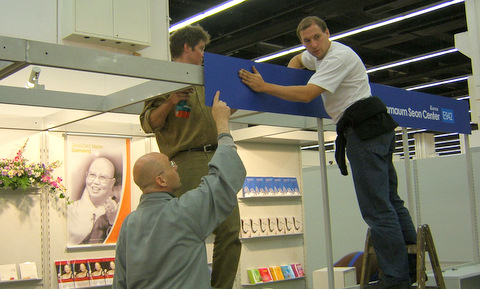
Things here have been a bit busy as we get ready for the bookfair in Frankfurt this October. One of the projects we’ve been working on is a Spanish-English edition of a great Dharma talk by Daehaeng Kun Sunim.  Her focus in this talk is on the necessity of us connecting with this inherent nature, the effects of being able to connect with it, and the need to function from that place.  There are some great lines in this talk where she really lays it bare for the practitioner; here’s one that got my attention!  If your thoughts just spill out your mouth, you won’t be able to make this connection!

 Here is the excerpt:
 

My overall point is this: people who want to discover their fundamental mind, shouldn’t allow themselves to be drawn outwardly by the things that happen to them. Instead, they must take everything that confronts them and return it inwardly.

Even though you have a good intellectual understanding of what I’m saying, please, please don’t mistake that for true understanding. Instead, have firm faith in your inherent foundation, and entrust every single thing there.

No matter what confronts you, your practice needs to be such that when you quietly entrust something to your fundamental mind, that which you entrusted will change and manifest back into the world. Your understanding and practice have to be translated into action.

Only then will you be able to truly deal with all the problems of your life, your family, and even the Earth. 


Copyright 2010 the Hanmaum Seonwon Foundation

advice to the sincere practitioner

In 1929, Hanam Sunim was asked about how to practice after enlightenment,  but I think his answer applies just as well to any point in our practice.  There’s also a bit of practical advice about how to avoid false teachers (or becoming one yourself!)

Yong-jia (永嘉玄覺, 665-713) said about people who are satisfied with one enlightenment experience and so stop practicing: “Saying that everything is empty, yet ignoring cause and effect, and behaving badly is to invite disaster.”

Don’t follow the example of those shallow people who misunderstand the meaning, who are too stubborn, who ignore the principle of cause and effect, and who don’t understand that what they receive is the result of their own actions.

If you don’t awaken to the living word and see only words and letters, or if you are caught by right and wrong, then you won’t be able to gather any strength, and your speech will not be in accord with your actions, so you won’t be able to avoid becoming one of those people who overestimate the level of their own practice. Thus you must have very sincere determination.

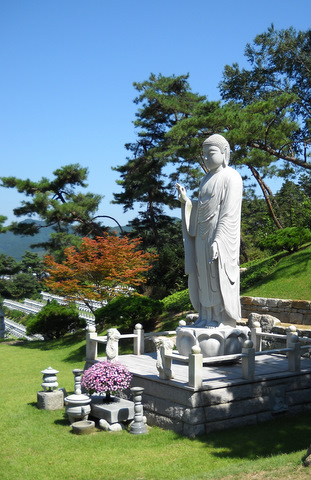
Bodhisattva statue in front of the Dharma Hall at Woljeong Temple

on the other side of the window…

Here’s an Autumn benediction from Joseph:

I’m just looking out the window,
wishing I were on the other side.
Look! a small patch of red in the leaves!
I hope you’ll get to spend more time outside than I! ^-^

p

p

p

p

p

p

p

p

p

Learning to rely upon our true nature

 Here’s a very nice Dharma talk by Daehaeng Kun Sunim.
I had to smile as I reread this, because it really reflects her direct style and emphasis on each of us awakening to this bright essence that we each have.

Regardless of whether you are a layperson or a monastic,
everyone has to practice
relying upon their fundamental mind.
For each person has this one, true thing within them.
If you think that the best thing in the world
would be to truly know
this inherent foundation of yours,
this foundation that is leading the you of the material realm,
then you will succeed in grasping the truth.

You have to practice
such that the visible realm
and the unseen realm
always function together.
If you would have your body and mind
always function as one,
then entrust everything to your true self,
the master within that formed you.
If you live like this,
you’ll be one with everything
and know what peace is,
so entrust everything there.

 This physical body is a servant of our unseen self.
It just runs errands.
So it doesn’t really matter
whether you’re considered someone important or not.
When you’re frustrated or suffering,
remember,
“Okay true self,
you’re the one that can take care of this,”
and keep entrusting.
Only when you do this with everything in your life,
can you make some progress in your practice.

The personality traits that harm and hinder you
are still quite prominent,
so let go of those things,
over and over again.
Remind yourself,
“This inner master is leading me,
only this can show me the way,”
and entrust everything to it.
If you go forward like this
while viewing things positively,
refining virtue, and doing good actions,
then your wisdom will become abundant,
and your life will be well spent.
So really give this a try.

pppppp -Daehaeng Kun Sunim

Text copyright 2010, the Hanmaum Seonwon Foundation

Images copyright Joseph

difficult people, difficult emotions

A couple of days ago, Joseph wrote a great post about dealing with difficult people.  He’d remind himself, that, as annoying as someone may seem, nonetheless, they’re growing and evolving, and have already come a long way.

They may have come a long way, but there are times when even that knowledge doesn’t make it any easier! 

Here are some other ways of looking at people, which have helped me get past some emotion or negative thoughts I’ve been caught up in. These are all true, but it’s often the case that one fits better than the others. (These are from Dharma talks by Daehaeng Kun Sunim) 

1.   I also used to be just like that

2.  They have a good heart, but when they open their mouth, it comes out all wrong

3.  This person(or event) is my true nature testing me.  And helping me discover all the garbage I didn’t realize needed to be dealt with.

4.  This is my true nature helping me grow up

5.  If I hadn’t made and sent out this kind of energy, it couldn’t have returned to me like this. 

6. All minds and my mind are one mind
pppppIf I repeat this one to myself, it’s like everything inside me settles down and becomes peaceful.

(I’m a bit reluctant to get into commenting on these too much, but every single one of these has helped me get through more than a few difficult situations.

We are all connected through our Buddha-nature. Through this non-dual foundation, energy and intention are freely going back and forth. Thus, the thoughts I give rise to are felt by others, and if those thoughts are contempt, resentment, or dislike, others will respond accordingly. 

If we can resolve the situation harmoniously, that’s the end of it. However, because we are all connected as one, if we leave things unresolved or with resentment and ill-will in the air, those will all come back to us. Again and again. So take care of things harmoniously, even though it may be a bother, or seem unfair (if you saw all the causes involved, you’d probably agree it was perfectly fair!).
As you free the other person, you’ll free yourself as well. 

The Day of the Dead – Ullambana, or Bek-jung

Today is Bek-jung here in Korea, with the ceremonies set to start in 30 minutes. It’s the day for remembering those who have passed away, and for practicing on their behalf.

In Sanskrit it’s called Ullambana, and is based upon a sutra of the same name. The premise is that we and the deceased are not separate, and that the thoughts we raise can benefit those around us.

So apart from the sincerity of the offerings, the parts of the ceremony that are chanted are also about compassion and understanding that we are not our bodies, (that they are composites that come and go) and so we are free to let go of those and be reborn at whatever level we choose.

And, as we internalize those truths (compassion, sincerity, and impermanence) and let them settle down within us, those beings we share a karmic connection with are also experiencing those truths. Because we know it, they do. Just intellectually knowing won’t do much good though, we have to input and let go of all of that to this very deep place where no fixed forms or concepts can survive. When we connect with this place, what we’ve input is communicated with all beings.

One of the big disadvantages about being dead is that, having no new sensory input, consciousness tends to “drift” along, stuck in whatever it was experiencing at the time of death, or in the very slowly changing karmicly conditioned states of consciousness.* So when we hold ceremonies like this, the purpose is to become one with the deceased, and, as they become one with our level, (which is hopefully focusing on these truths!) knock them out of the loop they were stuck in.

* If someone has experienced this inner light for themselves while alive, and is practiced at relying upon it, apparently “drift” isn’t a problem, because the person follows this inner light, instead of getting hung up in the various conditioned states of consciousness that arise.


My thanks to Roy, at Return to the Center, for getting me thinking about this topic.

The images are from the main Hanmaum Seon Center in Anyang, South Korea.

authority and transmission

People familiar with Buddhism in the West, particularly Zen, have often heard of Dharma transmission.

In some schools this is a certificate and a formal ceremony stating that you’re now the Dharma heir of so-and-so. It’s described as a mind-to-mind transmission that has continued uninterrupted from Sakyamuni Buddha himself, and only someone who has received this is an authentic inheritor of the Dharma.

However, Korean Buddhism has a rather different perspective on this.

In traditional Korean Buddhism, there are no certificates of transmission. After ten or twenty years, a general consensus would arise that someone was the Dharma successor of their teacher. Their authority was derived from their ability, not a piece of paper.

Likewise, people didn’t really buy into the idea of an unbroken lineage. There could be periods where there were a number of great teachers, where there was only one, and even generations where there was no particularly outstanding teachers. The Supreme Patriarch of Korean Buddhism, Hanam Sunim (1876-1951), explained why this wasn’t a problem:

It doesn’t matter whether or not you knew the previous king. If you sit on the throne, you’re now king.

That is, if you awaken to the inherent Buddha-essence within you, you are the successor of Sakyamuni.

We each this very same mind as Sakyamuni, inherent within us at every moment and every place. Our job then, is to learn to rely on this, even though it’s indistinct at first. If we can diligently do this, we will have the kinds of experiences that will confirm we are going in the right direction, and which will reveal our direction.

Continuously letting go and entrusting everything to this Buddha-mind is the path forward as well as a great Dharma protecting warrior, because in returning everything we experience, including what we know and what we don’t know, we keep letting go of “I” and “me”, and are not caught by the experiences that could serve as toeholds for pride, greed, and fear.

In meeting light, it becomes light

Here’s an interesting poem about practice

Let go of everything to this great Emptiness,
burning, burning, burning,
like a vast, black sun,
burning away the bent, twisted parts of ourselves.

In truth though,
nothing is burnt away,
nothing comes or goes
All of those bent, twisted lumps of agony,
in touching light,
become light.

Like a nail becoming a magnet,
in meeting light,
they become light.