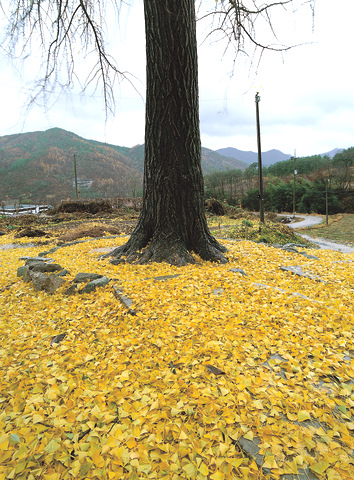
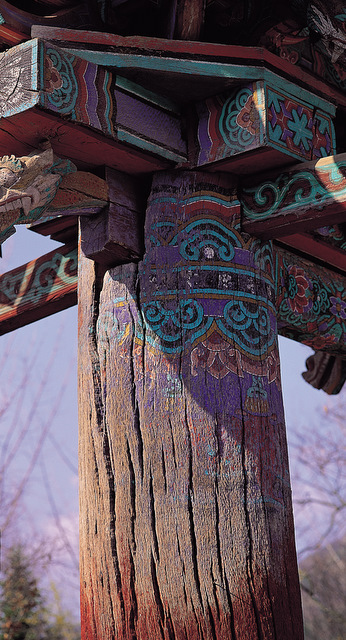
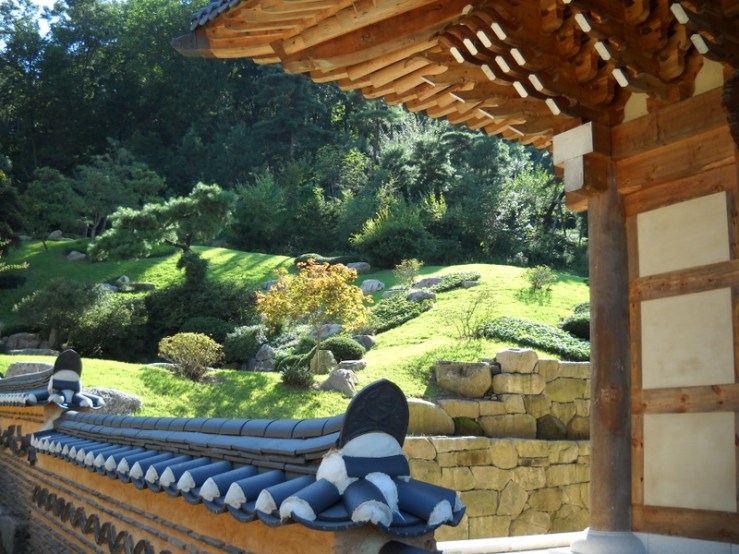
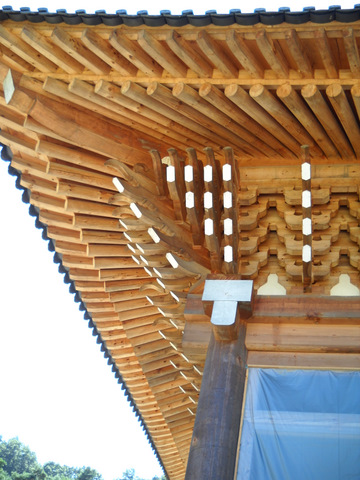
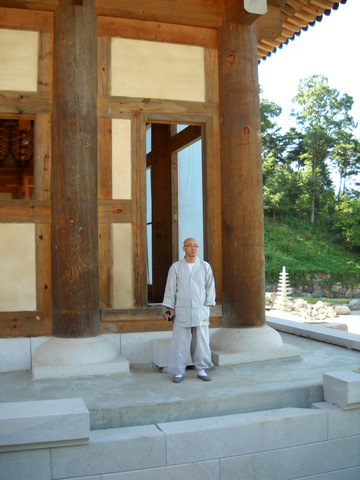
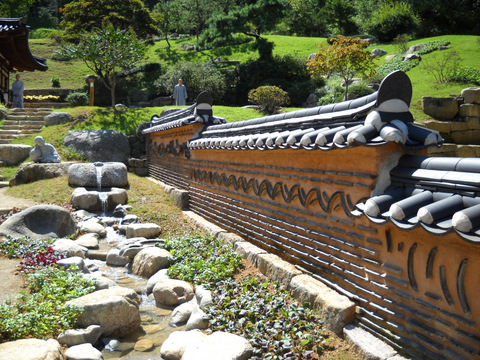
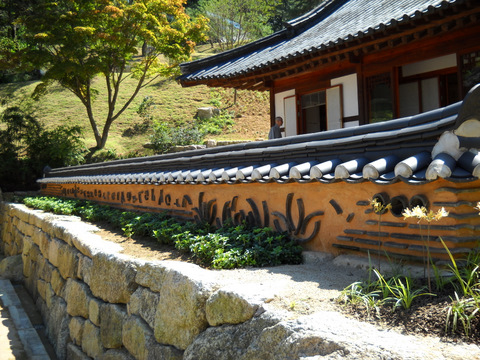
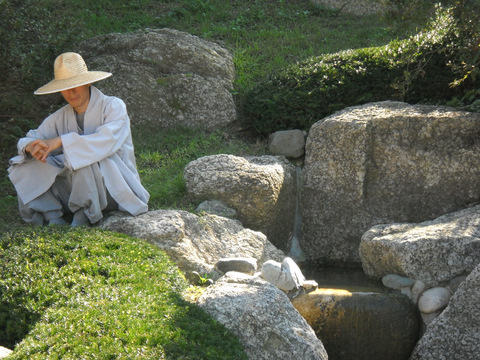
on the other side of the window…

Here’s an Autumn benediction from Joseph:

I’m just looking out the window,
wishing I were on the other side.
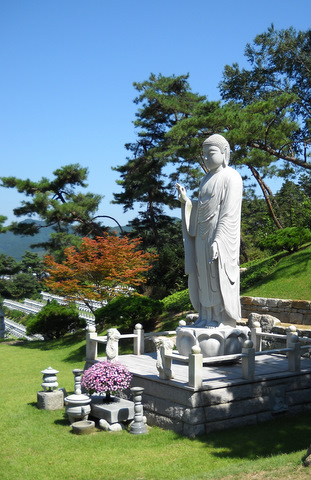
Look! a small patch of red in the leaves!
I hope you’ll get to spend more time outside than I! ^-^

p

p

p

p

p

p

p

p

p

Learning to rely upon our true nature

 Here’s a very nice Dharma talk by Daehaeng Kun Sunim.
I had to smile as I reread this, because it really reflects her direct style and emphasis on each of us awakening to this bright essence that we each have.

Regardless of whether you are a layperson or a monastic,
everyone has to practice
relying upon their fundamental mind.
For each person has this one, true thing within them.
If you think that the best thing in the world
would be to truly know
this inherent foundation of yours,
this foundation that is leading the you of the material realm,
then you will succeed in grasping the truth.

You have to practice
such that the visible realm
and the unseen realm
always function together.
If you would have your body and mind
always function as one,
then entrust everything to your true self,
the master within that formed you.
If you live like this,
you’ll be one with everything
and know what peace is,
so entrust everything there.

 This physical body is a servant of our unseen self.
It just runs errands.
So it doesn’t really matter
whether you’re considered someone important or not.
When you’re frustrated or suffering,
remember,
“Okay true self,
you’re the one that can take care of this,”
and keep entrusting.
Only when you do this with everything in your life,
can you make some progress in your practice.

The personality traits that harm and hinder you
are still quite prominent,
so let go of those things,
over and over again.
Remind yourself,
“This inner master is leading me,
only this can show me the way,”
and entrust everything to it.
If you go forward like this
while viewing things positively,
refining virtue, and doing good actions,
then your wisdom will become abundant,
and your life will be well spent.
So really give this a try.

pppppp -Daehaeng Kun Sunim

Text copyright 2010, the Hanmaum Seonwon Foundation

Images copyright Joseph

difficult people, difficult emotions

A couple of days ago, Joseph wrote a great post about dealing with difficult people.  He’d remind himself, that, as annoying as someone may seem, nonetheless, they’re growing and evolving, and have already come a long way.

They may have come a long way, but there are times when even that knowledge doesn’t make it any easier! 

Here are some other ways of looking at people, which have helped me get past some emotion or negative thoughts I’ve been caught up in. These are all true, but it’s often the case that one fits better than the others. (These are from Dharma talks by Daehaeng Kun Sunim) 

1.   I also used to be just like that

2.  They have a good heart, but when they open their mouth, it comes out all wrong

3.  This person(or event) is my true nature testing me.  And helping me discover all the garbage I didn’t realize needed to be dealt with.

4.  This is my true nature helping me grow up

5.  If I hadn’t made and sent out this kind of energy, it couldn’t have returned to me like this. 

6. All minds and my mind are one mind
pppppIf I repeat this one to myself, it’s like everything inside me settles down and becomes peaceful.

(I’m a bit reluctant to get into commenting on these too much, but every single one of these has helped me get through more than a few difficult situations.

We are all connected through our Buddha-nature. Through this non-dual foundation, energy and intention are freely going back and forth. Thus, the thoughts I give rise to are felt by others, and if those thoughts are contempt, resentment, or dislike, others will respond accordingly. 

If we can resolve the situation harmoniously, that’s the end of it. However, because we are all connected as one, if we leave things unresolved or with resentment and ill-will in the air, those will all come back to us. Again and again. So take care of things harmoniously, even though it may be a bother, or seem unfair (if you saw all the causes involved, you’d probably agree it was perfectly fair!).
As you free the other person, you’ll free yourself as well. 

The Day of the Dead – Ullambana, or Bek-jung

Today is Bek-jung here in Korea, with the ceremonies set to start in 30 minutes. It’s the day for remembering those who have passed away, and for practicing on their behalf.

In Sanskrit it’s called Ullambana, and is based upon a sutra of the same name. The premise is that we and the deceased are not separate, and that the thoughts we raise can benefit those around us.

So apart from the sincerity of the offerings, the parts of the ceremony that are chanted are also about compassion and understanding that we are not our bodies, (that they are composites that come and go) and so we are free to let go of those and be reborn at whatever level we choose.

And, as we internalize those truths (compassion, sincerity, and impermanence) and let them settle down within us, those beings we share a karmic connection with are also experiencing those truths. Because we know it, they do. Just intellectually knowing won’t do much good though, we have to input and let go of all of that to this very deep place where no fixed forms or concepts can survive. When we connect with this place, what we’ve input is communicated with all beings.

One of the big disadvantages about being dead is that, having no new sensory input, consciousness tends to “drift” along, stuck in whatever it was experiencing at the time of death, or in the very slowly changing karmicly conditioned states of consciousness.* So when we hold ceremonies like this, the purpose is to become one with the deceased, and, as they become one with our level, (which is hopefully focusing on these truths!) knock them out of the loop they were stuck in.

* If someone has experienced this inner light for themselves while alive, and is practiced at relying upon it, apparently “drift” isn’t a problem, because the person follows this inner light, instead of getting hung up in the various conditioned states of consciousness that arise.


My thanks to Roy, at Return to the Center, for getting me thinking about this topic.

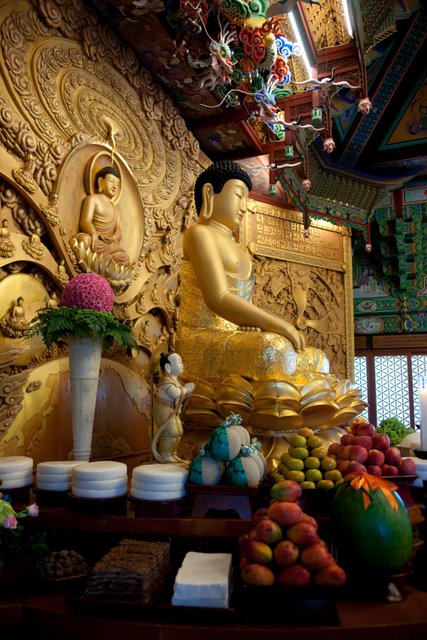
The images are from the main Hanmaum Seon Center in Anyang, South Korea.

authority and transmission

People familiar with Buddhism in the West, particularly Zen, have often heard of Dharma transmission.

In some schools this is a certificate and a formal ceremony stating that you’re now the Dharma heir of so-and-so. It’s described as a mind-to-mind transmission that has continued uninterrupted from Sakyamuni Buddha himself, and only someone who has received this is an authentic inheritor of the Dharma.

However, Korean Buddhism has a rather different perspective on this.

In traditional Korean Buddhism, there are no certificates of transmission. After ten or twenty years, a general consensus would arise that someone was the Dharma successor of their teacher. Their authority was derived from their ability, not a piece of paper.

Likewise, people didn’t really buy into the idea of an unbroken lineage. There could be periods where there were a number of great teachers, where there was only one, and even generations where there was no particularly outstanding teachers. The Supreme Patriarch of Korean Buddhism, Hanam Sunim (1876-1951), explained why this wasn’t a problem:

It doesn’t matter whether or not you knew the previous king. If you sit on the throne, you’re now king.

That is, if you awaken to the inherent Buddha-essence within you, you are the successor of Sakyamuni.

We each this very same mind as Sakyamuni, inherent within us at every moment and every place. Our job then, is to learn to rely on this, even though it’s indistinct at first. If we can diligently do this, we will have the kinds of experiences that will confirm we are going in the right direction, and which will reveal our direction.

Continuously letting go and entrusting everything to this Buddha-mind is the path forward as well as a great Dharma protecting warrior, because in returning everything we experience, including what we know and what we don’t know, we keep letting go of “I” and “me”, and are not caught by the experiences that could serve as toeholds for pride, greed, and fear.


In meeting light, it becomes light

Here’s an interesting poem about practice

Let go of everything to this great Emptiness,
burning, burning, burning,
like a vast, black sun,
burning away the bent, twisted parts of ourselves.

In truth though,
nothing is burnt away,
nothing comes or goes
All of those bent, twisted lumps of agony,
in touching light,
become light.

Like a nail becoming a magnet,
in meeting light,
they become light.

The Goofy-footed Buddhist

Here’s a guest post from Bonsai Doug about this messy process of working out our own salvation.

The term “footedness” refers to a preference to put one’s left or right foot forward in the various board-sports like surfing, or skateboarding – a “regular stance” if you will.  The opposite of this regular stance is often referred to as “goofy-foot.”

I often feel I’m traveling my personal Buddhist path a bit goofy-footed.  Let me try to explain.

I live in a small, rural area of western New York.  There is no temple or sangha to help me on my path.  So, I rely heavily on my library (I devour books!) and my online community to be my sangha.  While this sometimes makes for a bumpy path, it also makes for one rich in all the varied and wonderful traditions of Buddhism.

I have two bodhi seed malas which I love.  But I know I’m not using them quite as intended. Meditation (no secret here) is challenging.  So when concentrating on breaths, I often use a mala to count those breaths, and to keep my mind as focused as possible.  The result is that I do not sit quite as “still” as recommended, but it seems to work for me.  It has made meditation something I very much look forward to.  I know the mala is used in the counting of mantra and prostrations, so I guess my approach here too is a bit goofy-footed.  Or perhaps I should coin a new phrase… “goofy-handed?”

My goofy-footed approach, however, has resulted in many great stops along the way.  Friends made while in Korea.  Gary Gach, the author of “The Complete Idiot’s Guide To Buddhism.”  Lunch with the monks of Wat Mongkolratanaram.  A personal tour of the Byodo-In temple in Hawaii.  Being present when the Jade Buddha for Universal Peace arrived at the Minh Dang Quang Temple in Florida.  And of course, discovering “Wake Up and Laugh.”

I sincerely hope my goofy-footed approach proves fruitful.  I do know I am the better for it.  I’ve never been happier and more at peace with myself and those around me.  I am far more caring, loving and compassionate than ever before.  Walking my path, albeit goofy-footed, is providing for a wonderful journey.

And whenever I become a bit discouraged with my goofy-footed journey, I remind myself of a quote from His Holiness the Dalai Lama:

We all travel our own path to enlightenment.
  And just because someone is not following on our path, it does not mean they are lost.
 
Namaste, and be well!
                                        Doug

spiritual capacity like a bowl

More about bowls!

The last couple of posts have really brought up some great points about striving, versus freeing oneself from dualities. I found myself laughing, because I agreed completely with everyone!

The first point is spiritual capacity. As Joseph brought up in yesterday’s post, our spiritual capacity is a like a bowl: it can only hold that much. Anything more overflows and is lost (or makes a mess).  So what can we do to increase our size, or as Barry points out, is this desire to be a bigger bowl actually a dualistic hindrance.

I think the answer lies in the approach. Why do we want to do this? Is it because we keep hearing Dharma talks and can’t remember them afterwards? Is it because we aren’t doing a good job of putting into practice what we know, or that we feel like what the Tibetans call a broken cauldron – no matter how much is put in, nothing is retained, nothing seems to be learned (from the experience).

At the risk of pushing an analogy too far, what determines our bowl size? To me, it’s whether we are living based upon our conditioned thoughts and urges of the body, or whether we are moving from something deeper.  Then the question becomes how do we get in touch with this something deeper, this something that has ten-thousand names.  The only way I know how to do this is by heavily returning everything to this fundamental mind, this Buddha-essence – letting go of “me,” what I know, and what I want to do. I’ve also heard someone describing this as “letting go to emptiness.” 

In a sense this is dying to all that stuff, but the unexpected result is that in becoming aware of this that transcends all dualities, energy and wisdom burst forth, and I’m better able to respond and be with what is happening.  Now, I’m able to actually hear what it is I’m truly called to do.

Somehow, all that gunk of “me,” desires, and resistance, is a paradox. If I indulge it and chase it, worry about it and fear it, my life slowly becomes a hell realm. Yet, if I fully become one with it and dive into this emptiness, then even that becomes an opportunity to awaken and grow.  Even that which I would despise becomes my gateway. This still seems so weird and amazing to me! 

Daehaeng Kun Sunim once said about the desire to practice, that “Yes, it is also a discriminating thought. But when you let go of it and entrust it to your inherent nature, it becomes a burning log that ignites and consumes the great mountain of logs that have accumulated over endless eons.”

Virtuous friends

In this next section of Admonitions to Beginners, the Venerable Ya-un reminds us of the influence our environment can have. We tend to go in the direction of our thoughts, so there’s a good argument for being careful in who we associate with and what situations we put ourselves in.  

Associate with virtuous friends and avoid evil people.   

When a bird wants to rest, it chooses a good grove of trees. Like this, a person who wants to learn the way has to choose his teachers and friends. If a bird chooses a good grove, it rests peacefully. If teachers and friends are well chosen, great learning will be attained. Therefore, show devotion to good friends as you would to your mother and father, and keep wicked acquaintances far away from you.  

Just as a crane does not associate with crows, how could a majestic phoenix associate with cowbirds? Among a forest of pine trees, even an arrowroot vine can rise a hundred meters into the sky, but in a field of weeds, even a pine tree can’t rise more than three feet. Keep far away from low-minded and malevolent people, and always stay close to those outstanding beings who have attained the great meaning.  

Whether staying in one place
or traveling around,  

always associate with virtuous people,   

and remove all weeds and dust
from body and mind.


When all weeds and dust are removed,  

the way forward will suddenly
be bright and clear, 

                                             without taking even one step forward,  

                                                You penetrate the meaning of the Patriarchs.  


Sing, play, and dance

Here’s a guest post from Evelyn about life and practice.

See how, shaped by the excellence of the path,
I walk now without effort
toward the Buddha state.
I dance, I sing, I play!

— from Rainbows Appear: Tibetan Poems of Shabkar,
(Shabkar Tsogdruk Rangdrol) Translated by Matthieu Ricard

 
Have you ever done your very best with something, and then screwed it up…?

Let’s say you bake a wonderful cake for your son’s birthday party, and then you decorate it with a layer of mouth-watering strawberries….

and later you’re puzzled by the strange look your son’s girlfriend has as she take the first bite. Only then do you realize that at the very last step, you used salt instead of sugar for the glaze….…

 
Ok friends, you’re allowed to laugh – four weeks ago we did, too! LOL!

 
There was a time I would have been embarrassed for days about this mishap! I would have searched for reasons how this could happen ( somebody had left the salt on the kitchen worktop where it shouldn’t be, somebody called me in the crucial moment, I was in a hurry because…)

No. I was just careless.

My fault. The salt stood there and I took it because I just didn’t pay attention to what I was doing. I wasn’t “here.” 
 

Walking on the Buddha’s path, I’ve learned that there’s only one true misdeed: not to learn from what’s happened.

Tantra is a wonderful path: we can take our time to walk, we open our eyes and with a bit of patience for us and others, we finally come forward. We went wrong? Ok, let’s correct the direction. We can change negative aspects into positive ones – if we pay attention. And in case we aren’t too embarrassed to sometimes say “sorry, my fault.” 

On Raoul’s birthday i quickly said, “sorry, my fault,” (which finished the negative aspect) and because we all were hungry, I called the pizza service, (hmm, a rather positive aspect) and then we had a nice evening – dancing, singing, playing.