See with your heart

This is a famous temple site near the ancient Korean capital of Silla. One of my Dharma brothers lives nearby, and visits this site when opportunity presents. While it’s unquestionably beautiful, what draws him is the feeling of living energy. Sometime, far in the past, people practiced very sincerely and deeply here. And the echos of that can still be felt even now.
 
South Mountain near Kyoungju


The Message of the Stone Statue (Dharma song)

The Message of the Stone Statue(돌 장승 우는 소식, here’s a practice version Message of the Stone Statue(Korean 20111023). The levels for the piano are a bit off, but you can get a good feel for the song.)

There’s a chill in the air,
when the frost comes, white flowers will cover the earth.
Those who have no eyes must feel so sad, unable to see.
Those who have no ears must feel so frustrated, unable to hear.
Those who have no hands must feel so hungry, unable to lift food to their mouth.
Those who have no feet must feel so lonely, unable to go or come.

Over that mountain,
on the path that Spring travels,
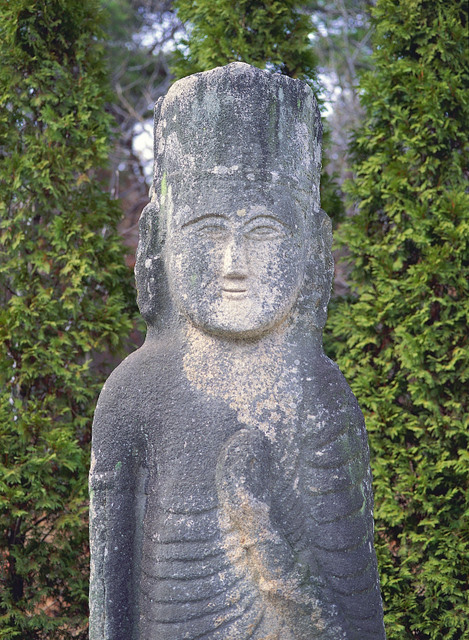
a stone statue, with tears of joy in its eyes,
is telling everyone that Spring is on the way.
Ah! How could we not know this promise of ripened flowers?!

Warm Spring is coming!
When the flowers blossom,
their fragrance will fill the land.
What a wonderful sight for those who have eyes that see!
What freedom for those who have ears that hear!
What satisfaction for those who can easily lift many hands
and help beings far and wide!
And for those whose broad feet can carry them far and wide,
without hindrance!

Over that mountain, in a valley
blossoming arrowroot vines
spread the news of Spring.
Ah! From the white-peaked mountain,
streams of thoroughly ripe water flow forth!

Even with walking, seeing, and listening,
After putting a foot on the ground,
Before lifting another up,
nothing is there.
The moon shines in a thousand rivers,
reaching in and grabbing for it,
eh-he-hah, de-he-hah!
opening my hand again,
could I even say that it came and went?

(verses by Daehaeng Sunim, English translation copyright 2011 Hanmaum Seonwon Foundation)

Korean Dharma Songs

Some of the earliest Buddhist songs in Korea were actually work songs, sung by farmers and their wives.  I’m sure that the work songs were present long before Buddhism came to Korea (circa 500 C.E.), but gradually they became examples of skillful means, as lyrics were created that reflected deep truths.
Imagine how deeply input the teachings would become as you spent hours reciting them while working:

Die once and open your eyes.
See yourself,
see yourself,
see, see.
Observe how this body is a collection
of karmic states of consciousness,
gathered together
according to karmic affinities.
See!
this body contains billions of lives.
See!
how they cause us to suffer
as they go back and forth
every instant.
o
o

Take the suffering and hardships that arise
and gather them together in your one mind.
Do this!
and the lives within your body
will be transformed into Bodhisattvas.
To save all beings,
start with those already within you.

This one mind that we all share
is the source of everything and every life.
One mind,
one mind,
our one mind and all Buddhas exist together,
working together as one. 

“All minds are my mind,
all bodies are my body,
not a thing is separate from me.”
Truly realize this for yourself,
truly bring forth this one mind.

Raise this unseen five-colored pillar high
and go forward entrusting everything to it.
Live magnificently throughout all the ups and downs of life.
Live magnificently!
Live magnificently!

(From the song “Live Magnificently,” by Daehaeng Sunim)

Dharma Songs

Koreans love to sing, and so the members of our temple have taken a number of poems and verses by Daehaeng Sunim and turned them into Dharma songs. This Saturday and Sunday we’ll even be having a festival of Dharma songs at the King Sejong Cultural Center in downtown Seoul. If you already have tickets, be sure to come! (I wanted to invite as many people as possible, but it sold out almost immediately.)

There will be a lot of performances by different lay choirs, as well as a sunims’ choir. Here’s one of the songs by the sunims during the 2004 Dharma Song festival, accompanied by traditional Korean instruments:


(This song is taken from a verse of Daehaeng Sunim’s translation of the Thousand Hands Sutra)

Sincerely entrusting everything to one mind,
Determined to know the real and help all beings,
Raising these great wishes,
May my Samadhi wisdom swiftly brighten.

May I attain every kind of virtue.
May the blessings arising from my practice guide and sustain all beings.
May all beings attain Buddhahood


This second song is called That Mind, Just As It is. It’s sung by the nuns of Hanmaum Seon Center, and is actually just a practice version.(They’ll kill me if they know I posted this!) The translation I did still feels a bit off, but here it is:

That Mind, Just As It Is (in Korean)

When water is clear, we can see the moon,
when water is murky, the moon is invisible,
but the moon doesn’t rise because the water was clear,
nor does it set when the water is murky.
When we dissolve all defilements and delusions,
mind becomes calm and clear,
and Buddha spontaneously appears.

 When our mind is clear, Buddha appears.
When our mind is murky, Buddha is unseen.
Buddha didn’t come from somewhere else,
Buddha didn’t go anywhere else.
If we calmly and flexibly guard the six senses
so that they don’t become thieves,
if we’re careful not to be caught by the functioning of the senses,
unenlightened beings at once become Buddhas.

(Chorus)
The green mountains use no words,
running water isn’t caught by anything.
Like nature, when mind remains
solemn and settled,
that mind itself is Buddha.

Children’s Dharma Talk

I really have to get with posting again! Sigh.  Things have been busy here with getting a manuscript ready for Wisdom Publications, and now the the Frankfurt Bookfair.  It also looks like there will be a Russian edition of “No River to Cross” coming out before the end of the year.
 
Here’s a Dharma talk that Daehaeng Kun Sunim gave to out center’s childrens group.

Children’s Dharma Talk  

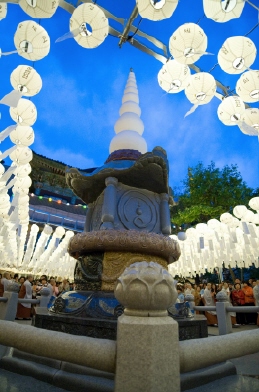
The Gugeong Pagoda on Buddha's Birthday (at Hanmaum Seon Center)

I can’t tell you how moved I am to see so many of you gathered together here today. Seeing you here today warms my heart. I was just like you when I was little. People may call you children, but you’re doing something very deep and significant when you gather here in front of the Buddha and learn about spiritual practice.

 You’re practicing, so you probably already heard that the minds of all life are connected as one. Stars have an essence that is also within us, so all of you are stars! You, stars, and this fundamental mind all respond to each other. This all happens without any wires or signals you can grab onto. When you eat something, and say “Thank you, Juingong (Buddha-nature)” your mother and father, Buddha, and sunims are all there inside of Juingong. When you take the things that come up in your life, and gather them all together at that one place, (Juingong), you can get a sense of this fundamental essence and can evolve your mind. Do this and bring forth this great power that’s within you.

             Keep practicing like this and become wonderful people. Become great beings who are able to bring peace to your family, who can guide your country, the world, and even the universe. This is all possible for you, according to how you practice. Okay?

 This Dharma talk was given by Daehaeng Kun Sunim during a Precepts ceremony for children.  

Do what makes you come alive

I happened to visit the Dalai Grandma the other day and found she had a great quote for me:

Howard Thurman 
Don’t ask yourself what the world needs. Ask yourself what makes you come alive and then go do that. Because what the world needs is people who have come alive.

Here’s another nice quote from Wikipedia:
community cannot feed for long on itself; it can only flourish where always the boundaries are giving way to the coming of others from beyond them — unknown and undiscovered brothers.

A lake in Russia, taken by my Dharma brother, Ilgyo Sunim

Guide to Korean temples.

Here’s a great guide to Korean temples, Dale’s Korean Temple Adventure. Set up by an expat in Busan, it focuses mainly on temples in the lower half of the country. (Which is fine, because that’s the heart of Korea’s Buddhist history and culture. )

He includes a lot of photos with each post, and relates the history of the temple, along with travel info and his overall impressions of how worthwhile it is to visit the temple.   Here’s what Dale wrote about Hwaeomsa (화엄사):
 Jirisan National Park was a place I long wanted to visit, but never got around to for one reason or another. I didn’t want to go hiking or camping, or anything like that at all. Instead, I wanted to visit two famous temples that sit on the side  : Hwaeomsa and Ssangyesa temples. And finally, in the fall of 2005, I visited with my wife.

The first of two postings will cover the most renowned temple at Jirisan National Park: Hwaeomsa (“Flower Garland Sutra Temple”).
Hwaeomsa (화엄사) was founded by Yeon-gi Josa in 544, when Buddhism was just gaining a hold ofKorea’s religious landscape. The temple was continuously expanded until its total destruction during the Imjin War of 1592. Fortunately for us temple lovers, it was rebuilt three decades later.  And today, it’s one ofKorea’s largest and most well-respected temples.
o
 
Once you’re dropped off at the bus stop at Hwaeomsa village, just south of the temple, you’ll have to walk about a kilometer up a beautiful and scenic valley road. You’ll pass through two gates, one of which is ensnared by dragons sculpted around the stone pillars. In the third gate are four largely sculpted heavenly kings protecting the temple from evil spirits. In the lower courtyard are two similar looking five-tier pagodas. As you continue walking straight, and on the upper level of the courtyard, is the main hall. Usually, the main hall is the largest structure at the temple; however, the main hall is dwarfed by the building that stands just left of it: Gakhwangjeon.  Gakhwangjeon has a two-tiered roof, and it’s also one of the largest and oldest buildings, dating back to 1703, in all of Korea. 
o

It’s a massive building that houses seven figures on its altar. Another strange feature about this temple is that the Seokgamoni Buddha (the historical Buddha) sits in Gakhwangjeon, and not in the main hall. Accompanying the Seokgamoni Buddha in this building are Amita and Dabo Buddhas, as well as the Gwaneum, Bohyeon, Munsu, and Jijeok bodhisattavas. Directly in front of this massive hall is the largest stone lantern in all of Korea, standing five metres tall. Next to this pagoda is an impressive “sari budo” with four fierce looking lions adorning it
.
o
 
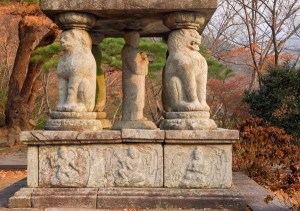
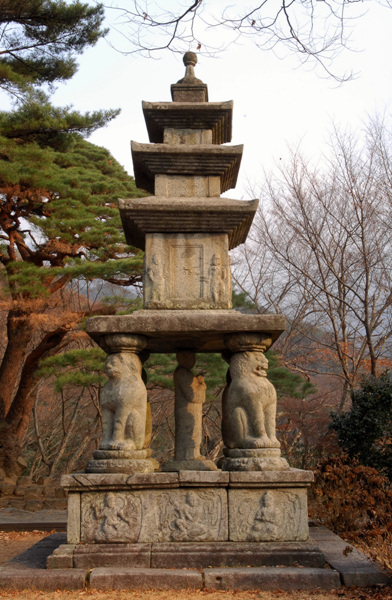
But even more impressive than the massive Gakhwangjeon is what stands on the hill just above this building. On the hill stands the most uniquely designed pagoda (next to the ones at Bulguksa) and stone lantern. The five metre tall granite pagoda has three-tiers on top and four lion-shaped pedestals at its base. Each lion represents the four primary human emotions: love, sorrow, anger, and joy. At the centre of these lions stands a human figure with hands held to his chest. There are numerous other designs etched onto this pagoda, so take your time and enjoy the intricacies of this pagoda. And just in front of this pagoda is the equally unique stone lantern with a squatting figure at the centre of its base. Some have suggested that this is the founder of the temple kneeling in obedience to his mother.
o
HOW TO GET THERE:  To get to Hwaeomsa from Busan, there is a direct bus from Seobu bus terminal at the Sasang subway stop (#227). It costs about 14,000Won, and the trip takes about three hours. If you’re not getting to Hwaeomsa from Busan, you can take a bus to Gurye. From Gurye to Hwaeomsa, you can take a bus that goes to Hwaeomsa village for about 1,000 Won.
Admission to the temple is 3,000 Won (and trust me, it is well worth it!)
o
OVERALL RATING: 10/10.  For its historical significance alone, Hwaeomsa rates highly amongst Korean temples. But if you add the giant splendor that is Gakhwangjeon, and the temple rates that much higher. And to top it all off, on the hill stands two of the most uniquely designed pagodas and lanterns in all of Korea.  So if you couldn’t tell already, I highly, highly recommend a visit to Hwaeomsa for both its cultural significance and artistic beauty!
 
(Photos: These are from my collection. I didn’t take them, but I can’t remember who gave them to me. Sorry! – Chong Go  Sunim. As you can see, Dale has great info about these temples (and photos as well), so be sure to check out his blog.)
 

Seen and Unseen Connected as One

Here’s a nice Dharma talk by Seon Master Daehaeng.

Everything, throughout the entire universe and Dharma realm
is connected with each other,
and connected to everything in our lives.
Although unseen,
this connection is like a great net of the Dharma,
a thread that connects everything,,
and a path on which there is no coming or going.
Even this realm of ours is connected, in every way,
to all upper and lower realms.


 Our world faces so many difficulties.
Like sailors,
we have to be prepared to deal with whatever kinds of waves arise.
Yet if we can’t take care of what’s right in front of our eyes,
how will we be able to overcome the larger, underlying aspects?
Our bodies and material things have no power to truly resolve
these kinds of problems.

o

Should even the energy that fills the air around us be depleted,
more would flow in from outside the Earth.
It’s not for lack of energy that our planet suffers,
but because people don’t recognize the energy that’s already present,
and so are unable to use it.
To use this energy,
people who understand about our fundamental mind
have to all become one mind.
If we can do this, the whole will respond to the thoughts we raise.
We have to become one mind, we have to become a great pillar.

o

As I’ve always said, this isn’t about finding something,
somewhere else.
It’s about what we’ve always had,
it’s about our foundation.
We, the owners of the Earth, have to firmly rely upon our root.
Start with brightening your own light, and others will become brighter,
eventually filling the world with light.
How could the world become brighter if the people remain in darkness?
o

You have to bring together both the visible and the unseen-realms
and function using both.
This is the practice of finding your root,
while becoming one with everything that arises in the world.
It’s my sincerest hope that all of you will become fellow practitioners,
diligently practicing, becoming brothers and sisters through our one mind,
and help people throughout the world find their way.

                     -Daehaeng Kun Sunim


(Lotus photo is by Joseph.)

Looking on the bright side

One of the things I’ve learned from my teacher is importance of interpreting things positively. (Basically, the thoughts we give rise to lead directly to our future.)

So I found myself laughing as I woke up this morning, with this song playing over and over in my head. Even now this video puts a smile on my face!

(from Monty Python’s The Life of Brian):

Last view of a Korean army Dharma hall

Most large Korean army bases also have Dharma halls. This may strike some as strange, but Korea has the draft, and just about every man, regardless of religious faith, ends up in the military.

One of the Dharma halls I look after is on a base that’s relocating as part of a consolidation project. As a result, the entire base is being emptied and demolished. So last night, which was also Buddha’s Birthday, we had a concluding ceremony and Dharma talk. It was really a celebration of a place where people have been able meet and grow for the last 23 years. (Here are some pictures before the ceremony; I got distracted and forgot to ask someone to take pictures of the event itself. Sigh. 😉 You can see some photos of last year’s celebrations here, as well as a larger Korean Army Dharma hall.)


Waiting for things to start (and having a few laughs)


taking care of everyone


The people who supported the Dharma hall over the years


Just a "panel-made" building, but it keep people warm and dry for 23 years


Thank you