entrusting/Green Tara

I noticed this comment by Roy, from Return to the Center;

It would be very helpful to me to hear more about entrusting. I react with worry to this encouragement. I think “entrust myself to what? How do I know if I am entrusting myself to my own delusion?” and things like that.

Actually, I had a very similar feeling after reading No River to Cross. I asked Chong Go Seunim at Saturday Sangha one day how to know if it’s truly intuition or your desires that you are following. His answer was to ask deep within and listen to what your true feeling is. Usually we know if we’re doing the right thing or not, we just don’t always listen to ourselves.

My wife and I decided that we would get married only three weeks after we first met. It sounds crazy even to us when we think about it now, but at the time, we just knew. I’d never had a relationship that I didn’t drive myself half crazy asking if it was right (because deep down I knew that it wasn’t, I just didn’t listen) but when I met my wife there was never any doubt. Three weeks isn’t long, but I looked as deep down as I could in that amount of time and didn’t hear anything but “Yes!” It’s only been a couple of years, and I can’t pretend to know what the future holds, but just trusting that everything will be okay, even if it doesn’t work out as planned, makes it seem okay. If there’s ever a time that things just can’t be worked out, I trust that I can find the strength to pack up (within) and become a monk!! ^ ^

Also, I wonder whether or not entrusting yourself is very separate from some devotional forms of Buddhism. Personally, I see the Amitas, Gwan Sae Eums, Taras, or which ever you prefer, as manifestations or projections of expressions that are also within yourself.  Honestly, it’s not a topic that I’ve given a great deal of thought to, my practice is decidedly not very devotional, but I’m sure Chong Go Seunim or Marcus will be willing to add something to that (and it doesn’t have to be in accord!).

I am reminded, though, of taking a night bus from Kathmandu to Lumbini. I usually travel entrusting that nothing bad is going to happen to me, but even the locals kept worrying we about the risks of traveling on the night buses. One of the shop keepers, from whom I’d bought a number of castings, gave me a small Green Tara amulet to hold on the ride. He reminded me of her mantra, said to remove fear, and then told me not to worry, even the daytime buses tend to get hijacked in Nepal…

A little short of reassuring, it still made me realize there was no point in worrying.  On the bus, however, my nerves were shaky. I clenched the Green Tara amulet in my left hand and my mala in my right hand and repeated the mantra until I lost count of how many times I’d thumbed through the 108 beads. I visualized Tara above me, shinning her light down. I visualized the green light hitting my forehead, spreading out to the others sitting around me, the others in the bus, and everyone else traveling on the road that night.

At one point, I opened my eyes to see the entire bus bathed in green light. I noticed a green plastic cover over the light at the front of the bus. I had to giggle to myself as my mind toyed with possibilities.

What I realized later about the mantra is that it doesn’t necessarily protect you from what you fear but more from the feeling of fear itself. It might be a stretch, but maybe what it’s doing is actually giving you the trust within yourself that everything will be okay.

Come to Korea for the Buddha’s Birthday!

Hi everyone,

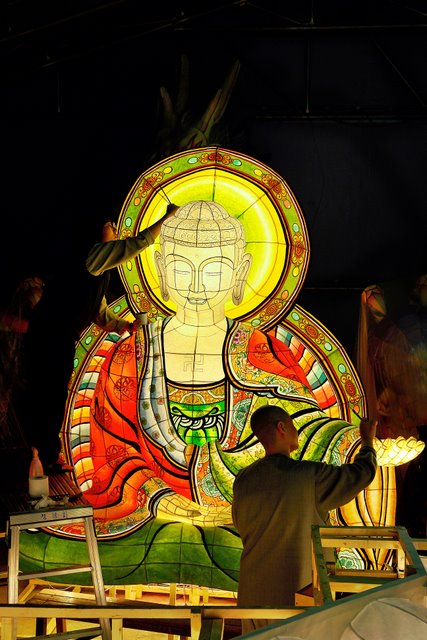
The Buddha’s Birthday is going to be celebrated here in Korea on the 21st, with the main lantern parade in Seoul on Sunday the 16th. The lanterns are spectacular, as are the performances and dancing, and shouldn’t be missed. I took this photo Sunday night at a review our temple was holding.  This lantern is about 10 feet high (3m) and will be used as a parade float. Like most of the lanterns it’s made from traditional paper over a wire framework, with electric lighting within. The paper is hand painted, with a weather-coating varnish of some kind.

There will be a street fair all day on the street in front of Jogye Temple, with the main parade starting from Dongguk University once it begins to get dark. The parade will move down Jongno road, ending in front of Jogye Temple. There will also be a shorter review held in front of Jogye Temple on Saturday, the 15th, again at dusk.

Here’s a close up of the leg:

So if you’re going to be in Korea, be sure to stop by Seoul on the 16th. Busan will also be having a parade, although I don’t know when. (It’s nice, but not as spectacular.) Likewise, there will be smaller parades at nearly every temple in the country on the 21st.

with palms together,

Chong Go

For an idea of the size of these lanterns, look at the peoples’ heads at the base of the elephant.

Ads on blogs

We’ve had some reports of large ads appearing on this blog, but haven’t been able to figure out if this is a spam program or WordPress’ doing. If you’ve seen an ad while visiting us, would you drop a line  in the “Comments” section? Thanks, we’re trying to get more info about this, and would like to know what people are seeing.

with palms together,
Chong Go

The Bangkok Seon Club – and choir!

Ice melts and water flows
down ten thousand valleys,
fish dance and play,
flowers bloom and birds sing,
the fruit of practice ripens naturally – let me know all ten thousand flavours
.
 —Daehaeng Kun Sunim
 

Here in Bangkok, our celebrations of Buddha’s Birthday on May the 28th this year will also mark the first anniversary of the Bangkok English-language Zen Club, the first English-language group led by the Seonwon here, under the wonderful guidance of our fabulous teacher Hyaedan Sunim. During this first year together we’ve met once every month, gathering on Saturday nights, to study ‘No River to Cross’ and share our experiences of applying the teachings.

The Seon Club, now firmly established after this first year, is made up of a small group of regulars of diverse backgrounds, both Korean and from many different countries, with a good number of visitors and the occassional special guest. Of course one of the great highlights of our first year was Chong Go Sunim’s visit last November as part of the Seonwon’s tenth anniversary celebrations, and the wonderful teachings he was able to share with us all.

And now, as we approach our first anniversary and the celebration of Buddha’s Birthday on May the 28th, the Seon Club is even preparing to sing! We have some very skilled musicians in our little group and a wonderful instructor from the seonwon. The most important thing, she said to me last night – as I was worrying about my own strangled-cat voice and the danger of my letting everyone down – is just to let go! Sing with love, she said, and your voice will be fine!

There is no specific English-language programme of events for Buddha’s Birthday, but if you are in Bangkok this month and would like to join the English-language group as we sing in the celebrations, get in touch and we’ll let you know about rehearsals. And if you can’t join the choir, but would like to celebrate Buddha’s Birthday with us on the 28th, you are more than welcome to come along. The morning ceremony (in Korean) is at 10am and the evening performances (also in Korean) start at 6pm. It will be a wonderful experience.

See you there!

Inherently sharing the same life and body

    Towards the opening of Daehaeng Kun Sunim’s translation of the Heart Sutra it says:

Inherently all beings
are sharing the same life,
the same mind,
the same body,
working together as one
and free giving
and receiving
whatever is needed.
They are endlessly
manifesting and
changing every instant,
but because they are unaware
of this,
they walk the path of suffering.

     I’m always amazed at how the implications of this continue to unfold. It explains the idea of “one mind” as well as “interbeing,” and has so many practical implications:


If I want to save myself, I can’t exclude or hate anyone else, for they’re also part of me.

Everything’s constantly changing, yet it’s denying this that causes one to suffer.

Everything I need is there, if I just stop building walls of self and other…

Buddha-nature: Theravada Zen

Last year, as part of its tenth anniversary celebrations, the Bangkok Hanmaum Seonwon hosted a joint Dharma talk on the subject of Buddha-nature with the Theravadan monk Phra Cittasamvaro Bhikku, the founder and guiding light of the English-language Littlebang Sangha, and Chong Go Sunim, who had kindly made the trip from the Hanmaum International Centre in Anyang, Korea.

Phra Cittasamvaro Bhikku, popularly known as Phra Pandit, started the evening with a brief history of Theravadan and Mahayanan Buddhism, and how the differences between them are not as great as they might at first seem. After all, he said, everything started at the same point, with the Buddha putting aside all theories and looking into the nature of things for himself.

What he saw under the Bodhi tree was experience in terms of fields of awareness, sight, sound, taste, and so on, and that they were forever changing. Finding no stability in this, he withdrew his mind and found it becoming brighter and sharper. And what he discovered there, the Buddha declared, was that which does not die.

He gave this a number of names such as original mind, source of mind, Nirvana, and so on, and later it was termed Buddha-nature. Phra Pandit suggested it was perhaps a little egotistical to give it this name as it exists in all people, regardless of the labels they use. A bit, he teased, like planting a flag on the moon.

He also pointed out that seeing this fundamental mind is a temporary experience and that we inevitably return back into normal life. However, once seen, it will change one’s way of relating to the world. The great problem, though, is how attainment of this fundamental mind can be taught. No matter what is said about it, it is not it.

So Buddhist teachings are like radio stations. We can switch between them, some we will like, some not, but the point is the silence beneath. Using the analogy of the diamond in the mud, Phra Pandit said that reaching it through purification or reaching it through realisation were simply differences in emphasis.

Chong Go Sunim agreed, pointing out how the Buddha’s teachings, using another analogy, are like medicine. And no single medicine is good for all illnesses. So a range of Buddhist teachings developed according to the needs of listeners. Different Sutras, in fact, are simply saying, “okay, let me put it like this, now like this”.

But the point to all these teachings is to transcend the limited sense of self, and Chong Go Sunim described how his own teacher, Seon Master Daehaeng Sunim, emphasises the practice of letting go. Like chanting, bowing, and meditation, he said, it is a tool for transcending the self, and a self-correcting one at that.

Often, he said, people have great meditation experiences or insights, but make the mistake of saying “wow, I want that again”. Soon, they are carrying around little more than a memory of a past experience. By practicing letting go, they are able to move on from it. But to carry out this practice requires trust.

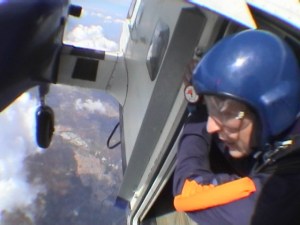
Which is where Buddha-nature comes in. Chong Go Sunim, before he became a monk, used to sky-dive, and he explained that no matter how badly you might be spinning through the air, simply getting into the correct position allows you to right yourself. In terms of practice, that position is the act of trusting and letting go.

“Perhaps this is all just a skillful means” Chong Go Sunim said, “but I can’t say it’s not true” and with the way that one’s ignorance grows back again and again, just like a monk’s hair, one must return to this practice over and over. Like the the Diamond Sutra, he concluded, which seems to repeat itself, but at deeper levels.

The evening ended with a short time for questions and answers and in response to one question Chong Go Sunim, using the large bell at the front of the Dharma Hall, demonstrated, to an audience of mainly English-speaking Bangkok residents, the sound of a Korean chant. The perfect way to round off a unique and wonderful evening of Dharma.

Link:
LittleBang: the English-language Bangkok Sangha

If you do what everyone else is doing…

I posted this elsewhere, but Evelyn in Germany offered such an insightful comment that I thought it was worth reposting here.

A few weeks ago, I overheard Daehaeng Kun Sunim say the following sentence during an interview:
 

 If you just do what everyone else is doing, you’ll be screwed.*   
 

How’s that for a to-the-point Dharma talk! She was talking about the cost of following the herd, but even more than that, the cost of not making an effort to find your own, true root; and the cost of not listening to this root, your Buddha-nature.

Evelyn:
Following the herd – in the beginning it may seem the easiest way… you don’t offend, you aren’t blamed. there are many places and opportunities ‘following the herd’ isn’t just wished but wanted from you – at school, in your job, at home. not to follow the herd implicates annoyance, dismissive treatment and a general uncertainty. you’ll think twice to dare! you try to please everybody. you run… up to the day you are at point zero. you are shattered. and yes, you are screwed. you feel desperately helpless. finally you start thinking again. who’s to blame if you aren’t where you want to be? who’s to blame when you aren’t doing what you want to do? how to untangle this situation and not to destroy everything?

You have to be brave. you have to take the risk. and you have to take the responsibility. then maybe you’ll find out wherefore you are here. it’s worth the effort…
 

   *The word Daehaeng Kun Sunim used was ‘mang-ha-da’, which could be literally “ruined,” but the nuance was much more like “screwed” or “up a creek.”

mending the seam

Mending the seam between self and others has been an extraordinary challenge. The teachings have given me the conceptual realization that I am but a thread in the cloth that makes up our existence, now I must do the work to experience that concept within.

I found “No River To Cross” momentous in the ongoing development of such a realization; Look within, trust your inherent nature, let the fundamental mind take care of things, are the mottoes that one is left to consider. At first, I had to ask myself, “How will I experience non-duality by focusing on myself?” I think it’s by looking past all the things that are usually associated with self; What’s my favorite color? What song do I feel like hearing? What do I want to eat? Beneath these are very universal functions. Actually, we spend every moment in non-duality, it’s just covered over by the daily concerns of self.

As I clear away enough mental debris to poke a finger-hole through, like in the paper windows of a temple door, my thoughts echo those of Dae Haeng Kun Sunim:

Your fundamental mind, your true self is invisibly connected to all things in the world and through it all things communicate with each other and work together as one. In this way, the whole universe is functioning together as one through fundamental mind, so this working together is called One Mind (Hanmaum).

The big difference is, she’s sitting peacefully on the inside, and I’m standing here fiddling with the latch!

Practicing through our fundamental mind

Practitioners don’t get caught up in labels
such as “man” or “woman,”
nor the preconceptions that go with such labels.
They’re focused on going forward while relying upon this fundamental mind.
Even if their situation seems unfair,
they see it in a positive light, and are at peace.
They don’t stir up the intellect and “I,” or give rise to plans and goals,
instead, they take the events of their daily life,
and entrust them to their fundamental mind.
While entrusting these things,
if they give raise a thought free of “I” and “mine,”
that thought will manifest into the world.
This is why this practice is so convenient and practical,
it reaches everywhere and communicates with everything.


It’s so hard to be born as a human,
but it’s even more difficult
to become a true human being.
It’s not something that someone else
can give you,
nor are great physical hardships necessary.
Listen often to Dharma talks,
try to practice through mind,
experience what happens
and know for yourself.


Belief and confidence are essential to this process.
Don’t worry about whether your practice is going better or worse than others.
Don’t try to achieve everything all at once,
steady and consistent is the key.
Steadfast faith in your fundamental Buddha-nature,
and consistently entrusting everything to it
is the most important thing.

In this new year,
I hope that you all will live together non-dually,
living as one,
working together as one,
and freely giving and receiving whatever’s needed.

                                        —Daehaeng Kun Sunim
 
 
copyright 2010, The Hanmaum Seonwon Foundation

What feeds your spirit?

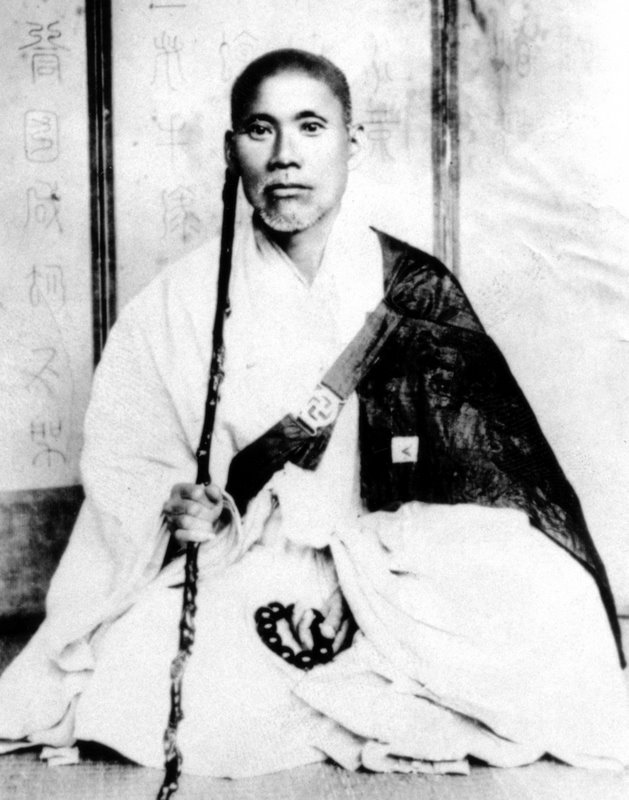
The great Korean Buddhist teacher Hanam Sunim (1876-1951) once said that the things we do in our lives either brighten our minds, or darken them. (He said that there’s really no neutral ground, just effects that are too subtle for us to notice.) 

I thought of this the other day, when I came across this great line :

Another washing machine, a bigger car, a nicer house to live in? Not much to feed the spirit in all that.  (Bangkok Tattoo, 179)

So here’s an open question for everyone: What feeds your spirit?