Entrusting, and devotion

Toward the great bodhisattvas in all directions
Who practice the Way out of sympathy for all,
One should have reverence and respect,
Saying ‘These are my great teachers’
.
– The Lotus Sutra, Chapter 14

Entrusting and devotion. Thank you to everyone who has brought this discussion into being; these are questions I’ve been struggling with for years, and what follows are my own personal thoughts and tentative conclusions based on my own feelings and practice. I offer this not as a replacement or supplement to the wonderful articles already submitted by Joseph and Chong Go Sunim, but just as a personal account of what is true for me.

But I start with Zen Master Daehaeng, who gave me my Dharma name and whose words I’ve found to be invariably wise and relevant. “First,” she says (in ‘No River to Cross’), “sincerely believe in your inherent nature, Juingong, and know that it is taking care of everything. Second, go forward with courage. Third, experiment with how Juingong takes care of everything, continuously apply what you experience, and never let yourself be daunted by anything”.

What Master Daehaeng Sunim does is invite us to know, for ourselves, that Juingong, Buddha-nature, is taking take of everything, that everything arises from it and returns to it. So entrust everything, she writes, “entrust the things you understand and the things you don’t understand, entrust happiness and entrust suffering, entrust poverty and entrust disease.” But let go to what? Entrust to what? To emptiness, Daehaeng Sunim says, to emptiness.

Emptiness, One Mind, True Self, the fundamental place. Daehaeng Sunim calls it ‘Juingong’ but she says “you can call it Amida Buddha, or the main Buddha. You can call it God or my love because it is the fundamental place… the true self that leads you, no matter what name is used.” The experience is the very same. The most pure and fundamental part of you responding to what is most pure and fundamental. And this call to the fundamental place is universal.

For me, this is the emptiness that manifests as Avalokiteshvara Bodhisattva or Amida Buddha, or in a church I may feel it as the Christ. I am held in the warm arms of the Buddha, wrapped in the loving cloak of the Bodhisttva. This is not poetry, it’s true. True not just because it’s in countless Sutras, but because I know it. When I die I will be met by Amida Buddha and the Bodhisttvas. Yet they are also here now, all I need do is remember. And to live well, all I need do, and here’s the thing, is entrust.

Perhaps that which we entrust to may best be described through rhythm, or art, or silence. When asked for highest wisdom, the ancient masters said ‘mu!’ – ‘nothing!’. But emptiness is also form, so then they told their students to chop wood, to carry water, to find that emptiness, that eternal ever changing flow, that fullness of love and awareness that sunders the bonds of suffering, in their every activity, in their work, in the very depths of their lives.

Where names are, for me at least, important. I’ll happily admit to being a beginner. I’ve tried, but cannot reach the most difficult philosophical heights of the Dharma. I’ve been to many Buddhist discussion groups where I’ve been lost at the complexity of it all. And I’m rubbish at meditation. But I look around at the good people in the temples, in Thailand and Korea, the places I know best, and see that Buddhist life is the precepts, generosity, chanting, and reliance upon the Buddha. That is enough. And difficult enough.

So faith is vital to me. I remember many times at Bonguensa with my Dharma friends performing prostrations and chanting Kwan Seum Bosal. The temple would be full of people, their practice clearly coming from faith. It rubbed off on me and I find myself often drawn to the Boddhisattva, with devotion and gratitude. Many times a day I chant the Bodhisattva’s name and feel her presence. I feel grateful for this and my practice is to entrust everything to her. Yet I also know that she is no different to my fundamental Buddha-nature.

Perhaps I’m in the wrong Buddhist group for this to find its full expression, but I don’t think so. Rather, I think the teachings of Master Daehaeng Sunim gives a depth to this faith that places it where it most belongs, right in my heart. Know that you are connected to all, believe, entrust, observe. For me, there is no contradiction between a devotional practice towards the Buddhas and Bodhisattvas (or whatever figure one is drawn towards) and faith in one’s fundamental Buddha-nature. How could there be?

“Because mind has no form, tens of thousands of different shapes can come out from it. This is called the ten billion transformation bodies of Buddha. Why is it called the ten billion transformation bodies? It’s because Buddha responds to you as you request: if you want the mountain god, Buddha manifests as the mountain god. If you want Avalokitesvara, Buddha manifests as Avalokitesvara. Like this, Buddha manifests in various forms. Furthermore, Buddha responds not only with certain shapes, but also with compassion and warmth.”
– Seon Master Daehaeng Sunim
 

Links:
Chong Go Sunim: Entrusting
Joseph: Entrusting/Green Tara
Master Daehaeng Sunim: To Discover Your True Self, “I” Must Die

Entrusting

 Several people have asked me to talk more about entrusting, and what Daehaeng Kun Sunim means by it.  Let me start off by saying that entrusting is probably the second-most important aspect of all spiritual practice. There’s so much that revolves around this topic, so I’ll just jump in, and if you all have questions unanswered, let’s continue the topic in the comments section.
 

What is entrusting?
The easy explanation is that it means trusting your root.

It’s trusting your inherent Buddha-nature, and turning over to it everything that arises, along with the things you get hung up on.  
 

To be even more accurate, you’re returning them back to the place they came from. Everything arises from there, so that’s the place they need to be returned to. If you want the answer to a problem, look for it at the source of the problem. If a bee or fly comes into your room, the only way for it to get back outside is the way it came in. If it came in through the doorway, and looks for the solution at the window, it will die there, hitting the window again and again. This is the feeling I get from looking for solutions in the wrong places.
 
Just off the top of your head, how many examples can you think of where things are made worse by searching for a solution somewhere outside the problem? If you have a relationship problem, is looking for the answer in the arms of another really going to make things better? If you’re stressed or lonely or bored, is there really any long-term relief in repeatedly looking for comfort in a bottle,  a pizza box, or the internet? Ultimately, it arose from this foundation, so that’s where we have to return it.

 
Root, Foundation, Buddha-nature, God, the master within, Mind

      Awakening is to know your root.
It’s got a lot of names, but it’s that which is your source and destination, your sustenance and support.

Sometimes I feel like people (unconsciously) misunderstand awakening  as a blissed-out feeling,  or a clear(er) intellectual understanding of what’s really going on in the world. This is probably there, to be sure, but this isn’t the main thing.

Your root is your source and your refuge. To paraphrase the words of the Sixth Patriarch, “Who would have guessed that my foundation was inherently complete, endowed with every kind of knowledge and ability, and able to perceive everything and respond appropriately through both the spiritual and material realms.”  This root of ours is the source of all energy, wisdom, courage, compassion, and is continuously taking care of everything. It seems that only our clinging and insistence on relying upon “me” and “my” thoughts and ideas can hinder it. 

         Daehaeng Kun Sunim gives the example of assigning a task to someone: if you give them a job, and then constantly bug them about how it’s going, they’ll throw the job back in your face. “Here, you do it!”  Or, if you keep calling to them and asking how it’s going, or give them something new to do every few minutes, how can they set about getting the task done?

 
What do we entrust?

We entrust everything, unconditionally.

What we know, along with what we don’t know. What we understand, and what we don’t understand. Things that go well, and things that are going badly. We have to entrust both sides, otherwise we end up (trying to) cling to those aspects that represent our fixed ideas of good and bad, pleasant and unpleasant.

 
Roy, at Return to the Center, asked “how to discern entrusting to my foundation / Buddha-nature from entrusting to my ego-driven storyline? Trust me on this – I have a very convincing storyline…” This is a great question, and I think this unconditional entrusting is a huge part of the answer. Somewhere in letting go of what I know and what I don’t know, I transcend this storyline. If (when!) I find myself caught up in the storyline, I let go of that too.

 
Barry, from Ox Herding, touched on the problem of carelessly thinking “things will turn out for the best.” Things don’t always turn out as good as they needed to be.  A big cause on the personal level, is me not entrusting both sides of the situation, or hoping for one result over another. And sometimes “best” is just a reflection of my own fixed ideas. But our root can still fill in the gaps and help things for the best in our current circumstances. However, this is often the second-best outcome. (Or third, or fourth!^^)

 
Similarly, how do we know what we’re feeling or sensing from within is arising from our true nature, versus our bad karma? This one isn’t easy. For one thing, we have to let go of even the things that arise from inside. Both the good and the blissful, and the wise. If they are true, they’ll return when we need them. Another sign is the tone of this inner “voice.” Is it something that violates the precepts? Is it something harsh and cruel? Something argumentative or spiteful? Those are really strong indications that what I’m sensing is just a karmic echo. No need to feel bad about them, just let go of them too, and don’t be deceived by them any longer.

 
Whether we see it or not, whether we can feel it or not, our Buddha-nature is there taking care of things. You don’t see the root of a living tree, yet it’s there supporting and feeding the tree. So a lot of what entrusting is, is simply getting out of the way and letting it work. Even when I don’t know it’s there, it’s still there, supporting me and sustaining me. Every breath, every cycle of our blood, every exactly produced hormone and enzyme is a miracle of the highest order.  A 100 billion lives are magically working together within just this one body.

Entrusting is a step off a hundred foot bamboo pole. It’s stepping beyond my own fixed ideas. It’s dying and traveling through that gray land where there’s nothing to grasp onto.

(Perhaps that’s why I used to love skydiving!)

However, for eons we’ve mistaken “I know,” “me,” and “mine” for a support, for something safe to stand on.
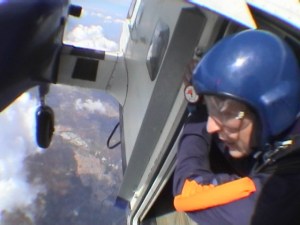
“So Neo, you think that’s ground you’re standing on right now?”


You think that floor is safer?  Far more skydivers die in plane crashes than skydiving accidents. You’re safer out of the plane than you are in it!

 
It was truly said that when you let go of everything you gain everything. When you’ve let go of all dualities, you become a channel for all the creativity, love, and wisdom in the universe.  

There are so many aspects to entrusting that it’s hard for me to address them all, and my own practice is still incomplete (by a lot!) so if there’s something I haven’t addressed, let’s go ahead and discuss it in the comments section.

with palms together,
Chong Go 

(The skydiving photos came from here and here. Thanks to the original posters.) 

entrusting/Green Tara

I noticed this comment by Roy, from Return to the Center;

It would be very helpful to me to hear more about entrusting. I react with worry to this encouragement. I think “entrust myself to what? How do I know if I am entrusting myself to my own delusion?” and things like that.

Actually, I had a very similar feeling after reading No River to Cross. I asked Chong Go Seunim at Saturday Sangha one day how to know if it’s truly intuition or your desires that you are following. His answer was to ask deep within and listen to what your true feeling is. Usually we know if we’re doing the right thing or not, we just don’t always listen to ourselves.

My wife and I decided that we would get married only three weeks after we first met. It sounds crazy even to us when we think about it now, but at the time, we just knew. I’d never had a relationship that I didn’t drive myself half crazy asking if it was right (because deep down I knew that it wasn’t, I just didn’t listen) but when I met my wife there was never any doubt. Three weeks isn’t long, but I looked as deep down as I could in that amount of time and didn’t hear anything but “Yes!” It’s only been a couple of years, and I can’t pretend to know what the future holds, but just trusting that everything will be okay, even if it doesn’t work out as planned, makes it seem okay. If there’s ever a time that things just can’t be worked out, I trust that I can find the strength to pack up (within) and become a monk!! ^ ^

Also, I wonder whether or not entrusting yourself is very separate from some devotional forms of Buddhism. Personally, I see the Amitas, Gwan Sae Eums, Taras, or which ever you prefer, as manifestations or projections of expressions that are also within yourself.  Honestly, it’s not a topic that I’ve given a great deal of thought to, my practice is decidedly not very devotional, but I’m sure Chong Go Seunim or Marcus will be willing to add something to that (and it doesn’t have to be in accord!).

I am reminded, though, of taking a night bus from Kathmandu to Lumbini. I usually travel entrusting that nothing bad is going to happen to me, but even the locals kept worrying we about the risks of traveling on the night buses. One of the shop keepers, from whom I’d bought a number of castings, gave me a small Green Tara amulet to hold on the ride. He reminded me of her mantra, said to remove fear, and then told me not to worry, even the daytime buses tend to get hijacked in Nepal…

A little short of reassuring, it still made me realize there was no point in worrying.  On the bus, however, my nerves were shaky. I clenched the Green Tara amulet in my left hand and my mala in my right hand and repeated the mantra until I lost count of how many times I’d thumbed through the 108 beads. I visualized Tara above me, shinning her light down. I visualized the green light hitting my forehead, spreading out to the others sitting around me, the others in the bus, and everyone else traveling on the road that night.

At one point, I opened my eyes to see the entire bus bathed in green light. I noticed a green plastic cover over the light at the front of the bus. I had to giggle to myself as my mind toyed with possibilities.

What I realized later about the mantra is that it doesn’t necessarily protect you from what you fear but more from the feeling of fear itself. It might be a stretch, but maybe what it’s doing is actually giving you the trust within yourself that everything will be okay.

Come to Korea for the Buddha’s Birthday!

Hi everyone,

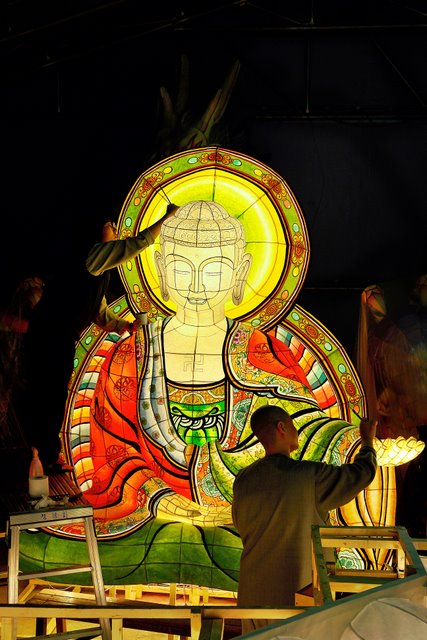
The Buddha’s Birthday is going to be celebrated here in Korea on the 21st, with the main lantern parade in Seoul on Sunday the 16th. The lanterns are spectacular, as are the performances and dancing, and shouldn’t be missed. I took this photo Sunday night at a review our temple was holding.  This lantern is about 10 feet high (3m) and will be used as a parade float. Like most of the lanterns it’s made from traditional paper over a wire framework, with electric lighting within. The paper is hand painted, with a weather-coating varnish of some kind.

There will be a street fair all day on the street in front of Jogye Temple, with the main parade starting from Dongguk University once it begins to get dark. The parade will move down Jongno road, ending in front of Jogye Temple. There will also be a shorter review held in front of Jogye Temple on Saturday, the 15th, again at dusk.

Here’s a close up of the leg:

So if you’re going to be in Korea, be sure to stop by Seoul on the 16th. Busan will also be having a parade, although I don’t know when. (It’s nice, but not as spectacular.) Likewise, there will be smaller parades at nearly every temple in the country on the 21st.

with palms together,

Chong Go

For an idea of the size of these lanterns, look at the peoples’ heads at the base of the elephant.

Ads on blogs

We’ve had some reports of large ads appearing on this blog, but haven’t been able to figure out if this is a spam program or WordPress’ doing. If you’ve seen an ad while visiting us, would you drop a line  in the “Comments” section? Thanks, we’re trying to get more info about this, and would like to know what people are seeing.

with palms together,
Chong Go

The Bangkok Seon Club – and choir!

Ice melts and water flows
down ten thousand valleys,
fish dance and play,
flowers bloom and birds sing,
the fruit of practice ripens naturally – let me know all ten thousand flavours
.
 —Daehaeng Kun Sunim
 

Here in Bangkok, our celebrations of Buddha’s Birthday on May the 28th this year will also mark the first anniversary of the Bangkok English-language Zen Club, the first English-language group led by the Seonwon here, under the wonderful guidance of our fabulous teacher Hyaedan Sunim. During this first year together we’ve met once every month, gathering on Saturday nights, to study ‘No River to Cross’ and share our experiences of applying the teachings.

The Seon Club, now firmly established after this first year, is made up of a small group of regulars of diverse backgrounds, both Korean and from many different countries, with a good number of visitors and the occassional special guest. Of course one of the great highlights of our first year was Chong Go Sunim’s visit last November as part of the Seonwon’s tenth anniversary celebrations, and the wonderful teachings he was able to share with us all.

And now, as we approach our first anniversary and the celebration of Buddha’s Birthday on May the 28th, the Seon Club is even preparing to sing! We have some very skilled musicians in our little group and a wonderful instructor from the seonwon. The most important thing, she said to me last night – as I was worrying about my own strangled-cat voice and the danger of my letting everyone down – is just to let go! Sing with love, she said, and your voice will be fine!

There is no specific English-language programme of events for Buddha’s Birthday, but if you are in Bangkok this month and would like to join the English-language group as we sing in the celebrations, get in touch and we’ll let you know about rehearsals. And if you can’t join the choir, but would like to celebrate Buddha’s Birthday with us on the 28th, you are more than welcome to come along. The morning ceremony (in Korean) is at 10am and the evening performances (also in Korean) start at 6pm. It will be a wonderful experience.

See you there!

Inherently sharing the same life and body

    Towards the opening of Daehaeng Kun Sunim’s translation of the Heart Sutra it says:

Inherently all beings
are sharing the same life,
the same mind,
the same body,
working together as one
and free giving
and receiving
whatever is needed.
They are endlessly
manifesting and
changing every instant,
but because they are unaware
of this,
they walk the path of suffering.

     I’m always amazed at how the implications of this continue to unfold. It explains the idea of “one mind” as well as “interbeing,” and has so many practical implications:


If I want to save myself, I can’t exclude or hate anyone else, for they’re also part of me.

Everything’s constantly changing, yet it’s denying this that causes one to suffer.

Everything I need is there, if I just stop building walls of self and other…

Buddha-nature: Theravada Zen

Last year, as part of its tenth anniversary celebrations, the Bangkok Hanmaum Seonwon hosted a joint Dharma talk on the subject of Buddha-nature with the Theravadan monk Phra Cittasamvaro Bhikku, the founder and guiding light of the English-language Littlebang Sangha, and Chong Go Sunim, who had kindly made the trip from the Hanmaum International Centre in Anyang, Korea.

Phra Cittasamvaro Bhikku, popularly known as Phra Pandit, started the evening with a brief history of Theravadan and Mahayanan Buddhism, and how the differences between them are not as great as they might at first seem. After all, he said, everything started at the same point, with the Buddha putting aside all theories and looking into the nature of things for himself.

What he saw under the Bodhi tree was experience in terms of fields of awareness, sight, sound, taste, and so on, and that they were forever changing. Finding no stability in this, he withdrew his mind and found it becoming brighter and sharper. And what he discovered there, the Buddha declared, was that which does not die.

He gave this a number of names such as original mind, source of mind, Nirvana, and so on, and later it was termed Buddha-nature. Phra Pandit suggested it was perhaps a little egotistical to give it this name as it exists in all people, regardless of the labels they use. A bit, he teased, like planting a flag on the moon.

He also pointed out that seeing this fundamental mind is a temporary experience and that we inevitably return back into normal life. However, once seen, it will change one’s way of relating to the world. The great problem, though, is how attainment of this fundamental mind can be taught. No matter what is said about it, it is not it.

So Buddhist teachings are like radio stations. We can switch between them, some we will like, some not, but the point is the silence beneath. Using the analogy of the diamond in the mud, Phra Pandit said that reaching it through purification or reaching it through realisation were simply differences in emphasis.

Chong Go Sunim agreed, pointing out how the Buddha’s teachings, using another analogy, are like medicine. And no single medicine is good for all illnesses. So a range of Buddhist teachings developed according to the needs of listeners. Different Sutras, in fact, are simply saying, “okay, let me put it like this, now like this”.

But the point to all these teachings is to transcend the limited sense of self, and Chong Go Sunim described how his own teacher, Seon Master Daehaeng Sunim, emphasises the practice of letting go. Like chanting, bowing, and meditation, he said, it is a tool for transcending the self, and a self-correcting one at that.

Often, he said, people have great meditation experiences or insights, but make the mistake of saying “wow, I want that again”. Soon, they are carrying around little more than a memory of a past experience. By practicing letting go, they are able to move on from it. But to carry out this practice requires trust.

Which is where Buddha-nature comes in. Chong Go Sunim, before he became a monk, used to sky-dive, and he explained that no matter how badly you might be spinning through the air, simply getting into the correct position allows you to right yourself. In terms of practice, that position is the act of trusting and letting go.

“Perhaps this is all just a skillful means” Chong Go Sunim said, “but I can’t say it’s not true” and with the way that one’s ignorance grows back again and again, just like a monk’s hair, one must return to this practice over and over. Like the the Diamond Sutra, he concluded, which seems to repeat itself, but at deeper levels.

The evening ended with a short time for questions and answers and in response to one question Chong Go Sunim, using the large bell at the front of the Dharma Hall, demonstrated, to an audience of mainly English-speaking Bangkok residents, the sound of a Korean chant. The perfect way to round off a unique and wonderful evening of Dharma.

Link:
LittleBang: the English-language Bangkok Sangha

If you do what everyone else is doing…

I posted this elsewhere, but Evelyn in Germany offered such an insightful comment that I thought it was worth reposting here.

A few weeks ago, I overheard Daehaeng Kun Sunim say the following sentence during an interview:
 

 If you just do what everyone else is doing, you’ll be screwed.*   
 

How’s that for a to-the-point Dharma talk! She was talking about the cost of following the herd, but even more than that, the cost of not making an effort to find your own, true root; and the cost of not listening to this root, your Buddha-nature.

Evelyn:
Following the herd – in the beginning it may seem the easiest way… you don’t offend, you aren’t blamed. there are many places and opportunities ‘following the herd’ isn’t just wished but wanted from you – at school, in your job, at home. not to follow the herd implicates annoyance, dismissive treatment and a general uncertainty. you’ll think twice to dare! you try to please everybody. you run… up to the day you are at point zero. you are shattered. and yes, you are screwed. you feel desperately helpless. finally you start thinking again. who’s to blame if you aren’t where you want to be? who’s to blame when you aren’t doing what you want to do? how to untangle this situation and not to destroy everything?

You have to be brave. you have to take the risk. and you have to take the responsibility. then maybe you’ll find out wherefore you are here. it’s worth the effort…
 

   *The word Daehaeng Kun Sunim used was ‘mang-ha-da’, which could be literally “ruined,” but the nuance was much more like “screwed” or “up a creek.”

mending the seam

Mending the seam between self and others has been an extraordinary challenge. The teachings have given me the conceptual realization that I am but a thread in the cloth that makes up our existence, now I must do the work to experience that concept within.

I found “No River To Cross” momentous in the ongoing development of such a realization; Look within, trust your inherent nature, let the fundamental mind take care of things, are the mottoes that one is left to consider. At first, I had to ask myself, “How will I experience non-duality by focusing on myself?” I think it’s by looking past all the things that are usually associated with self; What’s my favorite color? What song do I feel like hearing? What do I want to eat? Beneath these are very universal functions. Actually, we spend every moment in non-duality, it’s just covered over by the daily concerns of self.

As I clear away enough mental debris to poke a finger-hole through, like in the paper windows of a temple door, my thoughts echo those of Dae Haeng Kun Sunim:

Your fundamental mind, your true self is invisibly connected to all things in the world and through it all things communicate with each other and work together as one. In this way, the whole universe is functioning together as one through fundamental mind, so this working together is called One Mind (Hanmaum).

The big difference is, she’s sitting peacefully on the inside, and I’m standing here fiddling with the latch!