
This is a very short section, but you know, it doesn’t need to be long. If we could do only this, everything will be just fine.
My one mind itself is the Buddha-dharma,
present throughout all aspects of my life.
내 한마음이 바로 부처님의 법이며 생활일세
Learning to see the world as it truly is
This is a very short section, but you know, it doesn’t need to be long. If we could do only this, everything will be just fine.
My one mind itself is the Buddha-dharma,
present throughout all aspects of my life.
내 한마음이 바로 부처님의 법이며 생활일세
(are you remembering to recite these out loud? 🙂 )
The minds of all Buddhas are my mind.
Nothing I see, hear, or do exists apart from the truth they realized.
일체 모든 부처님의 마음이 내 마음이요,
듣고 보고 행하는 그 모든 것 부처님 법 아님 없어
I was asked to include the Korean as well, so here you go! 🙂
Buddha’s mind is realized in an instant.
Not knowing this instant causes an eternity of suffering.
한 찰나에 부처님의 마음이요,
한 찰나를 몰라서 끊임없는 억겁에 끄달리네.
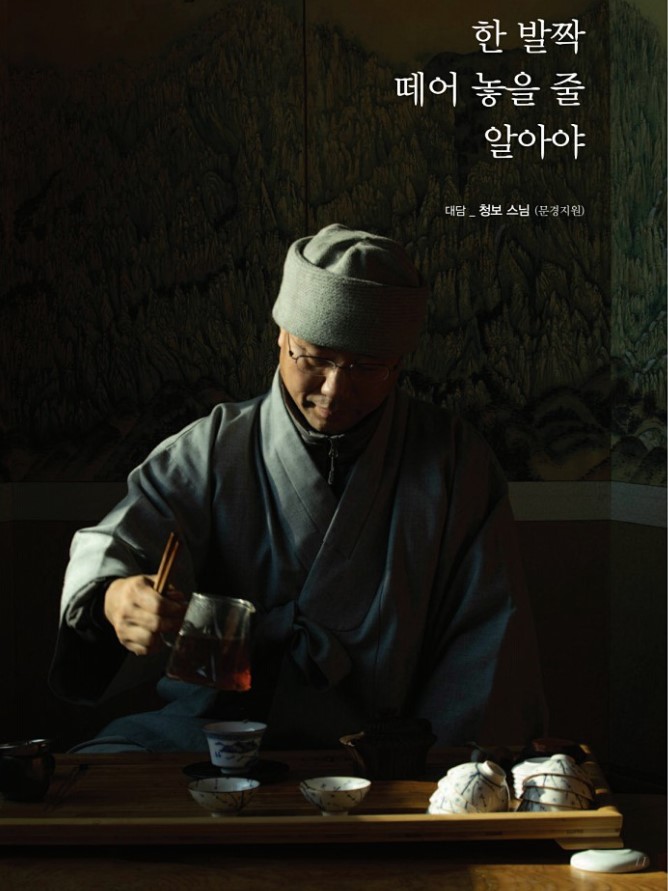
I’ve been working on translating an interview with one of our sunims, Chong Bo Sunim, for Hanmaum Journal. It’s a bit long, so we’ve broken into three parts. Here’s the first part that’s just appeared in the latest issue.
Letting Go and Taking a Step Forward – An interview with Chong Bo Sunim
An Interview with the head of the Mungyeong Hanmaum Seon Center, Chong Bo Sunim. This interview was originally published in Korean, in the March-April edition of Hanmaum Journal. This is part 1 of 3.
Encountering Kun Sunim
As a teenager, I was quite aimless. Most things seemed meaningless to me, until I happened to read a book by Seong Cheol Sunim [He was a famous Seon Master and spiritual head of the Jogye Order – translator.] He’d said, “If you die, that’s not the end of things. There is still an eternal road for us to travel. Given this, how should we live?” This really made me think a lot.
So, while in college, I was quite active in the Korean Buddhist youth group for college students, called “The Great Wheel of Dharma.” It was about this time that my conscription notice arrived, with orders to prepare to report for duty in the Korean army. But, under the stress of military life, I didn’t want to lose my desire for the truth. I talked with one of the older members of the youth group who had already done his military service, and asked him for his advice.
He suggested that I do a 100-day prayer retreat, and see what happens. I was on day 75 of the prayer retreat, when I received my final orders to report for induction and basic training. I’d been raising the intention that I would never lose the thread of the truth or stray from the Dharma. I had an interesting dream just as I was finishing basic training and had just received my first assignment. I was walking along an old trail in the mountains, when I came across a Dharma Hall. As I always do, I went inside and gave three full bows to the Buddha. But this time, the Buddha statue looked at me and smiled back!
When I reported to the army based I’d been assigned to, not too far from the Gwangmyeong branch of Hanmaum Seon Center, I learned that the Dharma Hall had been founded by Daehaeng Kun Sunim, and she herself had come and performed the “Opening the eye” ceremony on the Buddha statue. Apparently the military chaplain who’d been there when the Dharma Hall was built had been a member of the Anyang Hanmaum Seon Center’s youth group, and had asked if she would do that. So she did, and named the temple “Cheong Nim Sa” [Literally “Green (or Vibrant) Forest, but this is also the name used to describe the three major monasteries in Korea, in that they are places for raising and developing great monks and nuns. So there is a nuance that this temple would be a place for developing great people. – Translator]
I helped out at the Dharma hall when I could, and when the military chaplain who was responsible for the temple was reassigned, he arranged for me, an ordinary Private First Class, to replace him as the military chaplain!
Because Daehaeng Kun Sunim had built and dedicated this Dharma Hall, I decided to go up to Anyang and greet her, although I only knew her through what the chaplain had said. I arrived at Hanmaum Seon Center, and went to the second floor of the old offices, where Kun Sunim was meeting with the laypeople who’d come to see her. When it was my turn, she asked me why I’d come, and I explained that I’d been put in charge of the Dharma Hall she’d sponsored. She looked at me very steadily and said, “Take good care of Buddha!” And that was it. The remainder of my three years in the army and my time looking after the Dharma Hall went quite smoothly.
I was responsible for looking after about 150 soldiers, giving Dharma talks and holding the daily ceremonies. It was all on my shoulders, but it went off without any particular difficulties. Once a month, a sunim from the Gwangmyeong Seon Center would come and give the weekly Dharma talk, but the rest of the time, I did it. I was doing okay, but after a while I began to feel like something was missing. I’d look at Buddhist magazines and books to find a topic for that week’s talk, and then I’d give it three times to different groups.
But the longer that went on, the more I began to get a sense that what I was saying was just other people’s words. It wasn’t my experience at all. About that time, the sunim who visited said during his talk, “It gets easy to think that the Buddha’s teachings are great and wonderful, while my own life is trivial and meaningless, but everything the Buddha taught, everything he pointed to, exists within each one of us!” Those were the words that made me want to become a monk and dedicate myself to realizing this.
When I hear that, I knew that was it. I knew that I could only find what I was searching for by looking within. So once I finished my time in the army and went back to school, I joined the youth group at the Gwangju Hanmaum Seon Center, and after I graduated, I entered the temple to become a sunim.
While I was in the youth group, we would sometimes go up to Anyang to attend Kun Sunim’s Dharma talks in person. One time, as we were on our way [this trip used to take 4-5 hours], an older layman asked me what I was hoping to learn or achieve through Kun Sunim’s teachings. From somewhere inside of me, the response just came out, “I’d like to turn a negative emptiness into a positive emptiness.” At that time, a sense of pointlessness weighed heavily upon me.
I hated the sense of endless competition and struggling with others, and just wanted to live a peaceful, quiet life. At the same time, I was also weighed down by the many conflicts and problems going on in both sides of my family. So I didn’t really have a sense of what I should be doing with my life or what a meaningful life looked like. The only sense I had was that I wanted to offer everything I had to Kun Sunim, and walk this path of discovering our fundamental mind.
A while later, Kun Sunim came to Gwangju, where she gave a public Dharma talk at a stadium, and afterwards stopped by the Gwangju branch. The head of the branch arranged for me to meet her, and when I did, she just quietly looked at me for a bit. Then, out of the blue, she said, “Having been born as a human being and capable of grasping this foundation, if you were to apply yourself and become able to save untold numbers of people from a wave of lava flowing towards them, wouldn’t that be a meaningful life?”
With those words, I knew the direction my life needed to take.
In the next issue, Chong Bo Sunim talks about becoming a sunim and the years he spent working next to Daehaeng Kun Sunim.
The minds of all Buddhas are fully present within my one mind.

Here is today’s section of the Thousand Hands Sutra. Try to recite it three times in the morning and three times before you go to bed.
I was so amazed when I first started to understand this sutra, because each little section is a treasure in itself. The entire sutra is great, but just one little piece has so much power. It can change our lives, break up a habit that was holding us back, and touch something deep and quiet within ourselves.
(I’m going to schedule these for Monday through Friday, to give people a chance to get to these without being buried in a pile of endless notifications. ~ CG)
This world we live in is none other than the realm of Buddha.
Here it is forever Spring, flowers bloom without end,
and the fragrant path is ever open.
My one mind, present throughout every realm,
ceaselessly I follow it,
earnestly I trust it.

Okay…. I seem to be having some trouble reposting the old blogs. WordPress wants to treat them like updated drafts, and apparently doesn’t notify people of the new(*) post. So I’m trying this again! Please let me know if you actually did get an email today with the previous version of this post (Edit: It was supposed to be sent at 7am Korea time. Right now it’s looking like no one got them.) Thanks!
All Buddhas throughout all realms exist at this very moment within my one mind, sincerely relying upon my one mind is itself a true mantra.
I’ve been debating which direction to go with these posts, about whether I should post something new or repeat the daily posts from Daehaeng Kun Sunim’s translation of The Thousand Hands Sutra. Part of me was worried about boring people or that everyone would lose interest because there was nothing new, but this text just called to me. It’s so easy to understand; incredibly profound yet very straightforward. As I said when I first published this, I have no doubt that this will be considered a treasure of spiritual cultivation by future generations. To me, it also feels like just the medicine we need these days.
I’ll post a small section every day ~ see if you can recite it to yourself 2-3 times a day. Three times before bed is really good for people, and if you can combine it with 3 times just after you wake up in the morning, you will really feel it’s effects. Just recite it sincerely, not too fast, and just let it sink down within you.
It’s not long, but it doesn’t need to be. Just take that day’s section and let it percolate down through your body.
with palms together,
Chong Go
[This opening isn’t actually unique to The Thousand Hands Sutra, it’s included in the opening of many chanted sutras in Korea. It is how the sutra is opened however, and the text below is the English version of Daehaeng Kun Sunim’s Hangul translation.]
A mantra for realizing inherently bright nature, speaking truthfully,
and completely letting go of delusions such as good karma and bad karma,
like and dislike, defiled and pure:
Speak from the truth and each word becomes a mantra,
speak outside of the truth and each word becomes karma.
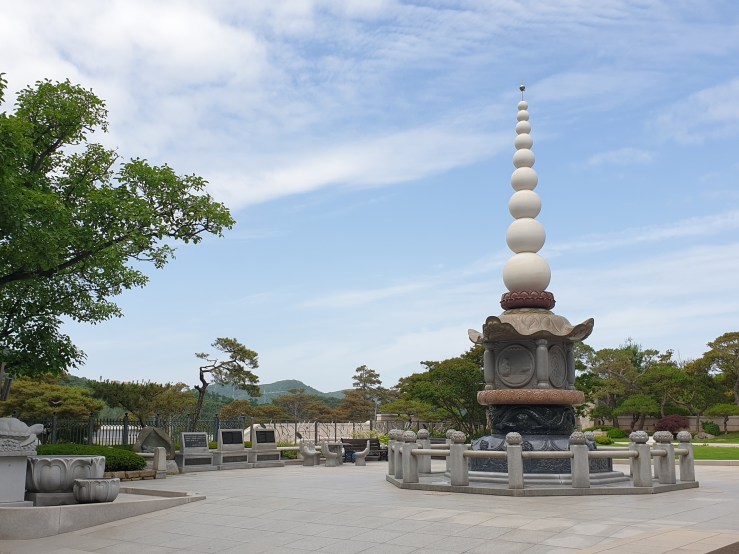
We call a temple a dor-lyang, which most people know from the Japanese pronunciation, a dojo. It doesn’t mean a place for fighting, but rather a place for learning, a place for finding one’s path, a place for applying one’s understanding.
This is the last verse of the Thousand Hands Sutra (Daehaeng Kun Sunim’s translation). I started putting these up daily, because with the corona virus and all the other things going on in the world, it seemed like we could all use some wisdom. But I didn’t realize how much these would touch me, or how much good just repeating a single line each day (several times) would do me. Or how powerful it would be.
Returning to and relying upon the Three Treasures of one mind (Vow 3)
I take refuge in the place for learning the truth.
Which is every place.

