speaking out – for animals in Korea

There is an on-going merciless holocaust taking place, across the entire world, involving torture, brutality and death on an industrial scale. It’s partly hidden, partly just accepted, and though trying to do what little I can about it has been an important part of my life for the past three decades (since first becoming vegetarian), it’s not something I’ve brought up here on this blog – until now.

And even now, I’m not going to trot out the usual arguments and Buddha quotes supporting the non-killing and non-eating of animals. Rather, I just want to help publicise a campaign against one recent aspect of this daily nightmare which specifically concerns Korea, and which I’m sure all readers, vegetarian or otherwise, will also support.

According to the Asia-Pacific branch of PETA, since the outbreak of foot-and-mouth disease in late 2010, approximately 1 million animals have been killed in Korea, many of them buried alive in mass graves. Large numbers of pigs have been dumped from trucks into pits and then covered in soil, where they slowly suffocate to death.

Some animals remain alive in air pockets but are unable to move, sometimes for days, before they eventually die from trauma, starvation, or dehydration. Using live burial as a disease-control method violates both the domestic animal protection law and Korea’s obligations under the World Organization for Animal Health’s Guidelines on the Killing of Animals for Disease Control Purposes.

PETA has contacted the relevant Korean authorities to ask for a more humane death for these animals but has received no response. And so are now asking for individuals around the world to contact South Korean embassies to ask officials to pressure the South Korean government to immediately stop burying animals alive and implement humane ways of dealing with the disease.

A suggested letter follows, but it is always better to personalise it, especially the subject line:

I was so disappointed and outraged to learn that a country like Korea, which is known for its forward thinking and modernity, is trying to contain foot-and-mouth disease in such a barbaric way.
Burying innocent animals alive is simply cruel, immoral, and illegal!
These animals slowly suffocate to death in the absence of air.
Worse still, improper burial often allows for air pockets to form, and many animals remain alive, sometimes for days, but are unable to move.
Until this cruel practice is stopped, I will tell my friends and neighbors not to visit South Korea.
Please use your position of influence to help those in need.

I personaly will be emailing the Korean embassy here in Thailand (where I live) this afternoon. And I urge all readers of Wake Up and Laugh to contact the Korean embassy in their countries as soon as possible too. It is, surely, time to speak out.

——-
Link:
PETA: Tell Korea to Stop Burying Animals Alive!

Updates:
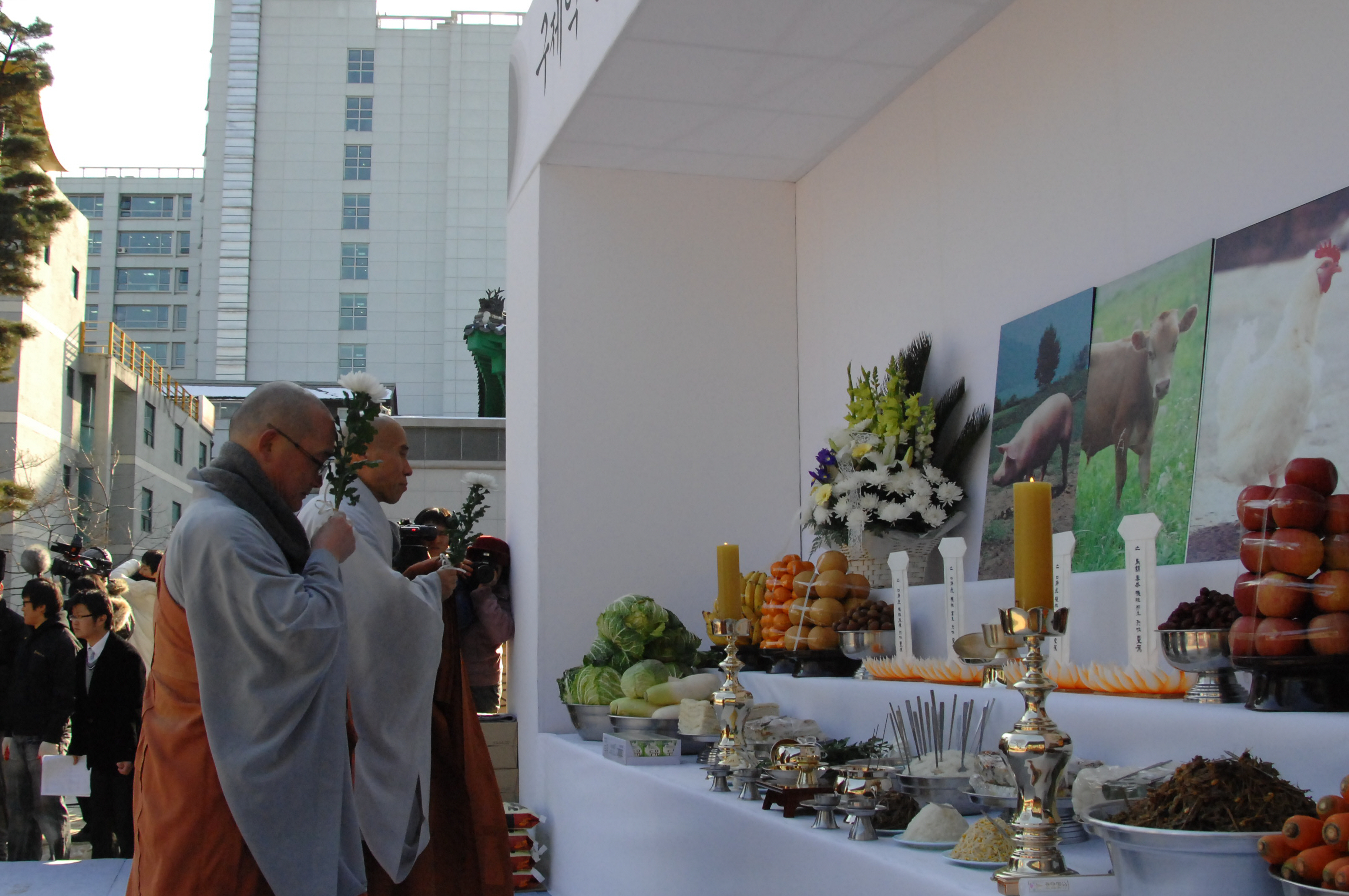
1) Thanks to Chong Go Sunim and Adam at Fly Like a Crow, here’s a report of a memorial service for the 1.9 million animals killed, held at the main temple of the Jogye Order in Seoul. One of the banners read “It must have been painful and you cried a lot. I hope that you go to a good place and enjoy happiness.”

2) There’s another report of the same memorial service on the website of the Jogye Order with some excellent photos, including one I’ve used here. During the service Ven. Hyechong said “Lord Buddha taught us to consider all sentient beings as our parents. If beings were to understand that we are born in different circumstances according to our karma, then we could create a Pure Land where we recognize each others’ value.”

When do we speak out?

This post arose from an online conversation with Barry at Ox Herding, about criticism, and the need to speak up.  Generally, criticizing others isn’t something helpful to our practice, yet when is it necessary to speak out?  When do we speak up? When is this the healthier choice?

Barry:  I have violated the “precept” of speaking about others so many times and usually have come to regret my speech.

Zen Master Seung Sahn used to say that the mouth is “the number one problem gate” and all available evidence supports this, at least in my case.

At the same time, there are times when we must speak out about the behaviors of others. I think about Eido Shimano in this context and the decades of silence that enabled the ongoing abuse of his students.

What if Aitken Roshi had spoken out in the late 1960s rather than in the last year of his life? How might that speech, had it occurred four decades ago, have helped?

In recent years, when confronted with some troubling behavior or speech, I’ve tried to examine my own troubling behaviors and words. If I can see how such actions arise within myself, then I can also see clearly how they arise in others. Then I might speak out. (But it’s hit and miss!)

Chong Go Sunim: I can see enough of my own faults to realize that, (in general) I definitely have no business going on about others’ behavior. That said, there are still times when it’s necessary to have the “hard conversation” with someone, when I have discuss something really unpleasant or uncomfortable.

I’ve heard of companies that have a “no gossip” policy, where they actually will fire someone who keeps it up. There, they define “gossip” as complaints/criticisms “given” to someone who has no power to do anything about them. I think there is something to this that helps separate the “bitch session” from the “hard conversation”. In the second it actually is my job to do something about it.

I can kind of imagine some of what’s involved with situations like the one with Shimano. I’d guess that a lot of practitioners (in other places) who only heard glimpses of the problem didn’t say anything because they felt that the people best able to actually solve this problem were the ones at that temple. I think this may have played a big role in the silence; plus, as outsiders they may have also felt uncertain about what exactly was going on.

On the one hand, it seems like that situation is continuing because the people in the middle of it choose to let it continue. So what’s my responsibility? As near as I can tell, it is to people new to Buddhism who might actually believe those kinds of behavior are “enlightened” or some kind of “non-dual wisdom” or even crap like “Asian culture.”

I kind of feel for Aitken Roshi, I’ll bet he really regretted not having had the guy deported back in 1964. Aitken Roshi seems to have been an honest and sincere person who was thrown for a loop when confronted for the first time with Shimano’s behavior. At the time, it didn’t fit the traditional “call the police” model for despicable behavior. And he’d probably never encountered anyone like that before. I’m pretty sure that Aitken unconsciously tried to deal with Shimano in the way Aitken normally treated people, as if they were basically honest and sincere. But this model doesn’t work with a compulsive behavior. I don’t think honest people react well, or decisively, to these situations until they’ve been burned once or twice. Until then, it’s something they never really imagined or had a need to think through.

Why did the rabbit give the tiger a pipe?

Tomorrow begins the holiday for Lunar New Year, one of the two major holidays in Korea. With the new moon will begin the Year of the Rabbit.

I don’t have much to say about what the Year of the Rabbit represents, I thought I’d share a bit of an anecdote from a small temple in downtown Suwon a few weeks ago…

We’d gone into the courtyard to have a space for our baby away from the traffic and crowds for a few minutes. Just as we were about to leave, a monk came down from one of the buildings and motioned us to follow him around to the side of the main hall. He wanted to show us the painting and see what we thought.

Usually, the paintings on a temple wall are depictions of the Buddha’s life, or Zen stories, such as the ten ox herding paintings, but here was a painting of two rabbits offering a pipe to a tiger.

After admiring it for a moment, the monk asked,

“So, why do you think the rabbit is holding the pipe for the tiger?”


(continued–>)

¤~∞~

¤


Learning to hear the voice of our true nature

I recently posed a question to Chong Go Sunim about how our foundation guides us.  His answer is insightful and I’d like to share it.

(The Korean word Juingong (主人空)means that which is really doing things, and which has no fixed shape or form. It can also be read as true nature or Buddha-nature.)

Question: How does our true nature, Juingong, answer, guide, and direct us?  What should I be looking for?   How do I know what is an answer from, my foundation and what is just noise from my busy mundane mind. Specifically, do answers ever materialize in dreams?  Do they show up in circumstances in daily life?

Answer:  I’ll break this down into two parts:  “What form does an answer take?”, and “How do I distinguish it from ordinary, conditioned thinking?”

For me, so far in my practice, the answer takes a huge variety of forms. It can be a phrase from a sutra or a ceremony that suddenly pops into mind, it can be a feeling, or a sudden understanding of what needs to be done. Once, it was even a voice that seemed to be coming from outside me. (Okay, that was a weird experience! I thought it was a friend goofing with me.) It often comes out as “my” thought, or some variation thereof. A lot of times I suddenly seem to understand things exactly just before I wake up, and have even given myself really good Dharma talks while asleep, that I couldn’t remember upon awakening.

I think one of the things to be careful about, regarding our true nature, is looking for an answer that’s separate from myself. (A voice from the sky would be SO convenient!) Because what I think of as myself is also part of Juingong, it speaks through my own consciousness. Even if my understanding is hazy, Juingong is still there. Because my faculties are clouded with habitual perceptions, I may not be able to understand/perceive the answer as clearly as a better practitioner, but it still is pointing me in the right direction.

Sometimes the answer comes in results, such as a situation that seemed intractable suddenly resolves itself in a flash. People who seemed to be a huge obstacle are suddenly very flexible and amenable.

So, the question becomes, “What is coming from my true self, and what is coming from a bit of moldy cheese or a fragment of undigested potato?”  What is arising from true nature, and what is just a bit of conditioned consciousness. I’ll admit this one is a bit tricky, and probably for truly advanced practitioners the difference is much clearer. But one thing I’ve learned is that things arising from our true nature are harmonious, wise, and tend towards the generous side. If it’s harsh, negative, and violates the precepts, you can be pretty sure that this is just the karmic echo, a bit of conditioned consciousness bouncing back.

At any rate, in practice if we cling to the idea that “I know” even if it’s something about our true nature, that act of clinging will lead us astray. So even when we know something, we need to respond as best we can, and entrust even that back to our true nature. It’s that act of letting go and entrusting that’s really magic, because it automatically corrects any delusions or misguided ways or dualistic tendencies that we may attach to the experiences we have, and to the things that seem to be arising from our Juingong.

Thank you Chong Go Sunim.

practitioners’ questions

At the last meeting of the Bangkok Seon Club I met two wonderful Thai women, friends and long-time Dharma sisters, with a real interest in the teachings of Seon Master Daehaeng Sunim and in Seon spiritual practice. Being new to Hanmaum, although of course far from new to Buddhism, they asked a lot of really great questions. Even better, both these women have stayed in touch with me by email since the meeting, and just today I recieved a list of very nice questions regarding some of the things that came up in the last Zen Club.

I’d like to post the questions here and open them up to all readers of this blog. If any of these questions, even if only one, inspire you to respond, please leave a comment. The idea isn’t just for Chong Go Sunim to come along and provide the definitive answers, but for anyone to say what the response is for them personally. These are genuine questions from two life-long serious Buddhist practitioners coming across Seon teachings for the first time, and they’ll both be following this post with interest! Thank you for your responses!

1) What’s the meaning of Sangha ? 
2) What is the difference between one mind and true nature ? 
3) If Emptiness is nothing, then what is one mind ?
4) Is awareness to realize true nature or not ?
5) What is the difference between Enlightenment and Awareness ?
6) Is One mind and meditation the same ?
7) What does it mean to say that wisdom comes from True nature or Buddha mind that is beyond good or bad ?

good and evil

Not to do evil, to cultivate the good, and to purify the mind.
This is the teaching of all the Buddhas.
 – The Buddha, The Dhammapada, verse 183

You who desire true life
and wish to walk on God’s path:
Depart from evil; do good;
seek peace with all your soul.
 – Psalm 34, adapted by Stephen Mitchell

Having done something evil,
Don’t repeat it,
Don’t wish for it:
Evil piled up brings suffering.

Having done something meritorious,
Repeat it,
Wish for it:
Merit piled up brings happiness.
 – The Buddha, The Dhammapada

Choosing to do good or evil
all depends upon whether I rely upon my One Mind.
 – The Mind of All Buddhas, Seon Master Daehaeng Sunim 

For one who at all times conclusively realizes the Buddha Mind, when he goes to bed, he goes to bed with the Buddha Mind; when he gets up, he gets up with the Buddha Mind…  He functions with perfect freedom in accordance with circumstances, letting things take their way. Just do good things and don’t do bad ones. If you pride yourself on good deeds, however, becoming attached to them and abominating the bad, that’s going against the Buddha Mind. The Buddha Mind is neither good nor bad, but operates beyond them both.
 – Bankei Yōtaku, (1622-93)

Thus the Master is available to all people
and doesn’t reject anyone.
He is ready to use all situations
and doesn’t waste anything.
This is called embodying the light.

What is a good man but a bad man’s teacher?
What is a bad man but a good man’s job?
If you don’t understand this, you will get lost,
however intelligent you are.
It is the great secret.
 – Tao Te Ching, translated by Stephen Mitchell

You are to be great teachers, freed from the ego; you must live only to serve all people. Desiring to become as a big tree or a great container of Wisdom prevents you from being a true teacher. Big trees have a big use; small trees have a small use. Good and bad bowls both have uses. Nothing is to be discarded. Keep both good and bad friends; this is your responsibility. You must not reject any element; this is Buddhism. My only wish is for you to free yourself from conceptions.
Zen Master Kyong Ho

Good and evil have no self nature;
Holy and unholy are empty names;
In front of the door is the land of stillness and quiet;
Spring comes, grass grows by itself.
Seon Master Seung Sahn

The one mind of all Buddhas is my one mind,
 inherently free of stain or purity.
 – A Thousand Hands of Compassion, Seon Master Daehaeng Sunim

the Ven. Ya-un: Cautions about criticizing others

I’ve learned the hard way just how corrosive criticizing and complaining about others can be. I’m sure there are things that are more damaging to us spiritually, but criticizing and analyzing other’s faults has to be near the top of the list.

No matter whether you hear good things or bad things, do not let yourself be affected by them. Being praised when you lack virtue is truly shameful, while having your faults shown to you is a wonderful thing. If you are happy to see your faults, then you will surely correct them, while if you are ashamed of your lack of virtue, then this will spur you on to practice more diligently.


Don’t speak of other people’s faults, because eventually it will return and harm you. If you hear harsh speech or rumors directed towards someone else, look upon that as if someone was slandering your parents. Your criticism of someone else today will become criticism of you tomorrow. All things are impermanent, so whether you are criticized or praised, there is nothing to be happy or upset about.
 

                           Talking about the things that others have done,
                         “This was right,” 
                         “That was wrong,”
                          from morning until night.
                         At last spending the entire night
                         deep in the haze of slumber.
                         If a monk lives like this,
                         how will he repay
                         all of the donations he has received?
                         Escaping from the three worlds will be
                         truly difficult.

reminders

Yesterday, at the Bangkok Seonwon, in a truly beautiful and deeply meaningful ceremony, everyone renewed their five lay Buddhist precept vows.  Half a dozen people also took them for the first time, and so gained a new Buddhist name reflecting their new paths and aspirations.

The proceedings were led by Haewon Sunim, who had especially and kindly flown in from Korea, and before precepts were given she delivered a short teaching. Luckily for us non-Korean speakers, we had Young there to jot down some instant translations as Sunim spoke.

The part that jumped out most significantly for me was the bit about everything in life being a teaching – but only if you are making an effort and paying attention. If not, there’s no teaching at all. So, yes, everyday life is itself the Dharma, but you must be an active student.

The problem, for me, is remembering. I mean, just hours later I was engaged in a coffee shop debate with all awareness gone, desperate to get my points across. One minute I was saying how most discussions are a waste of time, the next minute I’d lost all sense of my foundation in the middle of one!

But, as Sunim had said at the start of her talk, the very nature of learning is difficult. And that’s why I’m so grateful to all those in the Sangha around me, lay and ordained, that support me so richly. Sometimes we just need that reminder, that our inner teacher is there and is always available.

As Seon Master Daehaeng Sunim says in the latest Hanmaum Journal, in words that seem to apply especially to this weekend: “Coming to the Dharma Hall regularly will help you a lot in grasping this fundamental essence, and while relying upon it, whatever you need will come forth.”


(Here’s a post with a bit more about the Five Precepts.)

The Venerable Ya-un: Don’t forget about freeing yourself from desires

This is the eighth of Ya-un’s admonitions: Don’t lounge about in the realms of desire. It’s also a caution for monastics to remember why they originally became a monk or nun, and to not end up living like an ordinary lay person.

The person who renounces the desires of their heart is called a practitioner. Not longing for the worldly life is called leaving home. Having ended desire and left the mundane world behind, how could you possibly associate and amuse yourself with lay people? To miss and yearn for the mundane world is called “intense craving,” which has always been incompatible with the path.

When longing and attachment arises, the determination to achieve the way begins to fade. Therefore, cut off all longing and attachment and never look back. If you do not want to betray the reason you left home(to became a monk or nun), then you should go to an outstanding temple and uncover the profound meaning. If you go forward with your robe and bowl, and dissolve all worldly desires, without any concern for hunger or safety, then your practice will automatically deepen.

                 Even good actions done for yourself or others
                 are the cause of the cycle of birth and death.
                Among the pine trees and arrowroot vines,
                the light of the moon illuminates all.
                Diligently enter the true meditation of the Patriarchs.

born again

The first stage of practice, letting go of the self that is an unenlightened being, lasts until you know your true self. At this stage, a practitioner ‘dies’ for the first time and, at the same time, is newly born.
 – Seon Master Daehaeng Sunim

Buddhists don’t talk much about being born again, and yet death and re-birth is at the core of our spiritual practices and paths, both literally and as metaphor. However, such language isn’t entirely missing and I remember a few years ago reading an excellent article in Tricycle by Clark Strand, at an earlier point in his spiritual development and within the Pure Land framework, entitled ‘Born Again Buddhist’ in which he rightly claims the term.

“For too long” he writes, in words I can identify with and which have stuck with me, “I used Buddhism to convince myself that I understood something I did not, but now I know the truth. I do not know anything at all. But then, that is precisely the kind of being that Amida Buddha saves — the one who has no choice but to surrender to a power beyond his own.” Daehaeng Sunim describes that surrendering as letting go, and that power as one’s own Buddha-nature.

Of course the giving up of the small self, the letting go of all its concerns and attachments, is the essential teaching of all Buddhist schools. Sometimes it can take dramatic ritual form, as in the Therevadan temple not far from where I live in which people literally step into coffins in order to be re-born anew, but whatever form it takes, when you entrust all your thoughts and concerns and pains and joys to something greater, then, as Daehaeng Sunim puts it, “what you have thought of as yourself dies.”

And this takes faith. Faith in Amida Buddha perhaps, or in the efficiency of the ritual, or in Juingong, the True Self. Faith and practice. Those that have been there have described this death as a return to a previous condition, back to our ‘original face’, a state before we learnt to create and operate and defend a separate and self-centered self. They describe it as a re-birth. And, like all births, it brings with it feelings of great joy and happiness.

The Christian tradition is familiar with this and familiar with the forms it can take, from sudden and dramatic born-again experiences, to something a lot more subtle. Jesus, in Luke’s Gospel, tells his followers they need to take up their cross (the symbol of death) “daily”. And as anyone who has ever meditated knows, re-awakening, the re-birth of attention, awareness, and surrender, needs to be practiced even from moment to moment.

“Whether it happens suddenly or gradually, says Marcus J.Borg in ‘The Heart of Christianity’, “we can’t make it happen, either by strong desire and determination or by learning and believing the right beliefs. But we can be intentional about being born again. Though we can’t make it happen, we can midwife the process.” And one way of doing that is through practice. As Thich Nhat Hanh puts it in his commentary on the Lotus Sutra, “When we come to the practice, we are reborn into our spiritual life, thanks to the Buddha.”

Another way of midwifing our re-birth, as well as through faith, mindfulness and letting go, is through ritual and participation in significant markers. New Year, in my opinion, as a time when people re-consider and re-direct their lives, is such an event. Here in Bangkok I went to my favourite temple for New Year and sat and chanted with thousands of people, all linked together into one community with sacred thread. The next day thousands more visited the temple again to make merit and receive a blessing. To be, in some small way, born again.

And next week at the Seon Centre, the Bangkok Korean Buddhist community, and a small group of non-Korean Buddhists, will gather to participate in a formal refuge and precept ceremony, a truly significant communal event that marks a real moment of re-birth for all those involved. This is just the beginning of course, it will feel beautiful, blissful even, but “you must still continue to practice and go forward” Kun Sunim writes. The process of re-birth is ongoing. It is our practice.

Our heart’s garden is sown with attachment, hatred, and pride.
In us are seeds of killing, stealing, sexual misconduct, and lies.
Our everyday deeds and words do damage.
Al these wrong actions are obstacles to our peace and joy.
Let us begin anew.
 – Thich Nhat Hanh, ‘Beginning Anew’

Links:
Clark Strand: Born Again Buddhist
NYTimes: Thai Temple Offers a Head Start on Rebirth