A Spiritual Biography of Daehaeng Kun Sunim

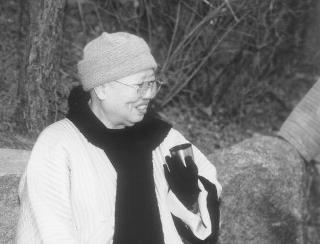
Although these are traditionally known as the Ox Herding Verses, I think they are also a fairly good spiritual biography of Daehaeng Kun Sunim.


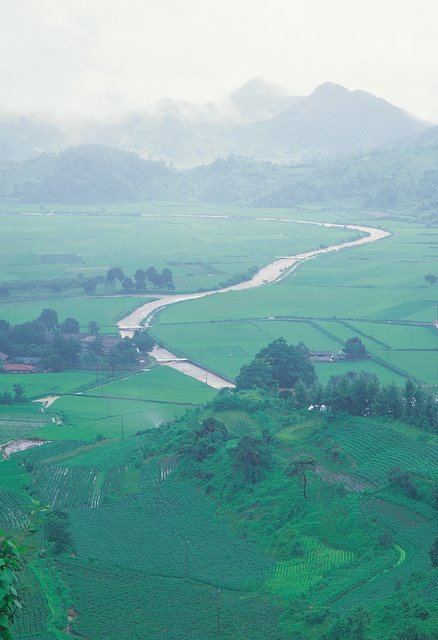
1. Searching for the Ox  On plains that stretch forward without end, pushing through the tall grass and brush, looking for the ox. Going here and there, following a nameless river and unknown paths deep into the mountains. Utterly exhausted, yet still no trace of the ox, In the gathering dusk, only the sounds of the crickets.
  2. Finding Tracks of the Ox

Suddenly, on a river bank, under a tree, hoof prints of the ox! And there, under the sweetly flowing water, an ox print clearly seen. Stretching out before me as plain as day, hoof prints!                                                                                             3. Glimpsing the Ox

Somewhere a bird is singing. Under the warm sun, a peaceful breeze. On the banks of the river, the willow trees are brilliant green, how could an ox hide here! But look at that massive head, and those wide horns. What kind of strength will it take to drag it back to the path?

4. Catching the Ox

It was a difficult fight, but at last I’ve caught the ox. So stubborn and willful, its strength seemed endless, like it could tear through mountains. But at last the ox has come to a standstill. Long accustomed to roaming here and there, at last it has come to a stop.

5. Taming the ox

To tame this ox requires a whip and some rope. I tied the rope through its nose ring, but still have to use the whip. Otherwise the ox will rush about, rolling in the mud, or getting stuck in the marsh. But when he’s tamed, his gentle, true nature will show, and he’ll follow me, even without a nose ring.

6. Riding the Ox Home

As I ride the ox, making my way home, it turns out he already knows the way. Sitting on his back and playing the flute, its harmonious melody goes far and wide. Hearing this sound, the villagers all come out to welcome me.

7.  Forgetting the Ox

At last the ox and I have returned home. My mind is utterly at peace,   the ox too is resting, and an auspicious light fills the entire house. This small, thatched-roof hut knows no worry or suffering, and at last I can lay down the whip and reins.


8. Myself and the Ox both Forgotten  

The whip and the rope, even the ox and myself, are all empty, gone without a trace. Oh this sky, so wide and open so vast and boundless. There’s no place for even a single dust mote to settle. How could I ever be ensnared again?   

  9. Returning to the Source

I’ve crossed over so many mountains in order to return to this root. Here is my true home in appearance like the open sky with nothing hindering it and nothing to be gotten rid of. The waters of a stream just flowing, the flowers so beautiful.   

10. Returning to the Town
Although I’m wearing old rags, there’s no sense of lack. As I mix with the many people on the streets and markets, their suffering fades away, and even dead trees come to life. Such a deep valley, yet the turbulent waters cannot claim me.
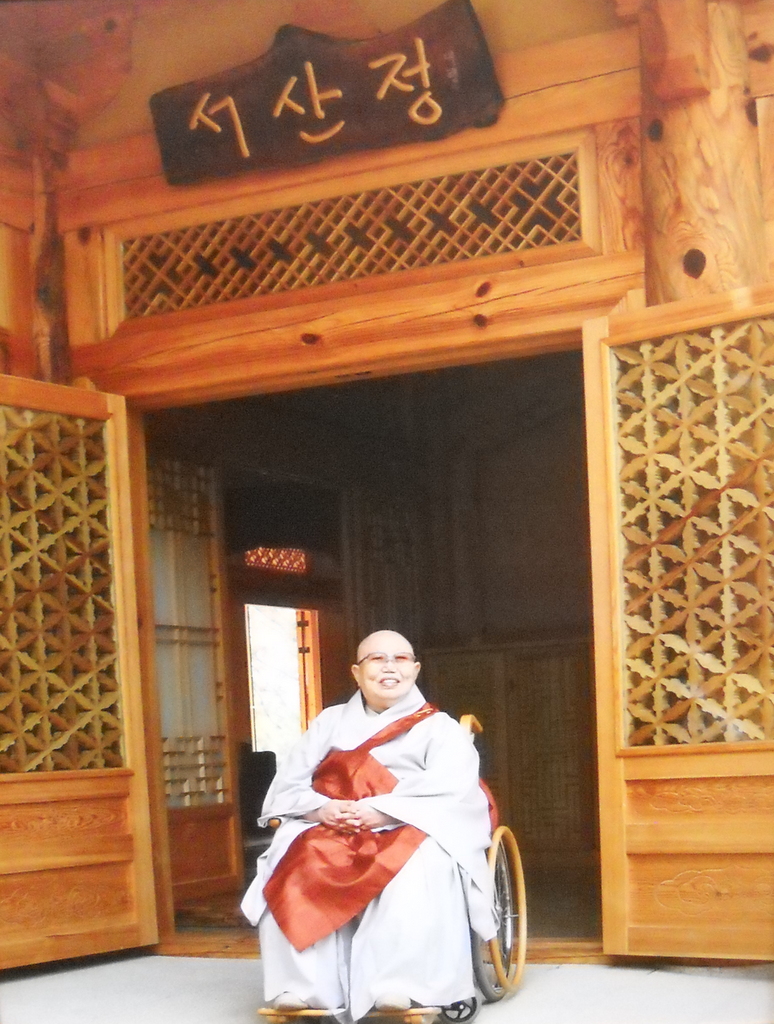
Dharma songs: Smooth the Rough Edges

Last November, we had a huge festival of Dharma songs here in Seoul. The singing was truly spectacular, as were the contents of the song. Listen to the song as you read through its lyrics, and see if it doesn’t touch you! (You may have to open the song in a new window while viewing this page. Let me know in the comments if the music isn’t playing for you.)

Smooth the Rough Edges and Become a Free Person

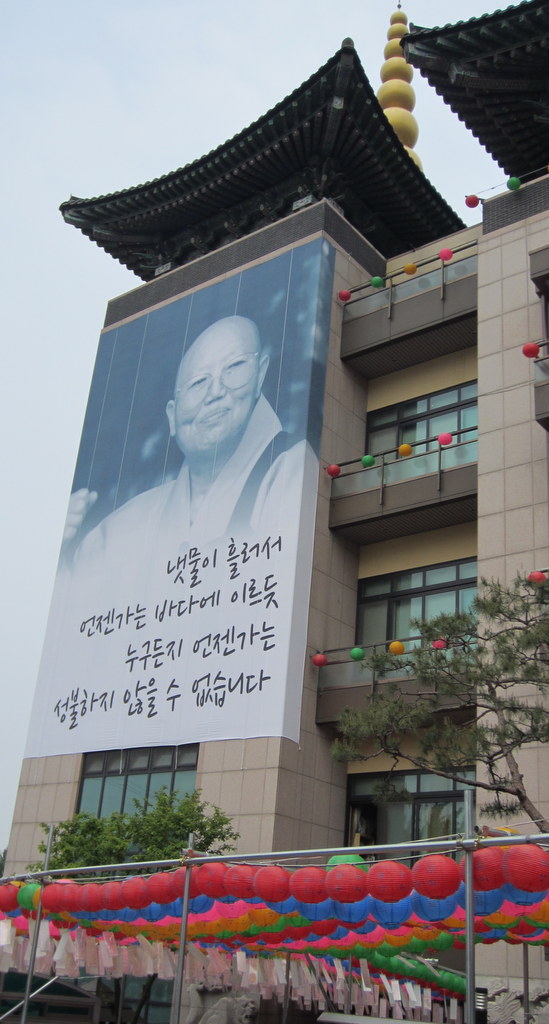
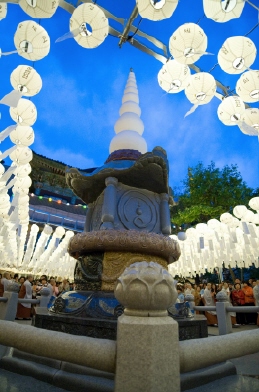
The Gugeong Pagoda on Buddha’s Birthday (at Hanmaum Seon Center)

When you’re able to use your mind harmoniously and generously
you’ll be able to use it freely,
becoming one with others
and manifest according to the need.
This harmonious mind can become smaller than the smallest dot,
and larger than the vastest universe.

Returning things inwardly makes your mind harmonious,
raising harmonious thoughts
helps you be more thorough about returning things inwardly.
Returning things inwardly also gives rise to compassion and caring.
If you have just compassion, just caring,
everything can be melted down,
and anything can be achieved.

If you can return things inwardly
you can communicate with everything.
You can become one with Buddhas,
one with a bug or a blade of grass.
Everything is also yourself!

With equanimity, with an empty mind,
observe your inner foundation,
without any thought of trying to see it:
This what it means to return things inwardly and observe.

Seeing everything as one,
embracing everything
without learning to one side or the other,
this is equanimity.

When everything has been put down
when there’s nothing left to hold onto,
and not even the thought that you have to put something down,
this is empty mind.

When you have such generous and harmonious attitude,
you can become one with all life
one with the whole universe.

This mind can make even rough things harmonious and generous,
and can find a use for them.
Not a single thing is thrown away!
This mind becomes one with all life.

This mind can make even rough things harmonious and generous,
and can find a use for them.
Not a single thing is thrown away!
This is compassion!


copyright 2011, The Hanmaum Seonwon Foundation

I’ll still be here to guide you

The following comes from a Dharma talk by Daehaeng Kun Sunim. Although it may be tempting to think that she’s speaking in metaphors, she isn’t. I’m reminded of the time she gave me a fierce look and said, “I always keep my promises!” 🙂

Let me talk about one more thing before we end today’s talk:  Some of you are worried about what happens after I pass away, that I won’t be here to guide you.  Right?  However, because you are practicing and learning to rely upon your fundamental mind, I will always be with you, just as if I was alive.  No…, not “as if.”  I will be there, alive. Even now, I often leave this body behind to go take care of things. So if I need “this” shape to help save people, I go use this shape.  When I need “that” shape to help save people, I use that shape.  If the shape of an old monk is needed, that’s shape I take. If a beggar is needed, then I go become a beggar.  If a bug is necessary, I become a bug. Could you call any of these shapes me? No.  “I” don’t exist.  Not even a little bit.  Not even now. If you all work hard and deepen your practice, what is there that you couldn’t do?!   So there’s nothing for you to worry about!

– Daehaeng Kun Sunim, April 2, 2000

Memorial Services

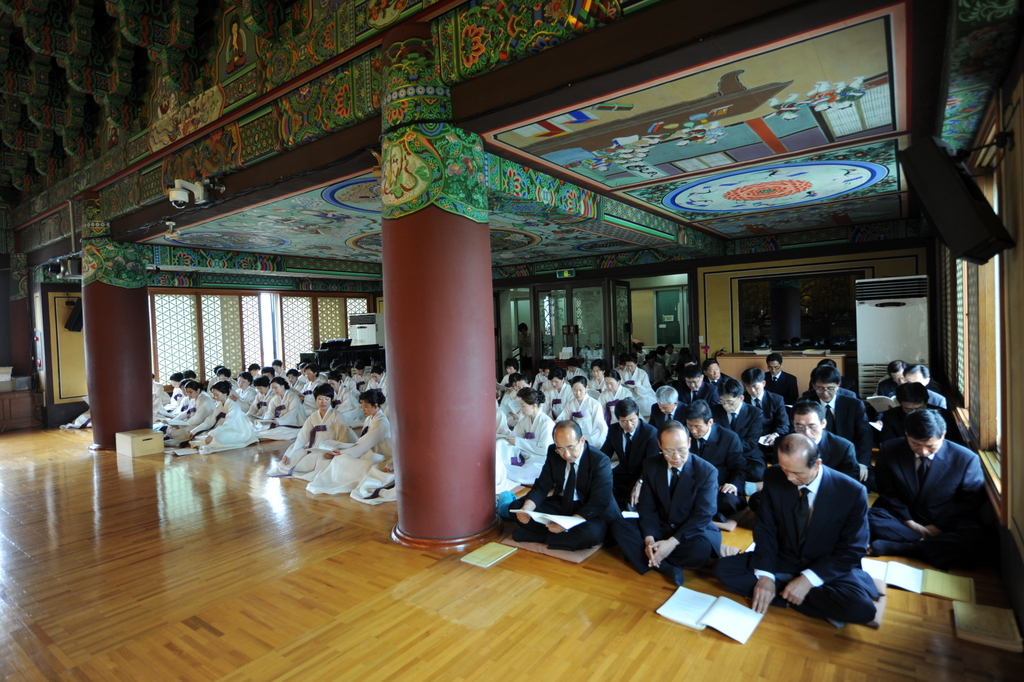
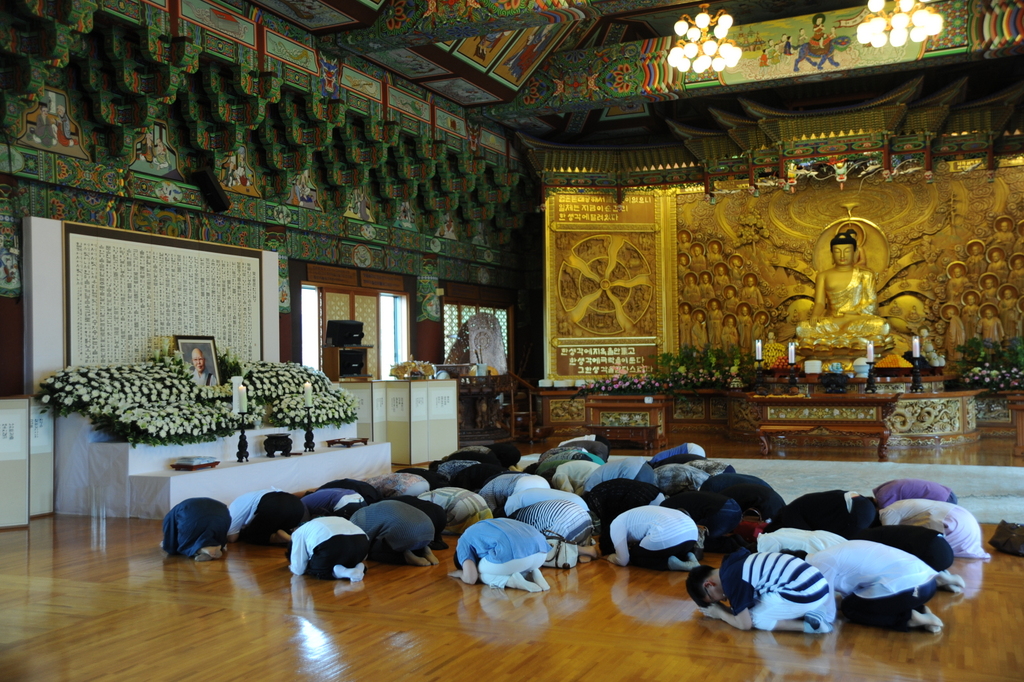
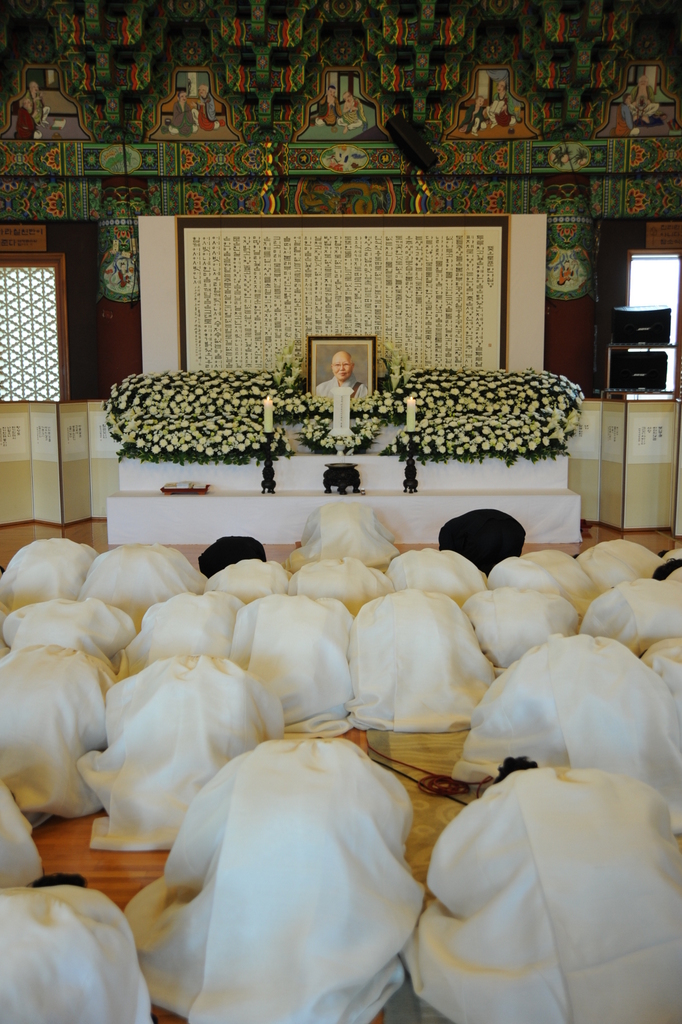
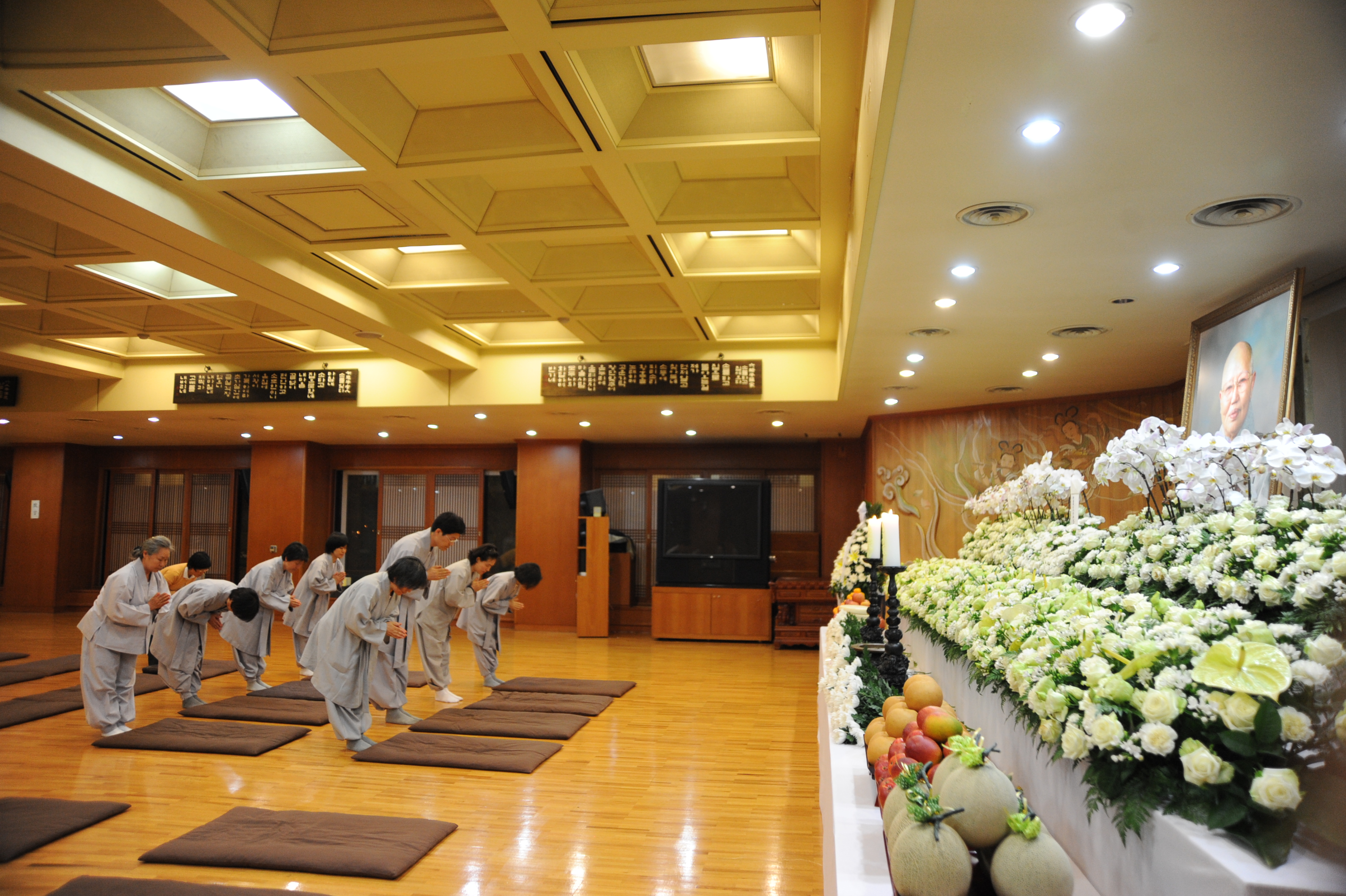
In Korean Buddhism, a memorial service is often held every seven days after death, until the seventh week, when a special 49th day service is held. After that, services are held once a year. Here at the Anyang Hanmaum Seon Center, we’ve been holding one every Monday for Daehaeng Kun Sunim. Many of our friends from overseas are unable to attend these, so here are some photos from the second service, which was held yesterday. (My thanks to Hae Young Jung for the use of these photos. Click on the photos to see a larger image.)

Nuns and monks chanting the Korean version of the Diamond Sutra

The choir came with an offering of Dharma songs
Bows

More from Daehaeng Kun Sunim’s funeral

Thank you everyone for your kind words and thoughts, and my apologies for not replying to each of you individually. As you can imagine, it’s been a rough couple of weeks. For all that, Kun Sunim often mentioned that there is much more going on than merely the visible aspect of existence. I’ll try to post more about this next week. Some of her talks about this (in Korean) are just incredible, and we are working on getting one of these translated and published by the autumn.

 Daehaeng Kun Sunim passed away just after midnight on Tuesday, May 22, 2012. Immediately afterwards, we began to prepare for the funeral, and the people who would be coming to pay their respects. We scheduled the funeral for five days later, both to give people more time to digest what had happened, as well as making it possible for people living overseas to attend the funeral. (The head of our Buenos Aires branch arrived only on the morning of the funeral, after a very long flight that included some odd legs.)  Because this all happened right before Buddha’s Birthday, we also had all of the lanterns up, and lit. It was almost as if Daehaeng Kun Sunim chose this time to leave her body, saying “Don’t be too sad.” For all of the bright lanterns really did do a lot to ease the mood.

Welcoming visitors

Condolences

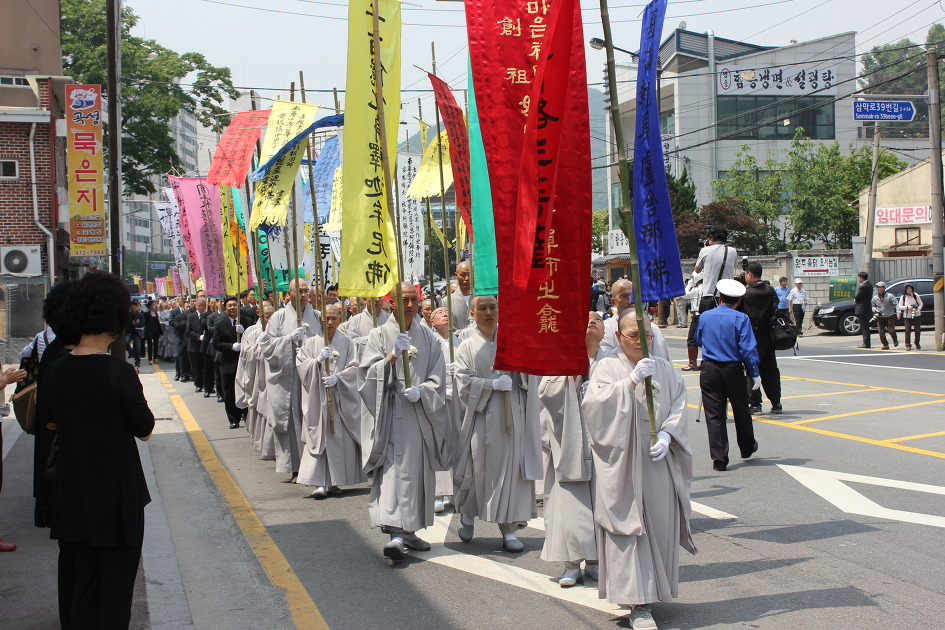
The next photos are from the day of the funeral. (Most of them were taken by Yunsu Im, and are used with permission. A few are by persons unknown, whom I haven’t been able to give credit.) After a last three bows to Kun Sunim, we gathered in front of the center, and prepared to carry her coffin over the hill to where the funeral would be held.

Taking Kun Sunim’s coffin one last time around the pagoda
Somewhere around 10,000 people attended this part of the funeral. Afterwards, we all left on foot for the cremation site.

click on this image if you have a decent internet connection

The place where Daehaeng Kun Sunim lived during the last several years. (The landscaping has suffered a bit with all the visitors.)

Daehaeng Sunim’s funeral – the last day

(You may be wondering what happened to the first days, but I’ll get those up after I get the photos.)

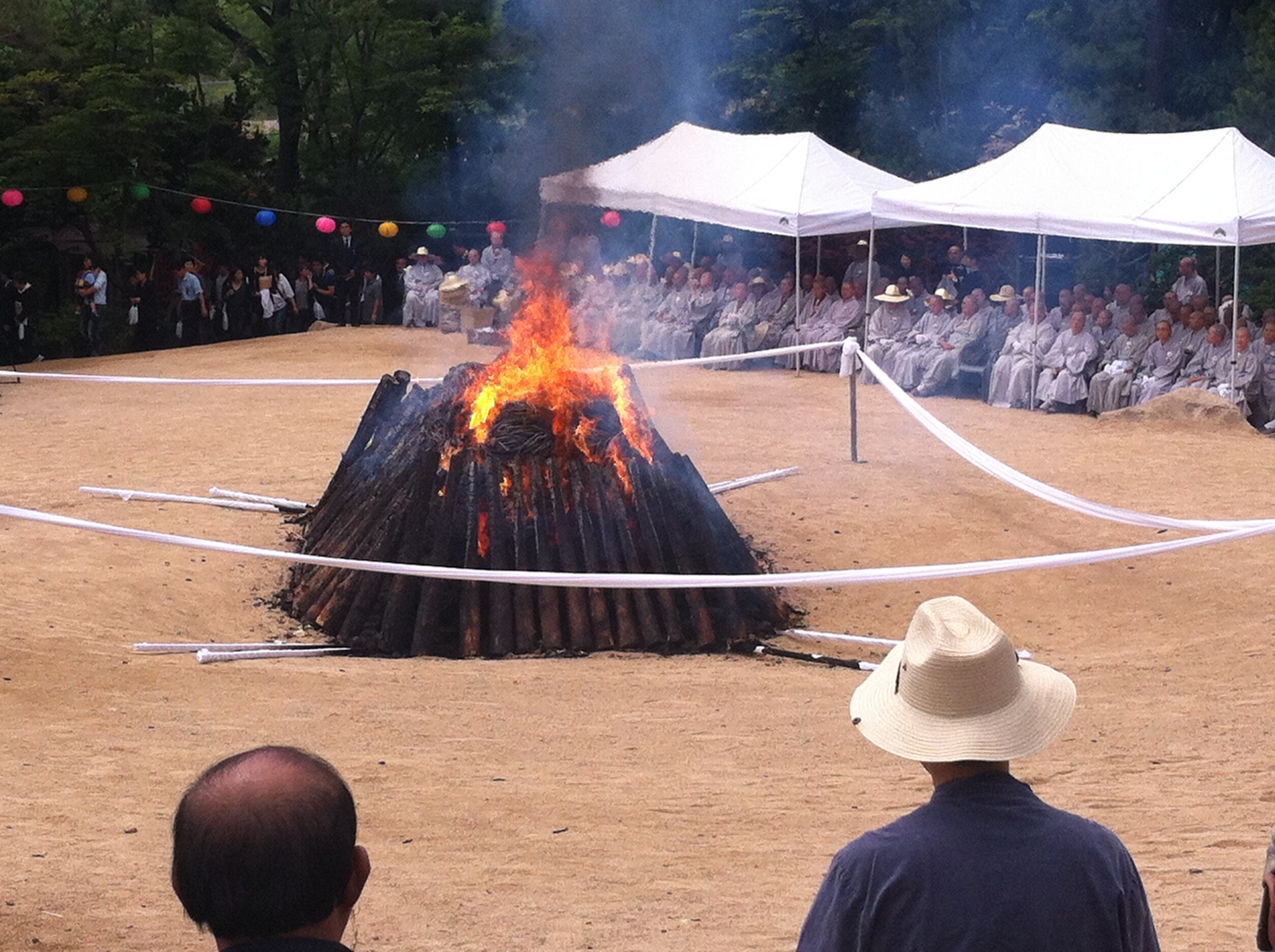
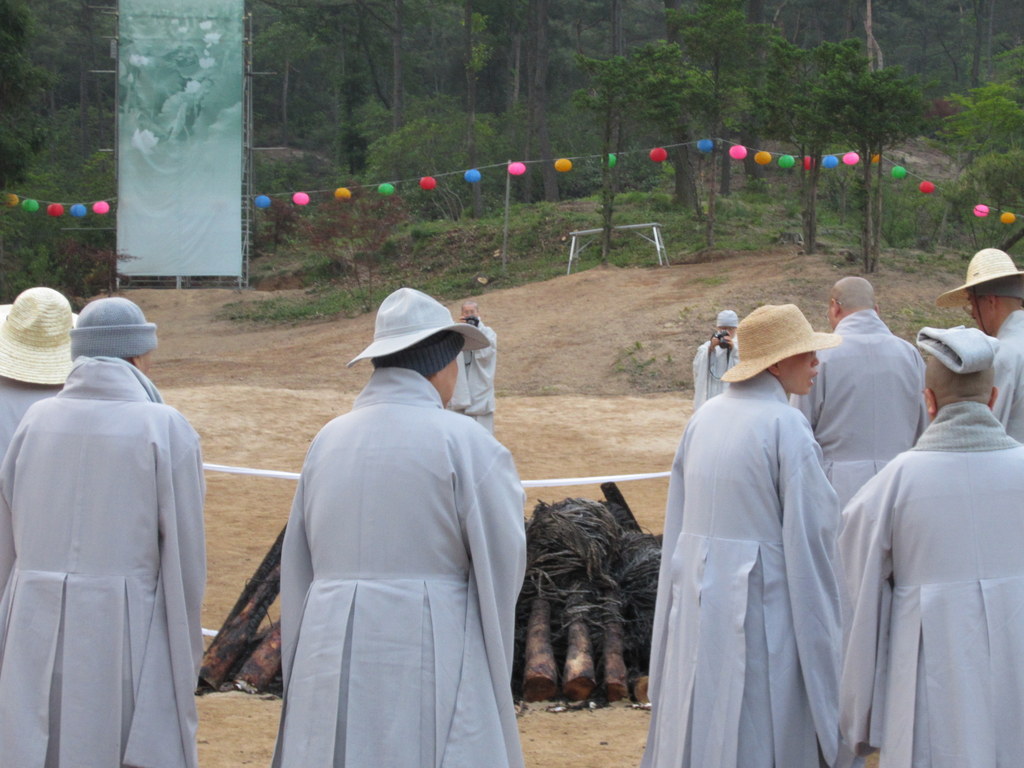
Yesterday we had the funeral ceremony for Daehaeng Kun Sunim. It was followed about an hour later by a traditional cremation ceremony. Although it was a difficult day in many ways, and I found myself crying again and again, it was also a very good day.

We lit the pyre at around 12 noon, and people stayed late into the evening. It was a beautiful day under the pine trees, amoung the grass and flowers, and all that was missing were picnic baskets. (I’m sure Kun Sunim wouldn’t have minded) Before the laypeople were sent home at 7pm, all of us who were left (75 sunims and ~300 laypeople) walked three times around the entire building and land, chanting all together.  After the third time, we formed a circle around the still burning pyre and sang Dharma songs, and the Buddhist version of the Korean “Teacher’s Song” and “Mother’s Song.”

With that the sunims began their watch. We stayed there, just meditating and being present (and only occasionally dozing off!) until 5am when the ashes had completely cooled.

Then we began the process of separating the remaining fragments of bone from the ashes. After this was finished, we moved back to the main center.


All water eventually flows to the sea,
like this every being will eventually achieve Buddhahood.

The Passing of Daehaeng Kun Sunim

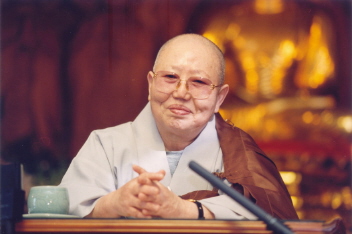
(Seoul, Korea) Hanmaum Seon Center regrets to announce the passing of our beloved teacher, the venerable Daehaeng, on Tuesday, May 22, 2012. She was 85 years old, and was ordained as a Buddhist nun 63 years ago. The funeral will be held on Saturday, May 26th, with more details to follow as they become available.

Daehaeng Kun Sunim* was a rare teacher in Korea: a female seon(zen) master, a nun who also taught monks, and a teacher who helped revitalize Korean Buddhism by dramatically increasing the participation of young people and men.

She made laypeople a particular focus of her efforts, and broke out of traditional models of spiritual practice to teach in such a way that anyone could practice and awaken. At the same time, she was a major force for the advancement of Bhikkunis (nuns), heavily supporting traditional nuns’ colleges, as well as the modern Bhikkuni council of Korea.

Born in Seoul, Korea, in 1927, she awakened when she was around 7 years old, and spent the years afterwards learning to put her understanding into practice. She would wander the mountains of Korea, wearing a ragged set of clothes and eating only what was at hand. Years later, she said that she wasn’t pursuing some type of asceticism; rather she was just completely absorbed in returning everything to her fundamental Buddha essence, and seeing how that affected what she entrusted.

This greatly affected her teaching style later, for she could clearly see the great potential, energy, and wisdom inherent within each of us, but saw that people suffered because they don’t know about this, and instead were looking outside of themselves. Clearly seeing the great light we each have, she taught people to rely upon this inherent foundation, and refused to teach anything that distracted people from that.

Her deep compassion made her a legend in Korea long before she formally started teaching people. She was known for having the spiritual power to help people in all circumstances with every kind of problem. She compared compassion to freeing a fish from a drying puddle, putting a homeless family into a home, or providing the school fees that would allow a student to finish high school. And when she did things like this, and much more, few knew that she was behind it.

She supported many social welfare projects, founded centers in seven countries around the world (15 centers in Korea, and 10 in other countries), and her teachings have been translated from Korean into English, German, Spanish, Russian, Italian, Chinese, Japanese, French, and Vietnamese.

*Kun Sunim is the Korean Buddhist title of respect for a senior nun or monk.

The Buddha’s Birthday: Lantern Parade and Street Fair

The Buddha’s Birthday is almost here, (Monday, May 28th this year). This means that the Lantern Parade in Seoul will be this Saturday, and with the street fair on Sunday.

The lantern parade will begin around dusk, and will start at Dongguk University’s stadium, and head north to Dongdae-mun gate, and from there along Jong-no to Jogye temple. The lanterns are amazing, so don’t miss it if this is your first time. (I’m terrible at night-time photography, so all I have in the way of photos are colorful blurs!)
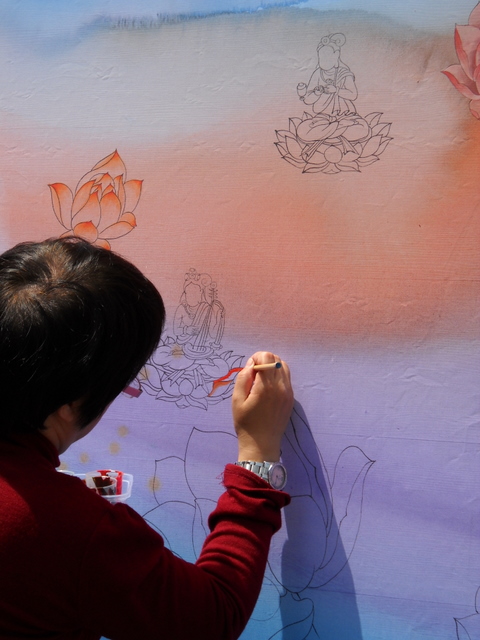
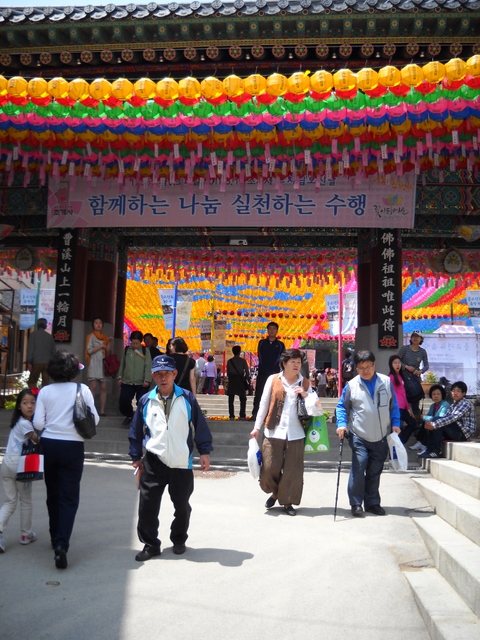
The street fair will take up the entire street in front of Jogye temple, and will start at 10-ish on Sunday morning. For an entire block, the road will be filled with activities and booths set up by Buddhist organizations and NGO’s from around the world. I can’t imagine any other place in the world where one could see so many different types of Buddhism and Buddhist organizations. Here are some photos from last year.  (You can see larger images of most photos by clicking on the image.)   For a great collection of night-time photos of Jogye Temple check out Robert’s photo blog.

Booths of the street fair stretching for a city block
you could hear these drums a block away
Farmer’s band: one of the great things about the day are incredible traditional music groups
a booth for making miniature lotus lanterns (like the ones in the top of the photo)


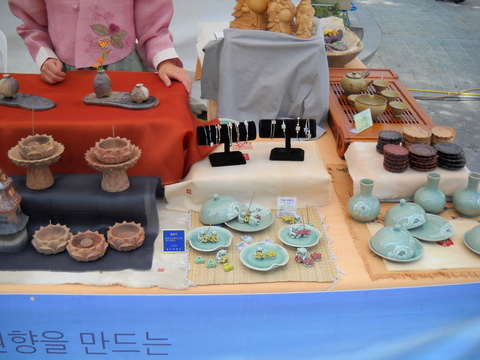
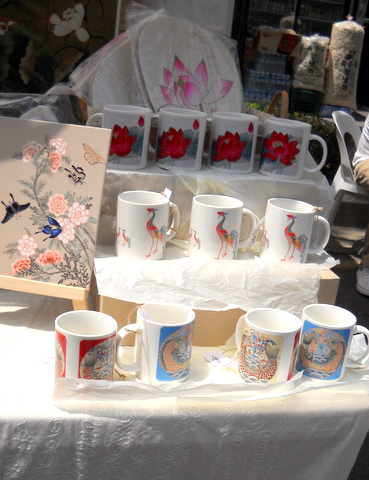
There was all kinds of interesting stuff for sale as well, here some incense holders
Incense being sold by Korea’s premier incense company, Neung In. They also provided the raw ingredients and showed people how to make their own incense.
One of the cool things about the street fair are the activities, here passersby participate in making a Buddhist painting
At Jogye Temple


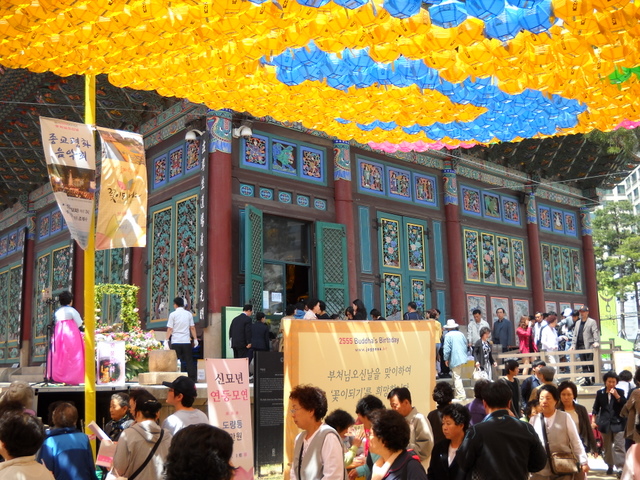
Under the lanterns in Jogye Temple
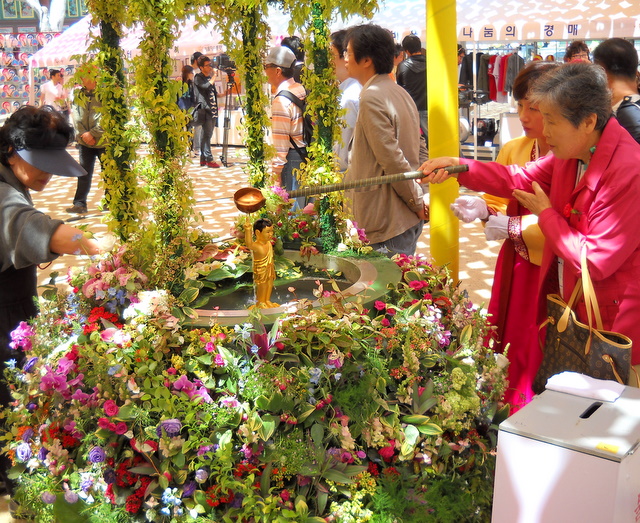
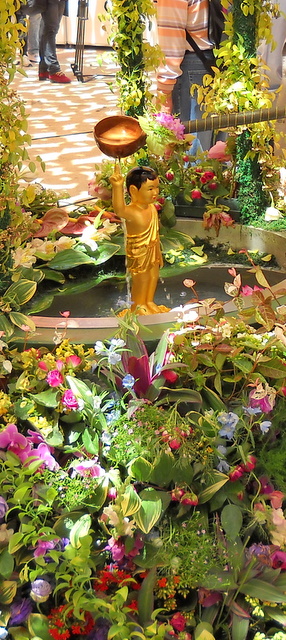
Bathing the infant Buddha
“Between Heaven and Earth, there is nothing that is not this precious Self”


Daegu Hanmaum, through the taxi window


When I first lived in Daegu, seven years ago, I used to occasionally pass by this building across the stream from the expressway that cuts through the city. It always caught my eye because of the unique tower of spheres on top.
When I learned about Hanmaum Seon Center, and found out there was a center, I wondered if it might be that building I used to peer at through the window of a taxi every couple of months or so during my first year in Korea. Last Saturday, after bringing Fina to the park for her birthday, we took a taxi downtown, and I waiting to pass the same place I hadn’t been by in nearly six years, and I could tell right away that it definitely was a Hanmaum center. It was interesting to me that for all these years that building poked out of my memory.

I’m hoping I’ll find a day really soon to drop by for once and visit the Dharma Hall. For now, I thought I would share the view from the expressway, an interesting sight/site in a sea of otherwise square, grey buildings

Daehaeng Kun Sunim:
Each of us has to believe in our potential to became a Buddha.
Deeply believe in your fundamental mind, the one that is doing everything, and make that your refuge.
For decades I’ve been repeating only this,
and going forward, I’ll keep saying it.
Even though I’ve said this for so long,
I’m not bored or tired of it,
and I’ll keep saying it
because I have deeply experienced for myself,
that this is the one true thing I’ve found.

“Know that you are Buddha,
return to and rely upon your Buddha essence,
and realize the full potential of a Buddha.”

I could emphasize this ten million times!