Here’s a short Dharma talk from Daehaeng Kun Sunim that appeared in the last issue of Hanmaum Journal.
What are you going to believe in? Buddha’s shape? Perhaps his renown? No. Know that his mind and your mind are not two. These bodies of ours have so many limitations, and will eventually fall apart. Mine, just as well as yours. It’s this non-dual mind. This non-dual mind where you and I are not two. This mind never decays.
부처님 형상을 믿겠습니까, 이름을 믿겠습니까? 부처님 마음을 내 마음과 둘 아니게 믿으라고 한 거지, 형상은 언젠가는 부서지고 한계가 있는 겁니다. 그러기 때문에 네 형상이나 내 형상이나 둘이 아니고, 부서지는 건 다 똑같다 이거예요. 그러나 부서지지 않는 게 한 가지 있는데 그것은 네 마음이나 내 마음이나 둘이 아닌 그 마음이 바로 부서지지 않는 것이다는 얘기죠.
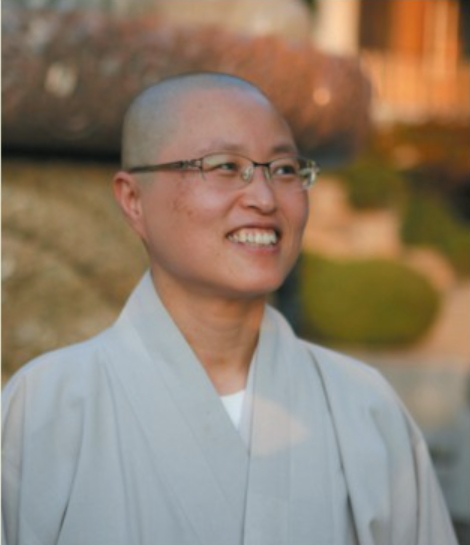
An interview with Hye Hong Sunim of the Washington DC Hanmaum Seon Center. This interview first appeared in Hanmaum Journal, in issue #78, November/December 2014, when Hye Hong Sunim was at the Jeju Hanmaum Seon Center. While there, she worked quite hard at establishing Dharma talks for foreigners.
Practicing Even More Diligently Than When My Teacher Was Here
Finding My Purpose
Hye Hong Sunim
From the time I was in High School, I attended church. At Christmas, my friends and I would go to church, and I think I must have spent five or six years like this. I was fairly diligent, participating in the choir, and teaching Sunday School.
It was during my first couple of years in college that I began to have questions about the teachings. As with many Protestant teachings, there was a sharp division between either going to Heaven or going to Hell. It was either one or the other, and I was bothered by this because they were saying that most of my ancestors were automatically in Hell (because Christianity hadn’t yet come to Korea.)
Somehow, this didn’t seem right, and I just couldn’t keep participating in something I didn’t really believe. I told the pastor of my concerns, and ceased attending church.
I was feeling very lost at this point, and didn’t do well in school because the question of “What is true? What is really going on?” took priority over everything else. I continuously read books on religion and philosophy, Catholicism, Cheondo Gyo, and went to retreats for breathing meditation and Qi cultivation. I was really wandering from this to that. I was feeling lost because I had been studying diligently, and thought I had found something true, only for it all to melt away.
I spent my mid-20s this way, and felt exhausted in both body and mind. I finally graduated from college, and one day I happened to visit a friend at her house. She had a calendar up that had a verse on it, and, reading it, it was as if everything that was blocked within me was suddenly blown clear. Everything I’d been stressed about suddenly relaxed a bit.
I asked my friend where the calendar had come from, and she said it was from Hanmaum Seon Center. Here mother was a member of the Jinju branch, and had brought the calendar for her. I had such a strong feeling of “This is the way I need to go.” I wanted to go immediately to the Seon Center, and, looking at the last page, found the phone number. I called them, and they told me that there was a center closer to me, in Masan.
So I started going to the Seon Center in Masan, and as I had hoped, I found my path. Funnily enough, when I first saw a video tape of one of Daehaeng Kun Sunim’s Dharma talks, it was the power and timbre of her voice that attracted me! I thought that was the most powerful and most profound sounding voice I’d ever heard, and really wished my voice sounded like that! I was very excited to have her as my teacher.
So I attended the Young Adults group, helped with the children’s group, and gradually began to understand what was really meant by terms like “entrust and observe,” and “melt it down.” I’d always thought of myself as a fairly good, developed human being, but as time went by, I began to see myself more clearly, and saw just how many things about myself that I needed to entrust and let dissolve!
The first time I got to see Kun Sunim in person was when the laymembers of the Masan branch went up to Anyang to greet Kun Sunim for Chuseok (Korean Thanksgiving.) I couldn’t say a single word, and just sat against the far wall. My heart was beating so fast that I thought I might be having a heart attack.
Following the Path Daehaeng Kun Sunim Set Out
I attended the Masan Hanmaum Seon Center for about two years as a layperson, before becoming a sunim in 1999. I felt like I had finally found my path, but at the same time, I was uncertain about becoming a sunim. Then, one day, I heard a layman say a variation of a Korean expression, “Having met Kun Sunim in this life, how could we not get in line behind her (and follow the course she has set)?”
As soon as I heard that, it was as if the mental cobwebs had been swept away, “Oh! Of course! If I don’t try, in this life, to undertake the path that Kun Sunim has shown us, how many more lives will I have to wait to learn something like this?” I felt so strongly about this that I decided to become a sunim.
After entering the temple, I think there must have been something wrong with my ears! When the new postulants (haeng-ja in Korean) had our hair cut off, we went to formally greet Kun Sunim. She asked me, “Where do you come from,” (In Korean, this is normally a version of ‘Where’s your home town,’ although in a Buddhist context it could also have a deeper meaning) but I heard, “Where did you sleep?” so I answered, “In the big room, next to the kitchen.” (Laughs.)
I think I must have been unsettled by the experience of adjusting to a completely different lifestyle, with so many new and strange things going on around me. One day, soon after I’d arrived, I was helping wash the dishes, when the abbess Hyewon Sunim asked me, “Do you want to live here?” Which was her way of asking if life at the temple was something that suited me. Instead, I heard, “Did you fold up and put away your bedding?” (In Korea, especially in the past, people didn’t use beds, and instead slept on thin futons on heated floors. In the morning they would fold everything up and move it out of the way.)
I can’t believe how completely I misheard her question! (Laughs) I thought it was some kind of a Seon question and answer. I couldn’t feel any kind of a response to that question, and just stood there like an idiot. Finally, the abbess just made a few “tsking” sounds and left. The sunim next to me couldn’t grasp why I didn’t answer such a simple question! (Laughing.)
The Caring of a Teacher
Daehaeng Kun Sunim
Most sunims soon have to go to a Gangwon (a traditional sutra education program for nuns and monks), or go to one of the branch centers to help out, so they didn’t have a lot of opportunities to hear teachings directly from Daehaeng Kun Sunim. That said, there was always a sense that she was looking over us, though unseen. Still, it’s different from being able to see and listen to her.
The postulant period was quite difficult for me, so one time Kun Sunim came to me and said, “Don’t get caught up in thinking of things as hard. All of it is just the varied and different manifestations of your foundation. Don’t let yourself be deceived by the different appearances those take.”
Once, during the period I was attending the gangwon, I was going to hold a Cheon-do ceremony to help my ancestors and those deceased with karmic affinity with me. This was to help them become unstuck and move forward on their own path. I went to greet Kun Sunim and let her know we were going to hold this ceremony, and she told me, “I’ll take care of the unseen part, and you take care of the visible part.” I suddenly felt very strange, and didn’t want to ask her any other questions. Instead I just said, “Okay, I will do that.” Even now, that teaching is something I reflect upon and let sink down within me. (It’s very likely that Kun Sunim wasn’t talking about the ceremony, as much as Hye Hong Sunim’s role as a sunim and her life – translator.)
As I was studying sutras in the ganwon, there were a few parts where I began to wonder if the Buddha had really said what was attributed to him. So when I had a chance to see Kun Sunim during a break, I asked her about that. She said, “Don’t bother yourself with ‘Is this right’ or ‘Is that right.’ Just trust in your foundation above all else, and let go of everything to it.” (Laughs.) To have been asking such questions when I myself didn’t know anything….
One day, Kun Sunim said to me that I understood as “Don’t be rushed or pressured.” I didn’t really know why she would say that, but I took it to mean that I should have a calm and steady demeanor no matter how busy things got.
It was only later that I realized that what she said had nothing to do with how busy I was. What sounded like “Be relaxed” was actually “Have a wide open mind,” and meant to let go of my fixed ideas and standards of how things should be. To have that perspective, as it were, and to take care of the things in my life with that attitude. Because I wasn’t doing that, I was also causing others to suffer.
One time, Kun Sunim admonished me, “Don’t be arrogant.” I was surprised by this, and didn’t really see where I’d been arrogant. Nonetheless, I was worried about why she’d said that. Later I realized that there were so many times I’d been arrogant! (Laughs.)
Another time, Kun Sunim said to me, “Everyone hates it when they’re told what to do, don’t they?” This is why I think Kun Sunim rarely ever told anyone what to do. But yet, she looked after us so carefully, that when I was so inflexible, she had to grab my attention to get me to start moving. She cared for everyone so much, and would go out of her way to bring something important to our attention. Even with things that I had begun to sense, having her mention a small point would cause me to focus more diligently on dissolving the underlying karmic states of consciousness.
In the next post, Hye Hong Sunim talks about practicing and working at the branch centers, as well as working with foreigners and starting an English Dharma group.
One of the interesting things about Daehaeng Kun Sunim’s translation of the Heart Sutra, is that it appears the beginning and end are essentially saying the same thing. Where the ending says “We all become free together,” the beginning says the same thing, while explaining why this is the case: “Inherently, all beings share the same life, the same mind, the same body. They work together as one, freely giving and receiving whatever is needed.” To me, this is saying that we all form part of the same whole. And as such, there’s no one we can exclude. There’s no we can look down upon. To the extent we behave like that, we cut ourselves off from the whole. It would be like chopping off one hand, and then complaining because we can’t open the jam.
This habit, this desire, to see others as less than ourselves is actually poisonous. It holds us back from awakening. It probably served some function at lower levels of existence, but it isn’t anything that can take us further. And as Daehaeng Kun Sunim said in the opening, not to know this connection to all beings and states of existence and nonexistence is to walk the path of suffering. So let’s work hard at letting go of all these discriminations and go forward on the path of freedom. with palms together, Chong Go
(the end of the Heart Sutra) Taking the path that’s no fixed path, leaving no traces behind, hurry, hurry, and become free. We all become free together. Let go of discriminations between this world and the next, hurry and become free. The enlightenment of one mind is always shining brightly, so now everyone, let’s all become free, hurry and become free, all become free.
(The opening of the Heart Sutra) One mind, deep all-embracing wisdom shining forth, seeing everything, functioning freely throughout all realms of the living and the dead. Its light reveals the truth of all realms seen and unseen: Inherently, all beings share the same life, the same mind, the same body. They work together as one, freely giving and receiving whatever is needed, ceaselessly manifesting and changing. But because they don’t know this, they walk the path of suffering.
so now everyone, let’s all become free, hurry and become free, all become free.
「우리 함께 어서어서 벗어나세」 (세번)
This is one of my favorite lines, as well as one of the hardest to translate. It’s got two things going on: One is a description “We all become free together” and the second is an imperative: “Hurry and become free.” It’s recited three times at the Heart Sutra, but to try to capture all of the nuances, we translated it in slightly different ways across three different lines. I’ll talk some more about the first nuance, “We all become free together” tomorrow.
Let go of discriminations between this world and the next, hurry and become free.
이승 저승 없는 마음 어서어서 벗어나세.
This is one of the more surprising lines in Daehaeng Kun Sunim’s translation of the Heart Sutra. Literally, it is “With the mind that has no discriminations between the world of the living and the world of the dead, hurry and become free.” I honestly can’t say I have a firm grasp on why this was included. Was it more for Koreans who tend to think more about the dead? Maybeee, but I’d be hesitant to say Kun Sunim included something because it was unique to a particular culture. Looking at the text again, it includes “this realm” and “that realm”, which would also include time, I think, because we tend to think of the dead as existing in the past. Maybe this just simply means that all beings, living and dead, visible and invisible, past and present, exist at this moment(?) we call Buddha-nature or true-nature or mind. Know this state, and from there, make yourself free. Maybe that’s what’s being said.
Hear now the mantra that awakens this deep one mind: Take the path that’s no fixed path, leave no traces behind, hurry, hurry, and become free. We all become free together.
이에, 깊은 한마음을 깨닫는 주문을 설하노니 발 없는 발로 길 없는 길을 어서어서 벗어나세, 우리 함께 벗어나세.
This verse has two lines that are some of the hardest to succinctly translate: 발 없는 발로 길 없는 길을, which literally would be “with feet that don’t have feet, on the path that doesn’t have a path.” The Korean is very poetic, with a very nice rhythm, but as you can see, the English is a bit… clunky, lol. In my opinion, (which should in no way be taken as all-knowing!), it seems that “path that doesn’t have a path” 길 없는 길을, means that there is no fixed path. There is no magic method that you just follow, such as “step 1, step 2, step 3,” to say nothing of some place where the mystic energy will somehow lift you beyond yourself. You have to go forward entrusting everything to this empty place, where no fixed ideas can stick, where there’s nothing you can grab onto (intellectually or physically) and say “This is it!” For whatever you think you know, you have to let go of that as well. Unless you are completely and utterly enlightened, what you are perceiving and thinking is almost certainly contaminated with dualistic habits and views. Even if they are good things, such as “help all other beings,” there’s likely some accidently dualistic views in there (besides the obvious), so you have to let go of even that again and again.
The first phase that was translated “Leave no traces behind” 발 없는 발로 , could also perhaps mean just “on feet that aren’t feet,” that is, this path we take isn’t a physical path, and so we travel it through mind, not through the body. Although I must have approved of this English version when this was first translated, I think it could also be expressed as: Take the path that’s no fixed path, traveling through mind, not the body,
I’m not sure. The second one is definitely more obvious, perhaps too much so. In the normal expression of spiritual practice, “leave no traces behind” means no trace of “I,” or “I did,” “I am,” “I deserved” “He/she/they did ___ to me,” and so on. This meaning might be the more useful one here.
You must know this: one mind, with deep and limitless wisdom, is the most profound, the most bright the most high the most upright, the unsurpassed level.
마땅히 알라 깊은 미지의 지혜로운 한마음이야말로 가장 신비하고, 가장 밝고, 가장 높고, 가장 당당한 위없는 심경이므로
These words aren’t some kind of bragging – the point is that everything you’d ever hope to find, everything that might help you, grow you, or lead you forward can be found within your one mind.
All Buddhas of the past, present, and future awaken to this one mind, obtain the highest and brightest wisdom, overcome birth and death, and attain the state of freely manifesting throughout all realms.
과거, 현재, 그리고 미래의 모든 부처님들도 이 마음자리를 깨달아 가장 높고 밝은 지혜를 얻어 생사를 초월하고 자유자재의 경지를 성취하셨나니




 Wake Up and Laugh!