born again

The first stage of practice, letting go of the self that is an unenlightened being, lasts until you know your true self. At this stage, a practitioner ‘dies’ for the first time and, at the same time, is newly born.
 – Seon Master Daehaeng Sunim

Buddhists don’t talk much about being born again, and yet death and re-birth is at the core of our spiritual practices and paths, both literally and as metaphor. However, such language isn’t entirely missing and I remember a few years ago reading an excellent article in Tricycle by Clark Strand, at an earlier point in his spiritual development and within the Pure Land framework, entitled ‘Born Again Buddhist’ in which he rightly claims the term.

“For too long” he writes, in words I can identify with and which have stuck with me, “I used Buddhism to convince myself that I understood something I did not, but now I know the truth. I do not know anything at all. But then, that is precisely the kind of being that Amida Buddha saves — the one who has no choice but to surrender to a power beyond his own.” Daehaeng Sunim describes that surrendering as letting go, and that power as one’s own Buddha-nature.

Of course the giving up of the small self, the letting go of all its concerns and attachments, is the essential teaching of all Buddhist schools. Sometimes it can take dramatic ritual form, as in the Therevadan temple not far from where I live in which people literally step into coffins in order to be re-born anew, but whatever form it takes, when you entrust all your thoughts and concerns and pains and joys to something greater, then, as Daehaeng Sunim puts it, “what you have thought of as yourself dies.”

And this takes faith. Faith in Amida Buddha perhaps, or in the efficiency of the ritual, or in Juingong, the True Self. Faith and practice. Those that have been there have described this death as a return to a previous condition, back to our ‘original face’, a state before we learnt to create and operate and defend a separate and self-centered self. They describe it as a re-birth. And, like all births, it brings with it feelings of great joy and happiness.

The Christian tradition is familiar with this and familiar with the forms it can take, from sudden and dramatic born-again experiences, to something a lot more subtle. Jesus, in Luke’s Gospel, tells his followers they need to take up their cross (the symbol of death) “daily”. And as anyone who has ever meditated knows, re-awakening, the re-birth of attention, awareness, and surrender, needs to be practiced even from moment to moment.

“Whether it happens suddenly or gradually, says Marcus J.Borg in ‘The Heart of Christianity’, “we can’t make it happen, either by strong desire and determination or by learning and believing the right beliefs. But we can be intentional about being born again. Though we can’t make it happen, we can midwife the process.” And one way of doing that is through practice. As Thich Nhat Hanh puts it in his commentary on the Lotus Sutra, “When we come to the practice, we are reborn into our spiritual life, thanks to the Buddha.”

Another way of midwifing our re-birth, as well as through faith, mindfulness and letting go, is through ritual and participation in significant markers. New Year, in my opinion, as a time when people re-consider and re-direct their lives, is such an event. Here in Bangkok I went to my favourite temple for New Year and sat and chanted with thousands of people, all linked together into one community with sacred thread. The next day thousands more visited the temple again to make merit and receive a blessing. To be, in some small way, born again.

And next week at the Seon Centre, the Bangkok Korean Buddhist community, and a small group of non-Korean Buddhists, will gather to participate in a formal refuge and precept ceremony, a truly significant communal event that marks a real moment of re-birth for all those involved. This is just the beginning of course, it will feel beautiful, blissful even, but “you must still continue to practice and go forward” Kun Sunim writes. The process of re-birth is ongoing. It is our practice.

Our heart’s garden is sown with attachment, hatred, and pride.
In us are seeds of killing, stealing, sexual misconduct, and lies.
Our everyday deeds and words do damage.
Al these wrong actions are obstacles to our peace and joy.
Let us begin anew.
 – Thich Nhat Hanh, ‘Beginning Anew’

Links:
Clark Strand: Born Again Buddhist
NYTimes: Thai Temple Offers a Head Start on Rebirth
Sunday Photo; Christmas tree lantern at Jogye Temple

This year, the head temple of the Jogye Order, in Seoul, put three Christmas tree lanterns by the street in front of the main gate into the temple.

It’s a nice display of the friendship maintained between Jogye and the Catholic Church in Korea.


How can I become a more spiritual person?

— Here’s another of the questions that Daehaeng Kun Sunim was asked. It’s quite nice because she clearly emphasizes where the focus of where our practice needs to be. I’ve highlighted a few of the really important points.
 
 
I’m trying to become a more spiritual person, and would like to know about spiritual practice and sitting meditation. 

Just physically sitting down is not the way to practice Zen, because spiritual practice is done through your mind, not through your body.  In this age, when people’s lives are so busy, our living itself– eating, working, driving, loving, sleeping – should all become practicing Zen. If sitting meditation were the only way to know your fundamental mind, there could be no more practice once you stood up.

A long time ago, when Ma-tsu was sitting in meditation, Zen master Huai-jang saw him, picked up a piece of roof tile, and began to polish it. Ma-tsu asked, “Why are you polishing a tile?” Huai-jang replied, “I’m polishing it into a mirror.” (In that age, mirrors were made out of polished bronze.)  Huai-jang then asked Ma-tsu why he was sitting there.  Ma-tsu answered, “I’m trying to become a Buddha.”  Huai-jang replied, “Then, you shouldn’t stand up, you shouldn’t eat, and you shouldn’t go to the toilet!  Otherwise, your practice will stop as soon as you move your body!” Ma-tsu awakened as soon as he heard this. The Buddha also tried practicing through his body for six years, but then realized that practice should be done through mind.

What is spiritual practice? What is Zen? It’s having faith in your foundation, and entrusting everything to it and observing the results while living your normal daily life.  Have you noticed what happens after a car accident?  The drivers stand around arguing about whose fault it was.  No matter whose fault it was, the drivers were the cause, not the cars.

Likewise, our fundamental mind, not our body, is the source of our every word and deed. Your fundamental mind is the driver; it can take care of every thing and guide you in your daily life.  In other words, the driver is taking care of every thing and resolving every problem in your life, so entrust everything to your fundamental mind and live smoothly.

Who makes you think, talk, and move? You may think it is obvious: “I do.”  But is that “I” the one that caused you to be born into this world?  Is that “I” responsible for your birth and death? W hat is responsible for the birth and death of every other being in this world? It is not the sense of “I” that you tend to think of as yourself. It is your true self, which is doing everything.  When you realize this truth, you can leave behind thoughts like “He did that to me,” “I’m doing…,” “I did…,” “I deserve….”  By the way, always view things positively.  If you keep interpreting things negatively or always criticize and blame others, this will lower your own spiritual level.

When you live with faith in your true self, which is taking care of every thing in your life, then your life itself becomes practicing Zen. You can practice while sitting, or if you are busy, you can practice while working or driving, and you can even practice while lying down: all of this is practicing Zen. Sitting meditation, standing meditation, lying- down meditation, and working meditation are not different.

No matter what you do in your daily life, if you believe in your true self, and entrust everything to it, you are practicing meditation. There is nothing in life that is not the cultivation of mind. So you should not think that practicing Zen and learning Buddhism are separate from your daily life.  Not ever!

Entrust all things to your true self. Then your daily life itself becomes practicing Zen. In everything you undertake, you should trust your true self to solve the problems you face and know that only it can lead you in the right direction.  This is the way to develop unwavering faith, to direct your attention inwardly, and to take refuge in your true self. If the thoughts of “I,” “me,” and “mine” die at every moment, then even though you do not sit down, everything you do becomes practicing meditation. 
 

Sunday Photo; Boxing Day Bodhisattva

I must say, my father was always very generous with gifts at Christmas… He just didn’t have the best talent at picking out anything any of us liked! By the time my sisters and I were all out of elementary school, it was an established tradition for my dad to buy us the tackiest school clothes he could find with the understanding that we would exchange them on Boxing Day and buy something we really liked. He was particularly good at picking out particularly bad clothes for my mom! I haven’t been home for Christmas in six years, so I should ask my mom if the tradition is still alive and well.

I’m not sure if it’s a traditon that will be carried through the generations. We’ll wait and see when my daughter is older how impressed she is with the gifts I choose for her!

The Bodhisattva Jesus

 Here in Korea, the Buddhists take the Christmas holidays in good spirit, and when talking about Jesus, occasionally say Yesu Bosalnim: The Bodhisattva Jesus.

The general feeling is that there are a lot of teachings by Jesus that one couldn’t go wrong with. It may not be the direct path to enlightenment and Nirvana, but if one did his or her best to apply them, one would certainly become a blessing for those around them. 

Nor would they have to worry too much about what would happen to them after death. For kindness will naturally be attracted to kindness, generosity to generosity. If your mind/heart is broad and generous, it will naturally be drawn to such places and people. Unfortunately, if it’s cold and narrow, that’s the sort of place that will also feel most like home.

So the efforts we make are never in vain. Nothing is ever wasted. 

Ask and it will be given to you; seek and you will find; knock and the door will be opened to you.  For everyone who asks receives; those who seek find; and to those who knock, the door will be opened. (Matthew 7: 7-8)


  Merry Christmas and a happy New Year from everyone at Wake Up and Laugh! 


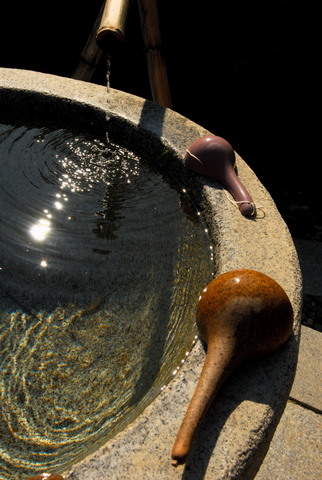
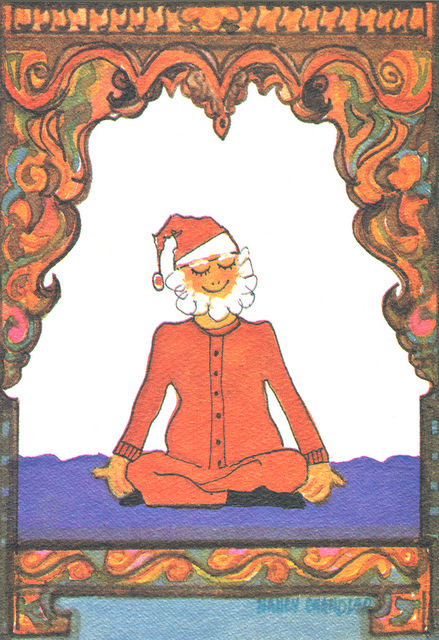
 Images: These actually started out as Christmas cards. The top one is from Japan, by way of Marcus, and the second is by an artist living in Thailand, Nancy Chandler (www.nancychandler.net)

the embodiment of love

If we wish to use our life to benefit the world,
then we must become of the world.
– Barry Briggs, ‘Generosity and Transparency

Every year, at this time of year, I am re-drawn to, and re-connect with, the religious tradition of my personal and cultural heritage. I am glad of it and I welcome this amazing time to learn from others, because there is so much good stuff in Christianity that I can draw from and which can enliven my Buddhist practice, especially in the central Christmas image of the Nativity.

Because Buddhas are born kings, in palaces, sheltered from suffering, wheras Bodhisattvas, those beings that embody Love and Compassion, can take on any form. Bodhisattvas are closer to us, we can imagine them as shepherds or carpenters, with dirty robes and work-hardened hands, or as a baby born in the toughest of circumstances come to show us how to live.

I went to a carol service this week at the small Anglican church here in Bangkok, and in one of the teachings someone quoted a passage from a writer called Max Lucado setting the Nativity scene, which I later looked up. Lucado writes: “The stable stinks like all stables do. The stench of urine, dung, and sheep reeks pungently in the air. The ground is hard, the hay scarce.”

The beauty of the Christian message is, for me, this very real embodiment of the otherwise abstact notions of Wisdom and Compassion. How else are we to understand these ideas if not in our very lives? Jesus’ birth represents the unfailing possibility of love, kindness, and understanding right where we are. It’s always here, we simply have to wake up. As Max Lucando writes, “Those who missed His Majesty’s arrival that night missed it not because of evil acts or malice; no, they missed it because they simply weren’t looking.”

When is the time for love to be born?
The inn is full on the planet earth
And by greed and pride the sky is torn –
Yet Love still takes the risk of birth.
 – Madeleine L’Engle

Happy Christmas to all you Christians, to all you Buddhists, to all you Bodhisattvas (and that’s all of you) everywhere!
– From everyone at Wake Up and Laugh!

———

Links:
Barry Briggs: Generosity and Transparency
Max Lucado: God Came Near

Picture:
The gorgeous image used here, with permission, is by the artist and Pastor John Stuart. His amazing art blog is well worth checking out: http://stushieart.wordpress.com/

———

My Practice is Doubt?

As long as I can remember I’ve believed in our fundamental innate wisdom. It made sense that the Creator would build a self-sufficient organism, endowed with all the elements necessary for its journey through life, including and especially the knowledge for self-realization .

Despite this conviction, however, I have struggled to manifest this wisdom in my own life and for years I have struggled with doubt.  I questioned my own wisdom, in favor of that of others.  I questioned my self-worth, such that I was often led down paths not suited to me. In questioning my character I would reinforced those traits I desired least. Doubt has certainly played a less than beneficial role in my life, although one could argue this point, if it brings me to this place of insight.

The Sakyamuni Buddha and many other wisdom teachers have encouraged us to test their teachings in order to realize our personal Truth.  This admonition would certainly seem to encourage fostering a certain degree of doubt as part of our practice.  Yet the Buddha also warns that there is nothing “more dreadful than the habit of doubt”,  and doubt is listed among the five hindrances that impede successful practice. So where is the balance? When do the questions stop being fuel for our journey and instead become hindrances to advancement.

The answer, I believe, is in the practice of letting go.  We let the questions come and release them into the emptiness that is constant change.  Then we observe what comes and let that go too. Into the emptiness. Into our fundamental mind. We practice listening to our inner Wisdom and applying its teachings in our lives.  This is not an easy practice, I’ve found.  I often find myself questioning the still, small voice and wishing it were a little more earth shattering and perhaps not so small.  This is where we engage our faith and trust in our essential Being, God, Unity.  We trust that the appropriate questions will arise for our particular path and just as surely, the right answers will manifest in us. Daehaeng Sunim calls this true, great questioning.  

“When you wholeheartedly believe in and entrust everything to your foundation, questioning bursts forth.  When you let go again of even these questions, the answer will arise from within”

Doubt opens up a space for exploration, a space of non-grasping where, in the words of Martine Bachelor, author and meditation teacher, we can creatively engage the present moment and let our wisdom blossom. Doubt is ok.  The questions will come.  My practice will be let them go and trust my innate wisdom to take care of me as it has through this and many past lifetimes.

some personal thoughts on the perfections

“The Buddha-Dharma is the fruit that has ten thousand flavors, the flower with ten thousand fragrances. It can be said that practitioners are the farmers who raise these fruits and the gardeners who tend these flowers.”
Seon Master Daehaeng Sunim

I’ve always had a bit of a problem with the Paramitas. Don’t get me wrong, I love the idea of a collection of virtuous practices, each re-enforcing and supporting each other, after all, it is the solid practicality of Buddhism that I’m naturally drawn to. No, my problem (apart from the obvious one of making them manifest in my life) is understanding why those particular ones.

Personally, I’d like to slightly re-write the Paramitas to suit myself and my own particular path and challenges, and I believe that is a legitimate way to treat these tools, to make them entirely and personally your own. But at the same time, it is useful to be able to talk a common language and so I’ll stick to the traditional presentation here. What follows are just some personal reflections.

Dana-Paramita – Giving
Shouldn’t we re-name this? Couldn’t we use a word that points more directly to what exactly our practice, our priority, our major aspiration really is? Giving is lovely, both in terms of giving the Dharma and giving real, solid, necessary material aid, but doesn’t the word ‘Compassion’ better reflect our vows, and the very purpose of giving? While generosity is a wonderful practice, Compassion is the very practice itself.

Sila-Paramita – Precepts
Of course the order of the Paramitas is not so important, after all each reflects and supports the others. But traditionally the perfection of sila, morality, comes second, but surely it is both gate and foundation to this path. It is by taking precepts that one becomes Buddhist, and this remains a practice and a challenge throughout one’s life. However, if we see the first Paramita as ‘Compassion’, then we can see the second as being the foundation of the first.

Ksanti-Paramita – Patience
Sometimes this Paramita is called patience, sometimes endurance or forbearance. Thich Nhat Hanh, in his wonderful commentary on the Lotus Sutra, renames it ‘Inclusiveness’, saying that the practice consists of “continually making your heart bigger and bigger so that it can accept and embrace everything.” For myself, in my own practice, I’d like to add the notion of ‘Gratitude’ to this paramita, something that is not discussed enough in Buddhist circles but something that can transform many otherwise painful situations.

Virya-Paramita – Effort
LIke patience, the name of this Paramita can have some negative overtones, giving rise to the idea that you must constantly push yourself forward, leading to stress and pain. But true diligence, again in the words of Thich Nhat Hanh, “is born from joy”. So why not re-name this Paramita as ‘Joy’ and be done with it? But then again, that might also lead to expectations and disappointments. So I just prefer to call this Paramita ‘Practice’.

Dhyana-Paramita – Meditation
The Paramitas are for every moment of our lives, not just those few grabbed minutes when I remember to sit on my meditation block! So personally I prefer the way that Seon Master Kusan Suryeon, in a marvellous essay on the Paramitas, calls this one the Paramita of Stillness and Stability of Mind. We could call this Paramita ‘Peace’. For myself, though, I’d re-name it ‘Faith’. For me faith in the Buddhas and in our own inherant Buddha-nature is the very bedrock of stability and peace. When faith is there, everything can be let go to it.

Prajna-Paramita – Wisdom
The two wings of Buddhism are Wisdom and Compassion and I love how the Paramitas start with Compassion and come round to meet Wisdom here – with precepts, patience (gratitude), effort (practice), and meditation (peace and faith) forming the body of the practice. Not wisdom as in book-learning (or Sutra-learning) of course, but wisdom as understanding. As Daehaeng Sunim writes, “True wisdom is obtained only through applying and experiencing”.

The Seventh Paramita
That marvellous essay on the Paramitas by Seon Master Kusan Suryeon that I mentioned earlier is called ‘The Seven Paramitas’. Seven because he allocates one practice to each day, with Monday being Dana and Tuesday Sila and so on, and gives Sunday, the seventh day, the seventh Paramita: ‘The Perfection of the Simultaneous Practice of All the Paramitas’. I think that’s a wonderful idea, and if I had to come up with a name for this one, I’d call it ‘Love’.

“By awakening to our ‘True-I’, and through the practice of befitting ourselves and others, let us show kindness to others, accomplish the Path of Bodhisattvahood, and transform this world into a Buddha Land.”
Seon Master Kusan Suryeon

Link:
Seon Master Kusan Suryeon: The Seven Paramitas – The Right Road

Exhibition featuring Jijang (Jizo, Ksitigarbha) Bodhisattva

There is an exhibition about Jijang Bodhisattva at the Buddhist Museum at Jogye Temple through January 16. (The museum is beneath the new building in the temple complex, and is closed Mondays.)

I don’t actually know anything about this exhibition!  Its title is:  “Leading beings from the hell realms to enlightenment“. It could be quite interesting, depending upon how they’ve used the older paintings and statues to illustrate how Jijang responds, even in the depths of hell, to those who are suffering.

Sunday Photo; JiJang Bosal gazing at Mudeung Mountain

I’ve always really liked JiJang Bosal. His green hair, his staff, his Great Vow.

This is a beautiful bronze JiJang Bosal, outside of a small temple at the foot of Mudeungsan.