know your root!

I suspect many readers of this blog have been doing yoga for years. For me, it’s all new. And packed full of discoveries and surprises. It started about six months ago during a period when the ‘Littlebang’ Bangkok Sangha had a regular Monday night meditation session. Someone was offering a pre-sit yoga class and I thought I’d go along.

The weekly meditation sessions came to an end sadly (strange, there are stacks of great Dharma talks all the time in Bangkok, but there’s no regular Thai-Buddhist English-language meditation group), but the yoga continued. The teacher, I soon learnt, is amazing. Her name is Nat, she’s Japanese and she speaks great English and Thai.

I have a bad back, tending (after being involved in a collision with a car years ago and decades of neglect) to painful muscle spasm and having very little flexibility. Nat has helped me, in just the few months I’ve been studying with her, to understand my back a little better and work on strenghtening and lengthening it.

She has been practicing and teaching yoga for years and is a breast cancer survivor, and she sometimes talks about how yoga helped in her recovery, physically, mentally and spiritually. And she smiles. She really smiles. And gets her students all smiling too. “Lift”, she says, “higher, higher, and smile”, and we can’t help but grin!

Last month she helped me with something called the tree pose (my apologies to all you yoga practitioners out there, but this is all new to me) in which you stand on one leg and lift your arms above your head! I practiced for a week and then tried again in class. Of course, I wobbled all over the place – even despite using a wall.

“Don’t forget to breathe”, Nat said. “Breathing will bring you stability and balance.” I tried again. It did. Later Nat showed me how to place my feet and said that as well as breathing I had to grow deep roots, that energy and connection comes from those roots. The connection to the Dharma here is obvious to most no doubt, but for me it was a revelation!

Because the tree exists, you can know the root; because the fruit exists, you can know the seed. Likewise, even though the body is only a temporary, karmic combination of the four elements, through it you can know the fundamental place, Hanmaum Juingong, which is the source of all life and all phenomena.
 – Seon Master Daehaeng Sunim

Links:
Nat’s blog: A summer day in the city of Angels
The Bangkok Sangha: Littlebang
If People Knew the Results of Giving

O monks, if people knew, as I know, the result of giving and sharing, they would not eat without having given, nor would they allow the stain of stinginess to obsess them and take root in their minds. 

 Even if it were their last morsel, their last mouthful, they would not eat without having shared it, if there were someone to share it with. 
 
But, monks, as people do not know, as I know, the result of giving and sharing, they eat without having given, and the stain of stinginess obsesses them and takes root in their minds.”

(It 26; 18–19)

Quote:  This great quote comes from “In the Buddha’s Words:  An Anthology of Discourses from the Pali Canon” edited by Bhikkhu Bodhi, p 169. 
I’m reading this now, and as you might guess, it’s a pretty good read!

Sunday Photo; frozen lotus pond at GwanChok Temple

“One who performs his duty without attachment, surrendering the results unto the Supreme Lord, is unaffected by sinful action, as the lotus leaf is untouched by water.”
-Bhagavad-Gita


Awakening is likened to a lotus rising from the muddy waters, flowering in consciousness.

I’d never really considered, though, where does the mud come from?

speaking out – for animals in Korea

There is an on-going merciless holocaust taking place, across the entire world, involving torture, brutality and death on an industrial scale. It’s partly hidden, partly just accepted, and though trying to do what little I can about it has been an important part of my life for the past three decades (since first becoming vegetarian), it’s not something I’ve brought up here on this blog – until now.

And even now, I’m not going to trot out the usual arguments and Buddha quotes supporting the non-killing and non-eating of animals. Rather, I just want to help publicise a campaign against one recent aspect of this daily nightmare which specifically concerns Korea, and which I’m sure all readers, vegetarian or otherwise, will also support.

According to the Asia-Pacific branch of PETA, since the outbreak of foot-and-mouth disease in late 2010, approximately 1 million animals have been killed in Korea, many of them buried alive in mass graves. Large numbers of pigs have been dumped from trucks into pits and then covered in soil, where they slowly suffocate to death.

Some animals remain alive in air pockets but are unable to move, sometimes for days, before they eventually die from trauma, starvation, or dehydration. Using live burial as a disease-control method violates both the domestic animal protection law and Korea’s obligations under the World Organization for Animal Health’s Guidelines on the Killing of Animals for Disease Control Purposes.

PETA has contacted the relevant Korean authorities to ask for a more humane death for these animals but has received no response. And so are now asking for individuals around the world to contact South Korean embassies to ask officials to pressure the South Korean government to immediately stop burying animals alive and implement humane ways of dealing with the disease.

A suggested letter follows, but it is always better to personalise it, especially the subject line:

I was so disappointed and outraged to learn that a country like Korea, which is known for its forward thinking and modernity, is trying to contain foot-and-mouth disease in such a barbaric way.
Burying innocent animals alive is simply cruel, immoral, and illegal!
These animals slowly suffocate to death in the absence of air.
Worse still, improper burial often allows for air pockets to form, and many animals remain alive, sometimes for days, but are unable to move.
Until this cruel practice is stopped, I will tell my friends and neighbors not to visit South Korea.
Please use your position of influence to help those in need.

I personaly will be emailing the Korean embassy here in Thailand (where I live) this afternoon. And I urge all readers of Wake Up and Laugh to contact the Korean embassy in their countries as soon as possible too. It is, surely, time to speak out.

——-
Link:
PETA: Tell Korea to Stop Burying Animals Alive!

Updates:
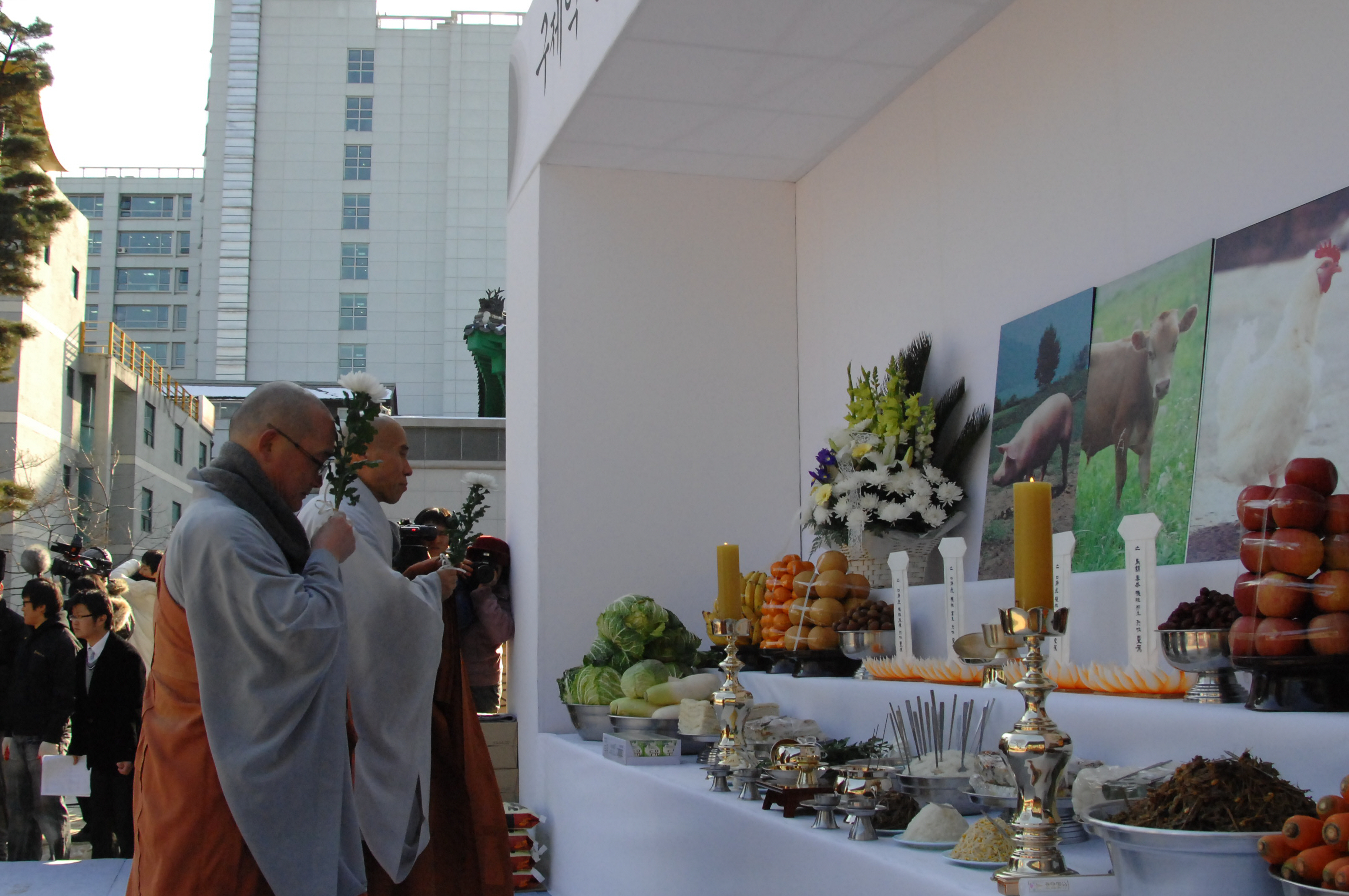
1) Thanks to Chong Go Sunim and Adam at Fly Like a Crow, here’s a report of a memorial service for the 1.9 million animals killed, held at the main temple of the Jogye Order in Seoul. One of the banners read “It must have been painful and you cried a lot. I hope that you go to a good place and enjoy happiness.”

2) There’s another report of the same memorial service on the website of the Jogye Order with some excellent photos, including one I’ve used here. During the service Ven. Hyechong said “Lord Buddha taught us to consider all sentient beings as our parents. If beings were to understand that we are born in different circumstances according to our karma, then we could create a Pure Land where we recognize each others’ value.”

When do we speak out?

This post arose from an online conversation with Barry at Ox Herding, about criticism, and the need to speak up.  Generally, criticizing others isn’t something helpful to our practice, yet when is it necessary to speak out?  When do we speak up? When is this the healthier choice?

Barry:  I have violated the “precept” of speaking about others so many times and usually have come to regret my speech.

Zen Master Seung Sahn used to say that the mouth is “the number one problem gate” and all available evidence supports this, at least in my case.

At the same time, there are times when we must speak out about the behaviors of others. I think about Eido Shimano in this context and the decades of silence that enabled the ongoing abuse of his students.

What if Aitken Roshi had spoken out in the late 1960s rather than in the last year of his life? How might that speech, had it occurred four decades ago, have helped?

In recent years, when confronted with some troubling behavior or speech, I’ve tried to examine my own troubling behaviors and words. If I can see how such actions arise within myself, then I can also see clearly how they arise in others. Then I might speak out. (But it’s hit and miss!)

Chong Go Sunim: I can see enough of my own faults to realize that, (in general) I definitely have no business going on about others’ behavior. That said, there are still times when it’s necessary to have the “hard conversation” with someone, when I have discuss something really unpleasant or uncomfortable.

I’ve heard of companies that have a “no gossip” policy, where they actually will fire someone who keeps it up. There, they define “gossip” as complaints/criticisms “given” to someone who has no power to do anything about them. I think there is something to this that helps separate the “bitch session” from the “hard conversation”. In the second it actually is my job to do something about it.

I can kind of imagine some of what’s involved with situations like the one with Shimano. I’d guess that a lot of practitioners (in other places) who only heard glimpses of the problem didn’t say anything because they felt that the people best able to actually solve this problem were the ones at that temple. I think this may have played a big role in the silence; plus, as outsiders they may have also felt uncertain about what exactly was going on.

On the one hand, it seems like that situation is continuing because the people in the middle of it choose to let it continue. So what’s my responsibility? As near as I can tell, it is to people new to Buddhism who might actually believe those kinds of behavior are “enlightened” or some kind of “non-dual wisdom” or even crap like “Asian culture.”

I kind of feel for Aitken Roshi, I’ll bet he really regretted not having had the guy deported back in 1964. Aitken Roshi seems to have been an honest and sincere person who was thrown for a loop when confronted for the first time with Shimano’s behavior. At the time, it didn’t fit the traditional “call the police” model for despicable behavior. And he’d probably never encountered anyone like that before. I’m pretty sure that Aitken unconsciously tried to deal with Shimano in the way Aitken normally treated people, as if they were basically honest and sincere. But this model doesn’t work with a compulsive behavior. I don’t think honest people react well, or decisively, to these situations until they’ve been burned once or twice. Until then, it’s something they never really imagined or had a need to think through.

Why the rabbit gave the tiger a pipe

(<– continued from Why did the rabbit give the tiger a pipe?)

“Why did the rabbit give a pipe to the tiger?” the monk asked.

The only thing that came to mind was, “To save their own skin!” but lacking confidence in my thoughts, especially when it comes to Zen, I shook my head.

The monk eventually said, “Because the rabbits don’t want the tiger to eat them.”

Out of pride, I sort of wished I’d spoken my mind, but once that wore off, I thought about the answer a little more.

Initially, it seems basically selfish of the rabbit. He’s not genuinely concerned for the tiger’s wellbeing. If he were, he’d offer him something like a cup of tea, or perhaps his own flesh. I suppose back when tigers smoked pipes, they may not have been aware that it wasn’t very healthy, though. He’s only concerned about the tiger’s contentedness for his and his friend’s sake.

As I thought about it more, it reminded me of my own path. I didn’t become interested in the Buddha’s teachings for anyone’s sake but my own. I was (probably still am) self-centered, depressed, and hid behind a mask of cheerfulness not to let anyone see the real me. Eventually, I read in a book that I should shift my attention outwards, to be concerned for others. Grudgingly, I tried, because it was supposed to bring me happiness also, of course. Eventually, it started working, not because I was any happier, but because I’d genuinely started developing more concern for those around me.

So, maybe the rabbits, acting out of self-preservation, do have some concern for the tiger’s joy. And knowing rabbits, they probably have a den full of babies who are depending on their safe return, in which case, they’d be much more needed there than in the tiger’s belly!

Happy Korean New Year! Saehae Bok Mani Badeusaeyo!

Have a nice Year of the Rabbit!

Why did the rabbit give the tiger a pipe?

Tomorrow begins the holiday for Lunar New Year, one of the two major holidays in Korea. With the new moon will begin the Year of the Rabbit.

I don’t have much to say about what the Year of the Rabbit represents, I thought I’d share a bit of an anecdote from a small temple in downtown Suwon a few weeks ago…

We’d gone into the courtyard to have a space for our baby away from the traffic and crowds for a few minutes. Just as we were about to leave, a monk came down from one of the buildings and motioned us to follow him around to the side of the main hall. He wanted to show us the painting and see what we thought.

Usually, the paintings on a temple wall are depictions of the Buddha’s life, or Zen stories, such as the ten ox herding paintings, but here was a painting of two rabbits offering a pipe to a tiger.

After admiring it for a moment, the monk asked,

“So, why do you think the rabbit is holding the pipe for the tiger?”


(continued–>)

¤~∞~

¤


Sunday Photo; Optical Delusion

A human being is part of the whole, called by us ‘universe,’ a part limited in time and space. He experiences himself, his thoughts and feelings, as something separate from the rest — a kind of optical delusion of consciousness. This delusion is a kind of prison for us, restricting us to our personal desires and to affection for a few persons nearest to us. Our task must be to free ourselves from this prison by widening our circle of compassion to embrace all living creatures and the whole of nature in its beauty.

-Albert Einstein, 1921

Learning to hear the voice of our true nature

I recently posed a question to Chong Go Sunim about how our foundation guides us.  His answer is insightful and I’d like to share it.

(The Korean word Juingong (主人空)means that which is really doing things, and which has no fixed shape or form. It can also be read as true nature or Buddha-nature.)

Question: How does our true nature, Juingong, answer, guide, and direct us?  What should I be looking for?   How do I know what is an answer from, my foundation and what is just noise from my busy mundane mind. Specifically, do answers ever materialize in dreams?  Do they show up in circumstances in daily life?

Answer:  I’ll break this down into two parts:  “What form does an answer take?”, and “How do I distinguish it from ordinary, conditioned thinking?”

For me, so far in my practice, the answer takes a huge variety of forms. It can be a phrase from a sutra or a ceremony that suddenly pops into mind, it can be a feeling, or a sudden understanding of what needs to be done. Once, it was even a voice that seemed to be coming from outside me. (Okay, that was a weird experience! I thought it was a friend goofing with me.) It often comes out as “my” thought, or some variation thereof. A lot of times I suddenly seem to understand things exactly just before I wake up, and have even given myself really good Dharma talks while asleep, that I couldn’t remember upon awakening.

I think one of the things to be careful about, regarding our true nature, is looking for an answer that’s separate from myself. (A voice from the sky would be SO convenient!) Because what I think of as myself is also part of Juingong, it speaks through my own consciousness. Even if my understanding is hazy, Juingong is still there. Because my faculties are clouded with habitual perceptions, I may not be able to understand/perceive the answer as clearly as a better practitioner, but it still is pointing me in the right direction.

Sometimes the answer comes in results, such as a situation that seemed intractable suddenly resolves itself in a flash. People who seemed to be a huge obstacle are suddenly very flexible and amenable.

So, the question becomes, “What is coming from my true self, and what is coming from a bit of moldy cheese or a fragment of undigested potato?”  What is arising from true nature, and what is just a bit of conditioned consciousness. I’ll admit this one is a bit tricky, and probably for truly advanced practitioners the difference is much clearer. But one thing I’ve learned is that things arising from our true nature are harmonious, wise, and tend towards the generous side. If it’s harsh, negative, and violates the precepts, you can be pretty sure that this is just the karmic echo, a bit of conditioned consciousness bouncing back.

At any rate, in practice if we cling to the idea that “I know” even if it’s something about our true nature, that act of clinging will lead us astray. So even when we know something, we need to respond as best we can, and entrust even that back to our true nature. It’s that act of letting go and entrusting that’s really magic, because it automatically corrects any delusions or misguided ways or dualistic tendencies that we may attach to the experiences we have, and to the things that seem to be arising from our Juingong.

Thank you Chong Go Sunim.

practitioners’ questions

At the last meeting of the Bangkok Seon Club I met two wonderful Thai women, friends and long-time Dharma sisters, with a real interest in the teachings of Seon Master Daehaeng Sunim and in Seon spiritual practice. Being new to Hanmaum, although of course far from new to Buddhism, they asked a lot of really great questions. Even better, both these women have stayed in touch with me by email since the meeting, and just today I recieved a list of very nice questions regarding some of the things that came up in the last Zen Club.

I’d like to post the questions here and open them up to all readers of this blog. If any of these questions, even if only one, inspire you to respond, please leave a comment. The idea isn’t just for Chong Go Sunim to come along and provide the definitive answers, but for anyone to say what the response is for them personally. These are genuine questions from two life-long serious Buddhist practitioners coming across Seon teachings for the first time, and they’ll both be following this post with interest! Thank you for your responses!

1) What’s the meaning of Sangha ? 
2) What is the difference between one mind and true nature ? 
3) If Emptiness is nothing, then what is one mind ?
4) Is awareness to realize true nature or not ?
5) What is the difference between Enlightenment and Awareness ?
6) Is One mind and meditation the same ?
7) What does it mean to say that wisdom comes from True nature or Buddha mind that is beyond good or bad ?