
Sunday Photo; a rainy afternoon at Beomeo Temple
Learning to see the world as it truly is

Here’s a seaside temple for Evelyn ^_^
I tried to to merge these two pics together but couldn’t get the sky to match very well… but thought it gave a better idea of the setting. (just ignore that ugly line, if you can!)
Hyangil Hermitage is a famous spot to watch the sunrise. There are little guesthouses below the rocky path to the temple. I heard they’ll lend you a flash little for the walk up.

Vanavaccha
The color of blue-dark clouds, glistening,
cooled with the waters
of clear-flowing streams
covered with ladybugs:
…those rocky crags
…refresh me.
I shared this poem on my own blog on Friday, but loved it so much, I’d like to share it here as well.
It’s taken from the Theragatha, a collection of 264 poems in which the early monks recount their struggles and accomplishments along the path to enlightenment.

“As things confront you, let them go to your foundation and continue to let go and observe. Even if the sky collapses, continue to let go and observe.”
-Seon Master Daehaeng
Here’s a great guide to Korean temples, Dale’s Korean Temple Adventure. Set up by an expat in Busan, it focuses mainly on temples in the lower half of the country. (Which is fine, because that’s the heart of Korea’s Buddhist history and culture. )
He includes a lot of photos with each post, and relates the history of the temple, along with travel info and his overall impressions of how worthwhile it is to visit the temple. 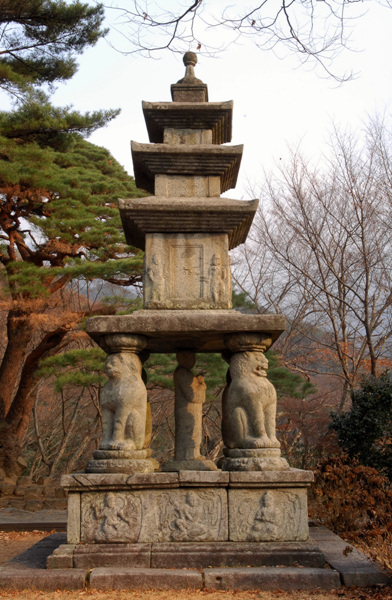 Here’s what Dale wrote about Hwaeomsa (화엄사):
Jirisan National Park was a place I long wanted to visit, but never got around to for one reason or another. I didn’t want to go hiking or camping, or anything like that at all. Instead, I wanted to visit two famous temples that sit on the side : Hwaeomsa and Ssangyesa temples. And finally, in the fall of 2005, I visited with my wife.


Here’s a nice Dharma talk by Seon Master Daehaeng.
Everything, throughout the entire universe and Dharma realm
is connected with each other,
and connected to everything in our lives.
Although unseen,
this connection is like a great net of the Dharma,
a thread that connects everything,,
and a path on which there is no coming or going.
Even this realm of ours is connected, in every way,
to all upper and lower realms.

Our world faces so many difficulties.
Like sailors,
we have to be prepared to deal with whatever kinds of waves arise.
Yet if we can’t take care of what’s right in front of our eyes,
how will we be able to overcome the larger, underlying aspects?
Our bodies and material things have no power to truly resolve
these kinds of problems.
o
Should even the energy that fills the air around us be depleted,
more would flow in from outside the Earth.
It’s not for lack of energy that our planet suffers,
but because people don’t recognize the energy that’s already present,
and so are unable to use it.
To use this energy,
people who understand about our fundamental mind
have to all become one mind.
If we can do this, the whole will respond to the thoughts we raise.
We have to become one mind, we have to become a great pillar.
o
As I’ve always said, this isn’t about finding something,
somewhere else.
It’s about what we’ve always had,
it’s about our foundation.
We, the owners of the Earth, have to firmly rely upon our root.
Start with brightening your own light, and others will become brighter,
eventually filling the world with light.
How could the world become brighter if the people remain in darkness?
o
You have to bring together both the visible and the unseen-realms
and function using both.
This is the practice of finding your root,
while becoming one with everything that arises in the world.
It’s my sincerest hope that all of you will become fellow practitioners,
diligently practicing, becoming brothers and sisters through our one mind,
and help people throughout the world find their way.
-Daehaeng Kun Sunim

(Lotus photo is by Joseph.)


I just thought I’d share this with those of you in the Seoul area, there is a Nonviolent Communication (NVC) practice group in Seoul.
A friend of mine has been involved with the group for a few years and what she’s told me of her learning has been very inspirational. (Especially considering that of all the things that come out of our bodies, words can be some of the most troubling!)
On their website (http://krnvc.org/eng/index.aspx), nonviolent communication is described as, “a way of relating to ourselves and others, moment to moment, free of past reactions.”
A big part of NVC is actually learning to listen, to understand the other’s needs as much as learning to express your own.
For more information on the group, here is a link: What We Do
And if you’d like to visit: Direction

To hike Jirisan, I’ve been told, takes a full three days, so the one time I went hiking in the mountain, I only went a short way up, to Buril waterfall, and camped out nearby, then made my way back down the next morning.
Just before the waterfall is a small hermitage, where the monk, Il-ryong (One Dragon), invited me in for some locally made green tea. I thought I would sit and have a nice talk with him, while he poured us tea but instead he pointed over to his tea sets and basket of tea, and said, “I have to go pray now, help yourself.”
I was a bit surprised, but took him up on his offer, anyway. Even more surprised was the older gentleman who came along a few minutes later to find the bald-headed foreigner sitting in the temple making green tea. He asked if I were a monk and was really puzzled when I said no, and that the monk was in the back shrine doing ye-bul (ceremony). He let me pour him one cup of tea, but quickly got up and left after. I wondered if he thought I’d invited myself in and didn’t want to be there if the monk came back.
I sat facing the open door, and enjoyed every sip until the leaves were finally exhausted, while gazing out at this view. I often think about making the eight hour trip back there just so I can enjoy it once again, but I know that moment will probably not be found again.

