
The Ten Vows made by all Tathagatas
Using mind, through mind,
I vow to never again to be seduced
by the three evil states of consciousness.*
*These are the consciousnesses of hell beings, hungry ghosts, and animals.

Learning to see the world as it truly is
The Ten Vows made by all Tathagatas
Using mind, through mind,
I vow to never again to be seduced
by the three evil states of consciousness.*
*These are the consciousnesses of hell beings, hungry ghosts, and animals.

The mantra for relying upon one mind (continued)
Sincerely entrusting everything to one mind,
determined to know the real and help all beings,
raising these great wishes:
May my samadhi wisdom swiftly brighten.
May I attain every kind of virtue.
May the blessings arising from my virtue guide and sustain all beings.
May all beings together attain Buddhahood.

Kun Sunim sometimes used the expression “stages that aren’t stages” when talking about spiritual practice. In general, she was talking about the fact that there is stuff to learn, there is progress, there are steps in spiritual practice. But. Don’t get caught up in those. Don’t try to imagine that as some separate stage that you want to achieve, but haven’t. Or that you have attained, while there are others that haven’t.
Best to stick with the idea that there is stuff to learn, there is stuff that you can do better, but do that, do your best, while immediately letting go of any idea of “I’ve attained.” “I’ve gained.” “She or he hasn’t gotten that far.” As Kun Sunim often said, just keep letting go of what you know, of what you don’t know, (and what you think you know!)
The mantra for relying upon one mind, Juingong, which is itself the mind of all Buddhas
Mind, with uncountable stages that are not fixed stages.
I will pass through these and truly turn the great jewel of mind.
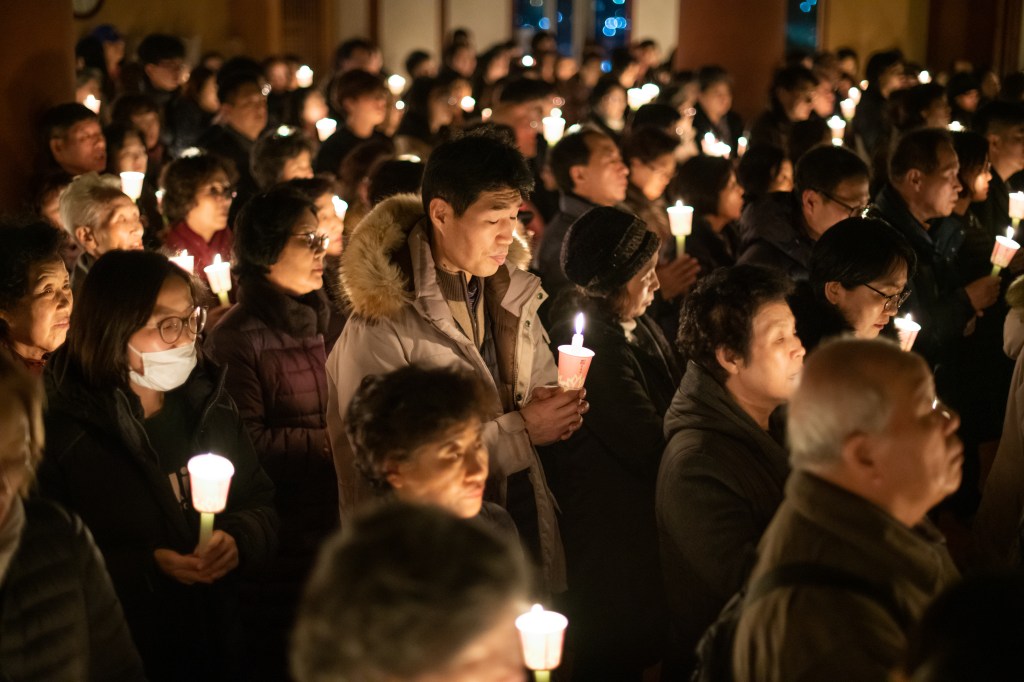
Candlelight ceremony from the lunar new year’s, January 2020 B.M. (Before Masks, lol. Sigh. Stupid corona virus. The lady wearing a mask is probably wearing it because she has a cold and doesn’t want to spread it to others.)
How is evil dispelled? How do we heal ourselves? How do we deal with all the aches and pains we have? How do we deal with the mental aches and pains we have have? We entrust them to our foundation. We make the actual, conscious effort to remember that we have a foundation, we have this source that’s guided us and taken care of us for a billion years, and entrust what we’re facing to it.
Why has it take a billion years (or more)? Because we’ve been doing things the hard way, would be my guess. We’ve been trying to solve things with our bodies. We’ve been trying to solve things with our intellect. We’ve been trying to do it with power, or with gold and silver. We’ve been trying to get bigger powers to show up and take care of things, either gods or politicians or those stronger than us.
But not all that often with our own inner light. Not very often by trying to rely upon our own inner foundation. Now it’s time to learn to rely upon this. Now it’s time to fully open this path.
This doesn’t mean getting what I think I want, with is often just a reflection of my own fixed ideas, but trusting this inner light. Trusting it to take care of things such that they’ll turn out for the best. Such that I’ll be able to grow and develop as best I can, given my circumstances and ability.
(Remember to try to recite these three times out loud. And more if you like. That really helps get all the lives within you to wake up and pay attention!)
The mantra showing the profound and subtle functioning of one mind
Using mind, may I completely dispel all evil.

“If you find yourself facing a calamity,
a disaster of untold magnitude,
If you can firmly entrust the thought that,
‘Juingong can deal with all of this!’
“If you let yourself believe that Juingong can take care of it,
and then even if fear or worry arises time after time,
you remain calm and dignified,
your foundation will be relentless in taking care of things.
It will be relentless in turning up solutions
because all the lives in our body respond and function
according to the thoughts we give rise to.
“Thus, these lives can work as bodhisattvas.
They take the form necessary
according to the needs and circumstances,
and help everything return to functioning as one mind.”
— Daehaeng Kun Sunim
As the Thousand Hands Sutra winds down, there are several short sections like this one. Here too, this is the entire section. But it tells where we can find those who protect the Dharma and practitioners, and how we can get in touch with them.
Daehaeng Kun Sunim gave a poem that was later turned into a song, that literally means “Live greenly,” and compares people to trees. While we translate this as “Live vibrantly,” there is a nuance to the Korean that I really like: How does a tree live? It turns its leaves or needles green by drawing upon it’s root. It draws energy from it’s root, and sends back air and light (and water).
There’s a huge, massive hint there for how we can live.
How often do we find ourselves trying draw upon our knowledge, upon all kinds of similar things? Upon affection from others, upon help from all kinds of places. But the first place we need to learn to go to is our own root. We need to practice drawing up it’s energy, and returning back to it everything that comes in.
The Dharma protectors of mind take care of my body
Entrusting and letting go – the truly limitless path.
This is all there is of this mantra. That’s the entire section. If I had to guess, I’d say it’s guidance for avoiding things that will cause us physical and mental suffering.
The Mantra for Purifying Mind
I’ll be upright and sincere in my behavior.

I take refuge in one mind,
the mother of heaven and earth,
the giver of life to all things.

“But Sunim,” some of you might be saying, “why all this stuff on repentance?” In part, because this is just the section in the sutra, lol. This text was gradually compiled around The Great Compassion Dharani, with people occasionally adding sections fore and aft. These extra sections were things that great teachers of the day thought people needed to know. Given that they weren’t cut out or dropped, I’d guess that centuries of people found them helpful.
The other reason is that we as growing, developing beings can’t move forward until we acknowledge that the harmful things we did were mistakes. Otherwise, we aren’t looking for new ways forward, and may even be hanging back, defending the way we did things.
The interesting, and truly odd thing about this section (which concludes tomorrow), is that nowhere aside from the title does it actually mention “repentance.” The contents are 100% about trying to find a new way forward. And that is also apparently a form of repentance.
If I am always aware of and rely upon
the great virtue and merit of one mind,
no disasters of this world can touch me,
and I will receive the blessings of all Buddhas.
Whether a heavenly being or a human being,
anyone who meets this treasure,
this one mind,
obtains the supreme Dharma.

There’s a bit more of this section, but nothing bad will come from reciting just this one line and letting it sink down within you. Truly.
The Mantra of Repentance
Let me awaken to how I should live. (repeated 3 times)

