Bangkok Seon – a one-day workshop

 Bangkok Seon:
a one-day meditation workshop in the Korean Zen tradition with the American Zen monk Chong Go Sunim
 
Saturday February the 19th, 2011
at the Bangkok Korean Zen Centre
8.30am to 6pm
 
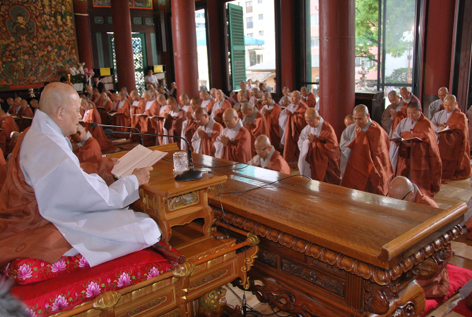
On February the 19th, 2011, the American Zen monk Chong Go Sunim will be returning to Bangkok to run a one-day English-language meditation workshop at the Korean Zen Centre in Ekamai. The workshop is from 8.30am to 6pm and is open to all comers interested in Korean Zen Buddhism and meditation, regardless of background or previous meditation experience.
Workshop Leader: Chong Go Sunim

Chong Go Sunim (Sunim is the Korean word for Buddhist monk) was ordained in the Korean Jogye Order (the largest Buddhist Order in Korea) in September 1993. He completed an MA in Seon Studies at Dongguk University in 2003 and received certification from the Jogye order in 2002 allowing him to ordain others and serve as an abbot. His own Dharma teacher is the Venerable Seon Master Daehaeng Kun Sunim.

Chong Go Sunim practices at the Hanmaum International Centre in Korea where he helps translate the works of Master Daehaeng Sunim into English and other languages. He also takes care of several Dharma groups and gives Dharma talks in English and Korean.

Schedule:
 
Full schedule to be announced, but the day will include talks, group discussion, sitting meditation, walking meditation, Q and A, opening and closing ceremonies, and breaks for lunch and tea.
 
Booking:

All participants must book a place in advance. Not least because the Zen Centre will be providing lunch and will need to know the numbers in advance. Please be very sure you will be attending before booking your place. Places can be booked by leaving a comment on this post or by seeing me (Marcus) at various Dharma events in Bangkok between now and February.

Location:

The Bangkok Hanmaum Seon Centre
86-1 Soi 4 Sukhumvit 63
BTS Ekamai Station – Exit 1

Take Exit 1 from Ekamai Station, and go down Ekamai Road (aka Sukhumvit 63). Turn right along Soi 4 and go to the end. Turning left you will see the Centre on your right a few meters along. A motorcycle from Ekamai can also take you there cheaply. Ask for the ‘Wat Gao-lii’ (Korean temple).

Scroll down to the bottom of the page for a map and photographs.

A few points to note:

  • Please try to arrive in plenty of time as the workshop will start at 9am sharp. We will try to finish at 6pm sharp too. Although discussion will almost certainly continue in a nearby restaurant or coffee shop!
  • There are no bare feet in Korean temples, it would be much appreciated if those wishing to come will remember to bring socks!
  • This is a good chance here in Bangkok to practice meditation in a Zen Buddhist temple with a fully ordained Zen monk in a close and supportive practice group. See you on February 19th!

Korean-Temple

Links:
Wake Up and Laugh: The Bangkok Seon Club
Therevada-Zen: Chong Go Sunim’s last visit to Bangkok
Littlebang: more details and background

Ven. Ya-un: the proper attitude towards wealth and sexual desire

Here Ya-un is writing about the two things that have the most power to lead astray those on the monastic path: money and sexual relationships.  

Actually, he used the word “women” instead of “sexual relationships,” but he was writing for an audience of male monastics. He must have known that nuns would also read or hear this, but perhaps he assumed that in 13th century China, nuns would be less likely to get themselves into trouble over issues of sexual desire. Or perhaps stating the issue outright was seen as vulgar. 

Although Ya-un was writing for monastics, I think this has to be read as a caution about unhindered desire, and in that sense, it applies to everyone.  
 
There is nothing more disruptive to the body than sexual behavior (again, it was “women” here), and nothing more detrimental to spiritual practice than wealth. Thus the Buddha set forth the precepts, and admonished practitioners to avoid wealth and sexual behavior, saying, “If you see beautiful women, treat them as you would poisonous snakes or tigers. If you come near gold or jade, look upon it as you would a rock or piece of wood.” Even if you are completely alone in a dark room, behave as if you were in front of an important guest.

Behave the same whether you are seen or not, and let your speech and thought be in accord. If your mind is pure, all good spirits will protect you. However, if you yearn for women, Heaven [i] will not tolerate you. If good spirits protect you, then you will not experience any difficulties, no matter how harsh the environment. If Heaven does not tolerate you, then you will not be at ease even in an outwardly peaceful place.

                           Greed and lust are the gates of Yama’s hell,
                           purity of mind and action lead to
                           the paradise of Amitabha Buddha
                           Enter hell and you’ll experience a
                           thousand kinds of suffering.
                           Enter liberation
                           and you’ll experience a
                           thousand kinds of happiness.


[i] In traditional Chinese literature “Heaven” roughly means the workings of nature or the universe. So to go against Heaven is to be in opposition to everything that nourishes and guides the universe.


Photos: These are images from the area around the Seokgor-am grotto near Gyeongju (Kyongju)

letting go

“When you let go, you can truly live.”
 – Seon Master Daehaeng Sunim

Therevadan Buddhism isn’t my path, but I’ve lived in Bangkok for most of the past ten years and there are certain teachers here and in this tradition I never miss seeing if I can help it. Foremost among them is Ajahn Brahm. Born in London in 1951, ordained in Wat Saket in 1974, disciple of Ajahn Chah for nine years at Wat Nong Pah Pong, and now Spiritual Director of the Buddhist Society of Western Australia, he is rightly famous for the depth of his experience and knowledge and the wonderful way in which he is able to present the Dhamma.

His teaching is seemingly simple, full of stories, warm anecdotes, and his famous, unashamedly oft-repeated, jokes, but his humour serves to present teachings of great depth. I’ve not always agreed with everything I’ve heard from him, but I have benefitted greatly from his wisdom and especially from his skillful instructions regarding practice. I mention all this because he was here again this week and during the workshops I attended he gave a short teaching so profound and eye-opening I just had to share it here.

I don’t know which sutta it comes from, and it doesn’t matter even if it doesn’t, but Ajahn Brahm told a story of how Buddha was wandering along with Ananda when they came across a monk sitting under a tree in meditation. The monk was sat on the ground with a straight back, his hands were folded, and his head and neck at just the right angle. He was deep in meditation and had been for some time. The Buddha turned to Ananda and said “I’m worried about that monk.”

A few minutes later they came across another monk sitting under a tree in meditation. He was on a comfy cushion, his back was bent forward and he’d fallen asleep. Every now and then he’d wake up only to nod off again. He was even snoring. The Buddha turned to Ananda and said “this monk I’m not worried about at all, he’s doing just fine.”

The point, of course, is about letting go. With his perfect posture and iron will, the first monk had turned meditation into a competitive sport, even if the only person he was competing against was himself. He wasn’t abandoning the ego, he was building it. Ajahn Brahm talked about a friend of his in Wat Nong Pah Pong years ago who was admired for his diligence and discipline, sitting upright while others would be half asleep with heads almost on the floor. Eventually the friend disrobed, the whole experience of monkhood had been, he discovered, an exercise in ego, nothing but a constant struggle.

The second monk, the one the Buddha wasn’t worried about, had the sense to relax. If he nodded off, then he nodded off, no big deal. He was able to let go, let go of his need for perfection, and let go of the struggle. Even more, he was able to trust that things would be just fine without his striving and without his perfection. It reminded me of  Daehaeng Kun Sunim’s comments on practice. Specific regimens, she says, will come to a dead end, but “if you keep letting go and entrusting, and experiencing the results of this, then the path that seemed narrow in the beginning will gradually widen, and in the end will become a great avenue and gateway to the truth.”

Ajahn Brahm talks about trying to control your mind and thoughts, trying to control anything in fact, as being like a farmer holding onto a rope trying to control a buffalo as it runs away. The rope can get twisted round your fingers and what will happen next? The farmer will lose his fingers. Crazy farmer, all he gets is pain and suffering, and in any case buffalos never go far. If the farmer had just waited a few minutes he could have just walked up to the buffalo and led it wherever he wanted to go.

“If you know how to let go and be at peace, you know everything you need to know about living in the world.”
 – Ajahn Brahm, ‘Practising In The World’.

———————————–
Links:
Ajahn Brahm’s Website
Ajahn Brahmavamso, ‘Practising In The World’
———————————–

Why does life seem empty? Questions and answers with Daehaeng Kun Sunim

 Here is another question from Find the Treasure Within:
 
 
My life has been very ordinary, but I’ve been fortunate in many respects. My wife and I get along well, and my children are happy and well-adjusted. Also, my work has been going smoothly. Nevertheless, I sometimes feel empty, like something is missing. Why do I feel like this, even though everything in my life seems to be going well?

 
Daehaeng Kun Sunim:  A wife, a lover, children, money, fame – none of those things have the power to make you feel complete. Only by returning inward to your true self, your foundation, can you become complete. 
 
However, many people are afraid of truly facing themselves. So they look for something outside, wandering around rather than looking within themselves. This is how they deceive themselves. As long as you deceive yourself like this, you can never know true peace, nor will the empty feeling go away — because both are caused by not knowing your true self. When you carefully observe your mind and live your life in touch with this inner mind, you’ll realize that peace is within you. However, if you don’t sincerely face yourself, you can never be truly free of this empty feeling, even if you achieve all of your goals such as having power, money, honor, and love. This applies to everyone. 
 
The more praise, the more pleasure you receive from outside of yourself, the deeper the emptiness will become. Then, as many people do, you may look around outside of yourself even more, searching for the cause or for something that will get rid of the emptiness, without realizing that both the cause and the cure are inside of you. Long ago, a poet left home looking for signs of spring. He searched everywhere, but was unsuccessful. However, upon returning home, he saw blossoms on the apricot tree in his courtyard. 
 
If you see the genuine, true self that’s within you, you will know true peace of mind and the feeling of emptiness will disappear. Yet, because this inner nature is truth itself, don’t think for a moment that things such as force, tricks, or lies can work there. So stop trying to use such deceit to find your true self. People often try to endure the hardships they face with the hope that somehow things will be better tomorrow or at some other place. However, these kinds of thoughts are like delusions if you don’t know about your inner self. They can’t help you for long.

Therefore, please, face yourself honestly. Discover the great, unimaginable “me” that’s already within you. Everything in the world – joy, sorrow, happiness, misery, and emptiness – comes from you; it is all within you. Because everything arises from you, you are the only one who can truly solve all of those issues. This is how it is. So entrust everything to your inner self. Let go of everything to your true self with firm faith, and observe how things work together inseparably. This is the inner path, which teaches you to see all things as not different from yourself, and which shows you that inherently there is no division between “you” and “me.” 


Buddhism and Love

Even offering three hundred bowls of food three times a day does not match the spiritual merit gained in one moment of love.
– Nagarjuna

One of the things that I adore most about Christianity is how love is at its very centre. Jesus summed up his message and teaching in the commandments to love God, to love you neighbour (and he talked a lot about just who your neighbour is) and to love yourself (Matthew 22:36-40), and Paul, the first great leader of the early church, placed love at the very pinnacle of Christian life, even above faith (1 Corinthians 13:13).

I wonder if love’s being so central to Christianity explains why the word is so rarely used by many Buddhist writers writing in English. After all there is a tendency, especially in many of the Buddhist blogs and articles I come across, to want to make clear distinctions between Buddhism, the adopted religion of the writer, and Christianity, often the religion left behind.

But not all Buddhist teachers are shy of the word, and two that come instantly to mind are my own root teacher Seon Master Daehaeng Sunim, and another Zen Master, Thich Nhat Hahn. Thich Nhat Hahn writes: “Do we need to love our teacher? Do we need to love our disciples? Do we need to love our Dharma brothers and sisters in order to succeed in our practice? The answer is, yes.”

But this imperative to love is not just about relations in the Sangha as a means of travelling along the path, it’s also about living in accord with the precepts and thus in harmony with the entire world: “Once love is in your heart you don’t have to do anything, you can practice the mindfulness trainings perfectly, very easily, without any struggle at all.”

Daehaeng Sunim is even more direct and goes even further in her call to love, sounding not a little unlike a certain well-known Galilean teacher from a couple of thousand years ago. “Love each other” she writes, “share each other’s burdens, and share what you have with others. This kind of love is more than enough to take care of everything in the world.”

Too often, to my mind, Buddhist writers stick to the term ‘compassion’, a kind of love-lite. Love is earthy, real, it’s based on flesh and blood and not just a nice notion. “The Buddha’s love and compassion and parents’ love and compassion for their children” Kun Sunim writes, “are both the same fundamental love.” I think there is a reason that in the four immesurables, Brahmavihara, love comes first and is different to compassion.

As loving-kindness it’s there in the Pali, most famously in the Metta Sutta (“Just as a mother would protect her only child with her life, even so let one cultivate a boundless love towards all beings”), and in the devotional texts too. The Thich Nhat Hanh quotes in this post, for example, come from his commentary on the Lotus Sutra (from which he thinks the most beautiful sentence is ‘The bodhisattva regards all beings with the eyes of love’), and the link between love and the Pure Land is obvious.

It’s also central to Zen, no matter that you might never be told that. When Daehaeng Sunim first awoke to her own True Nature, for example, she described the experience of Buddha-nature as being “full of love and warmth”, so much so that at first she responded simply by calling it “daddy” (which again puts me in mind of that same Galilean addressing his father on equally intimate terms).

Paul said that all of Christianity can be summed up in one word, love (Galatians 5:14), and it is no surprise that some of the most beautiful things ever said about love came from his pen. Buddhists would, naturally, like to add the idea of wisdom to his summation of the holy life, but only if that is the wisdom of real insight. Mere learning adds nothing:

If I speak in the tongues of men and of angels, but have not love, I am only a resounding gong or a clanging cymbal. If I have the gift of prophecy and can fathom all mysteries and all knowledge, and if I have a faith that can move mountains, but have not love, I am nothing.

If you are unfamiliar with this passage then I urge you to look it up at 1 Corinthians verse 1 to 13. There is so much there that anyone from any tradition can learn from about love. But, if you prefer to hear much the same in more Buddhist terminology and from a Buddhist Zen Master, you can’t do much better than this passage here:

Love each other…Throw away stubbornness and arrogance. Let go of greed and desire, disolve attachments and clinging, and free yourself from jelousy and envy. With a compassionate smile, entrust all of these harmful states of mind to your foundation, and let them melt down and become one. This is the love and action of a Bodhisattva.
 – Seon Master Daehaeng Sunim, ‘No River to Cross’, p.78

Renewing the Bodhisattva Precepts

 “Has the Sangha gathered together?”
We are all gathered.”

Is everyone united and in harmony?”
We are united and in harmony.”

For what have you all gathered?”
We have gathered to hear the Bodhisattva Precepts explained, and to reflect upon our own shortcomings.

Thus begins the ceremony for the Bodhisattva Precepts in Korea. While laypeople can and do take these precepts, every six months, monks and nuns are required go to their regional head temple for this ceremony.  (It’s  held once a month in meditation halls and sutra study halls, but it’s also held separately for those who aren’t in one of those.) Attendance is required; they actually make us sign in before the ceremony, and then sign out again after it’s over — no signing the ledger and slipping away!  Traditionally, this should be held at least once a month, but there is a lot of overlap with the Thousand Hands Sutra, which is chanted ever day.

Of the Ten Precepts, when western Buddhists think of numbers 6-10, they may be actually thinking of the ones from the set of Bodhisattva Precepts. 

6: Not discussing the faults of others.
7: Not praising yourself, or speaking ill of others.
8: Not being stingy with material or spiritual aid.
9: Not indulging in anger
10: Not speaking ill of the Three Treasures, the Buddha, Dharma, and Sangha.

You may have heard of the precepts against sleeping in a high bed, wearing perfumes, and accepting gold and silver. These are the original precepts of the Vinaya school, and are for renunciates. Whereas the Bodhisattva precepts were developed later, and are not necessarily for monastics alone.

  In total, there are 48 Bodhisattva Precepts. They originate from the Chinese version of the Bramha-jala Sutra, which takes the form of the Buddha reciting these precepts (here’s a link to one version of this sutra). Essentially what the Buddha is saying, is that those who are enlightened behave like this, and not like that. So if you want to become enlightened and a blessing for those around you, (and greatly reduce your own suffering) start by following the example set by the great practitioners whose awakening is reflected in their behavior.

Interestingly, the demand for complete vegetarianism comes from this sutra, as does the requirement of not eating the garlic and onions (perhaps they were considered the oysters of their day?) Some of these precepts seem like they are directed towards lay people, while others are clearly for monastics.

Some of these precepts are:

Don’t act as an agent or emissary for political powers,
respect your teacher and fellow practitioners,
help nurse those who are ill,
not teaching for the sake of profit,
not teaching those who would use what they learned to harm Buddhism and the faithful,
and so on. 

Here’s the full entry for a couple of precepts, to a taste of how they are presented (the quotes come from here) : 

On Slander and Libel

A disciple of the Buddha must not, without cause and with evil intentions, slander virtuous people, such as Elder Masters, monks or nuns, kings, princes or other upright persons, saying that they have committed the Seven Cardinal Sins or broken the Ten Major Bodhisattva Precepts. He should be compassionate and filial and treat all virtuous people as if they were his father, mother, siblings or other close relatives. If instead, he slanders and harms them, he commits a secondary offense.  
 
These precepts are also often worded in a way that makes it hard to deceive ourselves: he must not do it himself, nor command others to do it, nor allow it to happen through inaction, etc.

Some of these precepts also carry interesting insights into how the culture of how people lived at the time. I’m sure we can extrapolate the intention of the following precept, but look at who it’s directed at: slash and burn farmers.

On Starting Wildfires

A disciple of the Buddha shall not, out of evil intentions, start wildfires to clear forests and burn vegetation on mountains and plains, during the fourth to the ninth months of the lunar year. Such fires [are particularly injurious to animals during that period and may spread] to people’s homes, towns and villages, temples and monasteries, fields and groves, as well as the [unseen] dwellings and possessions of deities and ghosts. He must not intentionally set fire to any place where there is life. If he deliberately does so, he commits a secondary offense

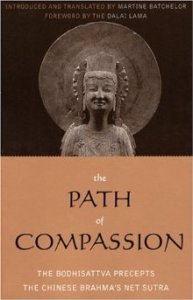
 Martine Batchelor has actually published an excellent translation of the complete Korean ceremony with precepts. It’s called The Path of Compassion: The Bodhisattva Precepts.  If you are at all interested in this subject, I recommend checking out her book. This sutra and ceremony are a huge part of the Buddhism of Korea, Japan, and China. I’d like to write a lot more about it, but I can’t find my copy! (If you’re the person I loaned it to, please send it back! ^-^)

How to overcome suffering: Questions and answers with Daehaeng Kun Sunim

   Look at how water flows.
When it meets a hole,
it fills it and continues to flow.
When water meets a rock,
it flows around it.
The path of finding your true self
is like this.
-Daehaeng Kun Sunim


In her regular Dharma talks, Daehaeng Kun Sunim often took questions afterwards. Some of these, and the answers, are quite useful to practitioners. We’ve been working on putting some of these into a small ebook edition called, Find the Treasure Within. We’re not quite finished, but I’ll go ahead and post slightly condensed versions of these. Some of what she says is so striking that I’ve highlighted it.

 Check out her answer to the question: Is life suffering?

 
Question: 
I had always hoped that my children would grow up happily because my childhood was not so good. Yet, no matter how hard I try, my life doesn’t seem to be turning out the way I wanted.
         I read in some book that Shakyamuni Buddha once told people, “Life is suffering.” Is that true? Does this mean there’s nothing I can do about these things?
 
 
Answer:
Every one of us experiences many things during our life, such as illness and poverty, joy and happiness. It might seem like some of those things happened by accident. However, because you were at that place and time, those things occurred and you experienced them. In fact, all the things that we experience are the result of what we have done over a great number of eons. It’s just that when they return to us, they tend to have a different appearance, so we don’t recognize them.

What we receive today is the outcome of what we did in the past, but how we react to this determines what our future will be. So don’t think that the difficulties you’re facing happened by chance.

However, even hardships are another face of your true self, which is trying to teach you. So, don’t blame others or the era for the difficult situation you are in. Instead, you should be grateful to your true self, which is giving you another chance to change things. Forgetting about your inner self and being depressed because of difficult circumstances cannot be excused.

When some hardship occurs, you can get angry and complain about it, or you can think of it as a good opportunity to complete yourself. Which way you approach things is entirely up to you. But your future depends upon the decisions you make.

It’s true Shakyamuni Buddha said, “The world is full of suffering,” and, “the world is like a burning house.” However, these were warnings given to people who chased after only material things, to people who never reflected upon the truth. 
 
Most people move through their life dragging their difficulties behind them. Thus they suffer twice: once when the difficulties come to them, and once more as they try to carry them along.  Every single Buddha has also experienced hardships because those things are the results of what one has made in the past,  and this applies to everyone. However,  without clinging to anything, Buddhas release everything to the fundamental place, the inner self, and by doing that, whatever they encounter becomes one with the inner self and so dissolves and melts away.

Once those bad situations have arisen, there’s not much that can be done about them. But, if you let go of all those difficulties to your inner self without holding on to them and without making discriminations about them, then you will not have to suffer from carrying them with you. You will also be freeing yourself from future suffering. When you keep doing this, you will gradually attain calmness and your suffering will dissolve,  and finally you will see your inner self, the truth.  

However, releasing everything like this isn’t easy if you’ve never tried it before. So, first, you should firmly believe that the truth is within you. In other words, know that your fundamental mind has the ability to take care of everything.  Next, you should understand that everything you confront is not suffering, but rather just another aspect of yourself.  Entrust it completely to your inner self.  Afterwards, the things you entrusted will dissolve because your inner self, your foundation, is the source of everything and the source of infinite energy.  
 
As I said before, the best way to solve the things you face is to truly let go of everything to your inner self with firm faith, because this is where everything arises from. This is true virtue and is the only way to live truly free


 copyright 2010, The Hanmaum Seonwon Foundation


Jogye Order International Seon Center Opens

This just in from the website of the Jogye Order:

The Jogye Order International Seon Center is now open to be a center to promulgate Korean traditional culture and Korean Buddhist meditation (Ganhwa-seon) to the world. The opening ceremony for the newly built center in Seoul was held on November 15. Jogye Order President Ven. Jaseung, members of the Council of Elders Ven. Jeongmu and Ven. Jongha, Director of the Bureau of Education Ven. Hyeoneung, Director of the Bureau of Dharma Propagation Ven. Hyechong, President of the Central Council Ven. Boseon, National Assemblymen Choi Byeong-guk and Jo Yun-seon, and local officials and other monks and nuns with over 1000 people attended the ceremony.

Here’s the full report.
And here’s the new International Seon Center.

The Five Precepts

Early next year the Bangkok Hanmaum Seonwon will be holding a ceremony for those wishing to formally take Buddhist refuge and precepts. The exact date has yet to be announced, but anyone interested in taking part is encouraged to come along to the next Bangkok Seon Club for more details.

Last month, as we continued our discussion at a local ice-cream place, the topic of next year’s ceremony came up. Someone asked about the exact wording of the precepts in the Hanmaum tradition, and so here they are, as written on my own Certificate of Precepts witnessed by Chong Go Sunim:

The Five Precepts

Being in harmony with one’s fundamental mind is the source of all upright behaviour. So always observe within yourself, returning there whatever confronts you, and uncover your inherently bright, true nature.

1. The Precept of Not Killing.
Knowing that all other lives are part of my life,
I vow to treat all other bodies as I would my own.

2. The Precept of Not Stealing.
Letting go of desires for others’ possessions,
I vow to cultivate generosity.

3. The Precept of Avoiding Improper Sexual Conduct.
Letting go of lust and harmful states of mind,
I vow to strive to keep my mind pure.

4. The Precept of Avoiding Harmful Speech.
I will not tell lies.
Being careful of what I say,
I vow to live with truth and sincerity.

5. The Precept of Avoiding Intoxicants.
I will never drink to excess.
For the sake of myself and others,
I vow to live within my limits.

—————————–

Link: WUaL: On Formally Taking the Five Precepts

Footprints of the Ox

Do you notice anything wrong with this painting? 


If you grew up on a farm, chances are you noticed that he’s following the hoof prints in the wrong direction!

The painter may have been a city boy, but, this also may have been deliberately painted like this.
As a warning. 

In the Tex Ox Herding pictures, the hoof prints are the traces of our fundamental mind. These are the deeper, transcendent experiences that arise as we make efforts to put our understanding into practice. 

The danger is that if we aren’t careful, these experiences can become footholds for ‘me’ and ‘I’. Look what I experienced. Now I know….  Not to let go of these is to put our neck in the noose.

The antidote is not to cling to even the magnificent and sublime experiences we have. We have to step forward, letting go of everything we think we know, and even the things we are worried we don’t know. We have to go forward with empty hands, trusting in the inherent Buddha essence within us all.
 
Genju, over at 108 Zen Books, posted a great painting by Hakuin that really speaks to this. 
It’s called “Blind Men Crossing a Log.”    


Walking in the dark,
on this narrow and dangerous path,
what would you depend on to guide you?
Ordinary knowledge
and mistaking the desires of the body for your true essence
will surely lead to missteps
and disaster.
 
Carefully, carefully now.
Though stepping forward into darkness,
the light of this fundamental mind,
this divinity, this Buddha essence,
guides each step
and shows the way.


(Thanks to Jack for the photo of the ox herding image.)