Buddhism and Love

Even offering three hundred bowls of food three times a day does not match the spiritual merit gained in one moment of love.
– Nagarjuna

One of the things that I adore most about Christianity is how love is at its very centre. Jesus summed up his message and teaching in the commandments to love God, to love you neighbour (and he talked a lot about just who your neighbour is) and to love yourself (Matthew 22:36-40), and Paul, the first great leader of the early church, placed love at the very pinnacle of Christian life, even above faith (1 Corinthians 13:13).

I wonder if love’s being so central to Christianity explains why the word is so rarely used by many Buddhist writers writing in English. After all there is a tendency, especially in many of the Buddhist blogs and articles I come across, to want to make clear distinctions between Buddhism, the adopted religion of the writer, and Christianity, often the religion left behind.

But not all Buddhist teachers are shy of the word, and two that come instantly to mind are my own root teacher Seon Master Daehaeng Sunim, and another Zen Master, Thich Nhat Hahn. Thich Nhat Hahn writes: “Do we need to love our teacher? Do we need to love our disciples? Do we need to love our Dharma brothers and sisters in order to succeed in our practice? The answer is, yes.”

But this imperative to love is not just about relations in the Sangha as a means of travelling along the path, it’s also about living in accord with the precepts and thus in harmony with the entire world: “Once love is in your heart you don’t have to do anything, you can practice the mindfulness trainings perfectly, very easily, without any struggle at all.”

Daehaeng Sunim is even more direct and goes even further in her call to love, sounding not a little unlike a certain well-known Galilean teacher from a couple of thousand years ago. “Love each other” she writes, “share each other’s burdens, and share what you have with others. This kind of love is more than enough to take care of everything in the world.”

Too often, to my mind, Buddhist writers stick to the term ‘compassion’, a kind of love-lite. Love is earthy, real, it’s based on flesh and blood and not just a nice notion. “The Buddha’s love and compassion and parents’ love and compassion for their children” Kun Sunim writes, “are both the same fundamental love.” I think there is a reason that in the four immesurables, Brahmavihara, love comes first and is different to compassion.

As loving-kindness it’s there in the Pali, most famously in the Metta Sutta (“Just as a mother would protect her only child with her life, even so let one cultivate a boundless love towards all beings”), and in the devotional texts too. The Thich Nhat Hanh quotes in this post, for example, come from his commentary on the Lotus Sutra (from which he thinks the most beautiful sentence is ‘The bodhisattva regards all beings with the eyes of love’), and the link between love and the Pure Land is obvious.

It’s also central to Zen, no matter that you might never be told that. When Daehaeng Sunim first awoke to her own True Nature, for example, she described the experience of Buddha-nature as being “full of love and warmth”, so much so that at first she responded simply by calling it “daddy” (which again puts me in mind of that same Galilean addressing his father on equally intimate terms).

Paul said that all of Christianity can be summed up in one word, love (Galatians 5:14), and it is no surprise that some of the most beautiful things ever said about love came from his pen. Buddhists would, naturally, like to add the idea of wisdom to his summation of the holy life, but only if that is the wisdom of real insight. Mere learning adds nothing:

If I speak in the tongues of men and of angels, but have not love, I am only a resounding gong or a clanging cymbal. If I have the gift of prophecy and can fathom all mysteries and all knowledge, and if I have a faith that can move mountains, but have not love, I am nothing.

If you are unfamiliar with this passage then I urge you to look it up at 1 Corinthians verse 1 to 13. There is so much there that anyone from any tradition can learn from about love. But, if you prefer to hear much the same in more Buddhist terminology and from a Buddhist Zen Master, you can’t do much better than this passage here:

Love each other…Throw away stubbornness and arrogance. Let go of greed and desire, disolve attachments and clinging, and free yourself from jelousy and envy. With a compassionate smile, entrust all of these harmful states of mind to your foundation, and let them melt down and become one. This is the love and action of a Bodhisattva.
 – Seon Master Daehaeng Sunim, ‘No River to Cross’, p.78

Renewing the Bodhisattva Precepts

 “Has the Sangha gathered together?”
We are all gathered.”

Is everyone united and in harmony?”
We are united and in harmony.”

For what have you all gathered?”
We have gathered to hear the Bodhisattva Precepts explained, and to reflect upon our own shortcomings.

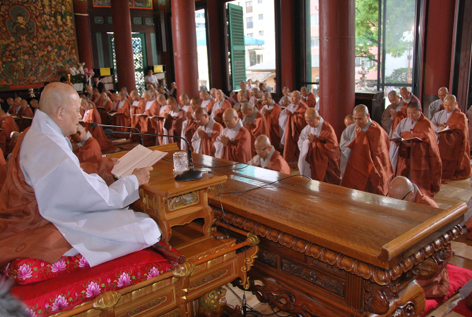
Thus begins the ceremony for the Bodhisattva Precepts in Korea. While laypeople can and do take these precepts, every six months, monks and nuns are required go to their regional head temple for this ceremony.  (It’s  held once a month in meditation halls and sutra study halls, but it’s also held separately for those who aren’t in one of those.) Attendance is required; they actually make us sign in before the ceremony, and then sign out again after it’s over — no signing the ledger and slipping away!  Traditionally, this should be held at least once a month, but there is a lot of overlap with the Thousand Hands Sutra, which is chanted ever day.

Of the Ten Precepts, when western Buddhists think of numbers 6-10, they may be actually thinking of the ones from the set of Bodhisattva Precepts. 

6: Not discussing the faults of others.
7: Not praising yourself, or speaking ill of others.
8: Not being stingy with material or spiritual aid.
9: Not indulging in anger
10: Not speaking ill of the Three Treasures, the Buddha, Dharma, and Sangha.

You may have heard of the precepts against sleeping in a high bed, wearing perfumes, and accepting gold and silver. These are the original precepts of the Vinaya school, and are for renunciates. Whereas the Bodhisattva precepts were developed later, and are not necessarily for monastics alone.

  In total, there are 48 Bodhisattva Precepts. They originate from the Chinese version of the Bramha-jala Sutra, which takes the form of the Buddha reciting these precepts (here’s a link to one version of this sutra). Essentially what the Buddha is saying, is that those who are enlightened behave like this, and not like that. So if you want to become enlightened and a blessing for those around you, (and greatly reduce your own suffering) start by following the example set by the great practitioners whose awakening is reflected in their behavior.

Interestingly, the demand for complete vegetarianism comes from this sutra, as does the requirement of not eating the garlic and onions (perhaps they were considered the oysters of their day?) Some of these precepts seem like they are directed towards lay people, while others are clearly for monastics.

Some of these precepts are:

Don’t act as an agent or emissary for political powers,
respect your teacher and fellow practitioners,
help nurse those who are ill,
not teaching for the sake of profit,
not teaching those who would use what they learned to harm Buddhism and the faithful,
and so on. 

Here’s the full entry for a couple of precepts, to a taste of how they are presented (the quotes come from here) : 

On Slander and Libel

A disciple of the Buddha must not, without cause and with evil intentions, slander virtuous people, such as Elder Masters, monks or nuns, kings, princes or other upright persons, saying that they have committed the Seven Cardinal Sins or broken the Ten Major Bodhisattva Precepts. He should be compassionate and filial and treat all virtuous people as if they were his father, mother, siblings or other close relatives. If instead, he slanders and harms them, he commits a secondary offense.  
 
These precepts are also often worded in a way that makes it hard to deceive ourselves: he must not do it himself, nor command others to do it, nor allow it to happen through inaction, etc.

Some of these precepts also carry interesting insights into how the culture of how people lived at the time. I’m sure we can extrapolate the intention of the following precept, but look at who it’s directed at: slash and burn farmers.

On Starting Wildfires

A disciple of the Buddha shall not, out of evil intentions, start wildfires to clear forests and burn vegetation on mountains and plains, during the fourth to the ninth months of the lunar year. Such fires [are particularly injurious to animals during that period and may spread] to people’s homes, towns and villages, temples and monasteries, fields and groves, as well as the [unseen] dwellings and possessions of deities and ghosts. He must not intentionally set fire to any place where there is life. If he deliberately does so, he commits a secondary offense

 Martine Batchelor has actually published an excellent translation of the complete Korean ceremony with precepts. It’s called The Path of Compassion: The Bodhisattva Precepts.  If you are at all interested in this subject, I recommend checking out her book. This sutra and ceremony are a huge part of the Buddhism of Korea, Japan, and China. I’d like to write a lot more about it, but I can’t find my copy! (If you’re the person I loaned it to, please send it back! ^-^)

How to overcome suffering: Questions and answers with Daehaeng Kun Sunim

   Look at how water flows.
When it meets a hole,
it fills it and continues to flow.
When water meets a rock,
it flows around it.
The path of finding your true self
is like this.
-Daehaeng Kun Sunim


In her regular Dharma talks, Daehaeng Kun Sunim often took questions afterwards. Some of these, and the answers, are quite useful to practitioners. We’ve been working on putting some of these into a small ebook edition called, Find the Treasure Within. We’re not quite finished, but I’ll go ahead and post slightly condensed versions of these. Some of what she says is so striking that I’ve highlighted it.

 Check out her answer to the question: Is life suffering?

 
Question: 
I had always hoped that my children would grow up happily because my childhood was not so good. Yet, no matter how hard I try, my life doesn’t seem to be turning out the way I wanted.
         I read in some book that Shakyamuni Buddha once told people, “Life is suffering.” Is that true? Does this mean there’s nothing I can do about these things?
 
 
Answer:
Every one of us experiences many things during our life, such as illness and poverty, joy and happiness. It might seem like some of those things happened by accident. However, because you were at that place and time, those things occurred and you experienced them. In fact, all the things that we experience are the result of what we have done over a great number of eons. It’s just that when they return to us, they tend to have a different appearance, so we don’t recognize them.

What we receive today is the outcome of what we did in the past, but how we react to this determines what our future will be. So don’t think that the difficulties you’re facing happened by chance.

However, even hardships are another face of your true self, which is trying to teach you. So, don’t blame others or the era for the difficult situation you are in. Instead, you should be grateful to your true self, which is giving you another chance to change things. Forgetting about your inner self and being depressed because of difficult circumstances cannot be excused.

When some hardship occurs, you can get angry and complain about it, or you can think of it as a good opportunity to complete yourself. Which way you approach things is entirely up to you. But your future depends upon the decisions you make.

It’s true Shakyamuni Buddha said, “The world is full of suffering,” and, “the world is like a burning house.” However, these were warnings given to people who chased after only material things, to people who never reflected upon the truth. 
 
Most people move through their life dragging their difficulties behind them. Thus they suffer twice: once when the difficulties come to them, and once more as they try to carry them along.  Every single Buddha has also experienced hardships because those things are the results of what one has made in the past,  and this applies to everyone. However,  without clinging to anything, Buddhas release everything to the fundamental place, the inner self, and by doing that, whatever they encounter becomes one with the inner self and so dissolves and melts away.

Once those bad situations have arisen, there’s not much that can be done about them. But, if you let go of all those difficulties to your inner self without holding on to them and without making discriminations about them, then you will not have to suffer from carrying them with you. You will also be freeing yourself from future suffering. When you keep doing this, you will gradually attain calmness and your suffering will dissolve,  and finally you will see your inner self, the truth.  

However, releasing everything like this isn’t easy if you’ve never tried it before. So, first, you should firmly believe that the truth is within you. In other words, know that your fundamental mind has the ability to take care of everything.  Next, you should understand that everything you confront is not suffering, but rather just another aspect of yourself.  Entrust it completely to your inner self.  Afterwards, the things you entrusted will dissolve because your inner self, your foundation, is the source of everything and the source of infinite energy.  
 
As I said before, the best way to solve the things you face is to truly let go of everything to your inner self with firm faith, because this is where everything arises from. This is true virtue and is the only way to live truly free


 copyright 2010, The Hanmaum Seonwon Foundation


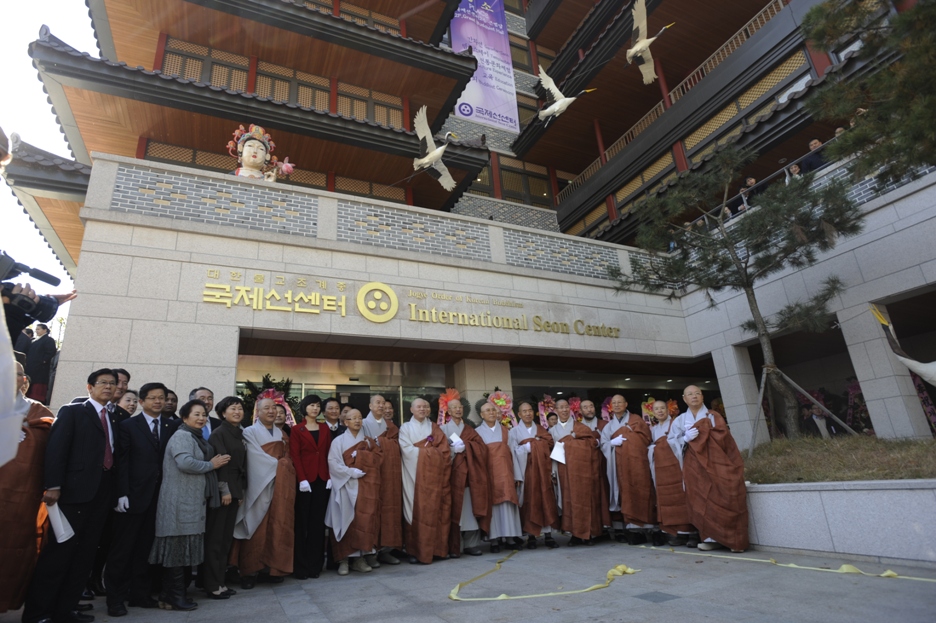
Jogye Order International Seon Center Opens

This just in from the website of the Jogye Order:

The Jogye Order International Seon Center is now open to be a center to promulgate Korean traditional culture and Korean Buddhist meditation (Ganhwa-seon) to the world. The opening ceremony for the newly built center in Seoul was held on November 15. Jogye Order President Ven. Jaseung, members of the Council of Elders Ven. Jeongmu and Ven. Jongha, Director of the Bureau of Education Ven. Hyeoneung, Director of the Bureau of Dharma Propagation Ven. Hyechong, President of the Central Council Ven. Boseon, National Assemblymen Choi Byeong-guk and Jo Yun-seon, and local officials and other monks and nuns with over 1000 people attended the ceremony.

Here’s the full report.
And here’s the new International Seon Center.

The Five Precepts

Early next year the Bangkok Hanmaum Seonwon will be holding a ceremony for those wishing to formally take Buddhist refuge and precepts. The exact date has yet to be announced, but anyone interested in taking part is encouraged to come along to the next Bangkok Seon Club for more details.

Last month, as we continued our discussion at a local ice-cream place, the topic of next year’s ceremony came up. Someone asked about the exact wording of the precepts in the Hanmaum tradition, and so here they are, as written on my own Certificate of Precepts witnessed by Chong Go Sunim:

The Five Precepts

Being in harmony with one’s fundamental mind is the source of all upright behaviour. So always observe within yourself, returning there whatever confronts you, and uncover your inherently bright, true nature.

1. The Precept of Not Killing.
Knowing that all other lives are part of my life,
I vow to treat all other bodies as I would my own.

2. The Precept of Not Stealing.
Letting go of desires for others’ possessions,
I vow to cultivate generosity.

3. The Precept of Avoiding Improper Sexual Conduct.
Letting go of lust and harmful states of mind,
I vow to strive to keep my mind pure.

4. The Precept of Avoiding Harmful Speech.
I will not tell lies.
Being careful of what I say,
I vow to live with truth and sincerity.

5. The Precept of Avoiding Intoxicants.
I will never drink to excess.
For the sake of myself and others,
I vow to live within my limits.

—————————–

Link: WUaL: On Formally Taking the Five Precepts

Footprints of the Ox

Do you notice anything wrong with this painting? 


If you grew up on a farm, chances are you noticed that he’s following the hoof prints in the wrong direction!

The painter may have been a city boy, but, this also may have been deliberately painted like this.
As a warning. 

In the Tex Ox Herding pictures, the hoof prints are the traces of our fundamental mind. These are the deeper, transcendent experiences that arise as we make efforts to put our understanding into practice. 

The danger is that if we aren’t careful, these experiences can become footholds for ‘me’ and ‘I’. Look what I experienced. Now I know….  Not to let go of these is to put our neck in the noose.

The antidote is not to cling to even the magnificent and sublime experiences we have. We have to step forward, letting go of everything we think we know, and even the things we are worried we don’t know. We have to go forward with empty hands, trusting in the inherent Buddha essence within us all.
 
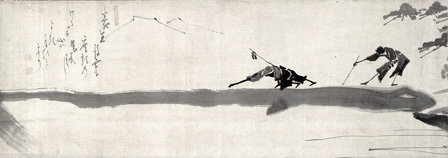
Genju, over at 108 Zen Books, posted a great painting by Hakuin that really speaks to this. 
It’s called “Blind Men Crossing a Log.”    


Walking in the dark,
on this narrow and dangerous path,
what would you depend on to guide you?
Ordinary knowledge
and mistaking the desires of the body for your true essence
will surely lead to missteps
and disaster.
 
Carefully, carefully now.
Though stepping forward into darkness,
the light of this fundamental mind,
this divinity, this Buddha essence,
guides each step
and shows the way.


(Thanks to Jack for the photo of the ox herding image.)

seon club notes – part four

Enlightenment does not mean getting rid of an unelightened self and then finding a self that is a Buddha somewhere else.
 – Seon Master Daehaeng Sunim
(‘No River to Cross’, p.59)

Before I write up the last of the great teachings I remember from October’s Seon Club, a short rant from me: The Buddha did not teach that the self does not exist! What he actually said is that there is no permanent, solid, unchanging self. What we usually think of as self is subject to change and is interconnected with everything else. Making the idea, sometimes voiced in Buddhist circles, that we must destroy the self, simple nihilistic nonsense.

In fact, the Buddha could be said to have even developed a kind of self-help programme: the Noble Eight-fold path. This is certainly the view of Thanissaro Bhikkhu, who, in an essay entitled ‘Hang On to Your Ego’, writes that “If you open your mind to the idea that the Buddha was actually advocating ego-development instead of egolessness, you see that there’s nothing lopsided or lacking in his understanding of healthy ego functioning.”

It’s also a view I’ve heard expressed by Phra Cittasamvaro Bhikkhu, the guiding light of the Littlebang Sangha here in Bangkok, not least in a talk he gave on the subject a couple of years ago during his annual teaching series: “You DO have a personality” he said, “which in English is what we could call ‘self’. It is not permanent, nor unchanging, and therefore not an Atman,  but it is real. And Buddhism teaches you should develop and nurture this personality”.

I heard much the same from another Therevadan monk not so long ago too, Venerable U Vamsarakkhita speaking in Bangkok, said that the Buddha did not teach detachment. The Buddha did not tell people to cast aside their bodies and thoughts and feelings. Rather, he said, the Buddha taught people to examine them. And then, through this investigation, they will be better able to live in the moment, experiencing a richer more fulfilling life.

And of course our own root teacher, the inspiration for this blog, Seon Master Daehaeng Sunim, says much the same, “There is no substance to the I that people have thought of as themselves” she writes. “However, it is said that I has no substance, not because such a reality does not exist, but because what is called I always changes from moment to moment.” And thank goodness for that. It is this constant change that makes our self-development possible.

And in Buddhism this self-development is carried out through the Noble Eightfold Path. The Buddha talked about developing skillful states such as morality, generosity, and wisdom, and breaking free of greed and anger and delusion. Right Effort was an integral part of his 8-step programme; and he encouraged people to support each other in this programme.

But what about ultimate liberation? Does the self disappear then? Despite all that’s been said above, are we, finally, left in a state of non-existence?  I must admit I find the idea of this both frightening and hard to understand. So, back to last month’s Seon Club discussion. “Enlightenment isn’t about annihilation”, Hyedaeng Sunim explained, “it’s about finding your true self, much bigger and more able than you ever thought imaginable”.

———

Links:
Thanissaro Bhikkhu: Hang On to Your Ego
Phra Cittasamvaro Bhikkhu: Notes on the Self

Venerable Ya-un: feeling superiour to others

Don’t feel that you are superior to others, and don’t look down upon others.[i]

Humility and modesty are the source of all good human qualities. Friendship arises from respect and trust. Without humility, the false ideas of self[ii] form a mountain that becomes higher and higher. And the ocean of the three evil rebirths,[iii] becomes deeper and deeper. Outward solemnity seems noble, but if there is no inner attainment, then it’s like a rotten ship.

As officials increase in position, their minds become smaller. As the spiritual cultivation of a practitioner deepens, they become more humble. When the distinction between you and I disappears, the supreme path is naturally achieved. Endless blessings flow naturally to those who are humble.

                      Wisdom is buried by arrogance,
                      ignorance feeds upon distinctions
                      of you and I.
                      While looking down on others
                      and not practicing,
                      you grow old and sick.
                     Moaning and sighing,
                     what can you do now?


[i] Don’t feel that you are better than someone else, the equal of someone else, or inferior to someone else. These are all considered wrong views.

[ii] There are four false ideas that people cling to: that there is a self, that this self is different from other beings, that all other beings also have a separate self, and that this self has a limited life span.

[iii] The realms of hell, hungry ghosts, and animals.

The Global Peace Initiative of Women, in Seoul

There’s a very interesting group meeting for three days this week in Seoul (Wednesday- Friday, Nov. 10-12), The Global Peace Initiative of Women  http://gpiw.org/

To be honest, most of the religious conferences I’ve been to have basically consisted of people waiting to speak. Few came to listen, few were interested in a dialogue or sharing of ideas and experiences. That’s what sets this conference apart. The organizers are very focused on creating a real dialogue. To this end, there are no prepared papers, and those with large egos haven’t been invited. Following brief opening remarks, the moderator sets the tone, and facilitates honest discussion among those who feel called to speak. It reminds me a lot of a Society of Friends Meeting. I’ve had a chance to talk with some of the organizers and have been very impressed with them as people, as practitioners, and with the spirit that they are approaching this with. If you want to hang out with some just plain good people, stop by if you have time. (And it isn’t just about women, there will also be many male participants.)

From their website:

The Global Peace Initiative of Women was founded to help awaken and mobilize spiritual energies in places of great need with the goal of aiding in healing and unifying the world community. GPIW facilitates this by seeking to gather together those of great insight, wisdom, compassion and dedication, many of whom are working quietly for the upliftment of the world. A major focus of GPIW’s work is to aid in building a global network of contemplative leaders who through their inner work can help transform the causes and conditions that lead to suffering at both the individual and collective level.

 Re-Envisioning Prosperity:
A Spiritual Forum during the G20 Summit

 Organized by The Global Peace Initiative of Women
in collaboration with Women of Wisdom, South Korea

November 10-13, 2010

While political leaders come together to discuss ways to stimulate the global economy, a parallel discussion will be taking place among spiritual leaders on a new economic paradigm that takes into consideration the need for greater and greater consideration for the health and wellbeing of the global ecosystems on which we depend for life. Can we have true prosperity without these?  What new framework is emerging that can guide us to a more inclusive, balanced, and life-sustaining understanding of prosperity?

 Wednesday, November 10th

8:00am     Depart for De-Militarized Zone (South / North border area) Cheorwon Peace observatory of the DMZ (1½ hours from Seoul)

 Global Prayers for Peace between South and North Korea

 Moderated by: Dr. Mary-Faeth Chenery, The Global Peace Initiative of Women Country Coordinator, Australia

 Welcome by:

Dr. Insook Kim, Founder, Women of Wisdom, South Korea

Dena Merriam, Founder and Convener, The Global Peace Initiative of Women, USA

 Religious leaders offer individual prayers or chants of 1-3 minutes each 

 2:00pm-4:00pm     Opening Session:

Re-Envisioning Prosperity for Greater Balance Between Our Material and Spiritual Aspirations 

There is a common misperception that material wealth brings greater happiness.   While there is a base line of human needs that must be satisfied, there is another base line, not much discussed, above which additional material accumulation does not contribute to happiness.  It is the work of all religions to help people turn inward for a sense of wellbeing and “happiness.”  Should this not be worked into the common understanding of “prosperity?”  How do our spiritual traditions define “prosperity” and how can this apply to our current time?

 Setting the Context: Prof. Dr. Phra Dharmakosajarn, Rector, Mahachulalongkornrajavidyalaya University, Thailand

 Moderated by: Dena Merriam, Founder and Convener, The Global Peace Initiative
of Women, USA

 Opening Remarks by:

  • Sraddhalu Ranade, Spiritual Teacher/Scientist, Sri Aurobindo Ashram, India
  • Bishop Bärbel Wartenberg-Potter, Former Bishop, Northelbien Evangelical-Lutheran Church of Germany
  • Dr. Doudou Diene, Former Director of the Interreligious Dialogue, UNESCO, Senegal/France
  • Rabbi Warren Stone, Temple Emanuel, USA

 Followed by Open Discussion of the Topic

 Thursday, November 11th 

Dongguk University, Main Temple Hall
9:30am–10:00am      Opening Prayer Ceremony (The Three Refuges)                                                                    
Moderated by:
 Prof. Kim, Aeju, Dongguk University, South Korea
 

                                     Prayer and Welcome

  • Greeting by:  Ven. Hae-Chong Sunim, Chogye Order of Korean Buddhism, Korea
  • Opening Remarks by: Ven. Wol-Ju Sunim, Chogye Order, Founder of Goodhand Organization, Korea
  • Prayer by: Ven. Bup-Ta Sunim, Director, Jeong-Gak Won Temple, Korea

 10:00 – 12:00pm     Emergence of New Global Norms

The American Dream has become the Global Dream – endless possibilities for every individual to achieve uncapped material success.  This dream is fast disappearing and spiritual communities in the US are beginning to talk about the new American Dream – not yet defined.  Some years ago the United Nations set a poverty line, which marks those living in extreme poverty and whose poverty the world had a responsibility to address.  Some religious communities are now working to establish a ‘greed line’ to demarcate a level of wealth amassment considered too extreme in a world of limited resources.  The new economic reality will certainly call for changes in the way we relate to both extreme poverty and extreme wealth.  These barometers, rather than being moral judgments, could emerge from a sense of urgency to re-balance our material and spiritual natures.  If our happiness depends on fulfilling our spiritual urges then this re-balancing becomes essential for the wellbeing of every individual.

 Moderated by: Dena Merriam, Founder and Convener, The Global Peace Initiative of Women, USA

Bishop Bärbel Wartenberg-Potter, Former Bishop, Northelbien Evangelical-Lutheran Church of Germany

 Speakers:

  • Prof. Dr. Phra Dharmakosajarn, Rector, Mahachulalongkornrajavidyalaya University, Thailand
  • Sraddhalu Ranade, Spiritual Teacher/Scientist, Sri Aurobindo Ashram, India
  • Ven. Hyon Gak Sunim, Zen Monk, USA/Germany
  • Rev. Dr. Chung Sook Ja, Theologian & Founder, “Women Church,” Korea
  • Zarko Andricivec, Chan Buddhist Master, Dharmaloka Center, Croatia 

 Closing Remarks:

  • Most Ven. Kakuhan Enami, Chairman, Japan Buddhist Conference for the World Federation and Chief Priest of Bishamon-do Temple and High Priest of Tendai Denomination, Japan

 2:00-4:00pm    Post-Prosperity: Challenges, Possibilities and a New Understanding
of Prosperity

 Young people today do not feel a sense of hope about their future, with regard to the economic opportunities. This is perhaps because of the comparison with the previous generation, which came of age during a time of unparalleled economic growth. But many young people are also coming to understand that making money is not the goal of life.  Money can enable one to fulfill one’s goal and thus is a means to an end, not an end in itself. The focus should perhaps be on finding purpose. This can be the defining goal in the post-“prosperity” era, and indeed this changed focus will help evolve a new understanding of prosperity.

 Moderated by:Prof. Dr. Hyun Kyung, Union Theological Seminary, USA

Nithya Shanti, Spiritual Teacher, India

 Opening Remarks by:

  • Dr. Christoph Quarch, Spiritual Philosopher, Lumen Naturale, Germany
  • Dr. Hwang Sookyung, Instructor, Dongguk University and Women of Wisdom, South Korea
  • Ven. Chang Kuan, Managing Director, Bhikshu Sangha of Dharma Drum Mountain and Vice Dean, Dharma Drum Sangha University, Taiwan
  • Ven. Myeong-Beop, Instructor, Unmun Seminary for Buddhist Nuns and Seoul National University, South Korea
  • Prof. Ejaz Akram, Sufi Scholar, Pakistan
  • Mr. Katsuji Iwahashi, Representative, Association of Shinto Shrines, Japan
  • Mr. Hiroshi Matsumoto, Trustee, International House of Japan, Japan

 Closing Remarks:  Ms. Hanne Strong, Founder Earth Restoration Corps, Canada

 The discussion will be followed by questions and answers.

 3:30pm      Closing Prayer Ceremony (The Four Great Vows)
                                   
Moderated by:  Prof. Kim, Aeju, Dongguk University, South Korea

 5:00pm      Tribute to “War & Peace” International Fashion Biennale

Friday, November 12th

 Hanmaum Seon Center of Korean Zen Master Daehaeng Kun Sunim

  Located at 101-60, Seoksu-dong, Anyang-si, Gyunggi-do / Tel: 031-470-3175 

 9:30am – 10:00am     
Opening Prayer Ceremony in Main Temple Hall – 4th Floor

 Welcome Remarks & Brief Introduction of the Hanmaum Seon Center by:

Venerable Hye Won Chuji Sunim, Abbess, Hanmaum Seon Center

 10:00am-12:00pm      
Morning Session: Spiritual Perspectives on the Current Economic Situation

 Each of the world’s economies seeks growth, and consumption is regarded as the path toward greater economic growth. There is much concern among economists about the decline in consumption, and yet from the spiritual perspective this would be regarded as a positive development. Is there another model emerging of a more “considered” or “conscious” growth? Is endless economic growth possible given the already heavy utilization of the Earth’s resources? What are the positive fruits of limited growth?

 Introduction of Theme by:  Dena Merriam, Founder and Convener, The Global Peace Initiative of Women, USA

 Session moderated by: Bishop Bärbel Wartenberg-Potter, Former Bishop, Northelbien Evangelical-Lutheran Church of Germany, Germany

Prof. Ejaz Akram, Sufi Scholar, Pakistan

  Opening Remarks by:

  • Ven. Dr. Hye Seon Sunim, Hanmaum Seon Center
  • Prof. Dr. Phra Dharmakosajarn, Rector, Mahachulalongkornrajavidyalaya University, Thailand
  • Prof. Dr. Samuel Lee, Director of ECO-ASIA, Former Director, UNESCO, South Korea 
  • Zarko Andricivec, Chan Buddhist Master, Dharmaloka Center, Croatia
  • Rabbi Warren Stone, Temple Emanuel, USA
  • Ven. Chang Kuan, Managing Director, Bhikshu Sangha of Dharma Drum Mountain and Vice Dean, Dharma Drum Sangha University, Taiwan

 2:00pm-4:00pm      
Open Discussion – Continuation of morning session

                                     Moderated by Dr. Doudou Diene, Senegal/France

                                     Opening Remarks:  

  • Prof. Dr. Hyun Kyung, Union Theological Seminary, South Korea/USA
  • Sraddhalu Ranade, Spiritual Teacher/Scientist, Sri Aurobindo Ashram, India
  • Sister Ruth Liddle, Brahma Kumaris Spiritual University, UK
  • Ven. Hyon Gak Sunim, Zen Monk, USA/Germany
  • Ven. Chonggo Sunim, Hanmaum Seon Center, Hanmaum International Culture Institute

 Concluding Remarks: Dr. Mary-Faeth Chenery, GPIW Country Coordinator, Australia

 Closing and Next Steps: Dena Merriam, Founder and Convener, The Global Peace Initiative of Women, USA


Acknowledgements Inner Trip Reiyukai International (ITRI), Japan

 Women of Wisdom, South Korea

 The Ministry of Culture and Health of the Government of South Korea

The Province of Kwangwon do

Chogye Order of Buddhism, South Korea

Hanmaum Seon Center, South Korea

 GPIW gratefully acknowledges the foundations, organizations and many individuals whose financial contributions, energy and efforts make our work possible

 Simultaneous translation for the Dongguk University Forum
kindly provided by Jhin, Jean Wookee and Hong, Yeon Ju

 Translation and assistance for the program at Hanmaum Seon Center
kindly provided by Lim, Hyangiel, Park, Hyejin, and Suh, Seonhee 

seon club notes – part three

Seon Club starts each month with everyone reciting the refuges and a little sitting meditation, and then we sit on benches in a kind of rough circle for our discussion. And every month Mrs Nam brings in a tray with little metal cups, seen everywhere in Thailand, and a big jug of cold water.

I placed my cup on the floor behind me, so as not to get in the way, and leant back to reach for it and have a drink. Sunim, following our discussion about the fairness or otherwise of the world, asked the group “what is the difference between an Englightened and an unenlightened person drinking water?”

“The taste of the water”, someone said. “The quality of the experience of drinking”, someone else added. “An Enlightened person” I thought to myself “would drink noiselessly and without drawing attention to himself!”

Sunim smiled at our answers and said “True. But the main difference in an Enlightened person would be, whilst drinking, the willingness and ability and action to help all other beings also quench their thirst too.”

———

Photo: The incredible image that accompanies this post is, like all images in the seon club notes series, a generous contribution from Joseph. Thank you brother.