Seon club notes – part one

There were only five people at Seon Club last week; me, Young, Arthur, MJ, and, of course, Hyedaeng Sunim, and yet the discussion was incredibly rich and covered a whole range of topics of concern to all in the group. I wish I’d taken notes, but some things stood out for me very clearly, and this month I’ll try to relate a little of it here on this blog.

The first was Sunim’s response to a question from me. I’ve asked this before, but it still bothers me. I understand, and can see in my own life, how everything we suffer is a manifestation of the Buddha-nature and necessary in order to learn and make progress, and in fact, last time I raised this, Sunim talked about how suffering is itself the compassion of the Buddha.

It’s like a father, she explained again to me on Saturday night, who cares for his child. Sometimes the father will reward the child, sometimes the father will need to use discipline. But the child, far from seeing the love, might see only the suffering and not the bigger picture and the opportunity to learn.

“Yes”, I argued, “Yes, I understand that, I see that, but look at the awful suffering in the world, the poverty, the hunger, the concentration camps. Rape, murder, torture. Surely there are better ways of disciplining, ways that don’t involve flaying the child alive. I mean, it’s just not fair.”

“This world” Sunim replied with gravity as well as a smile, “is perfectly fair. Everything you create eventually comes back to you.”

Link: Wake up and Laugh!: Suffering

the world, our sangha

I take refuge in the place for learning the truth, which is every place.
A Thousand Hands of Compassion

“You must realize that, your husband, your wife, or your children who give you hard time are Buddha who is trying to teach you. Don’t have preconception of Buddha. Buddha is not just a golden statue set high in the Dharma hall whom you always lit a candle or offer incense to. Buddha is very close to us. Try to think that our family, neighbor, friends and parents are Buddha.”
Seon Master Beopjung

“The trees, water, air, birds, and so on can all be members of our sangha. A beautiful walking path may be part of our sangha. A good cushion can be also. We can make many things into supportive elements of our sangha.”
Zen Master Thich Nhat Hanh

“What is this? How can spring rooster’s crow be the answer to the question of truth? If you hear the rooster crow in spring correctly, then you will know the meaning of life clearly.”
Seon Master Seung Sahn

“Which one is my True nature in Three Worlds? There is one single pure object, which is my Original Self. Flowers blossom and leaves fall but it has one root. The sun and moon rise and fall but leaves no traces.”
Seon Master Haeam

“There is teaching that, “The leaf returns to the root.” It means the fallen leaf will return to the root of that tree. The nature of returning to the essence is the teaching that Nature gives. The work and effort to return to one’s essence is the purpose of Buddhism.”
Seon Master Wolha

Bul, refers to the fundamental source of every single life, including even a blade of grass, and the second syllable, gyo, refers to learning from each other; we communicate with each other through speech, mind, and actions. So the word ‘Buddhism’ means communicating with each other through the foundation, the fundamental source of life, and through that, listening to each other and learning from each other.”
Seon Master Daehaeng Sunim, ‘No River to Cross’

“Say only the Truth and convey only the Teaching. That is the work of brightening the world with Buddha’s teaching. You need to be the leader and guide to a brighter world. All of you have reason for being in this world.”
Seon Master Gosan

“If you completely understand how mind works and are able to combine your mind with others’ minds, and if you are able to deepen your wisdom and continue to practice, then you can combine your mind with even the great stars of the heavenly realm. When you can do this, the heavenly realm becomes peaceful and comfortable, and in turn this world also becomes peaceful and comfortable.”
Seon Master Daehaeng Sunim 


Link: Most quotes from here
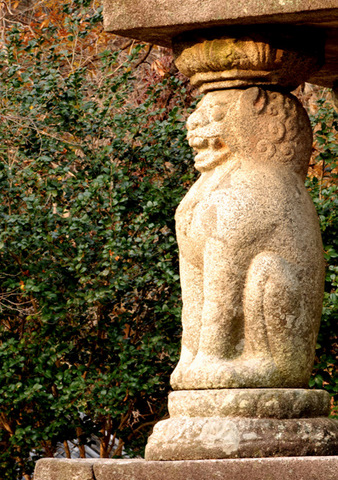
Images: This pagoda is at Hwaeom Temple, in the Jiri Mountains.

Guest Post: Colin on reading the Tao Te Ching

Introduction: I first met Colin back in Istanbul in 1998. He’d already lived in the city for five years, I was there for just one. In 2000 we both came to Bangkok, and while I’ve been coming and going, Colin has been here the whole time since.

I’ve not yet seen Colin at a single Dharma talk of any tradition, but I know few people who live the teachings more fully in every moment of his life and art. He paints, draws, takes great photos, and lives a life of compassion and appreciation.

I asked him if he’d like to contribute a post on this blog, and he said he’d write something on the Tao Te Ching. Which, by the way, he reads, a single verse a day, from the most battered-looking book you’ve ever seen in your life!

Guest Post: Colin on reading the Tao Te Ching

Now all you need for this exercise is… a piece of paper and a pen !

Now get down and draw a vendiagram , yup one of those ( if you can’t recall what it looks like feel free to ask marcus )

now place an X in the diagram to express where you currently stand in your life related to groups of interest or disinterest

eg. mother-inlaws or religion… excellent !

Now if this current place appears to be a tiny bit fractious or indeed you simply fancy a change in perspective without being noticed,

then you need L’s hat shop.

” Ma ! Bobbie’s wearing his grimy awful baseball cap but he’s walkin’ like he’s wearin’ a Trilby !”

” Come on J.R. you’re just jealous. ”

( Bobbie always did have a hard time… I mean even when J.R. was shot he came out dancin’. )

” Hon’ you’re got to learn to shoot straight… like I do . ”

Now at L’s hat shop he has as you all know, 82 different hats in all shapes and sizes to fit anyone, and that’s not all you can change them

anytime you want unbeknown to your fellow groups . hat no 18…. is what I’m sporting today.

Imagine there you are in that bunker again… before hole no 18 you can just about see the flickering flag. yes you have to get your

shoes mucky again, muttering to yourself because quite frankly your parnter has had enough you take your first swing at the ball.

No ! it hits the bunker edge and gently laughingly rolls back down…

Now comes that job of finding your swing, the one that suits your body and mind…. you read chapter eighteen again. looking between

the lines gritting your teeth you let go ! You feel the sand beneath your soles, the wind ruffles your hair and you begin to listen

to the rustling of the leaves ( why are leaves always rustling in zen accounts you mutter…. )

flowing you swing your club and VOILA the ball sails cleanly over the edge and I’ll be damned right into hole no 18.

and once again connecting with yourself you fin d your walk and mind seem to just float along… man that L really knew his stuff

good job he was around.

—————————–

Link:
He’s not updated it for a while, but here’s Colin’s excellent blog: Spaces and Lines

—————————-

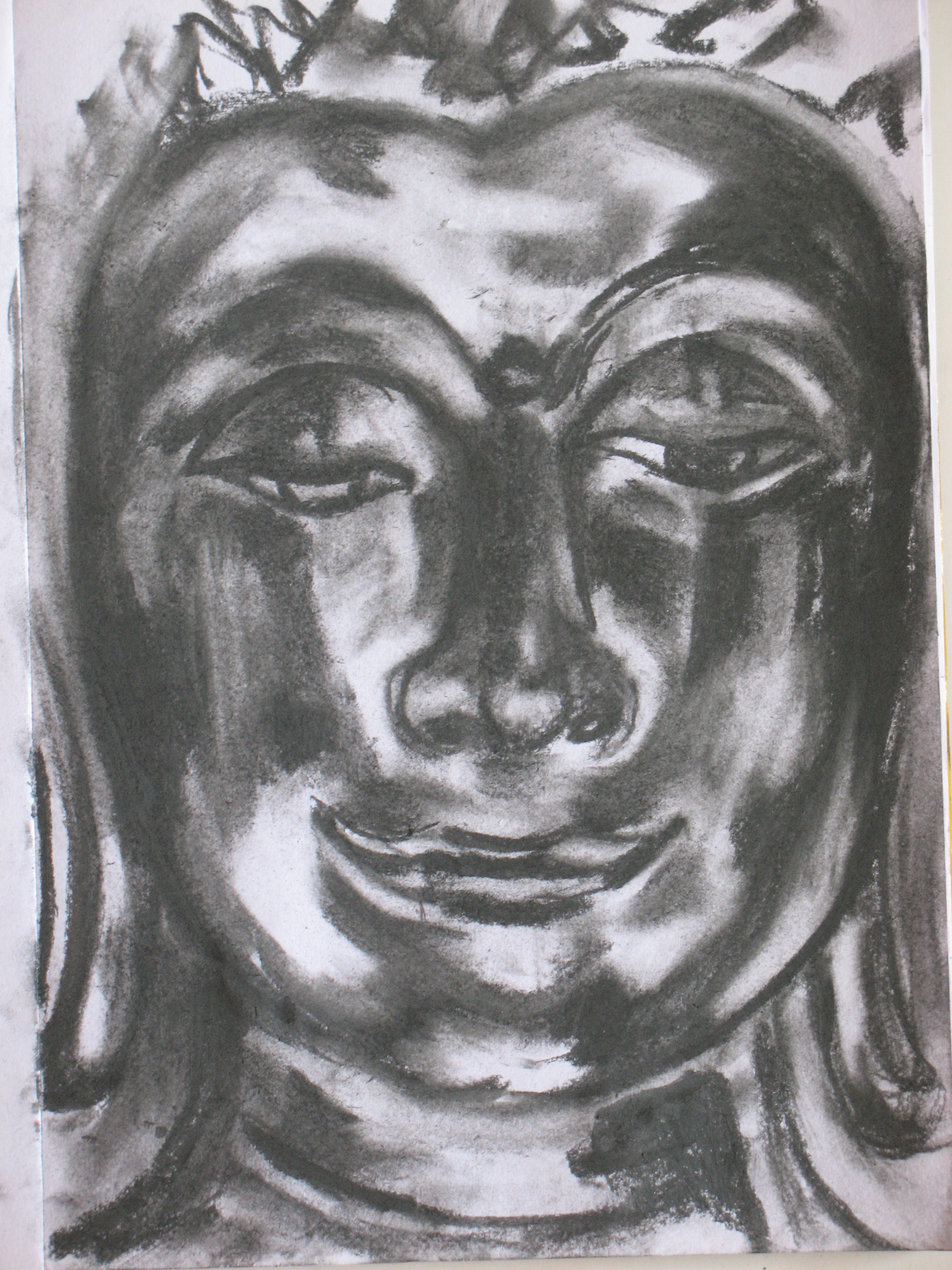
Picture: The lovely image here is also by Colin. His partner’s father, a wonderful man, passed away last year and after the five days of ceremonies at the local temple, Colin presented this magnificent work to the head monk, where it was very warmly received.

the true self

The name of Nirvana is One-mind. One-mind is the Womb of Tathagata
– The Lankavatara Sutra

“Observe the empty monarch of mind; mysterious, subtle, unfathomable, it has not shape or form, yet it has great spiritual power, able to extinguish a thousand troubles and perfect ten thousand virtues. Although its essence is empty, it can provide guidance. When you look at it, it has no form; call it, and it has a voice.”
– Layman Fu Shan-hui (487–569) in Cleary, Teachings of Zen

“Nirvana has innumerable names. It is impossible to give them in detail; I will list only a few. Nirvana is called extinction of passions, the uncreated, peaceful happiness, eternal bliss, true reality, dharma-body, dharma-nature, suchness, oneness, and Buddha-nature. Buddha-nature is none other than Tathagata [Amida Buddha]. This Tathagata pervades the countless worlds; it fills the hearts and minds of the ocean of all beings. Thus, plants, trees, and land all attain Buddhahood.”
– Shinran, Commentaries on Notes on the Essentials of Faith Alone

“If you touch the phenomenal realm deeply, you touch the ultimate realm which is the realm of no birth and no death. The ultimate is nirvana, it is God, and it is available to us twenty four hours a day.”
– Zen Master Thich Nhat Hanh

“Having searched for myself in all myriad things
True Self (Juingong) appeared right before my eyes
Ha! Ha! Meeting it now, there is no doubt
Brilliant hues of udumbara flowers spill over the whole world”
– Seon Master Gyeongbong Jeongseok (1892 – 1982)

“You can call Juingong one thing or inherent nature. You can call Juingong the thing that does not have anything, or you can call it Amida Buddha, or the main Buddha. You can call it God or my love because it is the fundamental place. Juingong can never be fixed because it can become anything. Juingong is the parent as well as the child, the highest person as well as the lowest. Juingong is the true self that leads you, no matter what name is used.”
– Seon Master Daehaeng Sunim, ‘No River to Cross’
——————————————————————–

Links:
– Thank you so much to Joseph for the great photo.
– More from me on True Self at this post, here.

how to get to heaven

The world we live in
is none other than the realm of Buddha.
Here it is forever Spring,
flowers bloom without end,
and the fragrant path is ever open.
 – A Thousand Hands of Compassion
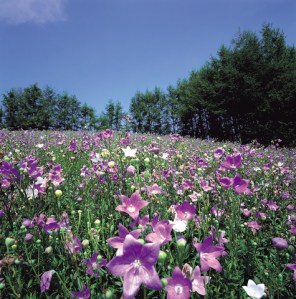
As a teenager, to the bewilderment of my family, I became a Christian. My memories of that period are of long summers, walking across the gorgeous East Anglian countryside totally in love with the trees and fields and birds and insects, praising God in everything I saw.  I’d walk from church to church across farmland and along country lanes, and never left the divine presence.

A couple of decades later my interest in things spiritual re-awoke and, living in Thailand, I looked to Buddhism. I loved the temples and Buddha images and the devotion of the Thai people, but recoiled from teachings that denied the beauty of this world. To this day I disagree with the Four Noble Truths, I don’t see life as only suffering and I don’t want to eliminate love for life.

I remember going to hear a Therevada monk give a talk on developing dispassion in which he used a day trip to see a waterfall as an example of the human condition. After traveling up into the mountains, everyone looks at the waterfall for a few minutes and then, seconds later, they’re eating their sandwiches – ready for the next distraction. So, what use waterfalls?

It’s only recently I’ve seen how Buddhism truly encompasses a love of, and even gratitude for, this very world we live in. I saw it first in the sheer attention to beauty in most Korean temples. But then I saw how that lovely balance of building, stream, woods and mountains didn’t come about by accident, how it was a manifestation of a core teaching I’d overlooked.

Yet I have trouble seeing this world as the Pure Land. After all, that’s where I’ll be taken by Amida Buddha and the Bodhisattvas after death. This world, with its violence and cruelty, is far from pure. Even in its pristine state, creatures live and die by eating each other. Illness, old age and death touch us all. The Buddha wanted to transcend this, the Therevadans and Pure Landers are both right – our task is to just get out.

And yet, doesn’t the idea that this very realm is no other than the Buddha-realm accord with my earliest, and possibly deepest, spiritual experiences as I communed with all the creative energy and beauty of the world? Doesn’t the teaching that we are all connected through this power-source of Buddha-nature accord exactly with my impulse for appreciation and gratitude?

I take refuge in one mind,
remaining just as it is, it ceaselessly takes care of all things.
I take refuge in one mind,
with all-embracing harmony it saves all beings everywhere.
I take refuge in one mind, which completely looks after all beings throughout the world and universe.
I take refuge in one mind,
with a single thought transcending time and space, it nurtures all.
I take refuge in one mind, endlessly giving light to all.
 – The Thousand Hands of Compassion

Thinking back, looking up at those huge East Anglian skies and resting in the all-encompassing arms of God didn’t mean that all my pain went away, it did mean I had, in some small way, transcended it, even transformed it. And it happened not through practice or meditation, not through Buddhology or Theology, but through resting and appreciating and letting go.

You only need to breathe lightly
for the miracles to be displayed.
Suddenly you hear the birds singing,
the pines chanting;
you see flowers blooming,
the blue sky,
the white clouds,
the smile and the marvelous look
of your beloved.
 – From ‘Our True Heritage’, a poem by Thich Nhat Hanh

And now I think of it, that monk I heard in Thailand those years ago had a point. What use waterfalls if you then simply head for the sandwiches? But if you bring to the waterfall your time and peace and appreciation, if you are in touch with that part of yourself that is deep and still and peaceful, then, yes, life also is deep and still and peaceful and we can taste the Pure Land.
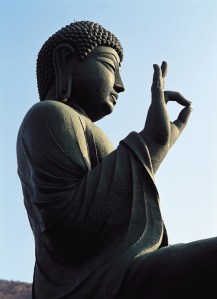
So, for me, the Pure Land remains a destination after I die and I make no apologies for my faith, but what I have learnt from masters such as Thich Nhat Hanh and Daehaeng Sunim, is how to spend more time in the Pure Land whilst in this realm now. Something that accords with my experience and makes sense to me. Pain and suffering doesn’t go away, but it can be seen for what it is, a necessary part of being alive. And being alive is wonderful.
how to get out of hell

how to get out of hell

“With one thought, evil karma accumulated over endless eons disappears, leaving nothing behind, like dry grass in a fire.”
A Thousand Hands of Compassion

Funny how life is. One minute things are going nicely, and the next, seemingly out of nowhere, everything is Dukkha. Wobbly axle? Uncomfortably grinding along? Tell me about it. My beloved flew back to Japan and, feeling miserable, I sat and watched too much TV. With no practice I became yet more unsettled and this downward spiral led, as it always does with me, to my becoming argumentative and quietly angry. Especially on-line, but off-line too. At work, and at Sangha.

I believe in Hell Realms, real places that truly exist. The Buddha certainly did, and there are hundreds of Sutras from all Buddhist traditions that go into great detail describing the gruesome tortures that await the unfortunates destined to go there, in many cases for kalpa after kalpa, for thousands of millions of years.

Genju recently discussed these realms on her wonderful blog 108zenbooks and Joseph posted a fabulous follow-up soon after. One of the points raised in their discussions was how hell is a reality just as much in this realm as in others. Not just in terms of the vast swathes of human suffering existing on this planet, but as mental states that we all of us experience. And this was certainly true for me this week.

Thank goodness for Sangha. In this case, the usual Monday evening Littlebang meditation group. My sit was awful, my mind at fever-pitch, and although I can’t say that the meditation helped in any direct way, it certainly revealed just how off-centre I was running. And although, while in this hell of the past few days, I never killed anyone or stole anything or slept around or lied or took intoxicants, I saw that on a subtler level my mind was certainly generating the energy that would run in such a direction. Heading, in fact, straight for hell.

Just as some new western Buddhists may be surprised to learn of the existence of myriad Buddhist Hell realms (their existence taken for granted throughout Asian Buddhism), others might also be surprised to learn how important confession and repentance is in Buddhism. But for me, this week, it was my way out of the fire. Daehaeng Kun Sunim’s modern translation of the Thousand Hands Sutra, ‘A Thousand Hands of Compassion’, is a beautiful book with a text perfect for slow devotional reading and repetition.

All harmful deeds I have committed, all unwise actions arising from greed and desire, all harm done through my body, speech, and thought, I now repent of this and all other harm I have caused.”

And with that I re-commit myself. Just as I’ve done before, and just as I’ll do again, but each time is better. I re-vow to watch my energies and the directions in which I send them. Practically speaking, it means I approach people a little differently than before, with less hostility and more kindness, I remove myself from my latest Internet debates (arguing on the web is probably my very worst habit and still a tough one to break) and I treat myself more kindly too. After all, this hell burns me more than anyone else.

The photo that accompanies this seems to sum up everything I want to say. It was taken by my beloved when she was here a week or so ago and says everything that needs to be said about our lives. Heaven, Hell, student, teacher – I’m sure I’ve experienced all in previous lives, just as I know I’ve experienced all in this life; we just keep cycling round and round all the time. The way out is to look towards the Buddha, and – just as in the picture – to find the Buddha at the very centre.

For myself, I’m not really very concerned with the question of inside or outside. I believe in the Buddhas and Bodhisattvas, but I also believe that they manifest within me through my own Buddha-nature, a Buddha-nature that is shared with all. In either case, the point is to step aside and allow the Buddha to manifest. Having done that, and this week it was through repentance, what then of hell? In relying fully upon the Buddha or Buddha-nature, everything both is, and is heading towards, peace, compassion, and wordless wisdom.

“Amitabha Buddha
existing with my mind,
I vow to hurry and meet.”
A Thousand Hands of Compassion

Links:
Somewhere in Dhamma: Hell Realms
108zenbooks: no sin, no self

as we bow…

A thing becomes broader as it becomes lower.
We are also like this.
As we let go of “I” and “mine,”
Our hearts become broader and more fragrant.

Link: Littlebang: A Broader You

108 bows

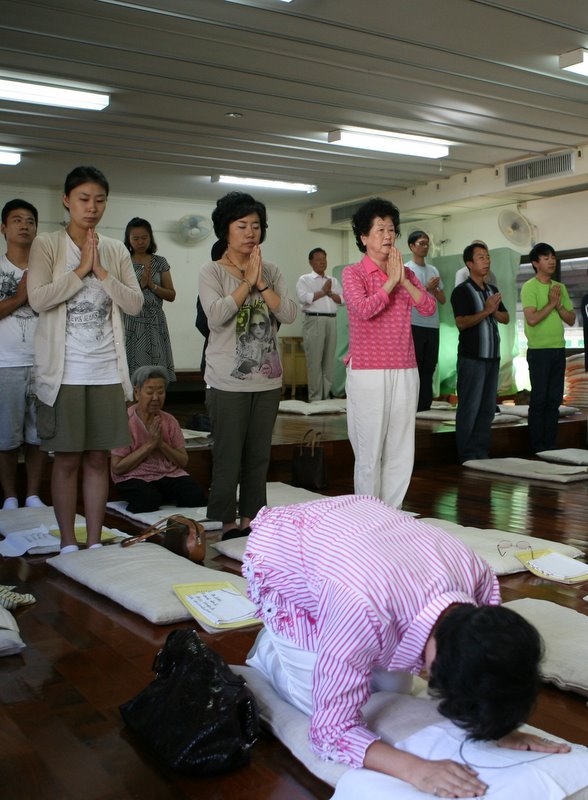
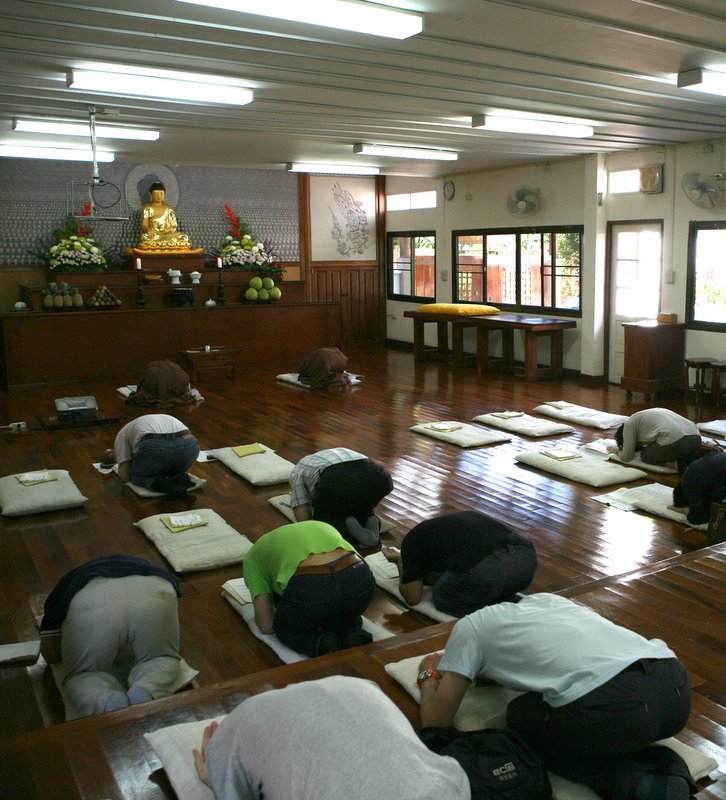
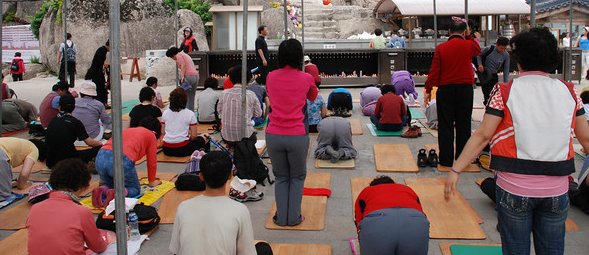
In the period leading up to Tuesday’s Bek Jung remembrance ceremony, many people in the Bangkok Seonwon took part in a special 15-day bowing practice. Of course, for some, performing 108 bows each day is part of their normal spiritual routine, but during those two weeks many more also joined in and also meet together to practice each day at the Seon Centre.

At Seon Club last weekend Hyaedan Sunim spoke a little about the benefits of a bowing practice, both spiritual and physical. There have been a great many scientific studies attesting to the health benefits of a daily routine of prostrations she said, but Hyedaen Sunim also told us of more personal stories too.

She told us about people who had overcome physical challenges through bowing, of children who had dealt with attention deficit problems through the practice, even of a construction site where the numbers of accidents dropped dramatically after a programme of morning bowing was implemented.

It reminded me of an article I’d read about doctor Kim Jaeseong, one of Korea’s leading exponents for making 108 bows a popular form of exercise. Although a Catholic by religion, Doctor Kim has benefited greatly himself from the exercise and recommends it to all his patients. He’s also the author of the Korean book “108 Bows a Day”

I remember the first time I ever performed 108 bows, at Bongeunsa, the temple featured in the last ‘Sunday Photo’ here. It was agony! After just a few minutes I was seriously worried I’d be sick and at the end I could hardly walk down the temple steps. The trick, of course, is to build up to it slowly. Start with just ten bows a day perhaps and increase gradually.

I did eventually get much better at it and would often perform 108 bows while in Korea (but even at my best, 108 bows would take me at least twenty minutes to complete rather than the ten Doctor Kim seems to be aiming for in the advice in his book), and I can honestly say that I felt a good deal fitter during that period!

In fact, the benefits are obvious to see. Korean temples are full of old ladies who can bow with a strength, and gracefulness that put my efforts to shame. And friends from the seonwon, people like Linda who start each morning with 108 bows, have an energy and vitality I admit to envying. And studies from Gangnam’s Oriental Hospital, affiliated with Dongguk University, among others, back up these observations.

“But” I asked Sunim, “what about the spiritual aspect to the practice? Surely that must also have some bearing on the physical benefits?” Sunim, as she often does, smiled and nodded and allowed me to see, once again, that I’d just stated the obvious! Of course, bowing is a physical giving up of the small self that allows the true self, the fundamental part of us, to shine through.

We all have Buddha-nature, Buddhists, Christians, everyone. And Doctor Kim, a Catholic, in his advice to make a start, uses words that seem almost to echo the language of Kun Sunim and that shows the direct link between this exercise and our fundamental selves: “It’s better if you bow with a smile on your face. You will feel happiness and peace well up in your heart, like fresh and clear spring water.”

Oh, and to make a bow, you start from a standing position and, with your palms together in front of you and your back upright, kneel on the floor. Then place your hands on the floor and bend until your forehead rests between them. Next turn your palms upwards and lift them from your elbows to the level of your ears. Put your hands back down and lift your body back into a kneel. Then stand and repeat…

108 times!

There’s a link below that shows each step clearly in photographs and I’m sure it’s possible to find videos of Korean bows on the internet too. Many people also chant as they bow, you can repeat the name of the Bodhisattva, Kwan Seum Bosal, or another Buddha, or chant a Sutra. I know that at the seonwon there is a sheet of 108 short teachings that many use, and which I’d love to see a translation of one day!

But the most important thing is not this, or the number of bows, the most important thing is the attitude in which you bow. Daehaeng Kun Sunim says in No River to Cross: “If you bow once in front of Buddha, while returning everything to your foundation, your present mind, past mind, and future mind all function together as one mind, so one bow can surpass ten thousand bows.”

Links:
How to do a prostration: photo essay
108 Bows for Exercise: Doctor Kim Jaeseong
Sumi Loundon: vow to bow

start by letting go

From the ‘Lotus Lantern’, the English-language journal of the Jogye Order of Korean Buddhism, Vol.42 – Summer 2010:

What are you looking for?
Whatever it is, you have to start by letting go;
Learn to trust the fundamental source within you.
Whether we call this Buddha-nature, God, or true self
Makes no difference. It has guided you and supported you
For a billion eons. Through it all things are connected,
And unseen energy flows back and forth
Between all lives and things.

– Seon Master Daehaeng 


Link: Lotus Lantern

Avalokitesvara’s Great Compassion Stupa of 10,000 Buddhas

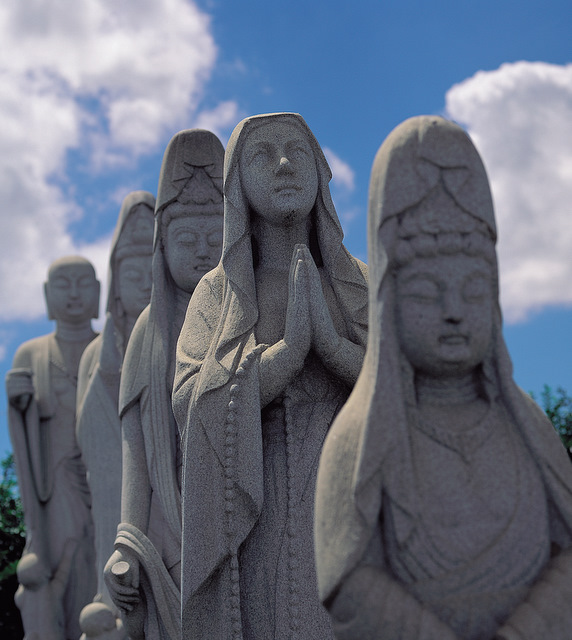
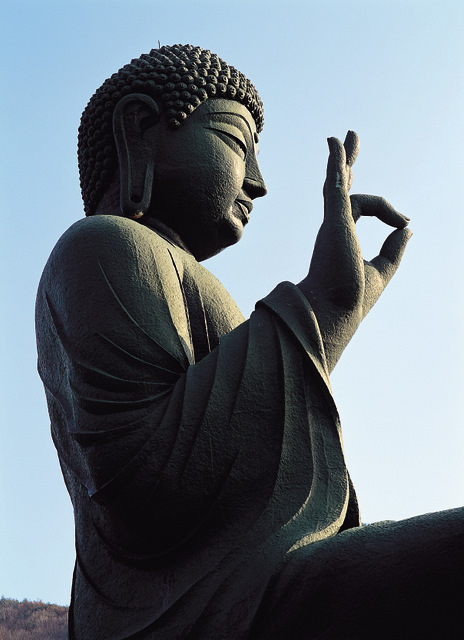
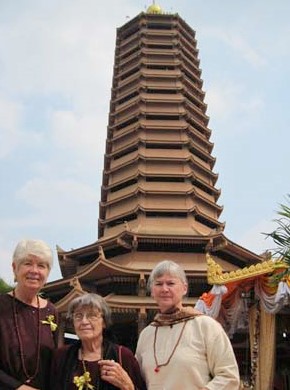
These pictures are from Sandy Boucher's website (see link below)

There is a magnificent temple in Ladphrao, Chokchai 4, in the north of Bangkok, dedicated to the Bodhisattva Avalokitesvara, which is well worth a visit. At the temple’s centre is a huge pagoda containing four thousand-armed Kuan Yins, and in every hall there are an uncountable number of statues and images of Kuan Yin and of Amida Buddha.

I went back there again last December as a guest of the Sunims at the Bangkok Hanmaum Seonwon, who had been invited there with many other Bhikkunis and female laypeople to recieve special awards honoring them for their work on Women and Buddhism by the Grand Master Shi Kuang Seng, who founded the temple, the ‘Avalokitesvara’s Great Compassion Stupa of 10,000 Buddhas’, twenty one years ago.

The awards were delivered by HRH Princess of Thailand, Prof. Dr. Chulabhorn Walailak, the youngest daughter of the King of Thailand, and so we arrived in good time to take our seats. The sight of so many Bhikkunis in many different kinds of robes – Thai, Korean, Chinese, Tibetan, Japanese, orange, grey, brown, red, black – was wonderful. Sadly, due to a computer glitch, I have no photos to show you.

Dr Lee Bhikkuni, a regular visitor to the seonwon, was also there to receive an award, as well as Mae Chee Brigitte, and many others who I didn’t recognise. You can imagine the colours, the brass band playing, the fans whirring, and even the Princess herself, after presenting the awards, giving a recital of some traditional Thai music. And behind all the female monks were a thousand Bhikkus there to perform a chanting ceremony later in the day.

Spotting a few faces I recognised, I went over to the monks and learnt that Phra Pandit, organiser of the wonderful Little Bangkok Sangha, had also been there. Apparently he’d seen me wandering around with my camera and had waved furiously, but was unable to get my attention. “What sexism” he joked on the phone later that night, “taking all those photos of the Bhikkunis and ignoring the thousand Bhikkus behind you!”

The Princess left to the waves of crowds of enthusiastic Thai people in the streets outside, and we made our way back to the seonwon. Ceremonies to mark the anniversary of the temple, and to pray for the health of King Bhumibol and for World Peace, continued all month, with, on one evening, a Dharma talk from Hyaedan Sunim from the Bangkok Seonwon in Thai.

(For all us English-speakers, there’s no need to worry! We can study with Hyaedan Sunim every month at the Bangkok Seon Club! See you there!)

Link:
Sandy Boucher: A wonderful account of the event, and of her two weeks with Shi Kuang Seng.