These days in Seoul we’re studying No River to Cross, by Seon Master Daehaeng. It’s a wonderful text with such hidden depths, that, from time to time, I thought it would be nice to recap a few of the key points here. Chapter 2 is one of the harder chapters because it deals with the fundamental reality of the world around us.
Everything in all universes is directly connected to the fundamental mind of humans and all life. Everything that functions and moves in the world is already directly connected to our foundation. Everything in the whole universe, including both visible and invisible realms, is connected and communicates as one. Nothing exists apart from anything else; the mind of all Buddhas is your inherent mind, and the Dharma of all Buddhas is the Dharma of your inherent mind and your daily life. (No River to Cross, p. 9-10)
In Korean Buddhism, it’s sometimes said that we are the combination of our body, our present consciousness, and our Buddha-nature or true self.
Body and perceptions
What we usually think of as “me,” are the perceptions and interpretations that arise from our body making contact with the material world. If I encounter something, a feeling arises, it’s interpreted, and I react to that judgement. If it’s fun, I’ll start wanting more, and if it’s painful, I’ll try to avoid it. In this way, the fears, desires, and judgements that occupy so much of my time, are only the automatic results of my body’s interaction with the environment.
An extreme example of this is sexual orientation: If I’m born as a man, the make-up of my body will naturally turn my thoughts towards women, and yet if I were born as a woman, the elements of my body would turn my thoughts towards men. (There are exceptions, obviously, but you get the point!) These thoughts and feelings not fundamental to my essence, but rather a temporary result of this body meeting the environment.
If you’ve stuck with me up to here, then you’ve probably already felt the sense of lack and incompleteness that comes from making these feelings the focus of our life. That’s because these conditioned feelings and concerns aren’t the whole picture: there is true self, also called fundamental mind, luminous mind, and God-nature.
Daehaeng Kun Sunim says about this aspect:
… true self has always been with us. However, we won’t know this unless we try to find it. Realize that everything comes from true self. The physical body is like the leaves and branches that come from the root, the true self. How could you forget about the root…. Know the root! (p. 14)
Because this root is where even this feelings and thoughts ultimately arise from, this is where we need to entrust them. However, hearing this, people often begin to think that the body and the feelings and thoughts it gives rise to are something to be despised. Daehaeng Kun Sunim cautions people about this view, saying:
There has to be a physical body in order to know the Buddha-dharma. You need to be aware that throwing away your body is not the way to know the Buddha-dharma. To think that the flesh is worthless and must be thrown away because it’s only a temporary combination is an extremely misguided idea. Without the body, you cannot develop, cannot broaden your wisdom, and cannot become a Buddha. Because the son exists, you can know the father; through the existence of the servant, you can come to know the master. By understanding visible phenomena, you can understand the invisible essence, the non-material foundation that gives rise to and animates all visible phenomena, and which always works together as one with all things.(p. 14)
So our body is certainly something to value and take care of, yet while doing this, we have to be careful not to mistake it for our totality. Ultimately everything has to be entrusted, everything has to be combined as one. When this body, its perceptions and consciousness, and our inherent Buddha-nature all function together as one, then I think we’ll discover what living as a human being truly means.
Together with Wonhyo’sInspiring Yourself to Practice, and Chinul’sAdmonitions to Beginners, this forms one of the fundamental texts of Korean Buddhism. Originally intended for monastics, practitioners of all backgrounds may find this useful and inspiring. It’s a fairly long text, with 10 parts, so I’ll post each sectionseparately. It was written atthe end of the Koryo dynasty (~1394~) by a Korean monk named Ya-un (野雲和尙), and I did the English translation.
Admonitions to Myself (自警文)
by the Venerable Ya-un
My own true self! Listen carefully!
There have been so many people who have achieved enlightenment by dissolving all attachments and aversions.[1] Why do you still linger within the realms of suffering and defilements?
For endless lives, you have turned your back on your true nature, and through clinging and attachments have fallen into ignorance. Committing all kinds of unwholesome acts while not cultivating the roots of goodness, you have repeatedly fallen into the sea of karma that leads to rebirth as one of the four types of lives. [ii]
The body follows the six senses. Thus you will suffer immensely if they lead you to be reborn in an unwholesome place. Having turned your back upon the transcendental teachings of the Buddha,[iii] even if you are able to be reborn in a human realm, it will only be before or after the appearance of a Buddha. Fortunately, this time you have received the body of a human, but you have been born long after the Buddha’s entry into Nirvana. This is heartbreaking, but whose fault is it?
Nevertheless, if you sincerely repent and want to change your direction, then cut off all attachments to the world. Leave home, carrying your bowls and wearing the kasa, and take the direct path and learn the profound Dharma, which is free of all defilements. Like a dragon in the ocean depths, or Spring coming to a mountain, this profound truth is utterly inexpressible!
People have a past and present, but the Dharma is neither far nor near. People can be wise or foolish, but the Way is neither strong nor weak. Even if you had lived at the time of the Buddha, what would it have benefited you if you didn’t follow His teachings? Even though you live in a period of decadence, if you believe and live according to Buddha’s teachings, the benefits of this will be beyond measure.
Thus the Buddha said, “Like a good doctor, understanding the disease, I prescribe the appropriate medicine. The doctor is not to blame if the patient refuses to take the medicine. Or like a good mountain guide, I show people a safe path. If people ignore the directions he has given, it is not the fault of the guide.”
“The Dharma, which is beneficial to myself and to all beings, is omnipresent and inherent within all. Thus, even if I were to remain longer in this world, there would be no additional benefit. If my disciples continue to practice the Dharma without ceasing, then the Dharma-body of the Tathagata will never disappear.” If you understand this truth, then you will regret only your own lack of practicing, rather than worrying about things such as the decadence of the era.
I sincerely hope that you develop a resolute and expansive mind, and determine to completely cut off all ties to the mundane world, and get rid of all delusive thoughts. Thoroughly investigate the hwadus [iv] of the Patriarchs, attain the highest wisdom, and thus overcome the great matter of birth, aging, suffering, and death. Make the attainment of ultimate enlightenment your goal. Don’t take this lightly, don’t step backwards.
In this age of degeneration, it has been a long time since the Buddha left. Mara has grown strong and the Dharma has become weak. Those who lead people astray are many, while few are the ones who correctly show the path. Wise people are few, while the ignorant are many. Not only do they ignore the Buddha-dharma, but they also distract others. It’s not possible to talk about all of the hindrances to spiritual cultivation.
Worrying that you might go astray, I have outlined ten points to be cautious about. Please believe what I say and do not violate any of these points.
If you are ignorant and do not study,
your arrogance alone will increase.
If you do not polish the darkness of your mind,
your egotism will only deepen.
To have an empty stomach and a haughty mind
is to be like a hungry snake,
or an ignorant and lazy monkey.
Although you readily listen
to harmful and evil speech,
you purposely ignore the teachings of
the Buddhas and Bodhisattvas.
If you have no affinity with
the good path,
who will be able to help you?
Following the six senses,
leads only to terrible suffering.
[i] Literally, “…achieved enlightenment through the gate of emptiness.” This can mean a deep experiential understanding of emptiness, or it can also mean making your behavior and thought in harmony with the principles of emptiness.
[ii] Lives born from wombs, eggs, moisture, and through transformation.
An Introduction One of the major figures in Korean temple food is Seonjae Sunim. She’s been researching Korean temple food for many years now, and I had the privilege of attending a series of lectures she gave about the topic.
Modern history
One of the interesting points she made about Korean temple food is that much of the know-how has been lost. She said that before the Japanese occupation (1904 – 1945), there was a lot of accumulated techniques and knowledge about vegetarian cooking in the big temples. But with the Japanese control of Buddhism during the Occupation era, followed by the destruction and poverty of the Korean War and years afterwards (1950-1970 or so), this was lost.
Japanese Era – the loss of the vegetarian tradition The biggest thing about the Japanese occupation for Buddhists, was the “reforms” forced on Korean Buddhists. Chief among these was the effort to create an acceptance in Buddhism for the monks to marry, drink alcohol, and eat meat. They put this into motion around 1920, when after having centralized all of the temples into one network, they appointed their own people as abbots of the regional head temples. These men drank, ate meat, and tended to be married. The traditional Korean monks were outraged about this, but at first the Japanese government ignored their protests, and then made drinking, marriage, and meat officially accepted.
Through coercion and enticements, by 1945 the vast majority of the men in temples belonged to this system. This was really the biggest blow to the vegetarian tradition in Korea. For, after 30 or 40 years of this, a lot of the monks and nuns who were masters of the old system of vegetarian cooking had simply died without having passed on their knowledge.
Not helping was the poverty of these years, and the years after the Korean War, when anything at all to eat was gratefully received. So by the 1970’s what you had was temple cooking that was simply ordinary Korean cooking, minus the meat. Which, nutritionally, really isn’t adequate.
The Nature of Plants, and Seasonal Energies One of the interesting things that Seonjae Sunim discovered as she was re-discovering these old systems of vegetarian cooking, was that just because it was a plant or vegetable, that didn’t mean it was good for you. In the old system, it was very clear that every plant, vegetable, and dish had a season. This didn’t mean merely what was available, but that given the energy of a certain plant, it should only be consumed during the appropriate season. So there are dishes that are spring dishes, and only consumed in the spring. For example, mugwort has certain properties that make it beneficial only during a certain season or two.
Likewise, people’s energies also have seasonal fluctuations, and different seasonal needs. So what’s good for you in the spring, might be harmful in the fall. So traditionally prepared temple vegetarian food is based upon the interaction of the plant, the season, and the person. This is also a very local food, with the cook checking the markets, and hillsides, to see what’s available and appropriate for the season. Thus, if you visit a very traditional temple restaurant, all of the dishes on the menu will be those appropriate to the season.
The Energy of Local Food
This way of looking at traditional food has an interesting parallel with traditional Korean medicine. Rather than following the prescriptions from the great texts of China, Korean doctors realized that the best medicine would also have the energy of the same land as the patient. So instead of focusing on Chinese ingredients, they started researching local plants and their effects on people. That is, they were looking at what was nearby, and seeing what it’s effects were. A lot of traditional temple food is awareness of the energy of local food, and what it’s properties and flavors are, and seeing how this feels.
Thus, food should ideally be made with local ingredients that are fresh and seasonal. So dishes that require expensive, exotic ingredients aren’t really in keeping with this spirit. Rather than exact copies of Korean dishes with Korean grown ingredients, I look forward to seeing people (in other countries) creating their own “fusion” dishes, taking into account the local produce and the Korean techniques and spirit of preparation.
Now the disclaimer: I know good Korean food when I taste it, but I’m terrible at making it. Somehow it always comes out blah. If you’re really interested in Korean food, there are a lot of Korean cookbooks that look pretty good. Likewise, there are also a lot of websites dedicated to Korean food. And I’m sure there are cooking classes in most big cities.
If you’ve stuck with me this far, you deserve a treat! So here’s a recipe for a type of daal that Daehaeng Kun Sunim likes quite a bit. The recipe originally came from Yoga Journal, and is one of the few dishes I make that comes out great every time. The only caveat is that I have to follow the steps in order. Whenever I’ve tried to save time by combining steps, the flavor’s off. (By the way, if anyone knows any good daal recipes, please share them with me. Thanks!)
Kun Sunim’s Porridge
Grains 250 ml (1 cup) of glutinous rice, the Korean variety (chap-sal) works better than Indian rice
250 ml (1 cup) of mung beans these are a small, yellow legume
The rice and the mung beans should be rinsed several times and soaked for at least an hour before cooking (2-6 hours is best, but one hour is okay)
Spices 1 ml Turmeric powder – (1/4 teaspoon)
1 ml ground Cloves
1 ml ground black Cardamom
1 ml Salt
1 ml ground Pepper
2 ml ground Cinnamon (1/2 teaspoon)
3 Bay leafs
Cilantro Puree Cilantro, about a handful – clean leaves and stalks
30ml shredded coconut – 2 table spoons
15ml minced Ginger – 1 tablespoon
250ml of water – 1 cup
Put the coconut, ginger, cilantro, and water in a blender and pureed.
Cooking Sauté all of the 7 spices in 30ml (2 tablespoons)of clarified butter or coconut oil (organic) until brown.
Stir in the drained mung beans, and thoroughly mix with butter and spices.
Next stir in the rice.
Add the cilantro puree and thoroughly mix together.
Add 1.25 liters (6 cups) of water and bring to a boil, stirring occasionally.
Once it starts boiling, reduce heat to a simmer, cover and stir occasionally, cooking for 25-30 minutes. Take out the bay leaves before serving.
It’s a hot day here in Korea, and for some reason it seemed like it would be fun to share some of my favorite books about Korea, along with a couple that I’d like to check out.
(I’ll add links to these, because they can be hard to find, and expensive, depending on where you’re ordering them from.)
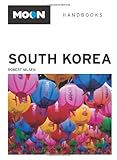
The all-time best travel guide to Korea has to be South Korea by Moon Handbooks. If you just want bus and hotel info, then Lonely Planet will probably be fine, but if you want history and details about the places you’ll visit, then this is the book for you. My Korean Dharma brothers were always amazed that I knew more about the places we were visiting than they did. This book is why!
(The new edition at Amazon has only two ratings, but if you look at the previous edition, you’ll see it was highly rated.)
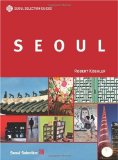
However, if you’re going to be spending most of your time in Seoul, then you can’t go wrong with SEOUL. For years the only city guides to Seoul have been small, pathetic things, but now that’s changed!
This is a huge book, filled with photos and every kind of information you could imagine about the city and the areas around it. This book was put together by the same team that publishes Seoul magazine, and runs the Seoul Selection website, so they really know their stuff. (If you live in Korea, you can also get it at the Seoul Selection bookstore.)
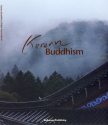
A very nice book about Buddhism here is Korean Buddhism. The photography in this book is incredible. It’s a nice introduction, but also quite detailed in explaining the different parts of the temple, temple etiquette, and a fair amount of Korean Buddhist history. (I really, really want to meet the photographer and see if I can use his images for this blog. They’re extraordinary.)
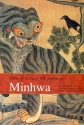
A book I’d like to check out the next time I visit Seoul Selection is Minhwa: Tales of Korean folk paintings. As you can see from the cover, Koreans traditionally really like wild drawings of tigers. A friend and I joked that it was because artists were trying to draw them from old skins, as few people survived getting good look at a live tiger!
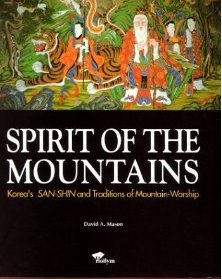
On a similar note, if you’re interested in Korea’s mountain spirits, then the book you have to check out is David Mason’s Spirit Of The Mountains. You can also order this directly from David at his website, San Shin (which is an incredible reference guide in its own right). This book is almost out of print, so if this topic interests you, order now. Filled with photos and in-depth explanations, you won’t see a book of this quality again.
If you’re into tea, then you might like Korean Tea Classics. I happen to know one of the translators, Brother Anthony of Taize, who in addition to being a wonderful person and fluent in Korean, really loves his tea.
This book is a collection of three texts by the greatest figures associated with tea in Korea. If you live in Korea, you can also find this one at Seoul Selection.
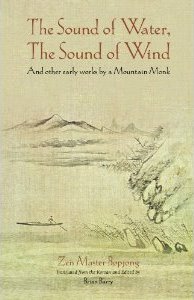
Recently, one of Korea’s most well-known monks, Beop Jeong Sunim, passed away. He was famous for his down-to-earth and humane essays that people of all religions could appreciate. Fortunately for us, Brian Barry had just finished an English translation of some of Beop Jeong Sunims most important essays, The Sound of Water, the Sound of Wind: And Other Early Works by a Mountain Monk. (Here’s the link to Seoul Selection.)
If you find Korean culture interesting, or want to share it with someone else, you might like the quarterly magazine, Koreana. This is really one of the very best sources of regular information about the history and culture of Korea, both modern and ancient.
(You can also order copies from Seoul Selection, or subscribe at the link above. This is also often sold in the major bookstores around Korea.)
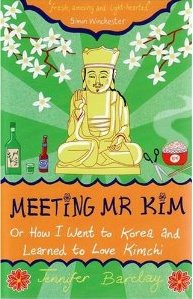
For a bit of fun and culture at the same time, check out Meeting Mr. Kim, by Jennifer Barclay. This is a great book about her time in Korea. She realized that if she really wanted to experience Korea, then she had to get out of Seoul. So she started taking weekend trips out to the countryside and just seeing who she could meet. Her description of life there, and the kindness of the people, really hits the spot. If you want to see what life in Korea is like, check this one out.
No matter how many thousands of things confront you,
no matter how painful or difficult,
even if someone you love is about to die,
entrust all of these to your foundation,
your inherent nature,
your true essence.
It’s always been taking care of me,
it’s guiding me even now,
so what’s there to worry about?
Just entrust everything there
while going forward.
You need this kind of attitude.
All of those things that confront you are your homework,
the path through which you can grow.
If everything in your life is smooth and trouble free,
you won’t be able to rise above the level
of an unenlightened being,
or understand the hardships facing others.
It all depends upon how well you can handle good and evil,
on how non-dually you can let go of both sides,
even including the Buddha.
Frustration, stress, and loneliness,
and situations where success seems unlikely,
all of these things are the raw materials of your spiritual practice.
So, when difficulties and suffering come,
be grateful for them.
For through these
you are able to practice and to grow.
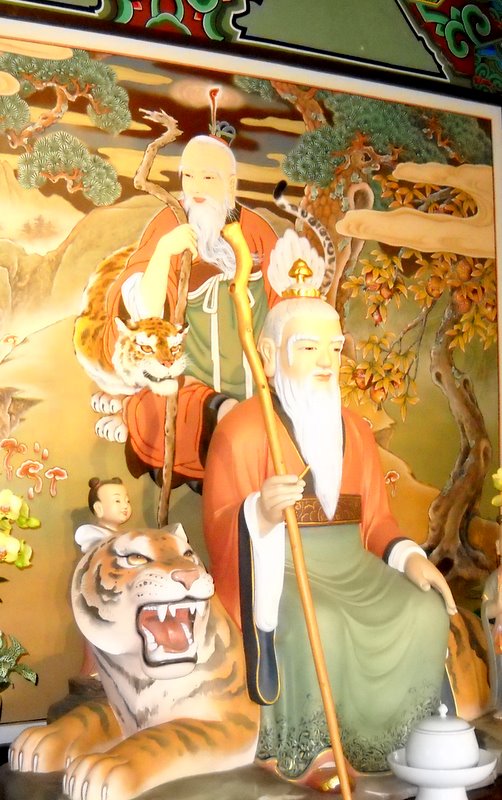
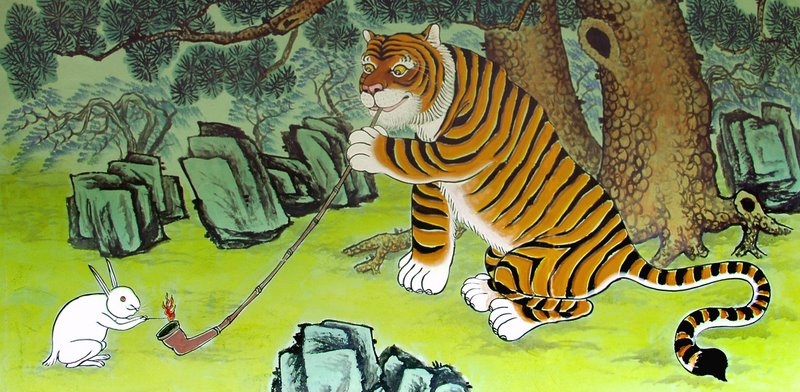
An image and painting from a Moutain Spirit shrine (click on the image to see a larger view)
Tigers play a prominent role in Korean spirituality, and stories about them were often used to convey deep ideas and practices. One of the most famous involves the legendary figure, Tangun. Considered the founder of Korea, he was a great being who taught spiritual cultivation as well as advanced methods of agriculture, medicine, and animal husbandry. In so doing, he brought great benefit to all the people of the land.
Tangun’s story begins with his mother.
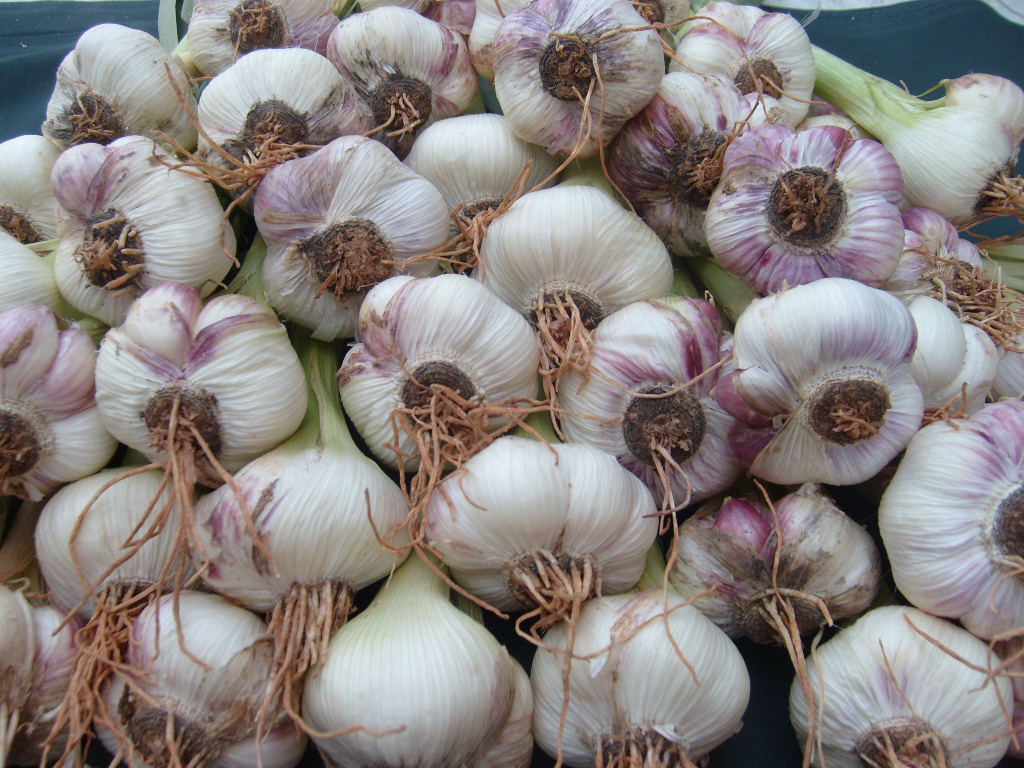
Around 2,400 B.C.E., a female bear and a tigress shared the same cave. Together they prayed to the heavenly king to become human beings. The king took mercy on them and said that if they could stay secluded out of the sunlight, and eat only garlic and mugwort for one hundred days, they would be transformed into human beings. He gave them garlic and mugwort, and they entered the cave. There they stayed, eating only garlic and mugwort. It wasn’t too long before the tiger began to have more and more difficulty with this. Soon she couldn’t resist the desire to roam and eat meat, and left the cave. The bear continued to eat the mugwort and garlic, and after just 21 days was transformed into a human being. Later, after marrying a heavenly prince, she gave birth to Tangun.
Although on the surface, this might seem to be just a strange folk tale, it’s actually a description of spiritual practice and awakening. Think of the bear and tiger as our animal natures, the habits we’ve carried with us as we’ve evolved. Instead of running around outside, indulging their habits, they were doing what was difficult, what tasted bitter, and returning all those back to the cave within us. One person couldn’t endure this and gave up. However, the other persevered and so realized her true nature, that essence that is vastly more than the temporary habits and thoughts arising from the body and its senses. In so doing, she was transformed into a true human being. Knowing this Buddha-nature for herself, she recognized it in others, and found a similar person for a husband. And together, they gave birth to a child who became a blessing for all around him.
This is a bit unrelated, but the Korean version of “A long, long time ago…” also involves tigers. It goes like this: “In the days when tigers smoked tobacco…” How this saying developed, I have no idea!
An image from Woljeong Temple in the Odae Mountains
Here’s a guest post by Gary about the pull he felt towards spiritual practice, and the path it took him on.
I have always enjoyed reading and have had a particular affinity for books on eastern philosophy. I remember seeking out books on Buddhism on lunch hour at the local library, as well as, scouring local bookstores whenever I had free time. Having grown up a Catholic, I was not too sure what I was getting into, but still I explored. I found books by the Dalai Lama, Dainin Katagiri, Philip Kapleau, and many more. The books were fascinating, but I must admit my comprehension level was quite low. Soon, my explorations led me to check out the philosophy from India and various Indian swamis and saints over the years. I spent hours reading Swami Rama, Swami Chetanananda, and Yogananda, to name a few.
Each day, I would write in my journal, dream, and pray about what I pictured as the “perfect” spiritual retreat – this was quite an undertaking since I was not affiliated with any formal spiritual group. I dreamt about my ideal place having a Swami from India and beautiful grounds, but knew of no such place anywhere nearby until one fateful day having run out of bookstores known to me I skimmed the Yellow Pages and found a listing for the Vedanta Society of Sacramento Bookstore. Having no clue what type of bookstore this was, nonetheless, I called and then soon thereafter drove over to what turned out to be a beautiful 8 acre retreat garden and monastery complete with a Swami from India – I could hardly believe my eyes, this place was hidden right in the middle of Sacramento and I had been oblivious of it for over 20 years.
Sacramento Vedanta Center
As it turns out, I began attending the Vedanta center and learning first-hand from a Swami from India. What I like about Vedanta is the Advaita philosophy of non-dualism, as well as, the teaching that each person can follow his or her own path toward realization. The center I attend in Sacramento follows the teachings of Ramakrisha, a 19th century saint from Calcutta, India. Buddha and his teachings are also revered. My time with Vedanta has taken me on trips to India two times. I have been able to see the Vedanta world headquarters in Calcutta, the temple where Ramakrishna lived, the holy city of Varanasi, and where Buddha gave his first public talk.
That was 10 years ago that I discovered Vedanta, or I should probably say that it was “revealed” to me. During the past 10 years, I have delved into Vedanta deeper and have sought out all I could find on Buddhism, particularly Zen. Most recently, I have found doing searches on Amazon to yield quite fruitful results, and one evening while searching “zen buddhism,” I found a listing for No River to Cross. I read the reviews and the pages of the text available. There was no doubt in my mind – this was a book to order. So, a few days later the book arrived and I excitedly began reading it. Daehaeng Kun Sunim is definitely a breath of fresh air – her deft touch and heartfelt guidance shine through from start to finish. And, once again, a dream has come to fruition – I have been led to a spiritual master, and have come in contact with some wonderful folks all the way across the world in Korea. I am indeed quite thankful.
Inspiring Yourself to Practice By the Korean Zen Master Wonhyo
This English translation and introduction were done by Won-myong Sunim and Mark Mueller
Inspiring Yourself to Practice was written by the Silla Monk Wonhyo (617-686). It consists of 706 characters, contained in one roll. In Korea, the text is one of the most important in the curriculum of the temple training. The text stresses the need to dissolve one’s worldly attachments and habits, and to begin immediately to practice. The original Chinese text is kept at Haein Temple, near Daegu, and the annotated version is kept at Songgwang Temple, in Sunchon.
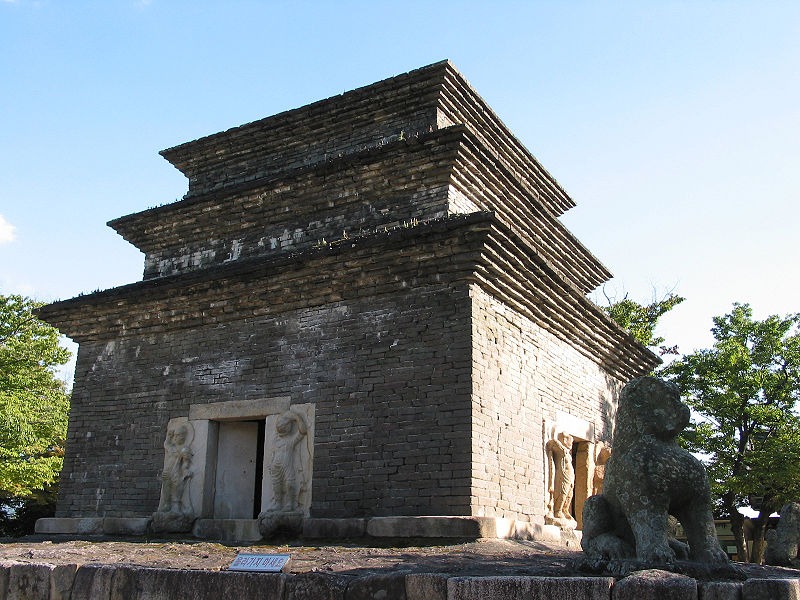
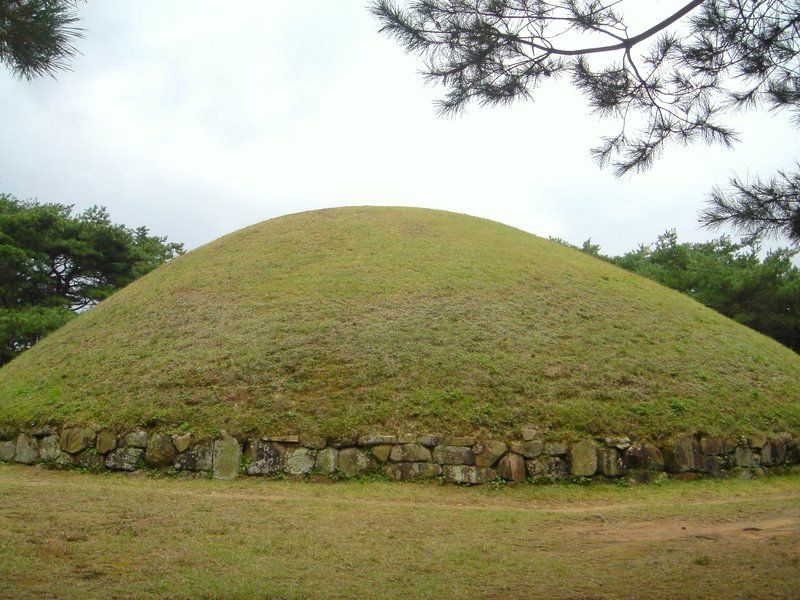
The twin pagodas at Kamun Temple siteThe stone pagoda from Bunhwang Temple, historically associated with Wonhyo. Photo by bifyu, on WikipediaThe grave of the Queen Seondeok (/sun-duck/). She was the ruler of the Silla Kingdom and known to Wonhyo
All the Buddhas
who reside within the splendid realm of Nirvana
have, throughout countless eons,
discarded their desires and undergone arduous training.
Sentient beings,
transmigrating within
the burning house of desire
have, for countless generations,
failed to discard their greed and desire.
The gates to heaven (the Pure Land)
are not blocked;
yet, few are those who enter them.
This is because most people make their home
among the three poisons. (1)
The evil realms (2)
have no real power to seduce us,
yet many enter them.
The deluded mind values
the four elements (3) that make up the body
and the five desires (4)
as if they were jewels.
This being so,
is there anyone who does not long
to retire to the seclusion of the mountains
in order to practice the Way? (5)
Yet people do not go there;
they remain caught up in desire.
Although you do not
retire to the mountains
to cultivate your mind,
you should strive with all your energy
to perform good deeds.
If you can renounce your own pleasure,
you will become as trusted and respected
as the sages.
If you can undergo
that which is difficult,
you will become as respected
as the Buddha.
Those who greedily seek after things
join the ranks of demons.
Those who give with compassion
are the disciples of the Dharma King.
High mountains and lofty peaks
are where the wise reside.
Green pines and deep mountain valleys
are home to those who practice.
When hungry, such people pick fruit from trees
to calm their empty stomach.
When thirsty, they quench their thirst
with water from a stream.
Although we eat fine foods
in an attempt to carefully preserve this body,
our bodies will definitely face destruction;
even though we cover this body
with soft cloth,
our lives are sure to come to an end.
Make a small mountain cave where echoes resound
into a hall to chant the Buddha’s name.
Let the sad cry of a wild goose
be the heart-warming call of a friend.
While bowing, your knees may become
as cold as ice,
but you must not long for a warm fire.
Your stomach may writhe with hunger,
but you must not give in to your thoughts of food.
One hundred years pass like the blinking of an eye,
so why don’t you practice?
How long is a lifetime?
Can you afford to neglect practice,
wasting your time on leisure?
It is only he who renounces
all of the desires in his heart
that is rightfully called a practicing monk.
Only he who no longer yearns for the ways of the world
is called “a monk who has renounced the house-holder’s life.”
A practitioner who is caught
within the net of worldly desires
is like a dog who wears
elephant’s hide.
A man who practices the Way
yet remains attached to worldly desire
is like a hedgehog
who tries to enter a rat hole.
Some people, in spite of their outstanding ability and wisdom,
choose to live in the busy atmosphere of the city.
All the Buddhas feel pity and concern for such people.
other people, although they have not yet developed
a deep practice,
choose to stay in the contemplative atmosphere of the mountains.
The sages feel a great joy
when they see such people.
There are those who are skilled and learned,
but do not follow the precepts.
They are like men who are told of a cache of jewels
but do not get up and go to it.
There are those who practice steadfastly
but lack wisdom.
They are like men who want to go east
but mistakenly walk towards the west.
The actions of a wise man
are like steaming grains of rice
in order to make a bowl of rice.
The actions of a man who lacks wisdom
are like steaming grains of sand
in order to make a bowl of rice.
Everyone knows how to eat and drink
in order to satiate their hunger;
but no one seems to understand
the method of training —
the way to transform the ignorant mind.
Practice and wisdom must exist side by side.
For they are like the two wheels of a cart.
Likewise, helping oneself and helping others
are like the two wings of a bird.
If you absent-mindedly chant for your donors
over the morning offering of porridge
without understanding the meaning,
you should feel ashamed
to face those who give alms.
If you chant
during the lunch-time ceremony
without attaining the essence of the words you utter,
won’t you be ashamed to face
great people and sages?
Everyone hates squirming insects
and those who can’t distinguish between the dirty and the clean.
Likewise, the sages feel disgust with those monks
who cannot distinguish between the defiled and the pure.
If you wish to be through with this world’s conflict,
good conduct is the ladder
that ascends to heaven.
Therefore, one who violates the precepts
and yet wishes to help others
is like a bird with broken wings
that puts a turtle on its back and tries to fly.
If you’re still not free from your own faults,
you will not be able to free others of their faults.
So why do you, who violate the precepts
receive that which is provided by others?
It does not benefit you in the least
to merely maintain your physical body
if you neglect to practice.
And all your concern for this transient, fleeting life
will not preserve it.
If you’ve set your sights
on the virtue of the great masters,
you must endure even the longest hardships.
Once you’ve set out for the Tiger Throne, (6) you must forever leave all your desires behind you.
When the cultivator’s mind is pure,
all the devas (7) bow in praise of him.
When a follower of the Way loves lasciviousness,
the good spirits leave him.
At death, when the four elements of the body scatter,
you cannot preserve the body and remain in it any longer.
Today, evening has already arrived;
tomorrow morning will soon be here.
So, practice now before it is too late.
Worldly pleasures are unsatisfactory;
why do you greedily cling to them?
Enduring joy can be won through a single effort in patience;
why won’t you practice?
Those who practice feel shame
to see a seeker of the Way who remains attached to greed.
The virtuous man laughs
at the seeker who forsakes the householder’s life
but is still wealthy.
Words, such as these written here, go on and on,
yet clinging attachment does not come to an end.
“I’ll do it next time” — such words go on and on,
yet you fail to put an end to clinging.
Clinging goes on and on,
yet you fail to renounce worldly matters.
Your mind is filled with endless devious plans,
yet you do not make up your mind to put an end to them.
“Today will be different,” you say,
yet you continue to perform evil actions every day.
“Tomorrow, tomorrow,” you say,
yet few are the days when you really do something good.
“This year will be different,” you say,
yet your defilements are without end.
“Next year I’ll do it,” you say,
yet you don’t grow in wisdom.
The hours pass,
snd too soon a day and night are over.
The days pass,
and soon it’s the last day of the month.
The months pass,
and suddenly another new year has come.
The years pass,
and in the blinking of an eye,
we find ourselves at death’s door.
A broken cart
cannot be driven.
When you’re an old man,
you cannot begin to practice.
When you lie down,
you will succumb to laziness.
And when you sit,
your mind will be overwhelmed
with stray thoughts.
For many lifetimes, you have failed to practice,
passing your days and nights in vain.
Having lived many lifetimes in vain,
will you again fail to practice during this lifetime?
This body will inevitably come to an end;
who knows what body you will have next time?
Isn’t this an urgent matter?
Isn’t this an urgent matter?
N o t e s
==============
1. Greed, hatred (anger) andignorance.
2. Durgati, the hell realm, the animal realm, etc.; there are 3, 4, or 5 according to text consulted.
3. Earth, water, fire and air are the four elements that everything is made of.
4. There are two meanings: 1) the objects of the 5 senses (eye, ear, nose, mouth, body); these defile the True Nature when the mind is filled with desire; 2) desire for wealth, sex, food, fame, and sleep.
5. The Way refers to the path to enlightenment.
6. This is a name for the Dharma Seat, the special platform that a great monk sits on to give a Dharma lecture. Someone aiming to sit on this seat is aiming for enlightenment and so needs to give up all attachments and desires.
7. The devas are the beings who live in the Heavenly realms.
Karmic affinity probably plays a role, but when I was first starting out, I was never attracted to the Theravadan tradition.
In large part this was due to what I perceived as the strong, perhaps extreme, focus on the 250 precepts for monks (and 348 for nuns.) If I had to keep all of those straight in my head, I imagined that each and every day would be occupied with worries about which shoe I put on first, and whether I was holding my bowl in the right hand.
Well, I’ve since learned that it’s a lot more simple than that.
Basically, the precepts are there to help practitioners gather energy and motivation in their practice.
To this end, the situations they address fall into several categories:
1) avoiding things that will create karmic hindrances or damage our energy and faith
2) avoiding things that cause us stress and worry
3) not putting ourselves in the path of temptation
4) not creating the appearance of wrong doing
5) the appropriate situations for teaching the Dharma
6) rules to help a large community live together harmoniously
(there’s one or two more categories that I can’t remember just now!)
The additional rules for nuns basically address their safety in an era when an unescorted female was assumed to be a prostitute, and could be treated as such.
Also for nuns, it’s important to remember who the first nuns were: they were from the noble classes, and were the family members of the Buddha and his great disciples. So when the Buddha said that an 80 year old nun had to bow to a 3 year old monk, these are the women he was addressing. It’s as if he was saying “your family status and connections with the leaders of the sangha don’t count here.”
I smile when I think of what might have happened otherwise: “Ananda! Come here and give your Auntie a shoulder rub!” 🙂 o
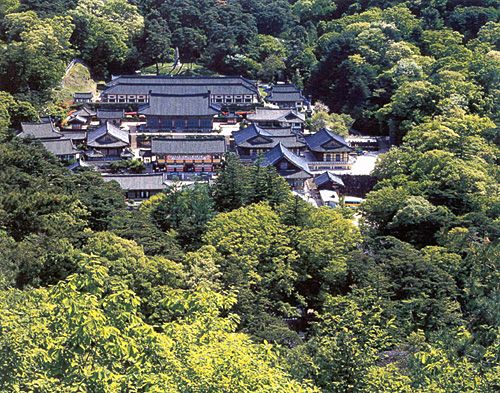
Traveling towards the Jiri Mountains, I had spent the last few nights at Haein Temple, but was down to my last six or seven thousand Won. (It would have been about eight US dollars in those days.) I’d wanted to travel like the monks of old, going where circumstances took me. So I left without taking any extra money, determined to rely upon the kindness of the sunims at the temples I visited. Normally this isn’t a problem; visiting monks are traditionally given traveling money to take them to their next destination. In practice, it’s always more than enough, usually at least 30,000 Won (about thirty U.S. dollars), and often more.
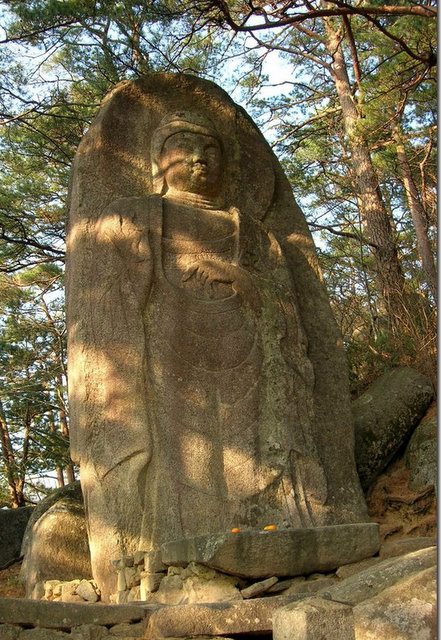
Standing Buddha on the mountain behind Haein Temple
However, upon leaving Haein Temple, I had been given nothing. In addition, while staying there, I’d been put in a dark, dirty room behind the kitchen and told to be careful that none of my personal belongings were stolen. (After thoroughly cleaning the room) I spent a few days at Haein Temple, paying my respects to the great wood-block collection of the Buddhist canon and attending most of the daily ceremonies. After the morning cleaning, I would hike the mountains behind the temple, and meditate before the huge rock carvings of Buddha. (This photo is from here, with thanks to the photographer.)
But for some reason, the wonju sunim (the monk in charge of guests and shopping) seemed to take a strong dislike to me. On top of this, when I left, I was given no traveling money. It was such a contrast to my previous visits to Haein Temple that I was in foul mood as I headed for the valley’s entrance. With almost nothing in my pocket, I barely noticed the lotus lanterns stretching for miles along the road, or the beautiful spring flowers on the fruit trees. Anger really makes a fool out of me.
Arriving at the bus stop on the main road, I went over to the small police station to ask for directions to a major temple in the Jiri Mountains called Hwaeom Temple. I suspected there might not be a direct bus, but I would be able to take a connecting bus from the nearest city. Bus fare in Korea is very cheap, and with what money I had, I might just make it if I stuck to the local buses.
Strangely enough, the policeman didn’t know which city I needed to go to, nor did he even have a road map of Korea. I had started out the morning irritated and was rapidly progressing to downright angry. “How could this be?! A policeman who doesn’t know the cities in the area or even have a road map?! And what’s with that jerk at the temple treating visiting sunims so badly?!” Anger really makes a fool out of me.
I knew I needed a bus going west, so as I stewed, I sat and waited. But part of me knew this anger was wrong. No matter how reasonable all of those justifications and descriptions, there was something fundamentally wrong with that anger and self-righteousness. I tried to let go of it, but I just couldn’t shake it. Finally I remembered what my teacher often said about aggressively entrusting the things that confront us. Determined to experiment with what she told us, I said “Okay Juingong, you’re taking care of all things, so take care of this anger too! I don’t want to carry this around any longer.” (“Juingong” is synonymous with true nature or Buddha-nature, and literally means the one that is truly doing things, but which has no fixed form.) I was still grumpy, but it seemed to help a bit.
A few minutes later the bus came, but flew right past the bus stop. My body bolted up and I found myself shaking my fist at the bus. The driver, seeing me in the side mirror I suppose, hit the brakes and came to a squealing stop about 50 meters past the bus stop.
I was still pretty hot, but managed to grunt thanks as I paid my fare and found a seat. A few kilometers further on, the road passed through some rice fields. Here the road bed was raised about two meters above the fields, with only about 30 centimeters of grassy shoulder on each side. Just ahead of us, a farmer had parked his car in our lane while he checked on something in a field. The only way around was for the bus to go into the oncoming lane. But as the bus barreled ahead towards the parked car, there was a car coming towards us in the oncoming lane. It was as if our driver didn’t realize that the car ahead was parked, and that he wouldn’t be able to go around it because of the oncoming car. We were closing fast on the car blocking our lane, and the oncoming car wasn’t slowing down either. In a moment two cars and a bus would be trying to occupy the same time and place. At the last instant, the oncoming driver seemed to realize that our bus had no intention of stopping behind the parked car. He slammed on his brakes as our driver wrenched the bus into the oncoming lane, passed the parked car, and then veered back again.
It took me a minute to remember to breathe, but as I did, I noticed that our driver’s head was rolling from side to side. Now his left ear would almost be touching his left shoulder, now with a violent jerk his head would swing up, and a moment later be almost on his right shoulder, and then back again. Seeing his bright red face in the mirror, I realized that he was drunk. Not just tipsy, but a full three sheets to the wind drunk.
My first thought was to get off at the next stop. But before I had a chance to, I remembered something I’d heard Daehaeng Sunim say about a plane crash, “This may be hard to believe, but if even one person on that plane had been practicing, it wouldn’t have crashed.” Ugh.
I stayed on the bus, and focused on entrusting the situation, and my fear(!), to this Buddha-nature that connects and guides all things. Finally the bus reached the terminal in the city of Geochang, and the driver got off. As I watched him head for the break room to sleep it off, I ran into a friend I hadn’t seen in several years. He was living at a large meditation hall, Sudo Hermitage, about an hour away, and invited me to stay there. Later that night, as I settled in and prepared to spend a few days, I suddenly remembered about having been angry earlier in the day.
The meditation hall at Sudo Hermitage. Photo by Chang, Dong Yeon
I couldn’t help laughing out loud, because with that terrifying bus ride, all of the anger I’d felt earlier in the day was utterly forgotten. I had raised the thought that I wanted to be free of that anger, and it had worked! By the time I got off that bus I had completely forgotten about being angry. I laughed again and thought to myself, “Be careful what you ask for!”
 There has to be a physical body in order to know the Buddha-dharma. You need to be aware that throwing away your body is not the way to know the Buddha-dharma. To think that the flesh is worthless and must be thrown away because it’s only a temporary combination is an extremely misguided idea. Without the body, you cannot develop, cannot broaden your wisdom, and cannot become a Buddha. Because the son exists, you can know the father; through the existence of the servant, you can come to know the master. By understanding visible phenomena, you can understand the invisible essence, the non-material foundation that gives rise to and animates all visible phenomena, and which always works together as one with all things.(p. 14)
 Fortunately for us,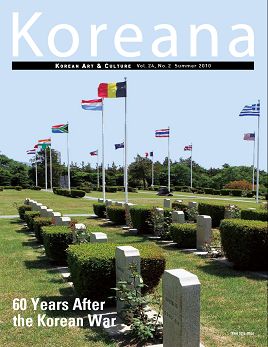





 Wake Up and Laugh!