The Goofy-footed Buddhist

Here’s a guest post from Bonsai Doug about this messy process of working out our own salvation.

The term “footedness” refers to a preference to put one’s left or right foot forward in the various board-sports like surfing, or skateboarding – a “regular stance” if you will.  The opposite of this regular stance is often referred to as “goofy-foot.”

I often feel I’m traveling my personal Buddhist path a bit goofy-footed.  Let me try to explain.

I live in a small, rural area of western New York.  There is no temple or sangha to help me on my path.  So, I rely heavily on my library (I devour books!) and my online community to be my sangha.  While this sometimes makes for a bumpy path, it also makes for one rich in all the varied and wonderful traditions of Buddhism.

I have two bodhi seed malas which I love.  But I know I’m not using them quite as intended. Meditation (no secret here) is challenging.  So when concentrating on breaths, I often use a mala to count those breaths, and to keep my mind as focused as possible.  The result is that I do not sit quite as “still” as recommended, but it seems to work for me.  It has made meditation something I very much look forward to.  I know the mala is used in the counting of mantra and prostrations, so I guess my approach here too is a bit goofy-footed.  Or perhaps I should coin a new phrase… “goofy-handed?”

My goofy-footed approach, however, has resulted in many great stops along the way.  Friends made while in Korea.  Gary Gach, the author of “The Complete Idiot’s Guide To Buddhism.”  Lunch with the monks of Wat Mongkolratanaram.  A personal tour of the Byodo-In temple in Hawaii.  Being present when the Jade Buddha for Universal Peace arrived at the Minh Dang Quang Temple in Florida.  And of course, discovering “Wake Up and Laugh.”

I sincerely hope my goofy-footed approach proves fruitful.  I do know I am the better for it.  I’ve never been happier and more at peace with myself and those around me.  I am far more caring, loving and compassionate than ever before.  Walking my path, albeit goofy-footed, is providing for a wonderful journey.

And whenever I become a bit discouraged with my goofy-footed journey, I remind myself of a quote from His Holiness the Dalai Lama:

We all travel our own path to enlightenment.
  And just because someone is not following on our path, it does not mean they are lost.
 
Namaste, and be well!
                                        Doug

spiritual capacity like a bowl

More about bowls!

The last couple of posts have really brought up some great points about striving, versus freeing oneself from dualities. I found myself laughing, because I agreed completely with everyone!

The first point is spiritual capacity. As Joseph brought up in yesterday’s post, our spiritual capacity is a like a bowl: it can only hold that much. Anything more overflows and is lost (or makes a mess).  So what can we do to increase our size, or as Barry points out, is this desire to be a bigger bowl actually a dualistic hindrance.

I think the answer lies in the approach. Why do we want to do this? Is it because we keep hearing Dharma talks and can’t remember them afterwards? Is it because we aren’t doing a good job of putting into practice what we know, or that we feel like what the Tibetans call a broken cauldron – no matter how much is put in, nothing is retained, nothing seems to be learned (from the experience).

At the risk of pushing an analogy too far, what determines our bowl size? To me, it’s whether we are living based upon our conditioned thoughts and urges of the body, or whether we are moving from something deeper.  Then the question becomes how do we get in touch with this something deeper, this something that has ten-thousand names.  The only way I know how to do this is by heavily returning everything to this fundamental mind, this Buddha-essence – letting go of “me,” what I know, and what I want to do. I’ve also heard someone describing this as “letting go to emptiness.” 

In a sense this is dying to all that stuff, but the unexpected result is that in becoming aware of this that transcends all dualities, energy and wisdom burst forth, and I’m better able to respond and be with what is happening.  Now, I’m able to actually hear what it is I’m truly called to do.

Somehow, all that gunk of “me,” desires, and resistance, is a paradox. If I indulge it and chase it, worry about it and fear it, my life slowly becomes a hell realm. Yet, if I fully become one with it and dive into this emptiness, then even that becomes an opportunity to awaken and grow.  Even that which I would despise becomes my gateway. This still seems so weird and amazing to me! 

Daehaeng Kun Sunim once said about the desire to practice, that “Yes, it is also a discriminating thought. But when you let go of it and entrust it to your inherent nature, it becomes a burning log that ignites and consumes the great mountain of logs that have accumulated over endless eons.”

Virtuous friends

In this next section of Admonitions to Beginners, the Venerable Ya-un reminds us of the influence our environment can have. We tend to go in the direction of our thoughts, so there’s a good argument for being careful in who we associate with and what situations we put ourselves in.  

Associate with virtuous friends and avoid evil people.   

When a bird wants to rest, it chooses a good grove of trees. Like this, a person who wants to learn the way has to choose his teachers and friends. If a bird chooses a good grove, it rests peacefully. If teachers and friends are well chosen, great learning will be attained. Therefore, show devotion to good friends as you would to your mother and father, and keep wicked acquaintances far away from you.  

Just as a crane does not associate with crows, how could a majestic phoenix associate with cowbirds? Among a forest of pine trees, even an arrowroot vine can rise a hundred meters into the sky, but in a field of weeds, even a pine tree can’t rise more than three feet. Keep far away from low-minded and malevolent people, and always stay close to those outstanding beings who have attained the great meaning.  

Whether staying in one place
or traveling around,  

always associate with virtuous people,   

and remove all weeds and dust
from body and mind.


When all weeds and dust are removed,  

the way forward will suddenly
be bright and clear, 

                                             without taking even one step forward,  

                                                You penetrate the meaning of the Patriarchs.  


Sing, play, and dance

Here’s a guest post from Evelyn about life and practice.

See how, shaped by the excellence of the path,
I walk now without effort
toward the Buddha state.
I dance, I sing, I play!

— from Rainbows Appear: Tibetan Poems of Shabkar,
(Shabkar Tsogdruk Rangdrol) Translated by Matthieu Ricard

 
Have you ever done your very best with something, and then screwed it up…?

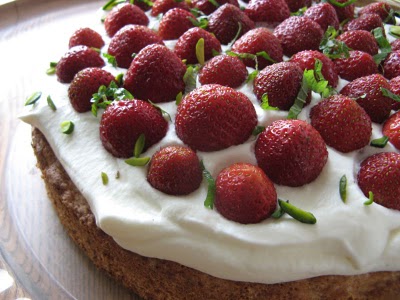
Let’s say you bake a wonderful cake for your son’s birthday party, and then you decorate it with a layer of mouth-watering strawberries….

and later you’re puzzled by the strange look your son’s girlfriend has as she take the first bite. Only then do you realize that at the very last step, you used salt instead of sugar for the glaze….…

 
Ok friends, you’re allowed to laugh – four weeks ago we did, too! LOL!

 
There was a time I would have been embarrassed for days about this mishap! I would have searched for reasons how this could happen ( somebody had left the salt on the kitchen worktop where it shouldn’t be, somebody called me in the crucial moment, I was in a hurry because…)

No. I was just careless.

My fault. The salt stood there and I took it because I just didn’t pay attention to what I was doing. I wasn’t “here.” 
 

Walking on the Buddha’s path, I’ve learned that there’s only one true misdeed: not to learn from what’s happened.

Tantra is a wonderful path: we can take our time to walk, we open our eyes and with a bit of patience for us and others, we finally come forward. We went wrong? Ok, let’s correct the direction. We can change negative aspects into positive ones – if we pay attention. And in case we aren’t too embarrassed to sometimes say “sorry, my fault.” 

On Raoul’s birthday i quickly said, “sorry, my fault,” (which finished the negative aspect) and because we all were hungry, I called the pizza service, (hmm, a rather positive aspect) and then we had a nice evening – dancing, singing, playing.

How to carve a Buddha

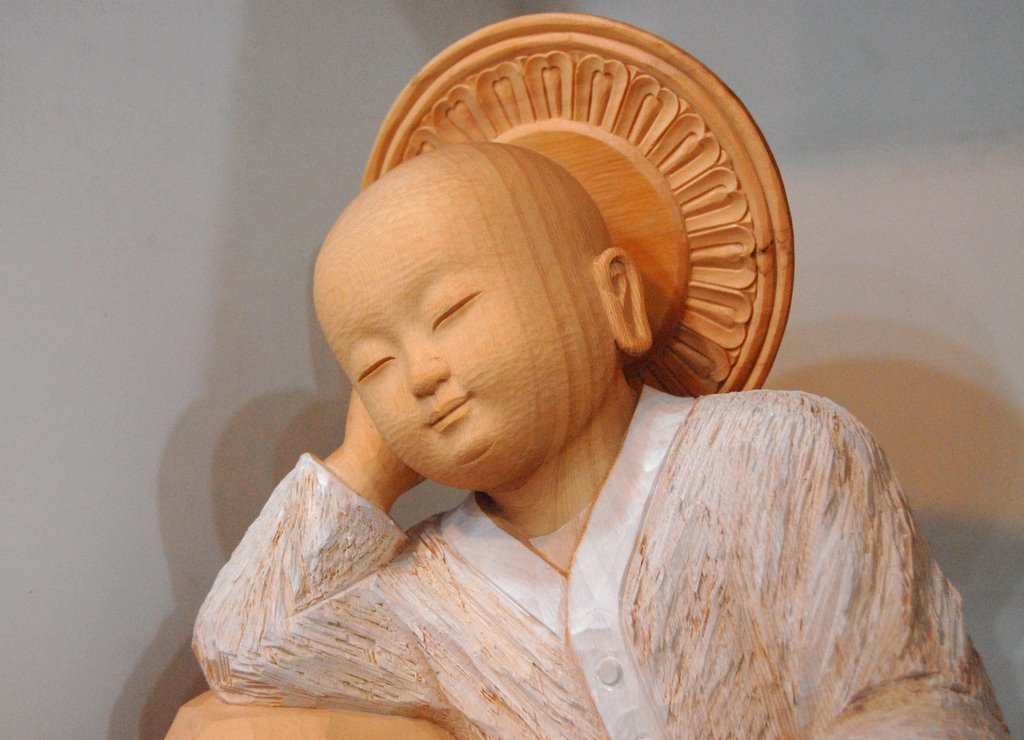
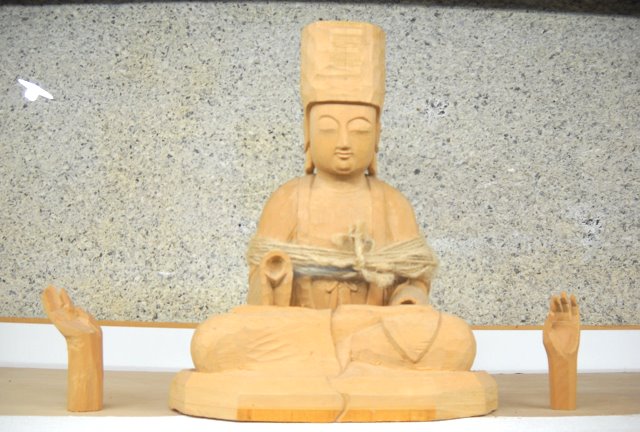
For all those who bear the secret sign of the woodcarvers’ guild (scars on the thumbs and index fingers from slips with the knife 😉 ), here’s a photo essay on how a wooden Buddha statue is carved. This display is at the Mok-A Museum in Korea, with the finished statue about 10 inches high. The founder is officially designated as what can best be described as National Living Treasure #108. Here’s a link to his site, and here’s a link to some photos of his work. (Click on the images here to see them up close.)

I was surprised to discover that even the smaller statues aren’t carved from a solid block of wood. Using multiple pieces like this might give him better control over the grain and quality of the wood, but perhaps this is simply a model of how he works with bigger statues, where a single block of wood would pose too many problems.

After the main pieces have been rough-shaped, he glues them all together. (Hence the twine.)

  o o o o o o o o i p p   o

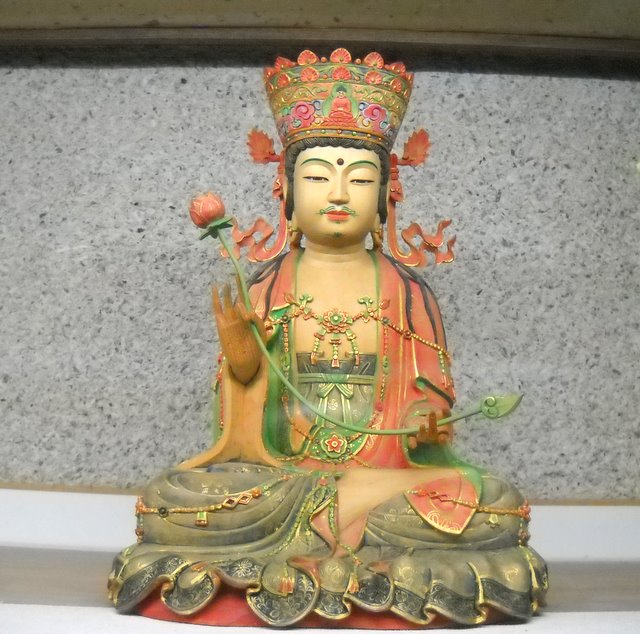
and here’s what the finished statue looks like. Incredible, isn’t it!

Seon Master Daehaeng: Dying and spiritual practice

This is one of my favorite Dharma talks by Daehaeng Kun Sunim, where she talks about spiritual practice and the importance of “dying.” She isn’t talking about the death of the body, but rather letting go of this sense of “me” and what “I” want. There are many aspects to this, but one question often asked is, “If I let go like this, won’t I become a fool or taken advantage of by others?” The short answer is “no.” As you let go of both sides, both good and bad, likes and dislikes, you see things more clearly, and discover the courage to do what needs to be done, whether it’s confrontation, accepting, or running away! 

One of the other incredibly huge things about this practice is that the beginning and the end are both the same. Whether you don’t know anything or are completely enlightened, the letting go and entrusting is done exactly the same.

 
You should entrust everything that comes up in your life – solitude, poverty, loneliness, anxiety, and illness – to your foundation and live freely. Entrusting everything is letting go of everything. This is the way to die. The phrase “First, you must die!” means unconditionally releasing everything, without any excuses or reasons, including both what you understand and what you don’t understand. When things go well, you should release them with gratitude. When things don’t go well, you should also release them with the faith that “My foundation can solve this and lead me in the right direction. Because nothing is fixed, this too can change.” You should keep letting go like this. For it is only by dying unconditionally that you can discover your true self, your eternal root.

Second, you must die again. While studying here, some of you have discovered yourself. Yet you still have not discarded your habits and your thoughts of “I,” “me,” and “mine.” So you’re happy if you see a Buddha in your dreams, but you’re scared if you see a ghost. When you feel or experience something extraordinary, you carelessly talk to others about what you experienced. What you see and hear is just an illusion, but nevertheless you still tend to cling to it. This is why you must die again.

Now do you understand why first you must die and keep what you experience to yourself, and why you must die yet again, keeping what you experience secret? Even though you are able to see or hear certain things after you discover your true self, those powers are not the Way. Even though you have obtained the five subtle powers – the abilities to know others’ thoughts and feelings, to know past lives, to hear anything, to see anything at any place, and to appear anywhere without moving your body – this is still not the Way. You can truly master the five subtle powers only when you are free from them. If you reveal what you hear, see, or know, it will only bring trouble. First, it will cause trouble for the Buddha-dharma, second, for sunims and the Seon center, and third, it will cause trouble for you.

Once you discover yourself, you enter the stage of experimenting. Don’t regard what you learn in your dreams as different from what you learn while awake. And keep everything you learn secret. Although you are able to see, hear, and know things that others are unaware of, do it without clinging to any thought of “I see,” “I hear,” “I know,” and do not reveal to others what you experience. This is a very powerful stage of practice in which you experiment with what you have learned. Your experiments result in experiences, and then you put those experiences into action. This is the meaning of dying a second time and keeping what you experience to yourself.


 Daehaeng Kun Sunim goes on to talk about the need for also dying a third time. There are a couple of very advanced aspects to that, but the main point is the need to continuously keep letting go, and to not dwell on what we experience.  (This talk has been excerpted from the book,
Wake Up and Laugh.)

Venerable Ya-un: settled body, settled speech

In this next section of Admonitions to Myself, the Venerable Ya-un warns us to settle our bodies and be careful with our words. On the surface, this section seems to be written for monastics, yet it also applies quite well to our modern form of laziness: Busyness. 

Refrain from unnecessary speech and movement:

If your body is settled, then confusion will cease and samadhi will be attained. If you speak little, foolishness will be transformed into wisdom. The true foundation is devoid of words and the ultimate principle is unmoving. The mouth is the door of calamity and so must be guarded carefully. The body is the root of disaster, so do not travel around unnecessarily. A bird that often flies back and forth is in danger of being caught in a net; an animal that roams around will have the misfortune of being struck by an arrow.

Thus the Buddha sat without moving for six years and Bodhidharma spent nine years in the Shaolin cave without saying a word. How then can later practitioners not follow these examples?

 
Enter meditation while holding mind and body still,
sit by yourself in a hermitage,
without leaving and returning.
Observing your own mind,
return to and rely on the Buddha
that is within.

Korean tigers and true human beings

An Eyebrow Hair
Here’s one of my favorite stories about Korea, which also involves a tiger.

Long ago, a young man was traveling through the mountains, when he ran across an old monk struggling to repair a tiny shrine. At a glance he saw what needed to be done, and after asking the monk to take a rest, he set about fixing the shrine.  For him it would only take a couple of hours, whereas it would have taken days for the monk, who seemed quite clumsy with his hands. While the man was working, the monk was silent, and seemed to be watching him closely. But then, mountain monks always did tend to be a bit strange, so he didn’t think much about it.   

 At last, he finished and, sweating, sat down next to the monk, who continued to stare at him. Finally, the monk spoke, “It must have been tough growing up without parents or family. I too, lost my mother at a young age. Looking at you, I think a wife and family of your own is what you want more than anything else in the world. Am I right?” The young man shivered despite the heat, for it was as if the monk had seen into the very depths of his heart. How had he known those things?   

 The monk spoke again, “Well, if marriage and a family are what you have your heart set on, it won’t do to marry just any woman. You have to see clearly. Here.” With that, the monk plucked out one of his long, white eyebrow hairs, and handed it to the young man. “Now,” said the monk, “hold it in front of your eye and look at me.” The young man did this, and almost died of fright! For where he had been talking to an old man, he now saw a huge mountain tiger!   

 The young man quickly lowered the eyebrow hair, and there was the old monk again. He raised the hair to his eye again, and the monk had become a tiger again. The man thought he was either crazy or about to die, or both! The monk smirked at him, and then said, “Don’t worry, I don’t eat humans.” Well, this seemed like a lie, for the tigers in those mountains were notorious man-eaters.  The monk seemed to read the man’s thoughts, and said again, “We’re actually quite spiritual, so we don’t eat humans. Only pigs and dogs, and maybe a donkey or fox, once in a while.”    

The old monk sighed in response to the dubious stare he was getting, “Take that hair with you and use it to look at the people you meet. You’ll see what I mean.” With this they parted, and the man made his way back down to his village. It was still hard to believe what had happened, but he was dying to try out the hair on other people.   
   

So early the next morning, he found a nice spot near the main road into the village and sat there waiting. Before long, the proud village mayor came by. Everyone treated him with much respect, but when the young man looked at him, he saw a great slobbering pig wearing clothes! Well, this was a shock! He next saw a line of woodcutters returning from the mountains, so he held up the hair, and to his amazement, most of them were dogs or pigs! Only two were actually human beings. This went on for a while, until he saw a beautiful young woman and her mother approaching. Just sight of the woman made his heart race, but when he held up the hair, he saw that she was really a fox-spirit!   

This went on all day, and he was amazed at how few human beings he was seeing. Neither fine silk, Confucian hats, or monks robes were any guarantee of finding a human being. Finally, he looked through the hair at a plain-looking woman who was walking by, and discovered that she was a radiant human being. They were eventually married, and became the joyful family the young man had always wanted.   

Well, the moral of this story isn’t about finding a spouse! (Though that is a topic that does tend to get young people to pay attention.)  The heart of this story is the importance of seeing beyond appearances and learning to become a true human being. 
  
In this story, the eyebrow hair of the tiger can become compared to our true nature, our foundation and Buddha-essence. When we can get in touch with this, and learn to see through it, then we’ll be able to truly see what is going on, and we’ll be able to respond in ways that go right to the heart of the situation.

It’s one thing to be born as a human being, but we still have to become true human beings. For while many are born with human bodies, many are still controled by the habits developed during animal incarnations.  So a lot of spiritual practice is simply working on letting go of animal habits, and learning the ways of a true human being. Let’s all become great beings who can see clearly and respond appropriately with infinite power of our Buddha-nature.

Tigers in Korea

One of the interesting things about Korea are the tigers.  Where I grew up, team mascots were always fierce and realistic. Perhaps it’s about balance: we, who knew basically nothing of real violence, chose mascots that had a threat of violence. Yet in Korea, where every man serves in the army, where there are tank traps and massive artillery bases north of Seoul, this was the mascot they chose for the 1988 Seoul olympics:     

"Tony the Tiger" with a hat!


Often tigers were used as comic relief, according to David Mason. With their fierce pride and dignity, they resembled the yangban, or aristocratic class. In images like this tiger, you can see the puffed out chest and aggressive expression, filled with pride about its noble heritage and superiority to all, but, where did those spots come from?    

It seems the tiger’s mother had an affair with a lowly leopard!  Here the tiger is used to mock the arrogance and unearned pride of the yangban.  


 On the other hand,  in mountain-spirit portraits, images of tigers often served to symbolize the power of the mountains and nature, as well as the power of spiritual practice to help us become one with this.     

More tomorrow about tigers and spiritual practice.  


the mind and evolution

In his post a few days ago, Joseph relayed the story of a monk who died in the Jiri Mountains (A glimpse). It highlighted two critical truths, namely, that we are not our bodies, and the importance of how we use our minds. 

In Chapter 2 of No River to Cross, Daehaeng Kun Sunim also covers these points: 

If we just wander around in the fog...

Even after your body falls away, your consciousness remains. It often happens that people do not understand that their body does not exist anymore, and they do not realize that living people cannot see or hear them. So, sometimes, in their confusion and desire, they cause other people to suffer. If you sincerely cultivate mind while you have a body, then you can leave without having any attachments. However, if you don’t practice, then even though you’re dead, you’ll be caught up in all of your old relationships, and won’t be able to freely leave. Instead, you may just wander around, stuck in that state for a very long time. When people die, if they have never practiced spiritual cultivation, their consciousness cannot see and cannot hear. In the middle of the darkness, their consciousness cannot correctly perceive things, so those people may (accidently) enter the womb of a pig or a magpie. However, people who have cultivated mind give off a great light and thoroughly illuminate their surroundings. Even their families tend to live brightly, although individually they may not know anything about spiritual practice. (p 20-21)  

...running from the things that scare us, chasing after desires, where will we end up?

Have you ever gotten caught up in a dream about walking through a building that no longer exists? Those steps you were walking up are now only empty sky a hundred feet off the ground. After we die, we no longer have physical senses, so with what are we seeing and hearing? If we haven’t practiced while alive, then we’re only experiencing the arising of karmic states of consciousness. However, we think those things are really happening, and so chase or flee them. In essence, we’re running outdoors at full speed, while blindfolded.  

Thus, how we use our minds while alive is critically important to us.  

In order to be born as a human being, it may have taken a thousand years of accumulated virtue and merit. It’s so hard to become a human being. Nevertheless, if you don’t let go of the habits you developed prior to becoming a human being, and if you think of only yourself, your suffering will be endless. If you live this way, you may live like this for many, many lives, stuck like a hamster on a wheel, unable to evolve. Or you may devolve and be reborn as an animal. Once you are reborn as an animal, you will suffer a lot, having to eat others or be eaten. There will be very little opportunity to reflect upon your state, and if you develop the habits of an animal, it will be even more difficult to free yourself from that state, even over billions of eons. (p 19)  

We go where we look. Or in this case, where we think.  

From the perspective of evolution, lives are affected by circumstances and the environment, and can adapt themselves to a certain degree. However, the more fundamental things all depend upon consciousness. (p 21)

Once the level of mind changes, the body also changes accordingly. Evolution is the process of the mind becoming brighter, while creation is the outward manifestation of the minds design. Thus, while this process is evolution, it is also creation.  

Mind is the basis of both evolution and devolution; they aren’t separate forces. Devolution is also done by mind. All of this is the manifestation of our fundamental mind (and how we use it.) (p 22) 

Alive or dead, awake or asleep, if we always rely upon our inherent Buddha-essence, what could we have to fear?