Mind and Science

This report of one of our regular Bangkok Seon Club meetings was first published on the now-deleted “Marcus’ Journal” in January of this year. I’m re-posting it now as I think it gives a nice picture of the kind of useful discussions we have at Seon Club, and the lovely people I meet there.

The ability of our fundamental mind is the most profound and mysterious thing in the entire universe.”
– Zen Master Daehaeng Sunim
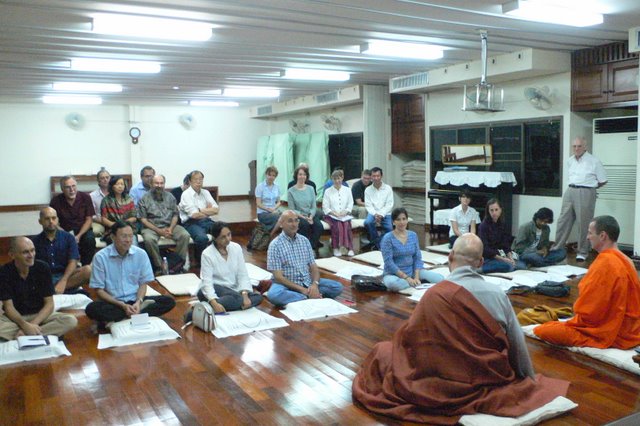
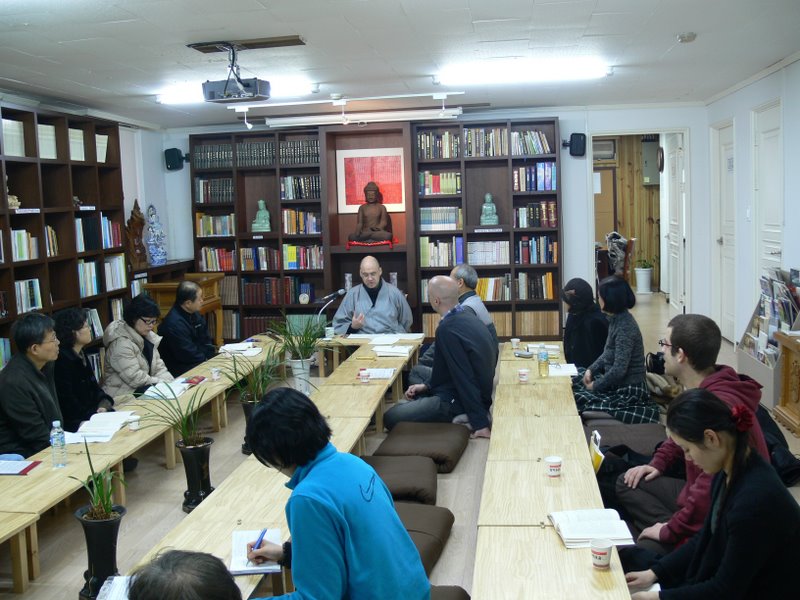
The Bangkok English-language Seon Club is really finding its feet. Thanks to the direction provided by the seonwon, everyone is comfortable with the structure of the meetings, starting with the refuges and some sitting meditation, and with the format of the discussion. Young, who does the translating, is simply amazing, and I think everyone gets a chance to speak and to ask anything they like of our wonderful teacher Hyaedan Sunim.

This month we returned to our study of No River to Cross and looked at chapter three, “Mind and Science.” I’ll admit that when I first read this two or three years ago I was dismissive. “Mars is crowded with lives” I thought, “what is this nonsense?” Hyaedan Sunim asked me on Saturday night if my reaction would be any different now, and I can honestly say that it is. Not only is Mars crowded with lives, but my body is too, there is nothing that is not crowded with lives.

We talked about how the universe functions as one life, about how material is actually energy, and how there is no difference between the particles within and outside of us. Pedro, a Seon Club regular, explained some of the latest thinking in science, and what little I understood was fascinating. Hyaedan Sunim agreed and then talked about how Buddhist teachings have never contradicted science but, rather, how science has evolved towards Buddhism.

Young talked about the energy between people, using the example of Pedro’s smile, which everyone thought was lovely, and about the limitations of language in expressing scientific discoveries. Sunim offered the example of how there were no Chinese characters for negative numbers, and then she brought us back to the relationship between fundamental truth and our developing understanding of it. “But how” Kirsten asked, “do we put this into practice?”
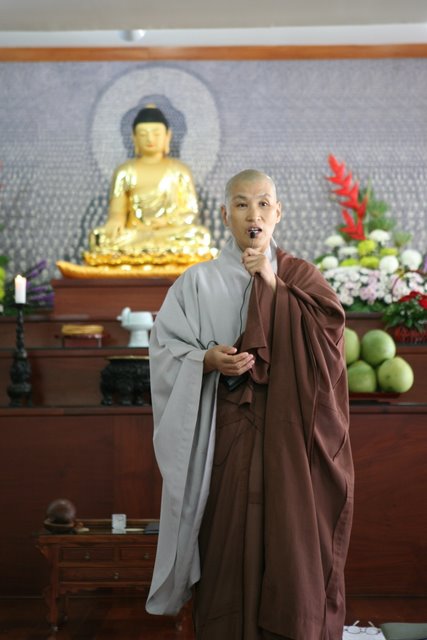
We came into being, Sunim said, because of this Fundamental Mind. It put us here, and after we are gone it will still be here; everything is a reflection of it, and our practice is to return everything to it. I talked about my limited understanding of this, how the theory often confuses me but how, basically, I believe that I and everything else shares this Mind, or Buddha-nature, and my job is to live from that, which is best done by entrusting everything to it.

Kirsten, her first visit to Seon Club, was keen to know more and asked lots of great questions, and Sunim talked about entrusting to Buddha-nature as a practice that cuts through trying to figure things out and Young gave some wonderful personal examples of how this works in her life. Then Joe, a fine poet and a regular here and at the San Fransisco Zen Center, quoted from the poetry of Huang Po on awakening to One Mind, True Self, or Fundamental Mind.

And, talking about what happens when you live not from what obscures it but from your original Buddha-nature, Joe told the story of King Mongkut, the great-grandfather of today’s highly revered King Bhumibol. King Mongkut became a monk at Wat Bowonniwet and then, to the great concern of all those around him, found himself more interested in staying in robes than in becoming King, so much so that he eventually became abbot of the temple.

“There is no manual” Hyaedan Sunim said, “just keep sending everything back to Buddha-nature, again and again.” And in a lovely phrase that raised a smile and gets to the heart of the matter, she said one should “use less and less your head, and more and more your Mind”. We finished by reciting the Four Bodhisattva Vows, bowing in gratitude to our wonderful Sunim and to each other, and left the Dharma Hall inspired and confident in this beautiful practice.

notes on karma

During last year’s season of Rains Retreat talks Phra Cittasamvaro Bhikku said the Buddha taught there are  four imponderables, four things just not worth thinking about as they are impossible to understand. One is the source of psychic powers, another is the mind of an Arahant, the third is the mind of a Buddha, and the final imponderable is karma. Trying to figure out how karma works will do little more than split your head into seven different pieces the Buddha said.

But I keep coming back to it this week. My post on moving the mala was prompted by reflections on karma, those “huge killer waves of our own making”, and Joseph’s post yesterday underlines again just how vital it is, if not to fully understand, then to at least have a basic grasp of how these energies work. Just as Phra Pandit suggested last year, we can get by with an outline of the principles of karma without delving into its more complex, imponderable, depths. And that basic outline is simply that everyone has karma and so we must be careful of what we do.

“That’s it”, he said. “Finished. Anything that comes next is, unlike most of the Buddha’s other teachings, going to be mainly speculation.” But it’s clear that our behavour, and the patterns we establish, can make all the difference between joining those figures in white at the bulgogi feast, or remembering one’s vows just in time. The clearest and most succinct formulation I ever heard of the workings of karma came from a Thai friend of mine when she said “Do good, get good. Do bad, get bad”.  Whichever way you look at it, our intentions and habits, orientation and practice, are what decide our fates.

Who can’t help but be reminded of Bodhidharma and Emperor Wu? “How much karmic merit have I earned by ordaining monks, building monasteries, having sutras copied, and commissioning Buddha images?” “None.” And then there’s the story of Nanta, the old lady who, despite her poverty, lit a lantern for the Buddha with such sincerity that not only did it burn late into the night, but she was also promised future Buddhahood from that single act of devout intention.


Link:
Littlebang: Notes on the Clockwork Universe

moving the mala

“Huge, violent, killer waves of our own making are bearing down on us, ready to smash us against the rocks.” I know this to be absolutely true. I’ve experienced some of it for myself already, across the moments, days and decades of my life. Every unskillful action I’ve ever performed either has, or will eventually, return to me. So when I think of what’s to come, the outlook really isn’t very pretty.

But, Phra Bhasakorn Bhavilai continues in his wonderful book ‘Karma for Today’s Traveler’, “somehow, we see more clearly, we improve ourselves, we reject our past behaviour and we embrace the five precepts. By changing our mental state like that… the power of our bad deeds to effect us has been reduced… The waves will hit us, we can’t stop them; but they only take a limb or an eye or some teeth. We are left alive. The five precepts will reduce the negative effects from our past.”

This is very practical stuff. It’s not about achieving Buddhahood through the perfection of precepts, something I know I am incapable of completing by my own efforts. Rather, taking refuge in the precepts is about developing the skills and habits to live with more peace and confidence in this very life, of being happier and having better relationships with everything and everyone around me, as well as making progress on the path.

I see how this works and rejoice in it, it brings results. And, though central to my personal practice, it’s still not easy. The trickiest for me, just as in Joseph’s insightful post yesterday, is the precept concerning speech. Partly formulated, in words from Thich Nhat Hanh’s Fourth Mindfulness Training, as “Knowing that words can create happiness or suffering, I am determined to speak truthfully, with words that inspire self-confidence, joy, and hope.”

The trouble, I find, is remembering. Sitting with friends, it is so easy to slip back into negative speech patterns. So easy to swear, to complain, to gossip, to exaggerate, to condemn and criticise. So easy to speak rather than to listen, to dominate the conversation, and to talk with urgency and anger rather than with kindness and peace. How can such behaviour not build up disasterous karma? How can I remember my vows?

I recently heard about a church minister in America who suggested to his congregation that they wear a wristband and that every time they catch themselves complaining or gossiping or otherwise engaging in negative speech, they simply move the band from one wrist to the other. What a brilliant idea. It’s a simple act that would re-enforce one’s aspirations and help break the habits of negativity.

I decided to try this out using the wrist-mala I wear everyday, and was surprised at the results. Although I was concentrating on speech, the first effect was that I became much more aware of my thinking too. The second thing I noticed was how often I had to move the mala. And thirdly, I was pleased to see how often I didn’t have to. Which is important, not because I imagine I can ever reach perfection, but because it improves my life here and in the future, reducing the size of those killer waves.

I also remembered Kun Sunim’s advice about striking back at negative thoughts and changing them into something positive, and I worked on just that.  Of course the most positive thing you can do is to entrust everything to your own Buddha-nature, and this technique really helped me do that. I let go of the negativity, and found myself smiling instead. “When you entrust everything to the foundation” Kun Daehaeng Sunim writes, “with a single thought you can go a thousand miles.”

Bangkok Kimchi

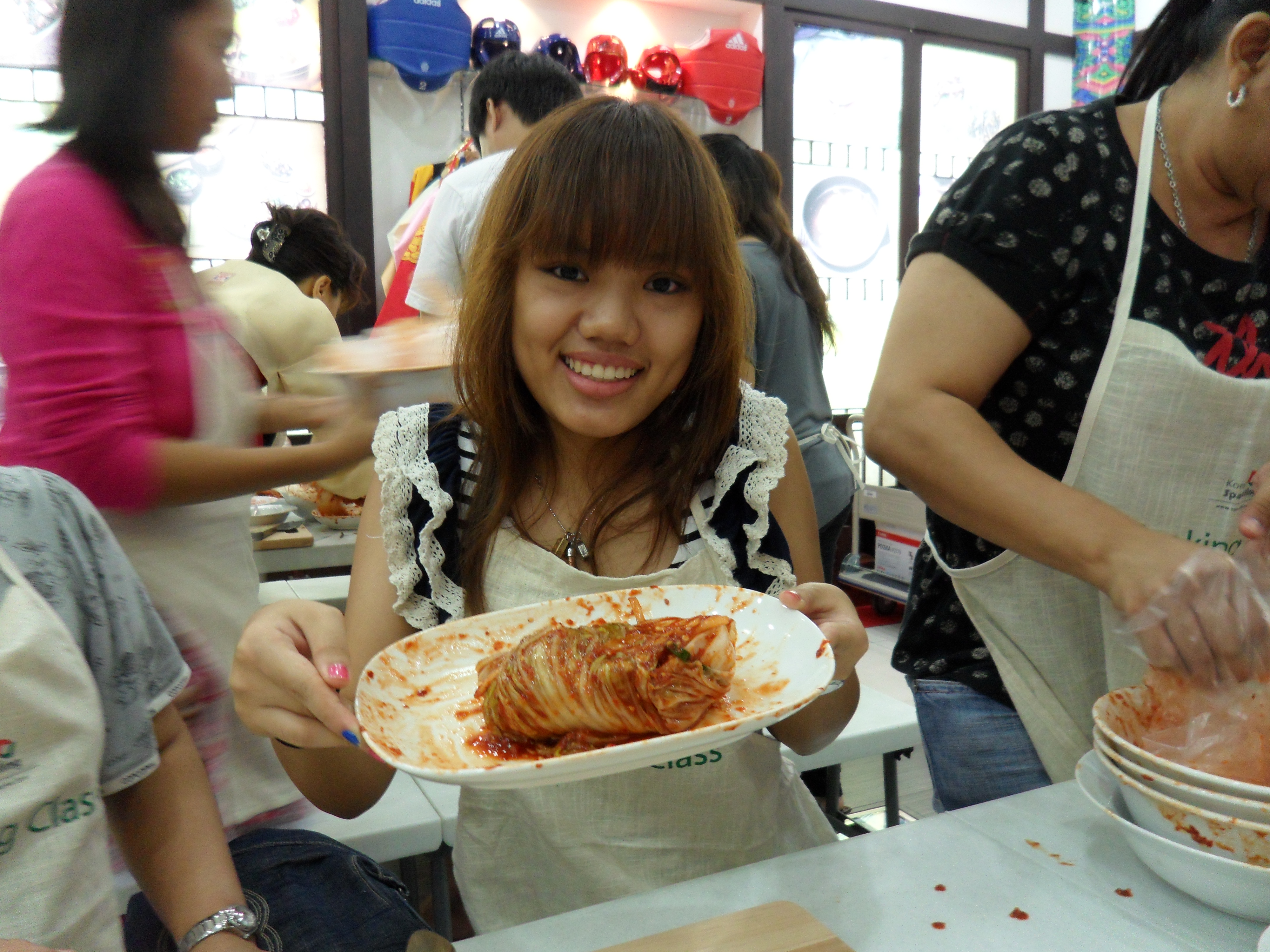
Just a few days after reading Chong Go Sunim’s fascinating post the other week about Korean temple food, and after having just finished a very fine Korean meal myself, I was asked if I’d like to attend a class in kimchi-making – part of a whole series of hands-on Korean cooking tutorials – right here in in Bangkok! 

The classes are organised by the Korea Tourism Organisation and are held in their Bangkok office on the ground floor of the Esplanade department store on Rachadapisek Road, a beautiful showcase for Korean tourism with lots of free information, a little movie theatre and even a rack of traditional Korean costumes to dress up in.

Best of all, the cooking course, consisting of four subsequent Sunday afternoon sessions, is entirely free of charge and is available for the next six months. In the first session participants learn to make bibimbap, in the second they tackle kimchi, this is followed in the third week with gimbap, and the final week consists of a class making japchae.

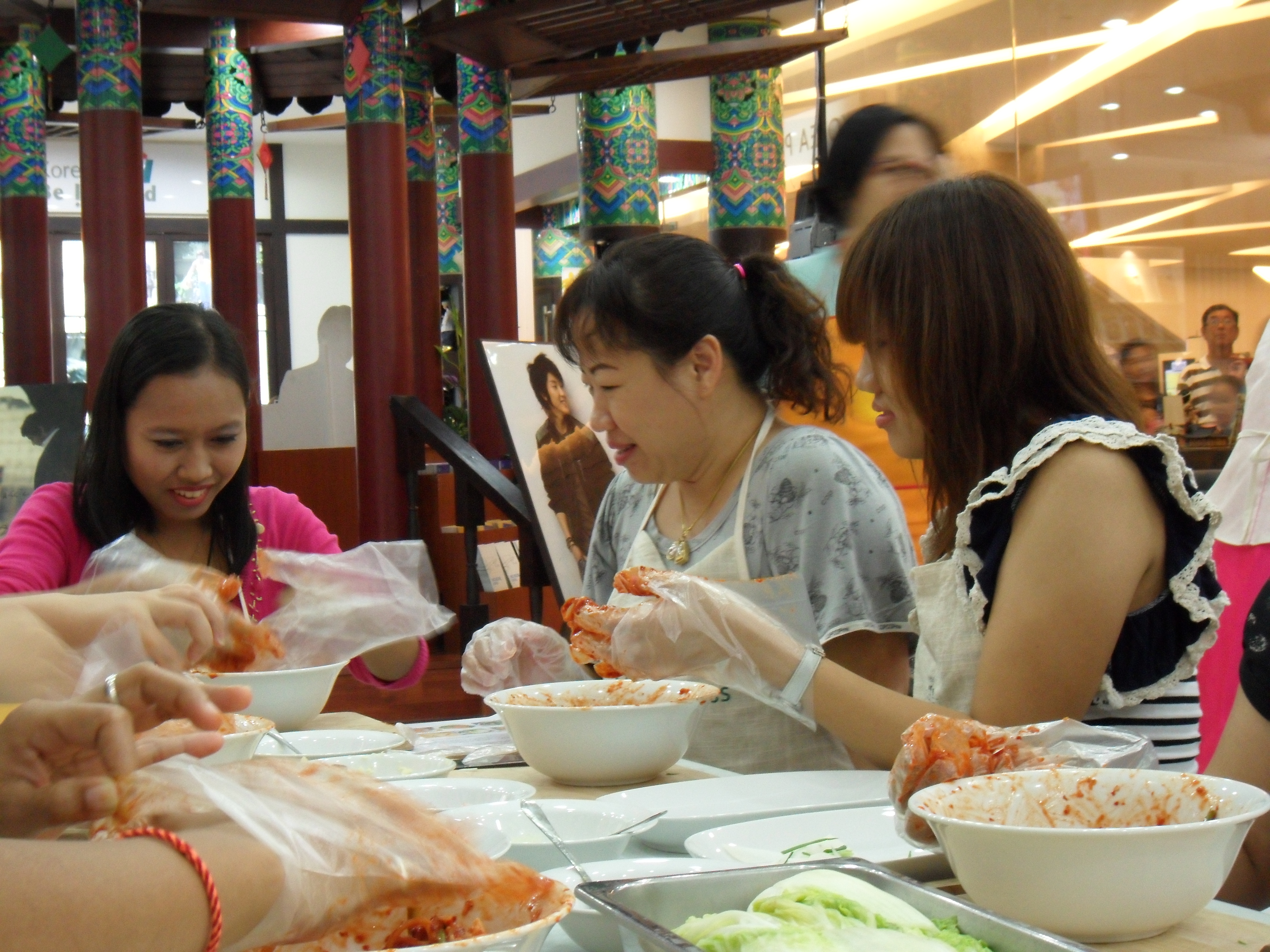
On the day I went along I was not an official participant, I hate cooking, but more of an interested observer – mostly interested, of course, in the end result! I arrived early and helped set things up. There were tables to move and bowls to put in place and then I watched as the chefs arranged the ingredients and the cooks donned their aprons.

The teachers were four lovely ladies from the Bangkok Hanmaum Seonwon, which explains where my lucky invite came from, all volunteering their services for free. And with just ten student chefs, everyone enjoyed a really intimate learning experience. Then again, when making kimchi, intimate is certainly the word!

As the chilli paste got mixed with the garlic, ginger and whatever all those other ingredients were – I’ll never be a real food correspondant! – I chatted to some of the students. Everyone was a fan of Korean culture and cooking, and one woman at my table had visited Korea more than nine times! 

Then I asked one of the ladies from the temple why she’d volunteered to give up her Sunday afternoons to help with this project and she said “well, first of all, I like the idea of helping to share Korean culture, plus I want to help the work of the Seonwon too.”

I later discovered that the funds raised by the Seonwon through this project are earmarked for the centre’s scholarship programme, which helps support a number of Thai students, who wouldn’t otherwise be able to afford it, study Korean at university.  I met some of these students, and one of their teachers, about a year ago, and was impressed by their dedication and skill.

But of course the real winner of the day was me! I went home that evening with a huge bag of kimchi which I left out overnight to ferment before putting in my fridge. I’ve almost finished it now and I can tell you that it’s gorgeous. Crunchy and fresh and just the right tangyness and heat. When’s the next class?

 In these fresh vegetables
I see a green sun.
All dharmas join together
to make life possible
.
 – Thich Nhat Hanh


Link:
Chong Go Sunim: Korean Temple Food

Suffering

But why” I asked, “does it have to manifest this way? What happened to the compassion of the Buddha?” 

“This is the Buddha’s compassion” the Sunim replied. “This is how you learn and grow. Everything comes from you, and serves to lead you to your True Self”.

Daily Life Seon

I’m doing it again. The details aren’t important, but it goes right to the heart of what it means to be following a spiritual path. Ever since I was a child I’ve argued with people, taken up positions and defended them, attempted to prove myself right on every little thing I’ve ever believed. It’s caused so much harm to others, and handed myself so much unhappiness too.

I am getting better and have made great progress, and yet still I sometimes feel the need to put forward a position, and to then defend it, sometimes in Dharma discussions, and especially on the Internet. But I’m getting better at seeing how ridiculous this can be. I need to ask if helps myself or others. And who cares if I’m right or wrong? Why does it matter to me so much? 

The Buddha defined Right Speech as “abstinence from false speech, malicious speech, harsh speech, and from idle chatter.” So there’s hope for me yet, I’m good at giving things up! I welcome another abstinance.  But after all what does it mean to believe in the active working of the Buddha which is my True Self, if I am still battling to defend opinions rather than letting go of them?

Here’s something to cut out and pin to back of the door or the side of the computer, somewhere I will see it often!  Something I want to learn.

Daily Life Seon

At those times when your speech can disturb others,
when your words can lower your spiritual level,
when you understand that if your level is lowered, the whole is damaged,
at those times return inwardly all the thoughts and feelings you’d like to express.
Let your inner foundation take care of everything,
and use speech when skillful means are necessary.

No matter how much you talk, it won’t help a bit,
if there’s no sincere behaviour backing it up.
Let this inner power plant take care of things,
(instead of chasing after outer things).
This is the premier method, the true shortcut of ‘daily life seon’.

      – Seon Master Daehaeng Kun Sunim, 
Hanmaum Journal, September – October, 2009. Used here with permission.

Kwan Eum Sa

I’ve no reason to re-post this except that it brings back such lovely memories. I had a wonderful picture to go with it that Ikumi took on her mobile phone, but that’s gone too. Anyway, it’s a slow Sunday afternoon, so I hope you don’t mind me posting this here now. Thank you.

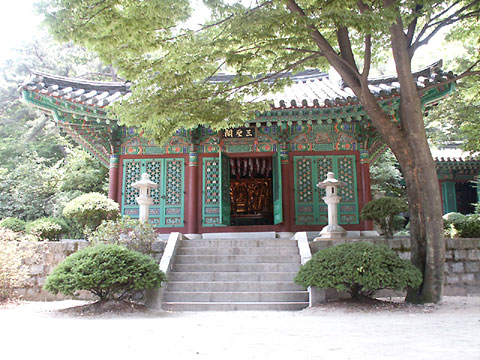
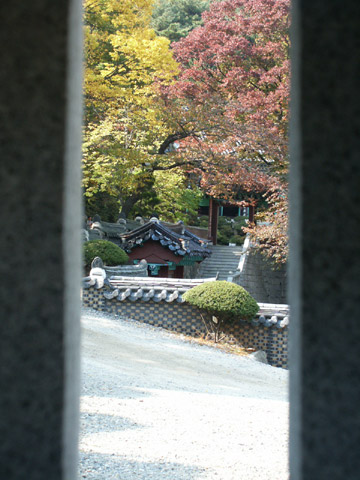
After thanking the monk and his friend that had given us a lift there, and bowing goodbye, we were instantly struck by the beauty of the place. For a long time I’d been wanting to show Ikumi a traditional Korean mountain temple, one with a stream close by, with rocky peaks rising up behind, with lush greenery everywhere, with architecture and nature rich and serene, and this was perfect.

The name of the temple was slightly different to that on the map, the wooden gates announcing it not as Gwanumsa, but as Kwan Eum Sa. Perhaps the same. And there was a new but traditional Kwan Seum Bosal statue in the main courtyard. Easily one of the best I’ve seen. The Amida in her crown was detailed and precise, surrounded by the most elaborate headdress, and her expression was a sutra in itself.

While I performed some bows, Ikumi explored the smaller shrines nearby. There was one for the local mountain god, one for Ji Jang Bosal, and others housing Amida Buddha and Sakyamuni Buddha. The 11am service came to an end and we sat near some ajumas in the shade by a pagoda. We drank our coffee and shared our biscuits and I wished I had learnt just a few more Korean words.

The bench was made from a long thick piece of timber, kept rough in places, smoothed and patterned in others, and it seemed typical of the overall care and craftsmanship to be seen all around us. Nearby was a pile of old temple beams, still painted in traditional colours, now stacked up under a tarpaulin to be used for firewood. I looked, not a nail in sight.

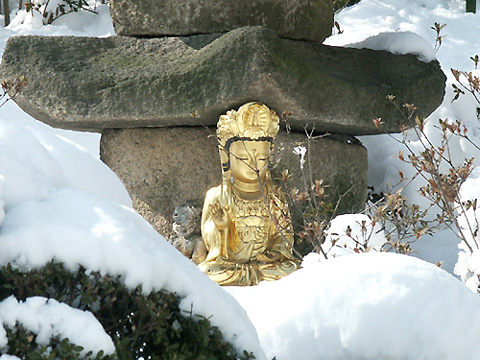
Close to the pagoda were two stone stupas, each containing a small gold Buddha forever looking out through the trees and over the city to a view of the distant Namsan Tower. The only sound was the trickle of the stream and the summer insects, and though we had to get back, we lingered as long as we could, returning to the statue and bowing once again – All beings, one Buddha-nature, Namu Amitabul, Kwan Seum Bosal.


(These photos are from KwanEum Sa’s website)

Saturday Sangha

To know when to stop,
to know when you can get no further by your own action,
this is the right beginning!

– Chuang Tzu

This blog, in its current form, has its origins in the friendships forged some years ago in a weekend Dharma study group that met at the Buddhist English Library in Seoul. The group was led by the wonderful Chong Go Sunim and was attended by a good mix of both Korean and non-Korean Buddhists. Through the group, in May 2008, during the period of the Buddha’s birthday celebrations, Joe, Joseph, Carl and myself became what we like to call Dharma Brothers when we took refuge together, in a ceremony with Chong Go Sunim, at the main Hanmaum temple in Anyang.

at the Buddhist English Library of Seoul

Most Saturdays I’d meet Joe at the veggie restaurant an hour before Sangha started, and we’d lend each other books, wonder who’d attend, make vague plans for the Sunday, and then go up to the Library. BELS, the Buddhist English Library in Seoul, is close to Angkuk station, exit six, and consists mostly of one long room lined with books on all aspects of Buddhism, and down the middle of the room are laid a long row of low tables and thick brown Korean temple cushions for people to sit on. It’s a wonderful place.

We’d arrive, bow to those already there, enjoy the snacks that many people had brought and just catch up. Chong Go Sunim in his grey robes would be sat at the end just in front of the Buddha image, and I’d usually place myself opposite the wall of books, with Joe and Carl on the other side of the table. Joseph was often there too, giving up his beloved trips to the mountains to be with us. Rinchen Gyatso Sunim often attended too while he was in Korea, in his bright Tibetan robes.

Chong Go Sunim had certain themes he’d refer back to, the core of his teaching. One was ‘Trusting Our Root’ and I remember one particular week when he made this the specific object of study. He started off with the above quote from Chuang Tzu – perfect for a room full of people who, by their own admission, tended to read and analyse too much and so (speaking for myself) actually slow down progress. We broke into groups and I remember talking to Ami about the Tao and Juingong and Buddha-nature and to Shin Hee about stopping. We discussed relying on our selves, and on other-power.

Everyone has a different practice. Some people, like myself, are more devotional than others and see things in terms of reliance upon the object of devotion, with everything given as a gift. Others see things more in terms of allowing their own Buddha-nature to shine through. I don’t believe that one approach is any more advanced than the other, and neither do I think you have to choose between them, or even see them as different. The key, for me, however,  is that it connects to the deepest part of yourself.

And I remember, in summing up, Chong Go Sunim gave us a quote from Venerable Master Lin Chi; “Friends, I tell you this: there is no Buddha, no spiritual path to follow, no training and no realization. What are you so feverishly running after?” Amazing message, isn’t it? Just stop and relax, it says, let go. After a short meditation a few of us would go out for some food and on to a coffee shop, later in the evening we’d go to a Bongeunsa to do some chanting, some bowing, or just to stop.

Buddha's Birthday at Anyang

At other times we met up at the main temple in Anyang, with Chong Go Sunim providing cups of tea on the large table in the International Section till late at night, and there was a wonderful little tea shop just a little way up the road too. The connections made during that time are still strong, and evident not just through this blog. I’m still learning the simple truths I came across there, about letting go and trusting, and am so grateful that the Sangha, in whatever new forms it takes, is always present, teaching, learning, and sharing.

Links:
Buddhist English Library Seoul
Seoul Dharma Group

A Buddhist Christian pilgrimage

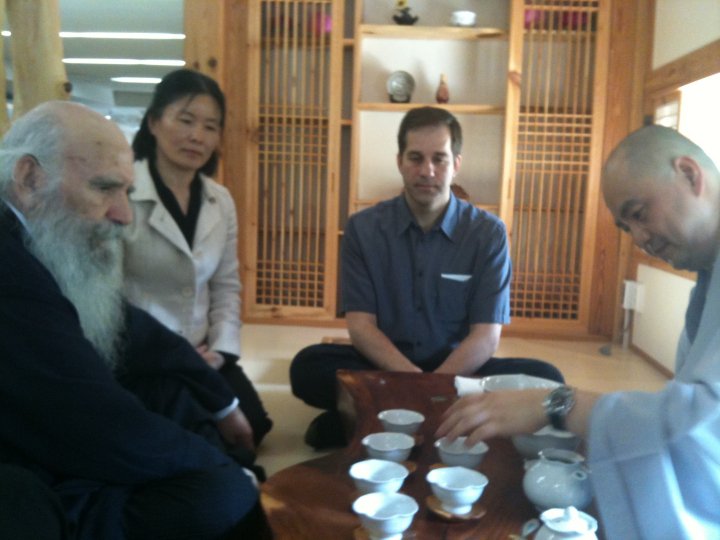
A few weeks ago, on the Tricycle Community, I was delighted to see some pictures of HE Gregorios, of the Eastern Orthodox Church, and Sung-Jin Sunim, from the Jogye Order, together during the anniversary celebrations of the Eastern Orthodox Church in Korea, visiting a temple and drinking tea. As Jack, who so kindly posted the pictures, originaly taken by his friend Fr Daniel Na, said, the contrast, and lack of contrast, between these two monks is amazing.

HE Gregorios and Sung-Jin Sunim

It reminded me a lot of last year’s 400-kilometer silent ochetuji pilgrimage, carried out with prostrations after every three steps, from Jirisan to Imjingak, jointly undertaken by Venerable Su Kyung, head monk at Hwagyesa Temple, and two Korean Catholic priests, Fathers Paul Moon Kyu-hyon and Simon Chun Jong-hun. They were joined in the pilgrimage by some 10,000 people, and the purpose of their journey was to help promote the cherishing of life and peace.

Father Mark Kim In-kook, from the Catholic Priests’ Association for Justice, said that the pilgrims “showed what religious communities in our society can do for the common good”, and their joint action seems to me to be a fine example of how Buddhists and Christians often work together in a spirit of friendship.

In contrast, many of the English-language Buddhist blogs often express a surprising degree of hostility towards Christianity. But this mostly comes from young converts with little experience of life in Buddhist countries and often with uncomfortable experiences of the Church. Such people are naturally keen to draw boundaries between the Buddhism they’ve adopted and the faiths they’ve left behind.

Of course sometimes it is perfectly necessary to point out differences between Buddhism and Christianity, especially when addressing an audience unfamiliar with one or the other. It is often thought necessary to explain, for example, that Christianity is a religion in which the Truth is revealed, with the job of the follower being to believe, whereas in Buddhism one is to experience truth for oneself.

And yet even this, one of the most basic distictions often drawn, if looked at from a slightly different angle, seems almost to disappear. Yes, Buddhists are to experience truth directly through the practice of wisdom, ethics and meditation, but the Dharma was first revealed through the Buddha. Is that really so different from Christianity, in which the central truth, of God’s love in this case, is first revealed, but which is then to be experienced in the everyday lives of Christians, and developed in ongoing daily practice?

a multi faith, benefit concert for the children of Ethiopia (photo from the Hyundae Bulgyo newspaper)
A pilgrimage to visit the holy sites of different religions and learn from their teachers (photo from the Hyundae Bulgyo newspaper)


Father Laurence, in The Good Heart, describes this practice:  

through meditation, we begin to experience the indwelling, the fact that Jesus is not only a historical teacher from the past, but now has an inner existence within each human being, as well as a cosmic presence.

The Dalai Lama, in the same book, talks about Buddha-nature and how to perfect it, and compares the Christian ideal of becoming one with the father with how enlightenment is described as becoming of one taste with the dharmakaya.  

But my central point here is not about the nature of enlightenment or the relationship between revealed and experienced truths, or even about the ways in which Buddhism and Christianity share certain features. My point is that Buddhism stands on its own three feet, and while some western practitioners automatically and instinctively look for points of contrast with Christianity, focusing on areas of convergence is a much healthier approach.  

So whilst I had a very different experience of the Church to Carl (during my similarly left-wing youth I often found myself on peace marches and marches for freedom in South Africa and Latin America etc, side by side with good church people, and the Church certainly does more to help the poor than any other organisation I can name), I very much welcome the way he embraces his spiritual heritage.  

Thich Nhat Hanh, in a book called called Teachings on Love, has written that: Buddhist practice can offer effective means to heal, reconcile, and reunite with one’s blood and spiritual families, in order to discover the precious gems in one’s own traditions. Thanks to the practice, people will see that Buddhism and their own spiritual tradition have many things in common, and therefore it is not necessary to reject their own spiritual tradition.  

I don’t think Thich Nhat Hanh here is calling for waves of western Buddhists to return to Christianity. What he’s suggesting is that practitioners make peace with all our traditions, to look for what we can embrace. In this we are lucky to have so many great examples. Father Laurence and the Dalai Lama. Venerable Sukyung and Fathers Paul Moon Kyu-hyon and Simon Chun Jong-hun silently walking across Korea. HE Gregorios and Sung-Jin Sunim. People whose default position is to find areas of convergence and genuine friendliness.  

Links:
Tricycle Community: HE Gregorios and Sung-Jin Sunim
UCAN: Buddhist, Catholic clergy complete 400-km pilgrimage

Bongeunsa and a thousand days of prayer

I first posted this on my now deleted personal website (‘Marcus’ Journal’) in September, 2009. Apologies to all those who have read this before.

Founded in 794, I first went to Bongeunsa temple in 2002 and was amazed at such beauty in the centre of Gangnam. At that time I was in Korea with Dao, from Thailand, and sometimes went with her, and once I went with my best friend Colin when he came to stay on a visa run from Bangkok. And I’d often go alone. I’d find a quiet place to sit and I’d listen to the chanting going on in the halls and look up at the trees and the temple roofs.

I started going more regularly, this time with Ikumi (from Japan), when I went back to Korea in 2007. We’d go whenever we were in the area and one time, while we were still finding our way around the order of chants in the evening services, a kind Korean woman came over to us who could speak Japanese and penciled in for us what and when to chant, when to sit, when to stand, and when to bow.

Later, I used to go every week with my Dharma friends after Saturday Sangha discussions at the Buddhist English Library. We’d travel across the city together, stopping for coffee before going into the temple, and almost always pick up some Buddhist nick-knacks in the temple shop. I can still remember the smell of the main hall, a smell of evening sunshine, warm wood and incense.

The temple drums would be sounded outside as everyone settled into quietness, with laypeople sitting towards the sides of the temple and the monks on cushions of a different colour in the middle. The deep sound of bells marked the start of the service and the first chant was the Heart Sutra. That was followed by the Thousand Hands Sutra and then came the Kwan Seum Bosal chant with 108 bows, a practice I always dedicated to my sons.

To make a full prostration, oh-che-tu-ji, in a Korean temple, you start from a standing position and, with your palms together in front of you and your back upright, kneel on the floor. Then place your hands on the floor and bend until your forehead rests between them. Next turn your palms upwards and lift them from your elbows to the level of your ears. Put your hands back down and lift your body back into a kneel. Then stand and repeat.

I remember the very first time Ikumi and I tried to do a full 108 bows during the Kwan Seum Bosal chanting. After just fifteen minutes I’d totally lost count of the number of prostrations and my admiration for the mainly elderly temple regulars had skyrocketed. My leg muscles were trembling and I was worried I’d be sick. The ajumas in front of me were making two perfect bows to every one of my sloppy ones, and I redoubled my efforts.

We made it, but only just. After some half-bows, ju-doo, to the people around us with the wish that they may become Buddhas and three final painful full prostrations to the Buddha, Ikumi and I clung to each other as we shakily approached the temple steps. The slope down to the gate was agony. We crossed the road and headed straight for the nearest coffee shop, glad to be able to sit for a while and take the whole experience in.

Over the following months I got better at it, and by the time I took formal refuge in May 2008, performing 108 bows was a lot less of a challenge. That’s not to say I could do it particularly skillfully, and I certainly couldn’t match the incredible bowing of the monk with the glasses who was always there at the back of the hall every time we ever went to a service at Bongeunsa.

I later learnt his name was Venerable Myeongjin and that he was the abbot of the temple. His bows were perfect. Every prostration identical to the one before and the one after, and all in perfect timing. He was like a metronome for the rest of the hall, the model that everyone aspired to copy. He also looked like a really nice person, with a ready smile and a calm manner.

What I didn’t know was that Ven. Myeongjin was carrying out a 1000-day prayer retreat confined to the temple and performing not 108, but a full 1000 prostrations each day. This incredible practice started on December 5, 2006, and ended on August 30, 2009. During that period he left only once, to attend the funeral of the former President on May 29, 2009.

“To keep this promise with Bongensa Temple members as well as Korean Buddhists,” Myeongjin said in an interview just before he completed his retreat “I would often set two alarm clocks on the days I went to bed late. There has not been a single day that has passed in leisure. There were times of distress, but with the faith and support of the faithful I will finish in good shape.”

The aim, he said, was to make the temple a place of genuine practice. And from what I saw and experienced there, he achieved his goals. The people I met in that temple, both the regulars and others, were not just welcoming, but also clearly committed to practice. The main hall was always full of people bowing, sitting, and quietly chanting, and there was never any noise and always a feeling of complete devotion.

Venerable Myeongjin’s period of practice also saw membership of the temple rise from 200,000 in 2006 to 250,000 members now. Likewise, temple income also rose and, under Myeongjin’s leadership, all financial records were made available to the public. Again it seems to confirm what has been my overall impression of Korean Buddhism, an impression of openness, strength and a seriousness about the Dharma and its future.

Ikumi used to wait for me on the bench outside the shop before going together to the main hall, and after the service we’d walk around the temple buildings, or sit together quietly.  Joseph met a woman there one week who later became his wife. Carl performed prostrations with a determination we all admired. And Joe knew the chants off by heart, and I’d follow his voice as I stumbled through them myself. There are very few places in this world I love more.

Photo: The amazing picture at the top of this post was taken by my friend Joseph and is used here with permission. For more of Joseph’s great pictures of Bongeunsa, and many other places too, follow the link below. Highly recommended.

Links:

Jogye Order: Bongeunsa Abbot’s 1000-day Prayer Retreat


Wikipedia: Bongeunsa


Bongeunsa Temple English site

Joseph Bengivenni’s incredible photos