No matter how many thousands of things confront you,
no matter how painful or difficult,
even if someone you love is about to die,
entrust all of these to your foundation,
your inherent nature,
your true essence.
It’s always been taking care of me,
it’s guiding me even now,
so what’s there to worry about?
Just entrust everything there
while going forward.
You need this kind of attitude.
All of those things that confront you are your homework,
the path through which you can grow.
If everything in your life is smooth and trouble free,
you won’t be able to rise above the level
of an unenlightened being,
or understand the hardships facing others.
It all depends upon how well you can handle good and evil,
on how non-dually you can let go of both sides,
even including the Buddha.
Frustration, stress, and loneliness,
and situations where success seems unlikely,
all of these things are the raw materials of your spiritual practice.
So, when difficulties and suffering come,
be grateful for them.
For through these
you are able to practice and to grow.
I’m doing it again. The details aren’t important, but it goes right to the heart of what it means to be following a spiritual path. Ever since I was a child I’ve argued with people, taken up positions and defended them, attempted to prove myself right on every little thing I’ve ever believed. It’s caused so much harm to others, and handed myself so much unhappiness too.
I am getting better and have made great progress, and yet still I sometimes feel the need to put forward a position, and to then defend it, sometimes in Dharma discussions, and especially on the Internet. But I’m getting better at seeing how ridiculous this can be. I need to ask if helps myself or others. And who cares if I’m right or wrong? Why does it matter to me so much?
The Buddha defined Right Speech as “abstinence from false speech, malicious speech, harsh speech, and from idle chatter.” So there’s hope for me yet, I’m good at giving things up! I welcome another abstinance. But after all what does it mean to believe in the active working of the Buddha which is my True Self, if I am still battling to defend opinions rather than letting go of them?
Here’s something to cut out and pin to back of the door or the side of the computer, somewhere I will see it often! Something I want to learn.
Daily Life Seon
At those times when your speech can disturb others,
when your words can lower your spiritual level,
when you understand that if your level is lowered, the whole is damaged,
at those times return inwardly all the thoughts and feelings you’d like to express.
Let your inner foundation take care of everything,
and use speech when skillful means are necessary.
No matter how much you talk, it won’t help a bit,
if there’s no sincere behaviour backing it up.
Let this inner power plant take care of things,
(instead of chasing after outer things).
This is the premier method, the true shortcut of ‘daily life seon’.
– Seon Master Daehaeng Kun Sunim, Hanmaum Journal, September – October, 2009. Used here with permission.
I’ve no reason to re-post this except that it brings back such lovely memories. I had a wonderful picture to go with it that Ikumi took on her mobile phone, but that’s gone too. Anyway, it’s a slow Sunday afternoon, so I hope you don’t mind me posting this here now. Thank you.
After thanking the monk and his friend that had given us a lift there, and bowing goodbye, we were instantly struck by the beauty of the place. For a long time I’d been wanting to show Ikumi a traditional Korean mountain temple, one with a stream close by, with rocky peaks rising up behind, with lush greenery everywhere, with architecture and nature rich and serene, and this was perfect.
The name of the temple was slightly different to that on the map, the wooden gates announcing it not as Gwanumsa, but as Kwan Eum Sa. Perhaps the same. And there was a new but traditional Kwan Seum Bosal statue in the main courtyard. Easily one of the best I’ve seen. The Amida in her crown was detailed and precise, surrounded by the most elaborate headdress, and her expression was a sutra in itself.
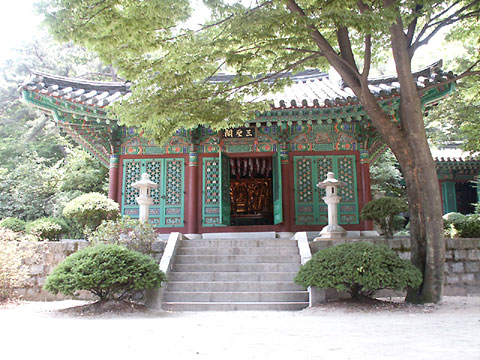
While I performed some bows, Ikumi explored the smaller shrines nearby. There was one for the local mountain god, one for Ji Jang Bosal, and others housing Amida Buddha and Sakyamuni Buddha. The 11am service came to an end and we sat near some ajumas in the shade by a pagoda. We drank our coffee and shared our biscuits and I wished I had learnt just a few more Korean words.
The bench was made from a long thick piece of timber, kept rough in places, smoothed and patterned in others, and it seemed typical of the overall care and craftsmanship to be seen all around us. Nearby was a pile of old temple beams, still painted in traditional colours, now stacked up under a tarpaulin to be used for firewood. I looked, not a nail in sight.
Close to the pagoda were two stone stupas, each containing a small gold Buddha forever looking out through the trees and over the city to a view of the distant Namsan Tower. The only sound was the trickle of the stream and the summer insects, and though we had to get back, we lingered as long as we could, returning to the statue and bowing once again – All beings, one Buddha-nature, Namu Amitabul, Kwan Seum Bosal.
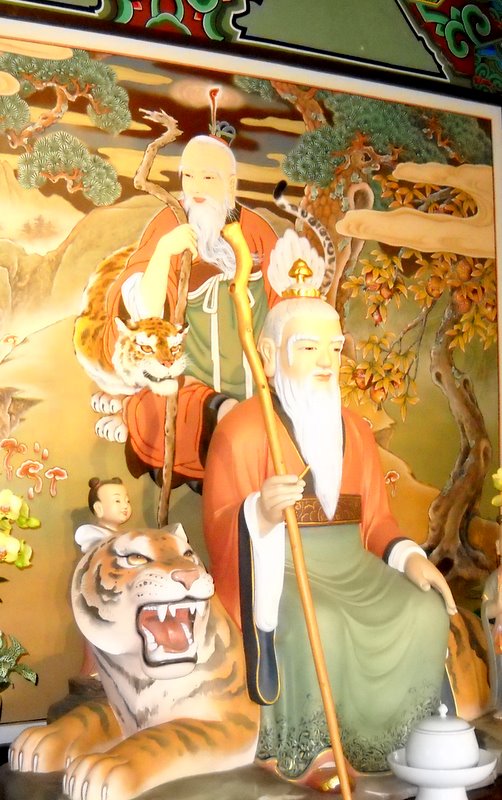
An image and painting from a Moutain Spirit shrine (click on the image to see a larger view)
Tigers play a prominent role in Korean spirituality, and stories about them were often used to convey deep ideas and practices. One of the most famous involves the legendary figure, Tangun. Considered the founder of Korea, he was a great being who taught spiritual cultivation as well as advanced methods of agriculture, medicine, and animal husbandry. In so doing, he brought great benefit to all the people of the land.
Tangun’s story begins with his mother.
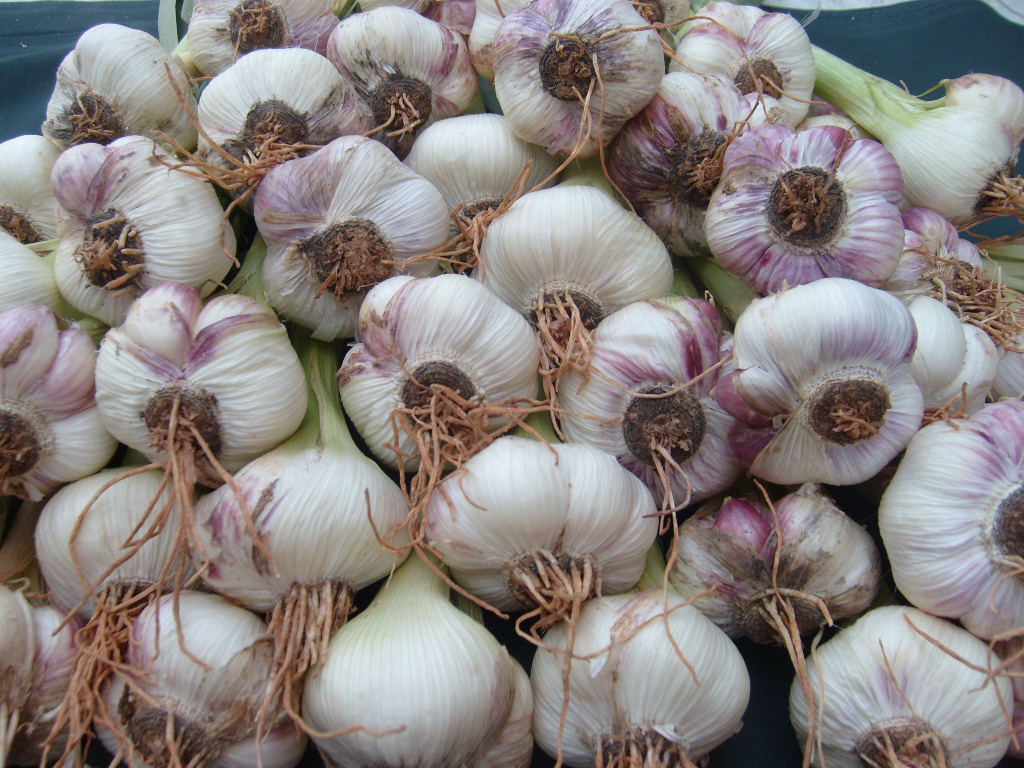
Around 2,400 B.C.E., a female bear and a tigress shared the same cave. Together they prayed to the heavenly king to become human beings. The king took mercy on them and said that if they could stay secluded out of the sunlight, and eat only garlic and mugwort for one hundred days, they would be transformed into human beings. He gave them garlic and mugwort, and they entered the cave. There they stayed, eating only garlic and mugwort. It wasn’t too long before the tiger began to have more and more difficulty with this. Soon she couldn’t resist the desire to roam and eat meat, and left the cave. The bear continued to eat the mugwort and garlic, and after just 21 days was transformed into a human being. Later, after marrying a heavenly prince, she gave birth to Tangun.
Although on the surface, this might seem to be just a strange folk tale, it’s actually a description of spiritual practice and awakening. Think of the bear and tiger as our animal natures, the habits we’ve carried with us as we’ve evolved. Instead of running around outside, indulging their habits, they were doing what was difficult, what tasted bitter, and returning all those back to the cave within us. One person couldn’t endure this and gave up. However, the other persevered and so realized her true nature, that essence that is vastly more than the temporary habits and thoughts arising from the body and its senses. In so doing, she was transformed into a true human being. Knowing this Buddha-nature for herself, she recognized it in others, and found a similar person for a husband. And together, they gave birth to a child who became a blessing for all around him.
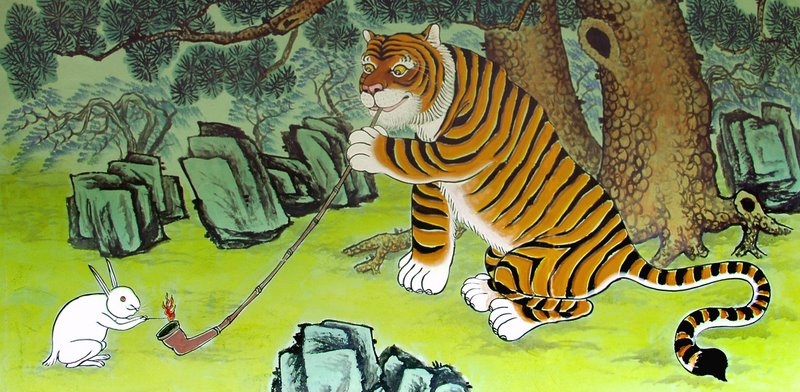
This is a bit unrelated, but the Korean version of “A long, long time ago…” also involves tigers. It goes like this: “In the days when tigers smoked tobacco…” How this saying developed, I have no idea!
An image from Woljeong Temple in the Odae Mountains
Here’s a guest post by Gary about the pull he felt towards spiritual practice, and the path it took him on.
I have always enjoyed reading and have had a particular affinity for books on eastern philosophy. I remember seeking out books on Buddhism on lunch hour at the local library, as well as, scouring local bookstores whenever I had free time. Having grown up a Catholic, I was not too sure what I was getting into, but still I explored. I found books by the Dalai Lama, Dainin Katagiri, Philip Kapleau, and many more. The books were fascinating, but I must admit my comprehension level was quite low. Soon, my explorations led me to check out the philosophy from India and various Indian swamis and saints over the years. I spent hours reading Swami Rama, Swami Chetanananda, and Yogananda, to name a few.
Each day, I would write in my journal, dream, and pray about what I pictured as the “perfect” spiritual retreat – this was quite an undertaking since I was not affiliated with any formal spiritual group. I dreamt about my ideal place having a Swami from India and beautiful grounds, but knew of no such place anywhere nearby until one fateful day having run out of bookstores known to me I skimmed the Yellow Pages and found a listing for the Vedanta Society of Sacramento Bookstore. Having no clue what type of bookstore this was, nonetheless, I called and then soon thereafter drove over to what turned out to be a beautiful 8 acre retreat garden and monastery complete with a Swami from India – I could hardly believe my eyes, this place was hidden right in the middle of Sacramento and I had been oblivious of it for over 20 years.
Sacramento Vedanta Center
As it turns out, I began attending the Vedanta center and learning first-hand from a Swami from India. What I like about Vedanta is the Advaita philosophy of non-dualism, as well as, the teaching that each person can follow his or her own path toward realization. The center I attend in Sacramento follows the teachings of Ramakrisha, a 19th century saint from Calcutta, India. Buddha and his teachings are also revered. My time with Vedanta has taken me on trips to India two times. I have been able to see the Vedanta world headquarters in Calcutta, the temple where Ramakrishna lived, the holy city of Varanasi, and where Buddha gave his first public talk.
That was 10 years ago that I discovered Vedanta, or I should probably say that it was “revealed” to me. During the past 10 years, I have delved into Vedanta deeper and have sought out all I could find on Buddhism, particularly Zen. Most recently, I have found doing searches on Amazon to yield quite fruitful results, and one evening while searching “zen buddhism,” I found a listing for No River to Cross. I read the reviews and the pages of the text available. There was no doubt in my mind – this was a book to order. So, a few days later the book arrived and I excitedly began reading it. Daehaeng Kun Sunim is definitely a breath of fresh air – her deft touch and heartfelt guidance shine through from start to finish. And, once again, a dream has come to fruition – I have been led to a spiritual master, and have come in contact with some wonderful folks all the way across the world in Korea. I am indeed quite thankful.

 No matter how many thousands of things confront you,
 So, when difficulties and suffering come,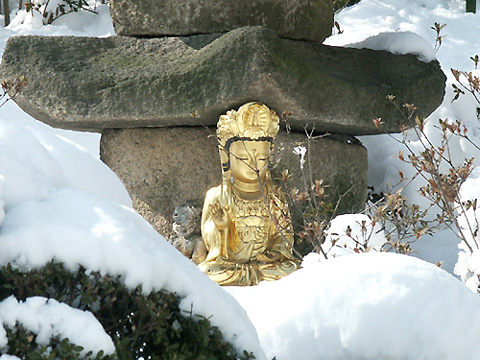





 Wake Up and Laugh!