“The name of Nirvana is One-mind. One-mind is the Womb of Tathagata”
– The Lankavatara Sutra
Back on my old, now deleted, blog, ‘Marcus’ Journal’, I made a number of posts wrestling with the term Hanmaum, or One-Mind. Recently, I put together some of those thoughts for the Tricycle Community Hanmaum page, and here I’ve re-written and added to that again. I don’t pretend to have come to the end of my journey with this term, but this post reflects my learning and practice so far.
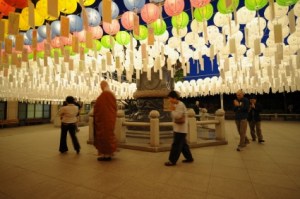
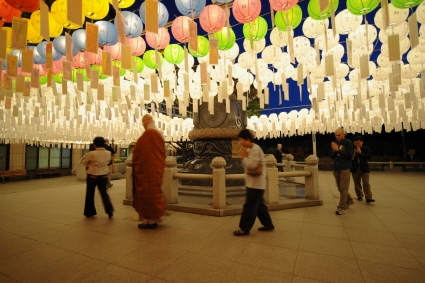
One of the highlights of that practice is found most Sunday mornings when I’m lucky enough to be able to visit the Seon Centre. And though it’s a bit too fast for me most of the time, there’s one line in the chants that is repeated and with which I have become familiar. I’m still not sure I can pronounce it right, but it goes “han-ma-u-mae-kwui-ha-li-da”, which means “I take refuge in One Mind”.
When I first came across this term, I found it slightly odd. Does it mean I take refuge in a mind? That there’s only one mind? What does that mean? To be honest, it made me somewhat uncomfortable and I prefered the untranslated term, Hanmaum. Attending the ‘Hanmaum’ Seon Centre, felt different somehow to attending the ‘One Mind’ Seon Centre.
 I looked it up and found that it was Master Won Hyo who first popularised the concept of ‘One Mind’ in Korean Buddhism after an enlightenment experience on his way to China. Waking up in a cave one night he drank from a bowl beside him; in the morning he discovered it was a skull, filled with maggot-ridden sludge.
That was the seventh century, and the term is still used today. Paul Lynch, Guiding Teacher for the Five Mountain Sangha, recently released an unpublished poem by Seon Master Seung Sahn – called ‘One Mind’. The opening of the poem, “One mind perceives/ infinite time./ One is all./ Everything is one” suggests something that is active and that connects everything.
But does this mean that there is only mind? Master Seung Sahn, commenting on the Won Hyo story in ‘Compass of Zen’ writes “Everything is created by mind alone. You made this whole universe. You made dog, and cat, and tree, and God, and mountain. You made the sun, the moon, and the stars.”
The refrain from the Sunday morning chant that prompted these thoughts is from Kun Daehaeng’s modern version of the Thousand Hands Sutra, The Thousand Hands of Compassion, and so I look at her definition. She calls One Mind “the fundamental mind that is intangible, invisible, beyond time and space, and has no beginning or end”.
A synonym, she makes clear, for Buddha-nature. “Every single life and thing in the universe has Buddha-nature… Buddha-nature is only one, so it is Hanmaum; it is inconceivably large, so it is Hanmaum; it is not an individual thing, but the interconnected whole, in which all things are working together, so it is Hanmaum.”
Strange how the idea of ‘mind’ seemed somehow impenetrable to me whereas belief in Buddha-nature comes perfectly naturally. I discussed this with some Dharma friends at the Seonwon and noticed again, not for the first time, how body language reveals what translation doesn’t.
When I say ‘mind’ I think of the brain. If I were to point to it, I’d point to my head, and when I talk about Buddha-nature, I point to my heart. In contrast, my Dharma friends point to the heart for both Buddha-nature and for mind. They are synonymous, and for me that’s the best way to approach what could be an otherwise difficult concept.
But “Of course,” my on-line Dharma friend Barry Briggs from the Ox-Herding site wrote, “if we make “mind” (one mind, many minds, no mind), then we fall into the ditch!” and I could see his point! Seung Sahn Sunim said the important thing is to attain mind. Daehaeng Sunim, in a teaching I find very accessible, and one that meshes with my more devotional nature, talks about entrusting.
Entrusting. I love that. But it’s funny how words had snagged me. I see now how Juingong, True Self, and Hanmaum, One Mind, are all exactly the same as Buddha-nature, the term I find easiest. But again, the term is not the point. Daehaeng Sunim and all the Masters tell us words are not the point. The goal is to attain it, the practice, and what a lovely practice it is, is to let go.
Link:
Chan Poetry: One Mind





 Wake Up and Laugh!