Sunday Photo; Buddha head at Waujeongsa

I first saw this head in a book that features dishes from different temples across the country accompanied by a photograph taken at each temple. I wrote down the name of the temple with the gigantic head and looked it up online when i got home. It turns out it wasn’t very far from my home, so I soon my a trip with my friends to visit.

When we got there, things had obviously changed. In the photo, the head sat humbly on the ground, the natural, raw material remained. As we stepped off the bus, we could see the head shinning in the noon light all the way from the road, painted gold, propped up on huge shoulders of piled stone. First impressions were a cross between impressive and ridiculous, and we all let out a good laugh at the sight of it.

I don’t know the dimensions, but the temple claims that it’s the biggest Buddha head (without a body) in the world. (If you’ve followed the Sunday Photos for a while now, you’ve probably caught on that this “biggest in the world” claim is a recurring theme in Korean temples.) All I know is, it sure is the biggest head I’ve come across in my travels!

I took this picture during my last visit, in the summer. I liked this angle because it reminds me a little of the first photo I saw of it, sitting humbly among the pines.

Sunday Photo; Yeon Ju Dae

For a while, I’ve been challenging myself to find a nice photo that suited either the weather or the season, if not both. This usually involved digging deep into the archives of my photosite (or my memory) to find just the right image. this week, I thought I’d save the hassle and post one hot off the press!

This is a shot from a hike I took with my family this afternoon to Yeon Ju Dae, a little shrine set right on the edge of Gwanaksan’s peak, looking over the South-Western corner of Seoul. I heard more than a few comments about the crazy foreigner carry a baby up the mountain, but when we came across another Korean family doing the same, resistance from my wife diminished considerably- ^_^

The great part about the hike is, just before you reach the peak, there is a large hermitage, Yeon Ju Am, buzzing with hiking-practitioners. If you make it between 6-9am or 12-2pm you’re welcome to join the crowd for a free meal. We got there at 2:10, but an enthusiastic Ajumma shouted into the kitchen that a foreigner was there so please make two more dishes! My wife is Korean, but I’m sure she enjoyed the special treatment, anyway… The food is simple, spicy, and salty, but after a hike up the mountain, it’s just as good as fine-dining!

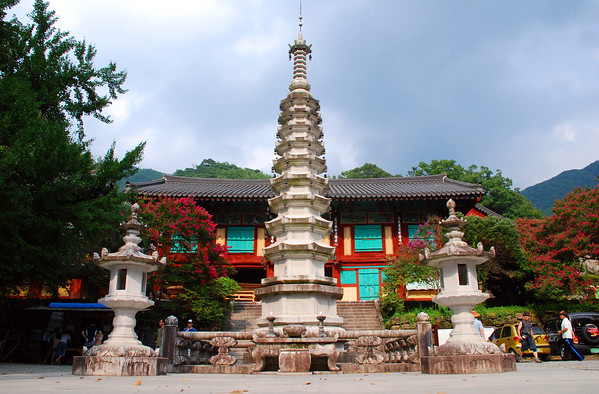
Sunday Photo; Pagoda at SsangGye Temple

They further asked, “In the future, there won’t be any difficulties, will there?

The Master said, “Five or six years after my extinction, a man will come to take my head. Listen to my verse:

Offerings to the parents with bowed head.
There must be food in the mouth.
When the difficulty of ‘Man’ is met,
The officials will be Yang and Liu.

The Sixth Patriarch’s Sutra


Five or six years after the Master’s death, a Korean monk named Chin Ta Pei hired Chan Ching Man of Hung Chou to steal the Patriarch’s head and bring it back to Korea so that he could make offerings to it. Being poor and hungry, Chan Ching Man accepted the money.

The Patrirch’s head was originally buried beneath the Main Hall, but after it was burned down and rebuilt, the head was enshrined inside the pagoda.


Sunday Photo; Parinirvana Buddha at Wa’u’jeong Temple

About an hour and a bit south-east of Seoul, tucked in the hilly countryside of YongIn is Waujeongsa, head temple of Korea’s lesser known Yeolban Jong, the Nirvana Order.

Near the top of the path that circles the steep grounds is a small grotto shrine in which lies this beautiful Parinirvana Buddha, carved from a single Juniper tree. It’s one of the many Buddhas I love sitting in the room with.

. . .

This year, a lot of special people in my life have had their leases expire. I know I’m not particularly unique or alone in this experience. Every religion and philosophy has their own explanations and beliefs about death (it’s usually a rather important subject!) and I’ve always appreciated what Buddhism has taught me.

It’s a difficult subject to discuss definitively because how many of us remember dying? What we do have, though, is the shared wisdom of those who can see, and personally, ones I trust. The Buddha spoke of witnessing his hundreds of lives, the number in the texts is 500, just before his enlightenment. If since that time, we’ve all been reborn as humans consecutively, we can probably add another 40-50 or so lives, but assuming the possibility that we could have gone anywhere from cats and dogs to birds and bees and who knows what else, well, from a Buddhist perspective, we’ve all experienced death enough times that there ought to be some knowledge stashed down in those roots somewhere!

At Saturday Sangha, Chong Go Sunim often talks about different situations when Dae Haeng Kun Sunim has assisted in the unseen realm of someone’s passing. One of the more practical stories, rather than one of the, “Holly cow! She did what?!” ones, was that she once said, “Even if someone has already been reborn, praying for them can still help them in their current life.”

There must have been people other than me who wondered about this for her to say it, but I’m glad that she did. It’s encouraging to think our thoughts and intentions can reach that far, even beyond death.

Sunday Photo; Maitreya Hall

Though the grounds of the Gold Mountain Temple are scattered with National Treasures, the most striking of them all is the three storied Maitreya Hall, the only one of its kind remaining in Korea.

Originally built in 599, the current buildings have been standing since 1635, after the entire complex was burned to the ground due to the discovery of a small army of monks who had gathered to train here in hopes to fight off the Japanese invaders.

There must have been intense debates among the temples at the time about whether or not to fight the Japanese. In the end the reasoning was that, ultimately, to fight them off would be less harmful. I believe the analogy was, if you see a rabid dog charging a group of children, it’s better the kill the dog than to allow it to attack the children. To borrow the conclusion of another anecdote, perhaps they struck down their opponents with all the compassion they could muster.


Sunday Photo; Great Unification Buddha

Well, finally a Buddha that isn’t a Mireuk Buddha!

This is none other than the Great Unification Medicine Buddha of Donghwa Temple, in Daegu.

Standing at 33m (108 feet, by chance…), locals claim that it is the largest in the world. Though, I’m not sure how many other “Great Unification Medicine Buddhas” there are to compete with, I think they refer to other free-standing statues. I could imagine that it is the largest Medicine Buddha anywhere.

Gazing up from beneath, the physical aspect of its greatness is obvious, but there is also another reason for this title. As you may have surmized from its name, prayers are offered here for the reunification of the Korean peninsula. Inside the body of the Great Buddha are two bone shards of Shakyamuni’s, presented as gifts from the government of Myanmar.

Sunday Photo; Temple and cosmos

I wasn’t in Korea for long before I started marking the passage of time by the bloom of whichever flowers. The cosmos flowers bloom in midsummer but are still prevalent late into the fall. Any sincere country road will probably be lined with them this time of year.

The small Dharma Hall among the flowers is in Yeon’ho-dong, Lotus Lake Village, a tiny country village in the eastern edge of Daegu, just passed the small mountains that separate it from the metropolis, within eyeshot of World Cup Stadium.

Although these small country temples can’t compare to the large temple complexes in their impressiveness, they often have a great feeling. Talk about sincerity, it’s no wonder all these cosmos decided to gather here!

Sunday Photo; Zen Cloud Temple’s Main Hall

Although there are many things that bring me back to SeonUnSa, the Zen Cloud Temple, its Dharma Hall is among my favorites in the country. Its long, thin Buddhas are friendly, welcoming, and smile down compassionately. The old, faded and beams and walls radiate wisdom. I haven’t found my way back to this temple in a couple of years, but I often find myself traveling here in my thoughts…

Sunday Photo; MangHaeAm Mireuk

Yes, another Mireuk Buddha, and one with a very interesting story, but I’ve decided to save that for another time, and take a personal approach to this one. I hope no one minds!

(And I realize that this anti-climatic intro just may be contrary to a certain Great Vow by creating a degree of suffering instead of saving anyone from it, so if you really do want to know the story surrounding the Buddha, and can’t find it on Google, let me know, I could add it in the comments, or it would make a nice little Future Post… (Future Buddha… get it?) 😉 )

(click here to continue reading…)

Sunday Photo; the path to GwanEum Temple

I didn’t think to count them at the time, but from what I was able to make out from another photo, if there aren’t 108 Buddhas here, it’s really close to it!

Each Mireuk Buddha has been carved with slightly different features and there are several different mudrā among them. Once you pass through the small shrine of the Four Heavenly Guardians, there are another two rows of much larger than life Mireuk Buddhas, each sitting on a column of piled stones.

There are more Buddhas across the grounds of this temple than most other temples combined!