The Bangkok Seon Club – and choir!

Ice melts and water flows
down ten thousand valleys,
fish dance and play,
flowers bloom and birds sing,
the fruit of practice ripens naturally – let me know all ten thousand flavours
.
 —Daehaeng Kun Sunim
 

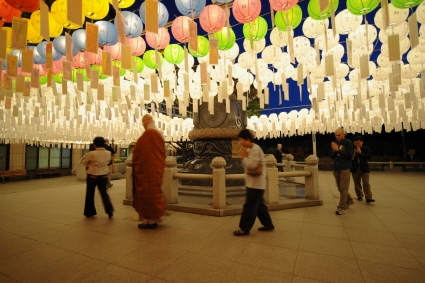
Here in Bangkok, our celebrations of Buddha’s Birthday on May the 28th this year will also mark the first anniversary of the Bangkok English-language Zen Club, the first English-language group led by the Seonwon here, under the wonderful guidance of our fabulous teacher Hyaedan Sunim. During this first year together we’ve met once every month, gathering on Saturday nights, to study ‘No River to Cross’ and share our experiences of applying the teachings.

The Seon Club, now firmly established after this first year, is made up of a small group of regulars of diverse backgrounds, both Korean and from many different countries, with a good number of visitors and the occassional special guest. Of course one of the great highlights of our first year was Chong Go Sunim’s visit last November as part of the Seonwon’s tenth anniversary celebrations, and the wonderful teachings he was able to share with us all.

And now, as we approach our first anniversary and the celebration of Buddha’s Birthday on May the 28th, the Seon Club is even preparing to sing! We have some very skilled musicians in our little group and a wonderful instructor from the seonwon. The most important thing, she said to me last night – as I was worrying about my own strangled-cat voice and the danger of my letting everyone down – is just to let go! Sing with love, she said, and your voice will be fine!

There is no specific English-language programme of events for Buddha’s Birthday, but if you are in Bangkok this month and would like to join the English-language group as we sing in the celebrations, get in touch and we’ll let you know about rehearsals. And if you can’t join the choir, but would like to celebrate Buddha’s Birthday with us on the 28th, you are more than welcome to come along. The morning ceremony (in Korean) is at 10am and the evening performances (also in Korean) start at 6pm. It will be a wonderful experience.

See you there!

Buddha-nature: Theravada Zen

Last year, as part of its tenth anniversary celebrations, the Bangkok Hanmaum Seonwon hosted a joint Dharma talk on the subject of Buddha-nature with the Theravadan monk Phra Cittasamvaro Bhikku, the founder and guiding light of the English-language Littlebang Sangha, and Chong Go Sunim, who had kindly made the trip from the Hanmaum International Centre in Anyang, Korea.

Phra Cittasamvaro Bhikku, popularly known as Phra Pandit, started the evening with a brief history of Theravadan and Mahayanan Buddhism, and how the differences between them are not as great as they might at first seem. After all, he said, everything started at the same point, with the Buddha putting aside all theories and looking into the nature of things for himself.

What he saw under the Bodhi tree was experience in terms of fields of awareness, sight, sound, taste, and so on, and that they were forever changing. Finding no stability in this, he withdrew his mind and found it becoming brighter and sharper. And what he discovered there, the Buddha declared, was that which does not die.

He gave this a number of names such as original mind, source of mind, Nirvana, and so on, and later it was termed Buddha-nature. Phra Pandit suggested it was perhaps a little egotistical to give it this name as it exists in all people, regardless of the labels they use. A bit, he teased, like planting a flag on the moon.

He also pointed out that seeing this fundamental mind is a temporary experience and that we inevitably return back into normal life. However, once seen, it will change one’s way of relating to the world. The great problem, though, is how attainment of this fundamental mind can be taught. No matter what is said about it, it is not it.

So Buddhist teachings are like radio stations. We can switch between them, some we will like, some not, but the point is the silence beneath. Using the analogy of the diamond in the mud, Phra Pandit said that reaching it through purification or reaching it through realisation were simply differences in emphasis.

Chong Go Sunim agreed, pointing out how the Buddha’s teachings, using another analogy, are like medicine. And no single medicine is good for all illnesses. So a range of Buddhist teachings developed according to the needs of listeners. Different Sutras, in fact, are simply saying, “okay, let me put it like this, now like this”.

But the point to all these teachings is to transcend the limited sense of self, and Chong Go Sunim described how his own teacher, Seon Master Daehaeng Sunim, emphasises the practice of letting go. Like chanting, bowing, and meditation, he said, it is a tool for transcending the self, and a self-correcting one at that.

Often, he said, people have great meditation experiences or insights, but make the mistake of saying “wow, I want that again”. Soon, they are carrying around little more than a memory of a past experience. By practicing letting go, they are able to move on from it. But to carry out this practice requires trust.

Which is where Buddha-nature comes in. Chong Go Sunim, before he became a monk, used to sky-dive, and he explained that no matter how badly you might be spinning through the air, simply getting into the correct position allows you to right yourself. In terms of practice, that position is the act of trusting and letting go.

“Perhaps this is all just a skillful means” Chong Go Sunim said, “but I can’t say it’s not true” and with the way that one’s ignorance grows back again and again, just like a monk’s hair, one must return to this practice over and over. Like the the Diamond Sutra, he concluded, which seems to repeat itself, but at deeper levels.

The evening ended with a short time for questions and answers and in response to one question Chong Go Sunim, using the large bell at the front of the Dharma Hall, demonstrated, to an audience of mainly English-speaking Bangkok residents, the sound of a Korean chant. The perfect way to round off a unique and wonderful evening of Dharma.

Link:
LittleBang: the English-language Bangkok Sangha

Ox Herding: No River to Cross

One of the very best Buddhist sites on the Internet is the ‘Ox Herding’ blog maintained by long-term practitioner Barry Briggs. Barry been running the site since June 2008 and it is essential reading. The blog started with a different theme each day matched with questions to challenge the reader’s ideas and practice, and has developed over time.

More recently Barry has introduced occasional week-long themes, which he often starts with a well-chosen cartoon and caps with a Friday video. Past themes have included, naturally, the Ox Herding pictures, as well as Zen art, the five desires, the poet Rilke, the nature of time, and, just last week, Zen books. One of the books he reviewed was ‘No River to Cross’.

It is a wonderful review which highlights and describes aspects and features of ‘No River to Cross’ in such a way that I, despite having read the book many times before, could see things about it in a fresh new light. The main thrust of the review is that ‘No River’ is a book about practice, or “practice life” as Barry so beautifully puts it.

“Zen Master Daehaeng” Barry writes, “strips away any notion that practice consists of technique. Instead, she views practice as a more expansive and ultimately more profound type of engagement with the world.” A perspective shared, of course, by Barry’s own root teacher Zen Master Seung Sahn, who once, when asked about the essence of Korean Seon, said:

This is NOT a school of samadhi, OK?
This is not about feeling good.
It’s about “How may I help you?”

I first heard that wonderful exchange on Barry’s blog, where he capped it with the comment “That’s the whole, sweet story.” And if ever I’d been in any doubt about the closeness between the teaching of Masters Seung Sahn and Daehaeng Kun Sunim, Barry’s review offers a fabulous line from Seung Sahn Sunim which directly parallels the practice of entrusting to Buddha-nature: “If you don’t hold onto anything, you will get everything.”

Thank you Barry. Not just for your wonderful warm review of ‘No River to Cross’, a review that allowed me to see the book from a whole new perspective, but for all your efforts on Ox Herding over the past couple of years, creating a true treasure house of beautiful teachings and reflections, and for all your work in the Dharma long before that. Thank you.

Link:
Ox Herding: No River to Cross

The Samadhi Treatise of the Treasure King

I remember seeing a different version of this in the Jogyesa magazine some years ago, but what follows is a fresh new translation by Chong Go Sunim which I first saw at one of our Saturday discussions in the Buddhist English Library of Seoul. Chong Go Sunim later gave me permission to publish his translation on my online journal, but this website is a much better place for it. 

The Samadhi Treatise of the Treasure King was originally written in China by Miaoxie in the 1390’s, but, though written in the Zen tradition as advice for those engaged in meditative practice, its wider application is fairly obvious. This is advice for everyone, monks and laypeople, Zen and Pure Land, Buddhists and beyond, it is good advice, surely, for all people everywhere.

Thank you again to Chong Go Sunim for kindly making this available to us.

The Samadhi Treatise of the Treasure King

1. Don’t desire perfect health. Perfect health can easily increase one’s greed and arrogance. Instead, let your suffering become medicine.

2. Don’t hope for a life free from hardships. Such a life would only increase your self-indulgence and contempt for others. Accept the worries and difficulties that come your way.

3. Don’t expect that your practice will be free of difficulties. Without difficulties, you could never learn anything. Obtain liberation in the midst of obstacles.

4. Don’t expect that you can practice hard and not experience temptations. A lack of temptations will only soften your resolve. See demons as friends who have come to help you along the Way.

5. Don’t hope for easy success. Easy accomplishment tends to make one careless. Instead, accomplish your goal by persisting and persisting.

6. Make friends, but don’t expect any benefit for yourself. Pursuing your own benefit damages trust. Maintain long-term friendship through integrity.

7. Don’t hope that others will agree with you or follow your leadership. This desire only increases your arrogance. Those who disagree with you are the ones who help build your character.

8. Don’t expect to be rewarded for your kindness. This leads to scheming. Throw out the expectation of rewards like you’d throw out an old shoe.

9. Don’t desire more than you’ve earned. Chasing after more than you’re entitled to gives rise to stupidity. Become rich through modest profits.

10. When you suffer unfairness and mistreatment, don’t dwell on it or try to expose it for everyone to see. This leads only to resentment and poisons the heart. Consider mistreatment the materials for making progress in your spiritual practice.

Progress in spiritual practice becomes possible when you are confronted by obstacles and hardships. Whereas no growth is possible where there are no obstacles. It was in the midst of hindrances that the Buddha realized supreme enlightenment.

Angulimalya committed terrible acts, and Devadatta and his followers rebelled against the Buddha, but nonetheless, the Buddha guaranteed that even they would one day be able to attain enlightenment. If even people like these are able to awaken, how can you claim that the things that offend and trouble you will prevent Liberation? Rather these will speed you on your way; through them you can make quicker progress. If you want to obtain the great treasure, you must face what confronts you and embrace it with wisdom.

On formally taking the Five Precepts

Precepts Ceremony

Another re-posting from the now deleted ‘Marcus’ Journal’ I’m afraid – but one that I absolutely must place here for being so very close to my heart. On the 10th of May, 2008, my spiritual journey reached something of a culmination and new starting point as I undertook, along with three Dharma brothers, a formal and very beautiful ceremony to take refuge in the Buddha, Dharma, and Sangha, and formally vowed to uphold the Five Precepts.

The ceremony was undertaken at the Hanmaum Seon Center in Anyang with my preceptor, who chose my Dharma name, being Seon Master Daehaeng Kun Sunim. The ceremony was led by Chong Go Sunim, and the other preceptees were Carl, Joe, and Joseph. Suki, Park and Amy from the Saturday group, and both ordained and laypeople from the temple, were also in attendance. Part of the ceremony involved me reading out a speech that I’d written for the occasion. This is the text of that speech:

The Dharma is simple. I take refuge in the Buddha, I take refuge in the Dharma, I take refuge in the Sangha, and today, gladly and in public, in this wonderful temple, with my good Dharma friends, and under the guidance of good Dharma teachers, I undertake to follow the five lay precepts – the basic moral and training requirements – and thus formally, for the first time, become a Buddhist.

It’s simple. I vow to abstain from killing, from stealing, from sexual misconduct, from telling lies, and from taking intoxicants. I do this for myself and for my friends, for my family and for my community; I do this because this practice IS the Dharma. It is not just the foundation, it is also the goal, not just the starting point, the five precepts are the Dharma itself. I follow the five precepts for the sake of all beings.

Someone might ask me why I want these restrictions, why I feel the need for these rules. But the precepts aren’t a prison, they are the key. Through the precepts we find freedom. Through my aspiration and vow to follow these trainings I allow my own true nature to act upon the world. These precepts are my deepest intentions, which here, today, I give voice to.

Of course I’m going to fail. Killing is inevitable in every mouthful of food I eat, no matter how strict a vegetarian I am. Stealing happens every time I posses something while others do not. Sexual misconduct lies in wait in almost every advertisement I see, every TV channel I watch. I tell lies when I say “I’m fine” or “good morning”. And what of intoxicants, do I count sugar? Do I stop drinking coffee?

Zen Master Daehaeng has reformulated the precepts, where traditionally they start with ‘do not’, she has given them new voice: ‘Love all beings equally and compassionately’, ‘Give alms and create virtue’, ‘Cultivate a pure and upright body and mind’, ‘Speak only the truth and uphold trust’, ‘Always maintain bright and upright wisdom’.

This is simple. This is the Dharma. And although I will stumble, and greed and anger and delusion will set me off course, in vowing to follow these precepts I am re-orientated. My efforts alone are not enough, sheer determination alone is not enough to follow these precepts. Yet by vowing to do so I allow the precepts to guide me and I allow the deepest and most fundamental part of me to respond.

This is my Buddha-nature, my foundation, my inherent nature, the part of me that is already the precepts, that doesn’t need the rules or the ceremony, that doesn’t need the chanting or the incense, but which responds to my vow and which wishes, through me, to fulfill it.

Thus the Five Precepts are, just as they were first set down by Sakyamuni Buddha and recorded in the Pali texts, “a vehicle of happiness, a vehicle of good fortune, a vehicle for liberation. Let our virtue therefore be purified and shine forth.”

Some thoughts on Hanmaum

“The name of Nirvana is One-mind. One-mind is the Womb of Tathagata”
The Lankavatara Sutra

Back on my old, now deleted, blog, ‘Marcus’ Journal’, I made a number of posts wrestling with the term Hanmaum, or One-Mind. Recently, I put together some of those thoughts for the Tricycle Community Hanmaum page, and here I’ve re-written and added to that again. I don’t pretend to have come to the end of my journey with this term, but this post reflects my learning and practice so far.

One of the highlights of that practice is found most Sunday mornings when I’m lucky enough to be able to visit the Seon Centre. And though it’s a bit too fast for me most of the time, there’s one line in the chants that is repeated and with which I have become familiar. I’m still not sure I can pronounce it right, but it goes “han-ma-u-mae-kwui-ha-li-da”, which means “I take refuge in One Mind”.

When I first came across this term, I found it slightly odd. Does it mean I take refuge in a mind? That there’s only one mind? What does that mean? To be honest, it made me somewhat uncomfortable and I prefered the untranslated term, Hanmaum. Attending the ‘Hanmaum’ Seon Centre, felt different somehow to attending the ‘One Mind’ Seon Centre.

 I looked it up and found that it was Master Won Hyo who first popularised the concept of ‘One Mind’ in Korean Buddhism after an enlightenment experience on his way to China. Waking up in a cave one night he drank from a bowl beside him; in the morning he discovered it was a skull, filled with maggot-ridden sludge.

That was the seventh century, and the term is still used today. Paul Lynch, Guiding Teacher for the Five Mountain Sangha, recently released an unpublished poem by Seon Master Seung Sahn – called ‘One Mind’. The opening of the poem, “One mind perceives/ infinite time./ One is all./ Everything is one” suggests something that is active and that connects everything.

But does this mean that there is only mind? Master Seung Sahn, commenting on the Won Hyo story in ‘Compass of Zen’ writes “Everything is created by mind alone. You made this whole universe. You made dog, and cat, and tree, and God, and mountain. You made the sun, the moon, and the stars.”

The refrain from the Sunday morning chant that prompted these thoughts is from Kun Daehaeng’s modern version of the Thousand Hands Sutra, The Thousand Hands of Compassion, and so I look at her definition. She calls One Mind “the fundamental mind that is intangible, invisible, beyond time and space, and has no beginning or end”.

A synonym, she makes clear, for Buddha-nature. “Every single life and thing in the universe has Buddha-nature… Buddha-nature is only one, so it is Hanmaum; it is inconceivably large, so it is Hanmaum; it is not an individual thing, but the interconnected whole, in which all things are working together, so it is Hanmaum.”

Strange how the idea of ‘mind’ seemed somehow impenetrable to me whereas belief in Buddha-nature comes perfectly naturally.  I discussed this with some Dharma friends at the Seonwon and noticed again, not for the first time, how body language reveals what translation doesn’t.

When I say ‘mind’ I think of the brain. If I were to point to it, I’d point to my head, and when I talk about Buddha-nature, I point to my heart. In contrast, my Dharma friends point to the heart for both Buddha-nature and for mind. They are synonymous, and for me that’s the best way to approach what could be an otherwise difficult concept.

But “Of course,” my on-line Dharma friend Barry Briggs from the Ox-Herding site wrote, “if we make “mind” (one mind, many minds, no mind), then we fall into the ditch!” and I could see his point! Seung Sahn Sunim said the important thing is to attain mind. Daehaeng Sunim, in a teaching I find very accessible, and one that meshes with my more devotional nature, talks about entrusting.

Entrusting. I love that. But it’s funny how words had snagged me. I see now how Juingong, True Self, and Hanmaum, One Mind, are all exactly the same as Buddha-nature, the term I find easiest. But again, the term is not the point. Daehaeng Sunim and all the Masters tell us words are not the point. The goal is to attain it, the practice, and what a lovely practice it is, is to let go.

Link:
Chan Poetry: One Mind

Some thoughts on Juingong

Eternal, unchanging, pure gold.
The bright essence of our true nature.
Seon Master Daehaeng Sunim

I don’t want all my posts here to be no more than re-writes of material I published on the now deleted ‘Marcus’ Journal’, but I used that website to do a lot of thinking about the practice and as a record of my journey, and there were one or two posts that I think bear being repeated. This is one of them. A little research and some persoanl reflection on what exactly is meant by ‘Juingong’.

In terms of its Chinese characters, juin is the person who carries out an action, whilst gong means sky, or empty. And an on-line dictionary I consulted suggests that the Korean term juin-gong originated in the theatre or in literature and means the hero or heroine, the lead role. Which, by extension, also means the central figure in any situation.

Korean Buddhists have traditionally translated this term as True Self, as in this poem said to have been expressed spontaneously by the great Seon Master Gyeongbong Jeongseok as he danced alone under a full moon upon the falling away of his doubts and the revelation of his true nature:

Having searched for myself in all myriad things
True Self (Juingong) appeared right before my eyes
Ha! Ha! Meeting it now, there is no doubt
Brilliant hues of udumbara flowers spill over the whole world.

Master Gyeongbong Jeongseok compared his finding of True Self to waking from a dream and, in terms both personal and touching, described it as being “as familiar as my own name”. Seon Master Daehaeng, when she first awoke to Juingong, called it appa, the Korean for ‘daddy’. Years later, according to Chong Go Sunim’s excellent biography, she’d laugh about this, saying:

“If I hadn’t been so young and uneducated, I might have called it Buddha-nature or true self, but at that time all I knew was that it was completely full of love and warmth, so I just called it ‘Daddy’.” Still today, Master Daehaeng teaches that you can call Juingong Dad or Mum, Amida Buddha or God, my love or pure water. It is, she teaches, ‘the true essence of me’ and the practice is to entrust everything to it.

My great friend and Dharma brother Carl once wrote an intimate and helpful essay on his practice of entrusting to Juingong. He says he first saw it in action in a friend before he tried it himself, and the effects were remarkable. It was “transforming her life,” he says “making her really happy, focused, and frankly, fascinated – I became more intrigued.”

Putting everything into Juingong is like slipping a post-it note into the mind, Carl said. He can just leave it there, knowing it’s being taken care of, and that he doesn’t need to do things alone. It works, he concludes, because “we are all connected – all people and all things – in this continuum of life and existence”.

This aspect of True Self, that it doesn’t exist separately, is why it is described as empty. Emptiness not as a void, but as continuous manifestation. Daehaeng Sunim describes it as “the fundamental place of ceaseless changing shapes” and says “JuinGong is never born, never dies, it is the eternal self, it cannot be seen with the eyes, nor can it be grasped with any thought”.

Which is a wonderful reminder to me to stop thinking and just rest, something I don’t do enough of. And yet, when I do, when I entrust everything to Buddha-nature and find myself held within its embrace, then, like Master Gyeongbong Jeongseok dancing under the moon, I discover that normal language can hardly express it at all.

Waking Up

I am so happy to be here on this brand new blog. For years I kept another (‘Marcus’ Journal’), and old readers of that will know me very well. But this new group blog, headed by the wonderful Chong Go Sunim, will have a much wider audience – and for all those new readers I’ll start with a brief outline of how I come to be here at all.

My journey into Buddhism goes back to my arrival in Thailand over ten years ago, but the greatest impact was when, a few years ago, I was lucky enough to be back in Korea. One day I stumbled across a beautiful little book called “My Heart is a Golden Buddha”. I thought the title alone was amazing, and I carried that book around with me for weeks.

Inside were many stories from Korea, stories of farmers and kings, animals and sages, wives and wisdom, and fabulous illustrations. A little later I saw that there was an American monk running a Dharma group on Saturday afternoons studying another book by the same writer.

That monk turned out to be, of course, Venerable Chong Go Sunim, and the writer of the book was Seon Master Daehaeng KunSunim. And my time in that little group, which we all came to know as Saturday Sangha, became one of the most significant periods of my life.

Over the weeks and months we met together Chong Go Sunim pointed to a teaching at once simple and profound. “Just trust in your foundation” he said, “Juingong, your Buddha-nature, is the only thing that can truly solve everything, so entrust everything that confronts you to your foundation and let go to that.”

The name is not the most important thing, the faith and the entrusting is, and it’s something that has deeply influenced my own spiritual practice. For me it points a way through all the various approaches, and places practice where it really belongs – in one’s own heart.

And that heart is also, we learn, the source of connection; something that has been very important to me personally. “Just keep letting go to your foundation” Kun Daehaeng Sunim says. “Then you can communicate with each other. If you dial a telephone on your side, the phone will ring on the other side. When you do this, your sincerity can be transmitted. This is truly loving [your family] and is the expression of the Buddha-Dharma.”

Well, eventually, our little Saturday group decided to formalise our commitment to the teachings and in May 2008, just days away from Buddha’s Birthday that year, four of us – myself, Joe, Joseph, and Carl – took formal refuge at the Hanmaum Seonwon in Anyang. Chong Go Sunim led the ceremony and Seon Master Daehaeng Sunim gave us our Dharma names.  It was a deeply beautiful and meaningful day.

I’ve returned to Thailand since then but have been delighted to find that there is a Hanmaum Seon Centre here too, and I’ve been astounded by the kindness and generosity of the Sunims and lay followers here who have done so much in facilitating, leading, and building the English-language Seon club.

And with ever more English-speaking people like myself being drawn to the teachings of Kun Daehaeng Sunim and to her message of entrusting to one’s own True Self, I’m sure this blog will go some considerable way in terms of connecting people, discussing the teachings, and helping everyone discover together that our hearts really are all a Golden Buddha.